Publication number H-2120 E
The main functions of county minicipalities and municipalities in Norway
Circular | Date: 07/11/2000 | Ministry of Local Government and Regional Development
Originally published by: Kommunal- og regionaldepartementet
The main functions of county municipalities and municipalities in Norway.
The main functions of county municipalities and municipalities in Norway
H-2120
October 2000
Introduction
The distribution of functions and responsibilities
The main functions of the municipalities
Education
Health care and social services
Housing, commerce and industry and environmental
measures
Culture and church affairs
Municipal planning and technical services
The main functions of the county municipalities
Education
Health and social services, nursing and care
Culture
Transport
Miscellaneous functions
Introduction
As of 2000 Norway is divided into 435 municipalities and 19 county municipalities. Oslo is classified as being both a county municipality and a municipality.
The municipalities vary significantly regarding size, topography and population. More than half have less than 5 000 inhabitants, eight have more than 50 000 inhabitants.
The county municipalities and municipalities have the same administrative status whilst central government has the overriding authority and supervision of county municipal and municipal administration.
Most of the welfare services provided are produced by the county municipalities and municipalities. Local governement services represent 2/3 of Norway’s production of public services and are as such an important factor in the country’s economy.
The framwork for the activities of
the county municipalities and municipalities is laid down by the
parliament (Storting) through legislation and decisions regarding
local government financing. The Storting determines the division of
functions between the different levels of government, i.e. central
goverment, county municipalities and municipalities. Government can
only assign new functions to local government by means of
legislation or decisions made by
the Storting. However, it is an important principle that
county municipalities and municipalities voluntarily may assume
tasks or functions that have not been assigned to others
by law.
Thus the present distribution of functions is partly the result of decisions made by the Storting and partly of initiatives taken by local government.
This brochure does not provide a complete description of the functions of central and local government. In describing the division of functions between counties and municipalities the emphasis will be on the main areas of expenditure in the national budget.
The distribution of functions and responsibilities
Central government is responsible for higher education and universities, the National Insurance Scheme, the armed forces, the national road network, railways, labour market training schemes, courts and the police force, prisons, foreign policy, policy regarding refugees and immigrants, and two of the main hospitals; the National Hospital and the Norwegian Radium Hospital.
The county municipalities are responsible for upper secondary schools, hospitals and specialist health service, childs welfare institutions and institutions for the care of drug and alcohol abusers, county roads, transport and museums.
The municipalities are responsible for nurseries/kindergartens, child welfare, primary and lower secondary schools, public libraries, primary health care, financial support for welfare clients, care for the elderly and disabled, fire departments, harbours, municipal roads, water supply, sewage, garbage collection and disposal, organisation of land usage within the municipality e.g. the laying out of land for industrial or commercial use or housing.
Since the 1960s considerable
changes have been made to the distribution of functions between the
three levels of governement. The largest of theese changes has been
the transfer of authority and functions from the county
municipalities to the municipalities. The resposibility of
care for the elderly was transferred from the county
municipalities to the municipalities in 1988, making the latter
fully responsible for this area. The responsibility for the care of
the mentally disabled was transferred in 1991.
The main functions of county municipalities and municipalities are reflected in the chapter headings of their accounts. Below is shown the largest items of expenditure of county municipalities and municipalities.
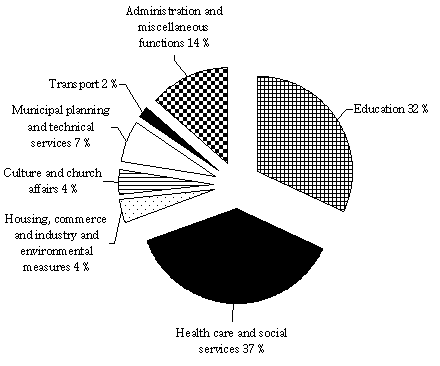
Figure 1 Operating expenses according to the main chapters of the internal accounts. Municipalities 1998.
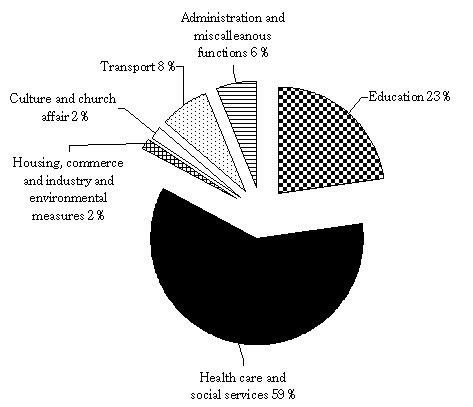
Figure 2 Operating expenses according to the main chapters of the internal accounts. County municipalities 1998.
The main functions of the municipalities
Education
The educational amenities provided by the municipalities cover a broad field; kindergartens/nurseries, preschool, primary and lower secondary school and adult education.
According to the act regulating primary and lower secondary education the municipalities are to provide ten years of education for everyone. The education has to follow basic principles laid down in the act as well as curriculum guidelines for primary and lower secondary education.
The act regulating kindergartens/nurseries makes the municipalities responsible for the building and running of day care facilities. The municipalities are not obliged to run the facilities themselves and may leave this to private organisations under municipal supervision.
Health care and social services
This represents the largest sector within the municipalities’ financial responsibilities.
The municipalities are responsible for primary health care, including preventative clinics such as mother-child clinics and school health service, treatment of diseases and care for the elderly. Thus the municipalities have to provide a variety of services; general practitioners, district and visiting nurses, 24 hour access to medical help, physiotherapy, nursing homes. The municipalities are free to organise these services in their own manner. They may employ people directly or enter agreements with practioners providing services on a private basis.
According to the social services Act the municipalities are required to provide assistance for people with special needs, financial support for people seeking welfare and special measures for drug and alcohol abusers.
Through The Child Welfare Act the municipalities are responsible for childrens’ welfare and for implementing measures to prevent behavioural problems and parental neglect.
The municipal health and social welfare systems give priority to measures for integrating people with disabilities into the local community, and for reducing institutional care by replacing it with individually oriented types of care.
Additionally municipalities are responsible for housing and measures for integrating refugees and people with residence permits granted on humanitarian grounds.
Housing, commerce and industry and environmental measures
The municipalities have a number of tasks relating to the preservation and use of natural resources as well as to the environment in general. They are required to draft plans and make decisions regarding the use of agricultural land, uncultivated land, areas for outdoor leasure activities, the use and protection of waterways and coastal waters, as well as the management of hunting and freshwater fishing.
The municipalities may lay out plots of land for housing and commercial or industrial purposes. They also have responsibilities regarding the applications for purchasing and running commercial or industrial activities.
According to the act regulating pollution control the municipalities monitor local pollution. The cost of preventing or limiting pollution and of treating waste are to be covered by the person responsible for the pollution in the first place.
Some municipalities run commercial enterprises such as electricity companies, cinemas and parking lots.
Culture and church affairs
The municipalities are responsible for running public libraries and school libraries.
They are required to finance churces and cementeries and cover their running expences.
The municipalities are involved in a range of cultural activities which vary in their nature and extent. They are free to get involved in and to support financially activities within media, music, theatre, literature, museums, arts and crafts, sport, and voluntary associations.
Municipal planning and technical services
According to the Building and Planning Act the municipalities have to make plans for the development of public services and for the use of land and other natural resources. Land development plans show areas allocated to housing with the accompanying roads, water mains and sewage system.
Most waterworks are owned by municipalities. The municipalities in general must build facilities for storing and treating refuse from sewage plants, and they are also responsible for garbage collection. Housing development plans often include the provision of child care institutions, playgrounds, sports grounds, cycling paths, foot paths and parks.
The Fire Protection Act requires that municipalities ensure that the fire and chimney sweep services are manned, organised and equipped to implement fire prevention measures and to be summoned in case of fire.
The municipalities are responsible for the construction and maintainance of municipal roads.
The municipalities are also responsible for the construction and running of wharfs and harbour installations within their boundaries. When having a harbour a municipality is responsible for the installation and maintanance of lights and buoys within its harbour district. Harbour districts are defined by the Coast Directorate which is part of the Ministry of Fisheries.
The main functions of the county municipalities
Education
The county municipalities are responsible for upper secondary schools including education for pupils with special needs and adult education at the upper secondary level.
The county municipalities have a number of functions as regards vocational training and thus have to ensure that apprentices doing their training receive the obligatory schooling.
Health and social services, nursing and care
In financial terms this represents the largest sector for the county municipalities and municipalities.
The county municipalities are responsible for specialist health services. These consist of somatic and psychiatric hospitals and institutions, outpatient clinics and specialist services outside institutions.
The county municipalties are required to ensure that the necessary places are available in child welfare institutions and institutions for drug and alchol abusers. They are also responsible for ensuring dental health service for its inhabitants.
Culture
The county municipalities are responsible for etablishing and running public libraries. Beyond this they may to a large extent choose themselves what cultural measures they would like to implement.
Transport
The county municipalities are responsible for the building and maintenance of their own roads. Additionally they are responsible for school transport and for ensuring that public transport is available within their boundaries. Part of this is the awarding of grants to local transport companies. The county municipalities issue permits for public transport and taxi services.
Miscellaneous functions
The county municipalities are required to make plans to coordinate the activities of central and local government, including the main features of municipal activies within social, economic and cultural affairs.
The role played by the county municipalities within regional development has increased in recent years. In addition to the functions mentioned above they help to determine the use of central government funds for the promotion of business and industry in remote areas of the country.