World Food Security and Agricultural Trade
Historical archive
Published under: Stoltenberg's 1st Government
Publisher: Ministry of Agriculture
Guidelines/brochures | Date: 16/10/2000
World Food Security and Agricultural Trade
by Keiji Ohga
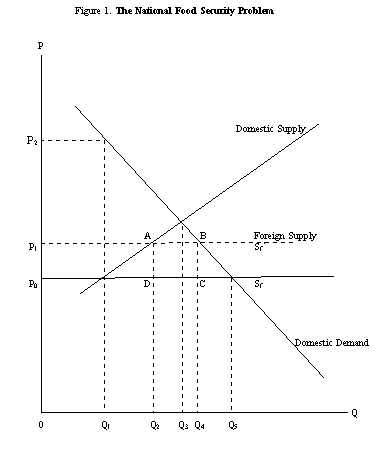
1>>
| Discussants:
|
I. Introduction
1.Food security and the identification of effective
measures for the future are the challenges of the 21
st> century.
2. Food security is defined as a situation in which all households have both physical and economic access to adequate food for all members and are not at risk of loosing such access. There are three implicit facets to this definition: availability, stability and access. If food needs are met through exploitation of non-renewable natural resources or degradation of the environment, there is no guarantee of food security in the long run.
3. This paper will begin with a basic definition of national food security and will then proceed to examine key questions regarding the relation between food security and agricultural trade which are raised in OECD meetings and other international forums. These questions are [COM/AGR/CA/TD/TC(98)5/REV1 (OECD, 1988)]: What does trade liberalisation imply for international food security? What can a rule-based and stable system contribute to food security in OECD countries? How can concerns by food importers on export taxes and embargoes, which might reduce food supplies in international markets and accentuate price swings, be alleviated? Which policies, including multilateral disciplines on export taxes and embargoes, are likely to be most efficient in generating a secure food supply for OECD countries that are heavily reliant on import?
II. National food security
4. Food security is an indispensable part of
national security as well as an international concern. Let us begin
our discussion with an analysis of the basic definition of national
food security.
5. When the good is a strategic and pervasive good, it can be very costly for consuming nations of that good to secure stable supply. The country's stability could be threatened by its losing access to that good due to oligopoly pressures, war, or natural disasters. Food oligopoly confers political as well as economic power on the producer countries. The producer nations can use an embargo on food as a lever to cajole reluctant countries into foreign policy concessions. When the good is of strategic importance, the potential for embargo diminishes the normally convincing case for free trade of agricultural products among nations.
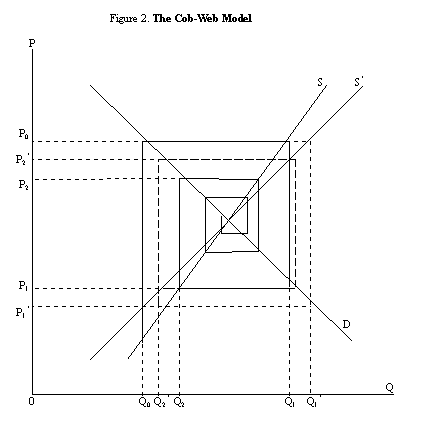
6. From an economic point of view, vulnerable strategic imports have an added cost which is not reflected in the market place. The additional national security costs, caused by vulnerable strategic imports and which reflect the possible damages when access to the good is lost, can be defined as the vulnerability premium. National security is a classic public good. No individual importer correctly represents collective national security interests when making decisions on how much to import. Thus, allowing the market to determine the appropriate balance between imports and domestic productionresults in an excessive dependence on imports.
7. Domestic supply curve assumes that there is enough time to develop resources. If a nation is struck by a sudden loss of access to a stable food supply there is not enough time to develop additional resources (a time lag of several years would be common). In the short run, therefore, the supply curve becomes perfectly inelastic. As prices would rise sharply to equate supply and demand, the loss in consumer surplus during a sudden loss of access could be very large indeed. An estimation of how large the welfare loss is almost impossible because food price data at the time of serious food shortage would be unavailable.
8. How can importing nations react to this inefficiency? Is full self-sufficiency the answer? If the situation is adequately represented by Figure 1, then the answer is clearly no. The net benefit from full self-sufficiency (the allocation in which consumption is Q 3 and imports are zero) is clearly lower than the net benefits from the efficient allocation (Q 4 ). The shaded area in Figure 1 indicates the size of the efficiency loss.
9. The vulnerability premium is lower than the cost of becoming self-sufficient for two primary reasons: (1) sudden losses of the access are not certain events—they may never occur; (2) domestic steps can be taken to reduce the remaining vulnerability to imports.
10. The expected damage caused by a sudden loss of access to one or more goods depends on the likelihood of this occurring, as well as its intensity and duration. This means that vulnerability premium will be smaller for imports having a lower likelihood of loss of access. Imports from friendly countries are more secure and the vulnerability premium on those imports is smaller.
11. For vulnerable imports, we can adopt certain contingency programmes to reduce the damage a sudden loss of access would cause. The most obvious measure is to develop a domestic food stockpile for consumption during such a crisis. This reserve would serve as an alternative source of supply, which could be rapidly distributed on short notice. It is, in short, a form of insurance protection. The less expensive this protection is, the smaller the vulnerability premium is and the more attractive imports are.
12. Governments can reduce vulnerability to imports, which tends to keep the risk premium as low as possible. Certainly for food, however, even after stockpile has been established, the risk premium is not zero. Consequently, the government must concern itself with achieving both an efficient level of consumption and an efficient share of that consumption to be borne by imports. Policy choices include the use of tariffs or quotas, the subsidisation of domestic production and food conservation through dietary orientation towards more direct consumption of plant energy.
13. There are two broad options for achieving food security at the national level: the pursuit of food self-sufficiency or the pursuit of food self-reliance. Food self-sufficiency means the satisfying of food needs primarily through domestic supplies with minimised dependence on trade. A number of larger countries have adopted this policy because year-to-year changes in their import requirements could otherwise have affected world prices. This was particularly true with respect to rice, for which the world market was relatively small.
14. Other countries have pursued a policy to encourage the production of enough food to provide a minimum level of food intake per person and to protect against the contingency that it might be unable to import food at any cost, as in time of sudden loss of the access. This concept of food self-reliance takes into account the possibilities of international trade. It implies maintaining a level of domestic production plus a capacity to import in order to meet the food needs of the population. The benefits and risks of relying on international trade to ensure food security are at the heart of the debate between these alternative strategies.
III. Effect of trade liberalisation on international food
security
15. Trade contributes to food security in a number
of ways: by making up the difference between production and
consumption needs; reducing supply variability; fostering economic
growth; making more efficient use of world resources; and by
permitting global production to take place in those regions more
economically suited to it. Reliance on trade, however, may also
bring some risks. These include uncertainty of supplies, world
market price instability, increasing environmental stress, and
deteriorating terms of exchange on world markets (falling prices
for agricultural exports, higher prices for food imports).
16. Most countries could meet more of their domestic food needs from national production if food prices were allowed to increase to a high enough level or if sufficient alternative incentives were provided to domestic producers. However, the cost of pursuing food self-sufficiency policies can be economically high, as shown by the differences between domestic and world cereal prices in some countries. The differences must be borne either by the government or consumers. Trade plays the role of allowing domestic food consumption to be cheaper through the importation of less costly supplies. Trade also increases consumer choice by providing access to a greater range and diversity of foods. This is particularly important in high-income countries where food trade includes the exchange of broadly similar but differentiated products. One-third of world food trade, which takes place within OECD countries, is of this nature.
17. While food imports can make a vital contribution to food security, countries relying on these imports have two key concerns: their capacity to maintain food imports at desired levels and reliability of access to these imports.
18. Food import capacity depends on the prices and other terms on which food can be imported, as well as on the foreign exchange situation. Those countries whose dependence on food imports has been increasing are more vulnerable to shocks arising in food or other markets. Another fear associated with opening up a country's food markets to trade is that it will lead to increased competition for food supplies between rich consumers in high-income countries and low-income consumers in developing countries.
19. As developed countries usually subsidise their agricultural sectors while developing countries often tax them, the net effect of policy reforms on world markets is ambiguous. The effects of the Uruguay Round on agricultural trade can differ for agricultural importers and exporters, but all countries have an interest in greater global price stability. The Uruguay Round will influence price stability in at least three ways.
20. Production will shift from highly-subsidised to low-subsided regions, with differing likelihood of production variability. If the shift results in a concentration of some products to a specific area vulnerable to climatic change, the resulting effect of fluctuations in production will cause a disruption of global price stability.
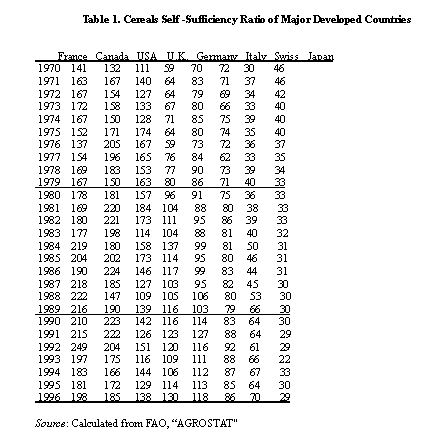
21. The Uruguay Round will also influence world price stability through the tariffication process. As tariffication has the effect on prices in all countries to be more responsive to changes in world market conditions, the magnitude of world market price changes needed to absorb supply or demand shocks is likely to be reduced. While most agricultural tariffs are now bound, countries may apply lower tariffs at any time. Where non-tariff measures were replaced by tariffs, use of that clause would also make imports responsive to changes in world prices. Further more, as improved information systems are in place to monitor harvests on a global basis, market surprises, such as the effect of cereal purchases by the former USSR in 1972, are less likely to happen.
22. On the other hand, most producers will respond to the world price change in the same way. These responses would be more elastic when producers involved deeper in global market economy, even though the synchronisation of responses may be mitigated by the offsetting effect of erratic production fluctuations in various countries. The supply elasticity change would lead to price fluctuation bigger. The well-known cobweb model (figure 2) illustrates this effect. When the world supply curve become more elastic and shift from S 0 to S 1, price fluctuation will change from P0, P1, P2, … to P0, P1', P2'… Thus it would become bigger and the duration of it would be longer.
23. The demand curve shift to a more elastic one would have the opposite effect of mitigating the price fluctuation (As shown by the cobweb illustration). Over all, the total effect of trade liberalisation is ambiguous, but it may make price fluctuations worse or at least prolong them when the change of production elasticity is bigger than that of demand elasticity.
24. Another way in which the Uruguay Round could influence the extent of world price instability is through changed incentives for stockholding. The reduction in market intervention, particularly by exporters, makes it less likely that government stocks will accumulate in the same way in the future as seen in the past and thus the size of global stocks may fall. With reduced global stocks, the world is less able to buffer adjustments of consumption to changes in production. Even though the substitution of private for public stocks could make the some contribution to stability, on balance price stability may deteriorate for cereals and for some livestock products because of the stockholding effect.
IV. Contribution of a rule-based and stable trade system to
food security
25. For countries dependent on agricultural trade,
either as exporter or importers, the prospects for global trade
growth is the link between trade and income growth. If greater
trade volumes or particular trade regimes lead to higher incomes or
faster growth, then agricultural exporters will benefit from a more
buoyant demand, while agricultural importers will more easily be
able to finance food import bills. A more stable general trade
regime should also increase food security of agricultural traders
by diminishing fears that arbitrary trade policies might lead to
disruption of foreign exchange earnings and a fall in purchasing
power with respect to food imports.
26. Trade provides new opportunities for specialisation and exchange, and is usually associated with structural change. Because small-scale producers, especially those in disadvantaged areas, often lack the necessary resources to grow export-oriented crops, they may not be able to participate in this growth. Small producers may abandon their land or be bought out by larger commercial interests. Export production is sometimes associated with the expansion of large-scale capitalist enterprises, which displace small-scale farmers from their land, and export agriculture may worsen the position of the poor majority.
27. The new WTO rules and commitments on import protection, together with the binding of virtually all agricultural tariffs, represent an unprecedented and important step in the direction of systematically liberalising trade in agriculture, in terms of both improved conditions of competition and trading opportunities. Under the new rules border protection may only be provided through tariffs. Border measures such as quantitative restrictions and variable levies are now formally prohibited, except for a few time-bound product-specific exceptions (mainly rice) in the case of four countries.
28. As environmental issues are the subjects of discussion in another session, we would like to draw your attention to the fact that global food security depends on maintaining and conserving the natural resource base. Many people have come to recognise that the possibility of further expanding cultivated land is limited and that the development of new farmland should be controlled in order to conserve the natural environment. How will reduced investment in research by international agricultural research organisations, such as IRRI, affect the increase in yield per unit area by breeding and other efforts? How will a reduction in irrigation investment affect long-term agricultural production? What effects will global warming have on food security? Studies on these long-term problems have just begun and we do not yet have the answers.
V. Concerns about export taxes and embargoes
29. Policy-makers in both developed and developing countries remain concerned about risks associated with reliance on international trade as part of a food-security strategy, and in particular whether imports will be available when needed and the possible impact of political trade embargoes. General trends in cereal markets suggest that these risks may have lessened (Donaldson, 1984). An importer can be more confident that additional import requirements can be supplied without a knock-on effect on market prices.
30. Occasionally, food-surplus nations place restrictions or embargoes of their exports when domestic economic or political conditions provide the necessary justification. The United States placed an embargo on soybeans in both 1973 and 1975 because world demand was threatening domestic availability and driving prices to record highs. More recently, in 1995-1996, exporters in Europe restricted their exports of some cereals via quantity controls or taxes in order to protect domestic consumers.
31. Food may also be used as a political and strategic weapon. However, political embargoes are difficult to enforce, and possibility of purchases through transhipment facilities in other countries makes it relatively easy to circumvent exporters' attempts to exert political pressure. Internationally agreed embargoes may be more effective in this respect but are even less likely to include food. Nonetheless, any trend towards the greater use of trade sanctions to enforce, for example, human rights concerns or international environmental agreements, will increase uncertainty about import supplies.
32. The concern of food importers' in this area is reflected in the provisions of the URAA on quantitative export prohibitions and restrictions. The new disciplines specifically require WTO members instituting export prohibitions or restrictions to prevent or relieve critical shortages of foodstuffs, and to give due consideration to the effects of such measures on importing countries' food security. Specifically, countries instituting such measures are required to give detailed advance notice to the WTO Committee on Agriculture and to consult, upon request, with any other member having a substantial interest as an importer.
33. For both developed and developing countries, stabilisation of both producer and consumer prices is an important objective. Production fluctuations can only be absorbed by consumption adjustments, changes in stocks, or trade. For most importing countries, consumption fluctuations are unacceptable because of the vital importance of food in daily life and reliance on stocks tends to be rather costly. Therefore, many countries rely to a significant extent on trade to even out their production fluctuations. This approach, however, requires a flexible import-management capability and does not eliminate price fluctuations, nor variations in exchange rates, demonstrating a degree of variability in world food prices. This price variability is a function of global production variability; the degree to which markets absorb some of this variability and the size and behaviour of global stocks.
34. Food security is most sensitive to cereal market instability. The volatility of cereal consumption decreased between 1960-1977 and 1978-1989, indicating that since the late 1970s world cereal stocks have protected consumers from the year-to-year volatility of cereal production (Martinez and Sharples, 1993). Since 1993, the global supply/demand situation has become tighter and there has been a significant fall in the size of aggregate stocks held in the main exporting areas, particularly the United States and the EC. As a result, wheat and maize prices rose sharply in 1995/96 over 1994/95 (FAO, 1996), though grain prices have since fallen in the following years. Reviewing the experience of the past 25 years, the irregular appearance of price "spikes" rather than instability per se appears to characterise world cereal markets. For all countries relying on food grain imports, an important aspect of the evaluation of trading regime changes for food security is the likely impact on world market instability. As global stocks are likely to remain relatively low in the 1990s and 2000s compared with the previous decade, and despite the higher share of the more responsive private stocks, the change of current price spikes is probably greater than in the past.
VI. Efficient policy for a secure food supply for major
importing countries
35.
World Agriculture towards 2010 - An FAO Study showed a
declining trend in self-sufficiency and rising import requirements
in most food importing countries, from the base period 1987-1989 to
the year 2010, offset by an increased self-sufficiency ratio in the
exporting countries (FAO, 1995a). Although the study concludes that
"there appear to be no insurmountable resource and technology
constraints at the global level that would stand in the way of
increasing world food supplies by as much as required by the growth
of effective demand", it is becoming apparent that there are a
variety of constraints in increasing food production, such as on
the expansion of agricultural land and those due to global
environmental problems, in addition to factors of instability such
as production fluctuations caused by unusual weather.
36. Other commentators predict the necessity for much larger trade flows, particularly in cereals (Brown and Kane, 1995). They argue that the FAO projections underestimate emerging constraints on growth in food output. These constraints are: the shrinking backlog of unused yield-increasing technologies; the diminishing yield response of cereals to the use of additional fertiliser; the need to reduce excessive irrigation; the effects on agriculture of social disintegration and political instability; and the effect on production of various forms of environmental degradation. If these constraints are indeed more binding than assumed in the FAO analysis, food-importing countries will face much higher import requirements and much higher import prices. These constraints should be borne in mind when interpreting the consequences of policy changes in the international trade regime currently underway.
37. For both of the major food exporters, the United States and the EC, agricultural policy has been under pressure because of its budgetary cost. In the United States, under the new bill, spending on farm programmes would be cut further and farmers given even greater flexibility in choosing crops to plant. Moreover, it is expected that the additional area currently set aside under the Conservation Reserve Programme will again be brought under cultivation. These changes reduce the government's ability to control the supply of commodity production resulting in prices more strongly influenced by market forces. In the EC, agricultural expenditure is constrained until 1999 by a financial guideline agreed between the European Council and the European Parliament.
38. For many food-importing countries, pursuing efficient and reasonable food self-sufficiency is the basis of food security. As noted above, the concept of efficient food self-sufficiency should include the vulnerability premium. In the light of uncertain food situations in the long-run, it would be essential for major food importing countries to set and achieve both the efficient level of consumption and the efficient self-sufficiency ratio to secure a stable food supply for their people. The question of how much food should be imported is not only an economic concern but also a security concern. The principle of free trade of food must be modified for food importing countries to achieve self–reliance of food in the long run.
VII. Policy direction towards world food security
39. In developing countries, about 800 million
people suffer from chronic hunger and malnutrition. This serious
problem needs to be urgently tackled not only from a humanitarian
point of view but also to stabilise world food supply and demand.
The question of how to ensure, through concerted national actions,
a stable world food supply which meets the anticipated large
increase in food demand is an important mid- to long-term
issue.
) Basic approaches towards achieving food security
40. To reflect the multifaceted nature of world food
security, it is necessary for each country to deploy a variety of
measures in accordance with its respective position.
41. For major food importing countries, the basis of a stable food supply should be an appropriate combination of three elements; namely the maintenance and expansion of sustainable domestic food production, the securing of stable imports, and the maintenance of proper stockpiles, depending on the situation of each country.
42. In devising their strategies, countries should bear in mind that although the use of stockpiles is effective to meet demands in an emergency situation, it is by nature a temporary measure because of the quality and cost constraints. With respect to food imports, although it is necessary to supplement the deficit of domestic food supply, the uncertainty of external supplies and the possibility of large purchases by rich importing countries may result in adverse effects on the world food market should be taken into account. In addition, if we consider a large population increase in the future, it would be important to maintain and increase domestic food production within the framework of international rules, making effective and sustainable use of existing production resources in an economical, social and environmentally sound manner.
43. Trade is an important element for achieving food security, as its stable development would lead to building a smooth and effective supply system. It should be noted, however, that sustainable food production is the most reliable basis for securing stable food supplies in order to meet growing demands. We still live in an unstable and uncertain world where sovereign countries place priority on securing a stable and safe life for their people. It is not appropriate to refer to trade liberalisation as being the sole guideline for the achievement of food security. Trade and domestic production should be carried out in an appropriately balanced manner.
44. Considering the important role of trade in securing stable food supplies for importing countries, food exporting countries need to strive for stable production and exports which are responsive to trends in demand and to ensure continued and stable food export to importing countries even during periods of food shortage.
ii) Tackling current hunger and malnutrition
45. Considering that there still are more than 800 million
people in developing countries continue to suffer from hunger and
malnutrition, our urgent task is find ways to secure stable food
supplies in those countries, especially low-income food-deficit
countries. To this end, in addition to food aid as an emergency
response measure, it is important to eradicate poverty by creating
a political, economic and social environment conducive to improving
access to food. Moreover, in order to provide a fundamental
solution to the hunger and malnutrition problem of these developing
countries, the strengthening of sustainable food production
capacity in each of these countries is important. It is also
important to provide technical and policy assistance, along with
the efforts mainly by developing countries to improve their
infrastructure and strengthen their investment in agriculture.
46. In addition, population problems should also be tackled and the implementation of the Programme of Action adopted by the International Conference on Population and Development is necessary.
iii) Measures towards the achievement of food security
47. Since food is a most basic necessity, the fundamental
role of agricultural policy is to ensure its stable supply. Given
the present state of national diets, it is difficult for most
importing countries to produce all the necessary food as production
resources and climatic conditions are constrained. It is essential
to have an appropriate combination of imports and stockpiling, in
addition to domestic production, so as to ensure a stable food
supply.
48. Japan is a typical food importing country which takes food security seriously. The Japanese food self-sufficiency ratio is only 42 per cent (on a calorie basis, 1995) and its cereal self-sufficiency ratio is 30 per cent, an exceptionally low figure compared to other developed countries (Figure 3 and Table 1). According to the results of recent public-opinion poll, 80 per cent of Japanese feel concerned over the future food situation and 70 per cent of them are willing to pay an additional reasonable cost for food so as to secure their food supply in the long run.
49. Following this national sentiment, the Japanese food and agricultural policy aims principally at putting the brakes on the declining trend of food self-sufficiency ratio. In concrete terms, based on the "Long Term Supply and Demand Outlook for Agricultural Products (1995)", the Japanese government expressed its will to make every efforts to maintain and increase domestic food production through sustainable utilisation of national land resources (effectively responding to consumer needs for high quality, safer and fresher products at reasonable prices) and through production and marketing efforts that would take advantage of the merits of domestic products.
50. As food production resources, such as agricultural land, are extremely difficult to restore once destroyed, it is important to secure the necessary level of domestic food supply capacity to cope with unexpected situations by maintaining and securing good agricultural lands, improving and enhancing soil productivity, and ensuring the availability of farming skills.
VIII. Concluding remarks
51. The purpose of the international trade regime is
to facilitate the mutual exchange of goods and services so as to
maximise each country's opportunities to exploit gains from trade.
An efficient trade regime in this sense is likely, as a by-product,
to enhance both global and national food securities. By encouraging
income growth, by broadening the range and variety of food
domestically available, by diffusing the risks arising from
domestic production fluctuations and by enabling global production
to be achieved as efficiently as possible, trade contributes to
food security in each of its dimensions of access, availability and
stability.
52. Nonetheless, international trade brings change and change usually implies winners and losers. Agricultural trade liberalisation has accompanied concerns that structural changes may lead to reduced food security among food importing countries and poor households. Food imports may become more expensive. Global food price instability may increase in the short run if global stock levels are extremely low and agricultural production is concentrated in several climatically homogeneous areas. The intensification of agricultural production in low-subsidising regions could contribute to further environmental degradation. That is, trade liberalisation can also have an adverse impact on food security in each of its three dimensions of access, availability and stability, as well as on sustainability.
53. In negotiating further trade liberalisation, these concerns should be understood and steps taken to minimise their adverse impact. There is a need for policies at both the global and national levels to ensure that cereals from trade are widely distributed and that the potential for greater food security is fully exploited.
54. The Uruguay Round made very substantial progress in integrating agricultural trade into the general GATT disciplines. But sustainable gains from trade possibilities will remain unexploited even when the Uruguay Round agreement is fully implemented.
55. It has been agreed that negotiations to continue the reform process should take place one year before the end of the implementation period for developed countries, that is 2000. They should take into account food security concerns of food importing countries in implementing the commitment and any further commitments that may be necessary to achieve long-term objectives.
IX. Issues to be tackled by OECD
56. Most of the points and reflections raised here
are hypothetical but should provoke further discussion. Following
are some of the food security issues relating to agricultural trade
liberalisation that are to be tackled in OECD.
i) Food emergency
57. What kind of food would be of strategic importance for
countries heavily dependent on food imports? In what situation the
emergency of losing food access occur and what are the
possibilities of that emergency occurring and the eventual damage
it can incur? What can food-exporting countries do to alleviate the
adverse effects of such food emergencies?
ii) Food sufficiency target
58. In what circumstances is it necessary to have a
national food sufficiency target compatible with trade
liberalisation arrangements?
iii) Food price stability and stock
59. What effects does trade liberalisation have on food
price stability and food stock policy? What are the effects of
trade liberalisation on agricultural production concentration in
areas vulnerable to climatic change? What international arrangement
should be made to stabilise food prices?
iv) Agricultural trade arrangement with big developing
countries
60. What would be the impact of big developing countries,
such as China and India, when they grow rapidly and buy sizeable
amounts of food? Is it not necessary to make a special
international agricultural trade arrangement with China when it
joins the WTO?
v) Long term effects of the market oriented agricultural policy
on food production
61. What are the long-term effects of declining trends of
investment in agricultural development and international as well as
national research institutes? What is the impact of global warming
on the newly emerging divisions of agricultural production under
agricultural trade liberalisation? What can we do to prevent the
adverse impact of world climatic change?
This paper has also been presented
in the OECD Workshop on Emerging Issues in Agriculture, Paris,
26-27 October 1998.
Back to text.