Norwegian contributions provided through the World Bank
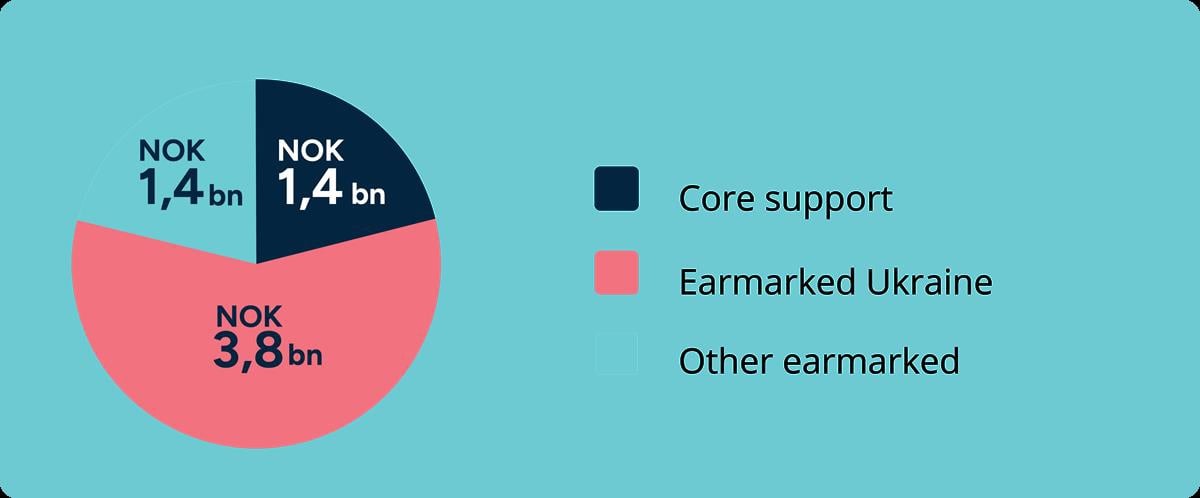
The World Bank is the single largest recipient of Norwegian aid. In 2024 Norway contributed NOK 6.6 billion to the World Bank, channelled partly as core support (NOK 1.4 billion), primarily to IDA, and partly as support to thematic and country-based funds (earmarked support: NOK 5.2 billion), of which a significant portion went to Ukraine (NOK 3.8 billion). See figure 1.
Figure 1 Norwegian support for the World Bank in 2024
Core support
Core support is voluntary, non-earmarked support provided to multilateral organisations that can be used in line with their respective mandates, procedures and negotiated priorities. Providing multilateral partners with core support is an overriding aim of Norwegian development assistance. The organisations in question rely on core support to fund their mandates and key tasks. Core support prevents aid fragmentation and provides the necessary flexibility to coordinate resources, ensure strategic direction and support the recipient countries’ domestic plans. Norway follows up on its provision of core support through its active engagement on the boards of multilateral organisations such as the World Bank. In its review of World Bank trust funds and FIFs, the National Audit Office of Norway recommended8 that more of Norway’s contributions to the World Bank be provided in the form of core support.
Providing core support to the World Bank helps to ensure effective use of limited resources by multiplying the capital available for lending for development and climate purposes (see Box 1). Many donors consider the World Bank to be an effective channel for channeling scarce development resources. Following pressure from the G20 in particular, the World Bank has carried out far-reaching reforms in recent years to increase its lending capacity by optimising its capital base and boosting financial innovation. Norway has supported these efforts on condition that the bank take a prudent approach to risk and maintains its high creditworthiness.
In 2024 core support to the World Bank made up 22 % of all Norwegian support to the World Bank and 2.5 % of all Norwegian development assistance that year. Core support is cost-effective, and its use by recipients is monitored through Norway’s representation on the World Bank board and in the IDA governance structure. Funding for IDA in the period 2026–2028 increased by 50 % compared with the previous three-year period. Earmarked support for the World Bank has also increased significantly since 2022, primarily due to the civilian support for Ukraine being channelled through World Bank trust funds. In the years to 2030, steps will be taken to shift Norwegian financing for the World Bank towards core support. Nevertheless, the overall composition of the financing provided through the World Bank will continue to reflect the need for earmarked support for countries such as Ukraine and Palestine as well as other priority initiatives.
IDA as a tool for tackling poverty, inequality and global challenges
The World Bank’s International Development Association (IDA) is an important tool in combating poverty and inequality and promoting development in line with the Sustainable Development Goals. IDA financing is based on recipient countries’ own priorities, while donor countries provide guidance in the form of thematic priorities established during the replenishment negotiations taking place every three years. IDA supports investment in healthcare, education, social safety nets, climate change measures (especially adaptation), food security, natural resources, biodiversity, good governance and infrastructure. Job creation, financial management, fragility, conflict, private investment and gender equality are cross-cutting issues. IDA assists with state-building, debt management and public services.
IDA provides heavily subsidised loans and grants to the poorest countries (see Box 1). IDA’s ability to give grants depends on generous donor contributions. Such contributions have levelled off in recent years. This weakens IDA’s creditworthiness over time and consequently also its ability to take up loans in the capital markets. This will result in lower volumes and increased pressure on the concessional loans and grants it provides. There will need to be clearer eligiblity criteria and prioritization of countries that can lend on the most favorable terms. Norway will continue to prioritise the poorest and the most fragile and conflict-affected countries.
The increase in Norway’s core support for IDA in 2026–2028 reaffirms that IDA is a key channel for Norwegian development assistance. Leading up to 2030, the Government will aim to increase the support even further. The support provided in 2026–2028 includes NOK 600 million in softly earmarked support for food security in the poorest countries. Norway will also be working to ensure that support for other priority areas is channelled through IDA as core support, preferably without such earmarking.
Earmarked support through Trust Funds and Financial Intermediary Funds
While this strategy recommends that core support be given priority, there are many good reasons why some Norwegian development assistance provided through the World Bank is earmarked. Norway provides earmarked support to World Bank trust funds for priority issues and particular geographical areas. Trust funds give the World Bank resources to achieve specific goals, advance new initiatives and support programmes at country level. In 2024 Norway financed 32 World Bank, IDA and MIGA trust funds. This accounted for 79 % of all Norwegian support channelled through the World Bank. The statistics reflect the World Bank’s status as the biggest channel for civilian assistance to Ukraine, primarily provided as earmarked support for three Ukraine-related trust funds.9 Norway also provided NOK 3.3 billion in 2024 to nine Financial Intermediary Funds (FIFs) administered by the World Bank. FIFs are independent funds with their own boards. The World Bank acts as trustee and in many cases host for the funds’ secretariats. The support provided for FIFs is additional to the earmarked support for World Bank trust funds described in figure 1.
Trust Funds
Trust funds are partnerships between the World Bank and donors. Trust funds finance much of the bank’s knowledge production and technical advice provided to member countries, underpinning the bank’s core operations. There are good examples of how trust fund financing through IDA helps to improve outcomes, including in the fields of health and education.10 Trust funds are also helping to bring about change at the World Bank over time. Examples include trust funds supported by Norway that focus on gender equality and human rights. Trust funds enable the World Bank to provide assistance when its lending powers are limited, as in the case of countries in conflict and non-members (e.g. Palestine). Trust funds are used by IFC and MIGA to mitigate risk when investing in challenging markets through blended finance mechanisms.
Norwegian support for World Bank trust funds also extends to priority areas such as governance, gender equality, energy, health, food security and digitalisation. For example, Norway has for many years supported the Energy Sector Management Assistance Program (ESMAP) trust fund, which serves as a particularly important source of knowledge for the bank as it seeks to increase investment in renewable energy. Through its engagement with ESMAP, Norway aims to influence the bank in a priority area for Norwegian development policy.
There is growing recognition both at the bank and among donors that there are too many trust funds and that the cost and amount of administration that goes into running them can be excessive. Reforms have been carried out to coordinate and reduce the number of World Bank trust funds. Compared to purely bilateral initiatives and trust funds, however, multi-donor trust funds are a way of reducing fragmentation while strengthening the World Bank’s core operations. Norway will work to ensure that the funding it provides through trust funds is targeted at supporting and enhancing the bank’s operations in Norway’s priority areas.
Financial Intermediary Funds (FIFs)
FIFs are used to coordinate international support for issues and sectors that require large-scale investment, such as climate change and pandemic preparedness, and to organise and manage support for countries and regions facing immediate financing needs, such as Ukraine and Gaza. While FIFs help to coordinate support, the growing number of financing mechanisms are creating a fragmented financing architecture which can be difficult for the recipient countries to navigate. Another disadvantage of FIFs is that they borrow less in the market and therefore do not provide leverage in the way that World Bank core support does. Discussions are ongoing about how to make FIFs more effective in order to improve coordination with the World Bank’s other activities and strengthen mobilisation of private capital. Norway supports these efforts. In the years to 2030, Norway will consider whether a greater proportion of Norwegian support for World Bank FIFs can instead be channelled as core support to the World Bank. However, given the importance internationally of providing support for the funding mechanisms under the climate change and environmental conventions, Norway will continue to support FIFs such as the Green Climate Fund (GCF), the Global Environment Facility (GEF) and the Fund for Responding to Loss and Damage (FRLD). The World Bank only serves as trustee and does not have operational responsibility for the running of the funds.
Addressing the National Audit Office’s review of World Bank trust funds and FIFs
Following its examination of selected World Bank trust funds and FIFs in 2021, the National Audit Office of Norway recommended closer monitoring of results and costs relating to such funds.11 Since then, the Ministry of Foreign Affairs and Norad have conducted an in-depth review of Norway’s support for both World Bank and non-World Bank trust funds and financing mechanisms. Norad has developed a set of criteria for assessing the funds, including enhanced assessment guidelines focusing on relevance, development effectiveness and cost efficiency. The criteria include guidelines for how any future support for new or existing funds must be assessed against alternative channels, including core support. A plan for phasing out the support (an exit strategy) must be included. In line with the recommendation that more of Norway’s support for the World Bank be channelled as core support, Norway will systematically consider core support for IDA as an alternative channel for earmarked sector-specific support through trust funds and FIFs.
Reporting and communicating results
The World Bank has good monitoring systems, safeguard mechanisms and systems for transparency and accountability. The bank has taken steps to improve and simplify the reporting of results and is working actively to communicate results. This extends to World Bank trust funds, whose outcomes are measured using their own results frameworks linked to the World Bank’s primary objectives. The Multilateral Performance Network (MOPAN) rates the World Bank as ‘satisfactory’ with regard to achievement of results, efficient delivery, and relevance to partners.12 Norway will continue to address and highlight results in its cooperation with the World Bank at country level and encourage the use of results to aid learning and make initiatives more effective. Norway will work to raise awareness of the World Bank and to highlight results, including in Norway.
The World Bank has launched reforms to simplify and streamline its processes to work faster and to increase development impact at country level. Reforms to the World Bank’s guidelines on social and environmental matters are part of this process. The World Bank has good social and environmental safeguards in place, including a requirement for the bank to support member countries in fulfilling their human rights obligations.13A more risk-based approach is currently under consideration. Norway supports reforms to simplify and streamline processes, providing that the bank maintains its knowledge-based approach, its effective systems for transparency and accountability and its strict criteria for social and environmental safeguards.
The Government will :
- Increase its core support for IDA and systematically consider core support for IDA as an alternative channel for sector-specific funding and support through trust funds and FIFs.
- Implement enhanced guidelines on support for new trust funds and FIFs and on phasing out support with emphasis on concentrating efforts and improving cost efficiency and aid effectiveness.
- Promote Norway’s priorities through IDA, taking into account the needs of IDA recipient countries, and safeguard funding on favourable terms for the poorest and most heavily indebted countries.
- Help to ensure quality in the reporting, monitoring and communication of results both in relation to core support and support through trust funds and FIFs.
- Support efficiency measures and a reduction in the number of trust funds.
- Ensure good coordination between earmarked support and core support through close monitoring by trust fund partnership councils and the World Bank board;