6 Progress on Goals and Targets
6.1 Current State & Key Changes 2021–2026
Norway is well positioned to achieve the Sustainable Development Goals. The assessment of progress on the 17 SDGs conducted in this review confirms this overall picture. Norway performs particularly strongly on goals related to poverty (SDG 1), gender equality (SDG 5), energy (SDG7), equality (SDG 10), strong institutions (SDG 16) and partnerships (SDG 17). This reflects long-standing investments in welfare systems, high-quality public services, and inclusive governance. According to the SDG Index, Norway is currently ranked number 7.
Since Norway’s previous VNR in 2021 substantial efforts have been made to contextualise the global goals within the national framework. A key policy initiative has been the development of national indicators. As national challenges are not fully captured by the global indicators, complementing them with nationally relevant measures provides a more accurate picture of progress. Since 2021, Statistics Norway has established a publicly available portal presenting both global and national indicators. This enables a more robust and analytical assessment of Norway’s progress. A detailed description for Norway’s monitoring and review mechanisms is provided chapter in 6.2.
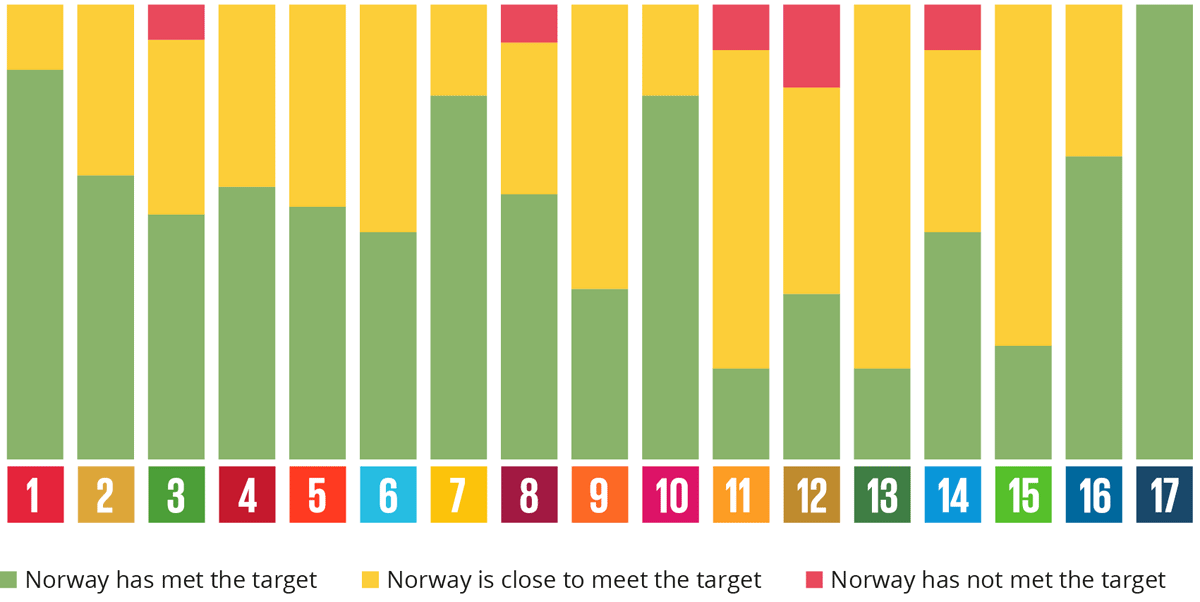
In this VNR the Government has assessed all 169 targets. The assessment shows that Norway has fully met 97 targets while further efforts are required for the remaining 72 targets. Most of these targets are close to being achieved, however six targets require significant improvement namely target 3.8, 8.4, 11.1, 12.2, 12.5 and 14.5. The targets with the greatest need for improvement emphasise how Norway’s high standard of living and material consumption pose create clear challenges to sustainable development. These challenges are particularly evident in targets related to resource use, waste management, climate action, biodiversity, and the relationship between economic growth and environmental degradation. Moreover, material consumption in Norway remains significantly higher than global and European averages, contributing to high levels of waste generation. Norway also has potential for improvement with regards to reducing marine litter and microplastics and strengthening marine conservation, ensuring access to affordable housing and dental care.
Figure 6.1 Status on the SDGs
Source: Ministry of Digitalisation and Public Governance, 2026
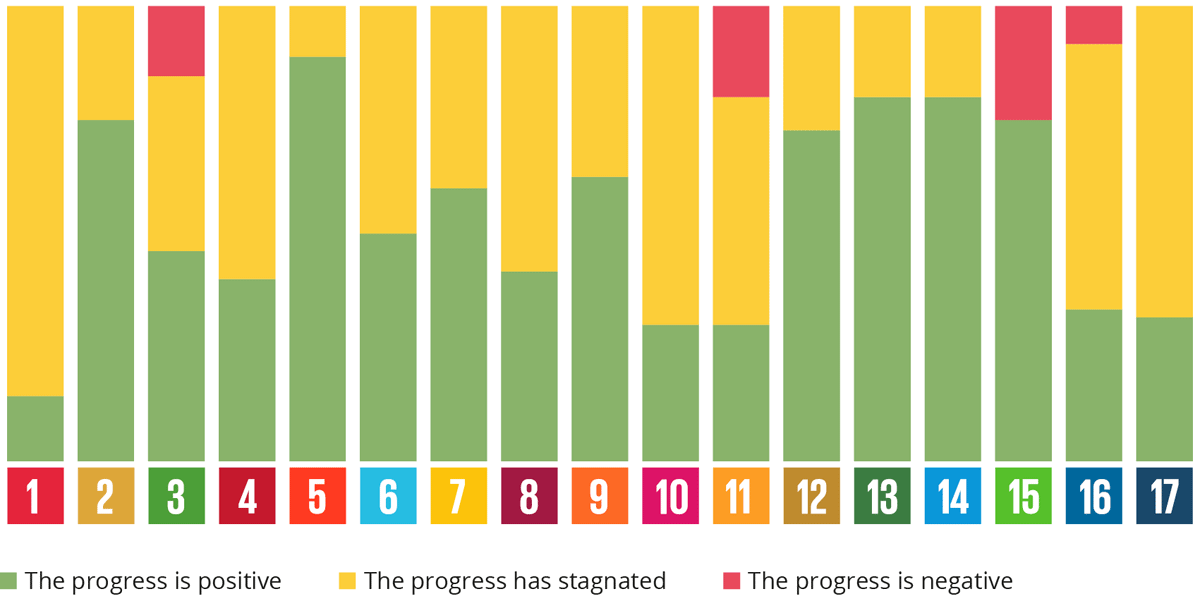
Overall, the assessment indicates a positive development trend, with positive development for 87 targets and stagnated progress for further 74 targets, indicating maintained performance. Only eight targets show a negative trend, underscoring that most areas are either improving or holding steady, as shown in the figure below.
Figure 6.2 Development Trend on the SDGs
Source: Ministry of Digitalisation and Public Governance, 2026
A comparison with the 2021 assessment indicates a slightly negative development of progress. 22 targets show regression, while 8 targets show progress. However, as the 2026 assessment is based on a more robust and expanded evidence base developed since 2021, direct comparisons are not well suited to draw firm conclusions about development over time.
6.2 Monitoring and Review Mechanisms
Since 2020, Statistics Norway (SSB), in cooperation with the public authorities, has published global indicators for monitoring progress on the 17 Goals in a SDG indicator portal. From 2023, this was expanded to also include national indicators. Over the past five years considerable effort has been invested in developing a comprehensive and coherent set of indicators for national follow-up. As a result, Norway now has a significantly strengthened knowledge base. The systematisation of indicators enables a far more thorough assessment of Norway’s progress on the SDGs than was possible at the time of the previous VNR in 2021.
The indicators are used by the Government both in the annual reporting on SDGs to Parliament, and in Norway’s reporting to the United Nations. The indicator portals published by SSB also play an important role in the work of many civil society actors and contribute to transparency regarding public authorities’ efforts to promote sustainable development.
As of May 2025, approximately 215 national indicators and 103 global indicators have been published. A detailed overview of the status on the global indicators is provided in the statistical annex to this report. To further strengthen sustainability efforts within the public administration and enable communication of the results to the public, there is a continuous need to enhance data quality on the SDGs and further develop the portal. This is a priority for the Government.
Access to quality data is also important for local and regional authorities. The Government has therefore supported the development of local- and regional-level indicators and reliable data collection. This helps local and regional authorities to measure progress towards SDG achievement.
Indicators for Local and Regional Authorities
Initiated by KS and developed by Statistics Norway a classification model called “the taxonomy for SDG-related indicators” was designed to help local-, regional- and national-level policymakers and administrative bodies in selecting indicators that are most effective for measuring progress towards SDG achievement. The taxonomy was developed in close collaboration with local and regional authorities, which have been involved in testing how to best connect SDG localisation and progress monitoring to the indicators already in use in municipal management. The taxonomy’s systematic framework organises indicators across three key dimensions: 1) Goal; 2) Perspective; and 3) Quality. Applying the same taxonomy to all the indicators helps in clarifying and comparing their uses and usability. KS is continuing the work by utilising the taxonomy to present a database of classified indicators, including a shortlist of relevant indicators for use in local and regional administrations.
Source: KS, Indicators and taxonomy for the SDGs
6.3 Progress on the SDGs – Assessment by the Government and Civil Society
This progress report presents an overview of the status and progress in the SDGs since Norway’s second VNR in 2021. The Government’s assessment is based on available data, drawing primarily on the recent White Paper on the SDGs, and the global indicators and national indicators produced by Statistics Norway. The Government assessment is followed by an independent assessment by civil society organisations.
The assessments by the Government are illustrated using the following:
|
|
Norway has met the target |
|
|
Norway is close to meet the target, but there is room for improvement |
|
|
Norway has not met the target |
|
|
The progress is positive |
|
|
The progress has stagnated |
|
|
The progress is negative |


The civil society assessments use the following symbols to indicate performance:
|
|
Norway has made positive progress towards achieving the goal |
|
|
Norway’s progress towards achieving the goal has stagnated |
|
|
Norway’s progress towards achieving the goal has slowed down |
1 No Poverty
Government Assessment
|
1.1 |
No one lives in extreme poverty as a result of universal welfare schemes. |
|
|
1.2 |
The share of population with persistent low income has increased somewhat after 2010. The increase in the number of children in families with persistent low income has tailed off. |
|
|
1.3 |
Norway has a comprehensive public welfare system that covers the entire population. |
|
|
1.4 |
The entire population has equal rights and access to economic resources, financial services, and basic welfare services such as healthcare and education. |
|
|
1.5 |
Norway has strong insurance schemes and systems for crisis management and emergency preparedness. |
|
|
1.A |
Norway’s development policy aims to eradicate poverty, reduce inequality, and promote sustainable growth by mobilising private capital, strengthening domestic resource mobilisation, and supporting key multilateral institutions. In 2025, Norway devoted 1,03% of its GNI to official development assistance. |
|
|
1.B |
The Government has submitted a White Paper to the Parliament on social mobility and social equalisation among children, youth and families. Norway contributes to the OECD DAC review on how ODA can better mobilise private funding. |
|



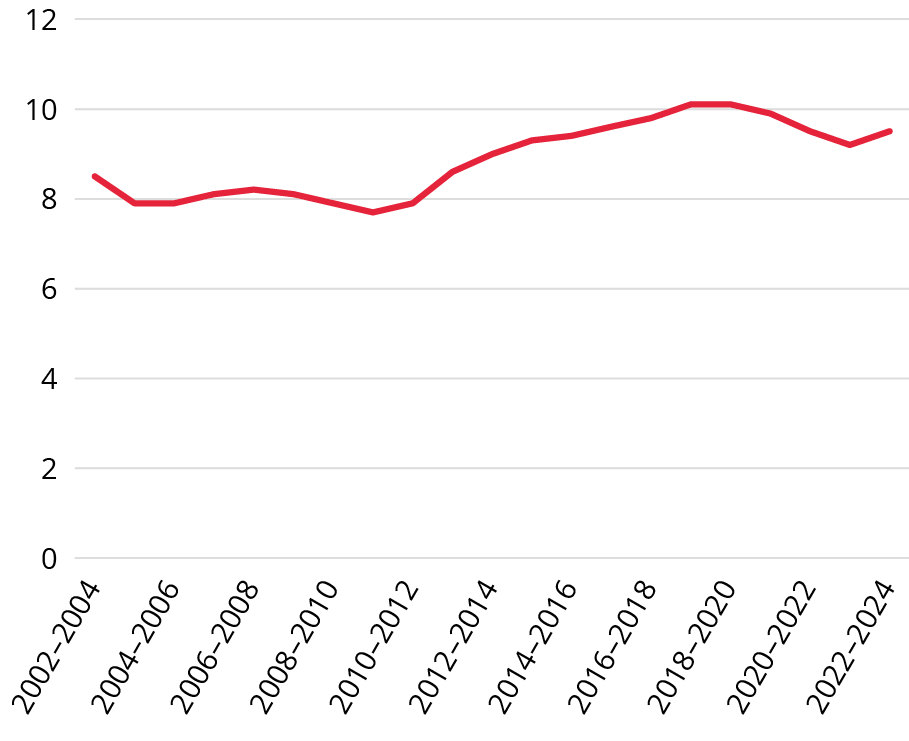
General Status: Norway has among the lowest levels of income inequality and poverty, driven by high employment rates among women and men, free education and public welfare schemes, and sustained economic growth. A small share of the population has low income and poor living conditions. Norway has no official poverty line, but it is common to use a measure of persistent low income. The share with persistently low income has been relatively stable but has increased somewhat after 2010. In 2022–2024, 9.5 percent of the population (excl. students) fell into this category. After rising from 2000 onwards, the share of children in families with persistent low income has tailed off. In 2022–2024, the figure was 10.2 percent.
Over time, average income within the low-income group has increased, but not in line with overall income growth. When the low-income threshold is fixed to a specific year and only adjusted with inflation, the share of people with low-income declines. However, rising living costs in recent years have disproportionately affected low-income households. This is illustrated by the figure below, which shows population living in households with a persistent low income 2007–2024 (EU scale 60 percent below median income, three-year period). Fixed and current low-income threshold.1
Figure 6.3 Population Living in Households With Persistent Low Income
Source: Statistics Norway, 2025
Main Achievements: All groups have experienced income growth, and the increase in children in families with persistent low income has tailed off. High labour market participation and increased child benefit have contributed to this. Universal welfare schemes have improved living conditions, particularly for low-income and vulnerable groups. Low income among the elderly has decreased. Families with children, especially single parents with small children, have had relatively good income development in recent years.
Norway’s Challenges: Norway’s main challenges include keeping income disparities low, preventing poverty from being passed on to new generations, and increasing labour market participation among vulnerable groups. The share of children living in households with persistent low income, particularly among families with an immigrant background and single parents, is concerning. The number of homeless people is also increasing after several years of decline. Norway has a relatively high degree of social mobility, but promoting equal opportunities for all children remains essential to improve equity in educational and social outcomes.
Global Responsibility: Norwegian development policy aims to promote societal change by combating inequality and poverty, and by fostering economic development and welfare in developing countries. Official development assistance from Norway (ODA) amounted to NOK 58.9 billion in 2025. As a share of GNI (gross national income), it stood at 1.03 percent in 2025. Norway was the only OECD country that contributed more than one percent of its gross national income to aid in 2025.
Main Policy Initiatives 2021–2026
- Active labour market policy measures, including a youth guarantee from July 1, 2023.
- Increased efforts to include immigrants in working life and society.
- Increased the universal child benefit.
- Reduced maximum parental fee for kindergartens and lower parental fee for out-of-school care.
- White Paper, Meld. St. 28 (2024–2025) Having Faith in the Future – Regardless of Background.
- White Paper on long term strategy for Norwegian developement policy to be presented to Parliament in the spring session of 2027.
Assessment by Civil Society
The following organisations have participated in this assessment: The Salvation Army, Collaborative Forum Against Poverty, Forum for Development and Environment (ForUM), Press – Save the Children Youth Norway.

Norway has succeeded in maintaining comparatively low poverty by international standards: extreme poverty is near zero and the nationalpovertyline rate stood at ~12.2 percent (2023). This is underpinned by a universal welfare state, high employment, and redistributive taxes. Income inequality in 2023 was at its lowest since 2014, and the overall atriskofpoverty rate remained about 10.9 percent.
Internationally, Norway remains a top donor of ODA relative to GNI and prioritises poverty reduction, domestic resource mobilisation, and social protection through ODA. In 2024 Norway delivered ~1.02 percent of GNI in aid, even as global ODA fell.
Norway’s challenges include stagnating or rising poverty risks since 2021. The share with persistent low income reached 9.5 percent (average 2022–2024). Vulnerability is concentrated among people with weak labourmarket attachment, disabilitybenefit recipients, single adults, and immigrants. Material and social deprivation have increased during the costofliving crisis, underscored by a documented surge in charitable food distribution in 2023 – which is now stabilised at a high level, suggesting it has become a lasting supplement to the welfare system rather than a temporary crisis measure.
In a recent report from Q1 2026, 47 percent of households from the lowest income bracket report that their financial situation has worsened over the past six months, while only 15 percent report an improved financial situation. This confirms a consistent trend in the same study where a disproportionate number of lowincome respondents report a worsening financial situation. In total, 8 percent of households surveyed in this report state that they do not have sufficient financial means to cover ordinary daytoday living expenses, a proportion that has remained stable since 2023. Among households reporting low income, one in four (26 percent) say they have skipped meals, and 14 percent say they have gone to bed hungry because they could not afford to eat enough. Among those whose financial situation has worsened, 65 percent report saving on electricity, 63 percent have bought less or less healthy food, 54 percent have avoided buying clothes, and 43 percent have refrained from or postponed seeking health services.
Internationally, although Norway continues to allocate a high share of GNI to ODA, total aid volumes declined in 2024 and a smaller share reached the poorest countries. Norad’s official statistics show that support to leastdeveloped/poorest countries declined in both amount and share in 2024 (countryallocated aid share to these countries dropped from ~40 percent to ~31 percent), while Europe—driven by Ukraine—became the largest recipient region. This mirrors a wider international shift and raises concerns for SDG 1 impact in lowincome settings.
Norway must:
- Introduce improved poverty metrics and data systems that reflect actual needs rather than income alone, recognising that income levels do not fully capture the experience of poverty.
- Legally mandate price indexation of all benefits (disability benefits, social assistance, AAP, child benefits etc) to ensure that vulnerable groups’ real incomes keep pace with living costs.
- Accelerate labourmarket inclusion for groups with the highest poverty risk (young adults, immigrants/refugees, people with reduced work capacity).
- Expand access to affordable child-care and after-school activities for low-income families.
- Target highrisk households (single adults, minimum disability pensioners, immigrants) with tailored support and activation pathways.
- Expand affordable housing supply and reduce housingcost burdens for lowincome households.
- Reinforce childpoverty measures, especially for immigrant and singleparent families.
- Uphold high ODA levels and reverse the drop to the poorest countries by restoring/increasing the share and volume to LDCs/lowincome countries, safeguarding humanitarian funding, and prioritising povertyfocused, countryowned programs.
- Maintain leadership on fair taxation and domestic resource mobilisation in partner countries to reduce structural drivers of poverty.
2 Zero Hunger
Government Assessment
|
2.1 |
The food security status is good, with access to safe, nutritious and sufficient food that meets dietary needs and food preferences throughout the year. |
|
|
2.2 |
The nutritional status in Norway is good. However, the prevalence of overweight and obesity is increasing, and frail older individuals are at higher risk of undernutrition. The proportion of mothers who exclusively breastfeed appears to be declining. |
|
|
2.3 |
There are well-developed institutions in both the agricultural and seafood sectors that provide equal access to knowledge, financial services, technology and other productive resources. |
|
|
2.4 |
Food production must be adapted to climate and environmental challenges. Environmental pollution must be reduced while ensuring the production of safe and nutritious food. The use of pesticides and antibiotics remains consistently low, and pasture use is stable. |
|
|
2.5 |
Cultivated plants are maintained in a joint Nordic gene bank and national clone archives, and livestock worthy of preservation through conservation herds and subsidy schemes. |
|
|
2.A |
Norway remains a major ODA donor and partner for international development and humanitarian assistance for food security and nutrition, including through UN and multilateral agencies, FAO, WFP, IFAD, CGIAR and World Bank/IDA, and NGOs, in accordance with government strategy. |
|
|
2.B |
Norway has phased out export subsidies on agricultural goods. |
|
|
2.C |
Domestically, Norway has a market regulation system where the main participants are the Agricultural Agency and the agricultural cooperatives. Norway also supports international and multilateral market information efforts, including AMIS, and is a key contributor to the FAO. |
|

General Status: Food security is generally good in Norway, but there are challenges with overweight and obesity. The country is largely selfsufficient in meat, dairy products, and seafood. Norway also has frameworks to ensure that food is safe to eat. National food security depends on continuous food production, safeguarding the production foundation, and a wellfunctioning trading system. Sustainable food production in agriculture, fisheries, and aquaculture forms the basis of national food security. Reindeer husbandry is an important Indigenous livelihood and a bearer of Sami culture and language.
Main Achievements: Sustainable management of resources for food production, safe food from land and sea, and trade are the main pillars of Norwegian food security. The Norwegian fisheries, aquaculture and agricultural sectors are among the most valuecreating primary industries in the world. These sectors have institutions providing access to knowledge, capital, technology, and other production resources. The total area used for cultivating crops for food and feed is stable. The Government has introduced measures to promote climate adaptation and robust farming practices, including a climate agreement with the farmers unions, the establishment of Bionova in 2023 and the establishment of a Food System Commission that will propose measures to strengthen the sustainability of Norway’s food system.
Norway’s Challenges: Unhealthy diets increase the risk of noncommunicable diseases, overweight, obesity and premature death. Over 50 percent of the adult population are overweight or obese, while frail elderly individuals are at risk of undernutrition. In general, the population consumes too little fruit, berries, vegetables, whole grains, and fish, and too much salt, added sugar, saturated fat, and red and processed meat. Exclusive breastfeeding rates appear to be declining. Agriculture contributes to greenhouse gas emissions but is also greatly challenged by climate and environmental changes. There is a need to adapt to these changes and to protect soil resources. The good status for animal and plant health must be maintained. Safeguarding national food production is a priority. Sustainable reindeer husbandry depends on sufficient grazing land, which is increasingly challenged by land use from other sectors. The aquaculture industry faces challenges with high mortality, mainly related to sea lice.
Global Responsibility: Food security, including from aquatic foods, is a priority area in Norwegian development policy, following the Government’s strategy against hunger from 2022. Food security is also a priority in the revised humanitarian strategy launched in 2024. Development assistance to agriculture, fisheries, and food security amounted to NOK 2.1 billion in 2025, with the largest proportion channelled via UN and multilateral institutions (FAO, IFAD, WFP, CGIAR, World Bank).
Main Policy Initiatives 2021–2026
- Revised Soil Protection Strategy (2023).
- White Paper, Meld. St. 11 (2023–2024) Strategy for Increased Self-Sufficiency in Agricultural Goods.
- Norway’s Path Towards a Sustainable Food System (2024).
- National Strategy for Organic Agriculture 2025–2032.
- Roadmap for the AgricultureBased Food Industry (2025).
- White Paper, Meld. St. 24 (2024–2025) on the Future of the Aquaculture Industry.
- White Paper, Meld. St. 15 (2022–2023) on Public Health – National Strategy to Reduce Social Health Inequalities.
- White Paper, Meld. St. 8 (2024–2025) on Animal Welfare.
Assessment by Civil Society
The following organisations have participated in this assessment: Caritas Norway, FIAN Norway, The Future in our Hands (FIVH), The Association for International Water Studies (FIVAS), The Royal Norwegian Society for Development, Norwegian Society for the Conversation of Nature, The Development Fund, Norwegian forum for Environment and Development.

Norway has succeeded in achievingnational food security. Hunger is effectively eradicated, and Norway maintains very low levels of food insecurity alongside high nutrition standards. The majority of the population has access to safe and nutritious food through well-functioning markets, high food safety standards, and universal welfare systems. Norway has also succeeded in establishing strong institutions supporting sustainable food systems. The country benefits from solid regulatory frameworks, stable agricultural systems, and effective governance arrangements, which contribute to high-quality food production and sustainable management of key natural resources for food and agriculture. In 2024, Parliament commissioned a public inquiry to prepare a report expected in 2026 with recommendations for developing more sustainable food systems in Norway. Norway has been an active advocate for global food security and has developed a comprehensive foodsecurity strategy within its development cooperation, including support to smallholder farmers. It promotes farmers’ rights to seeds worldwide to strengthen food security, build climate resilience, and conserve crop diversity, and it is home to the Svalbard Global Seed Vault. Norway maintains close collaboration between civil society and government in multilateral foodsecurity processes.
Norway’s challenges include persistent malnutrition among vulnerable groups. Elderly and disabled patients in institutions remain undernourished or at risk of malnutrition due to insufficient nutrition competence, inadequate meals, and weak follow-up routines. This undermines the right to adequate food and quality care and is also relevant to SDG 3.8. Dietary patterns are unsustainable. Norwegians consume high levels of meat and low levels of fruits and vegetables, and adherence to national dietary guidelines remains low. Overweight and obesity are rising (15–20 percent of children are overweight), and unhealthy diets increase the risk of non-communicable diseases and premature death. Food consumption patterns are also environmentally unsustainable. Food waste is high, and low self-sufficiency, particularly for vegetables and plant protein, creates vulnerability while shifting environmental pressures, including deforestation and emissions, abroad through global food supply chains. Agricultural policy continues to prioritise productivity growth, weakening rural livelihoods and long-term resilience. Many farms close, and farmland remains fallow. Aquaculture, although economically important, continues to cause pollution and environmental pressures, including high mortality in farmed fish, as documented in the 2026 Risk Report on Norwegian Fish Farming. Market concentration in the grocery sector and contract-based production systems limit farmers’ autonomy, weakening food system diversity and resilience. Rising food prices, aggressive marketing of unhealthy food, and insufficient social support contribute to increasing reliance on voluntary food assistance and rising nutritional inequalities. Greenhouse gas emissions from agriculture remain high, and land-use change, pollution, and erosion continue to undermine biodiversity and ecosystem resilience, threatening sustainable food production. Internationally, reduced prioritisation of long-term food security and climate adaptation in development cooperation amid shifting geopolitical priorities risks weakening Norway’s contribution to global progress on SDG 2.
Norway must:
- Strengthen nutrition competence and staffing capacity in institutions and home-based care to prevent malnutrition among vulnerable groups.
- Promote healthier and more sustainable diets and substantially reduce food waste.
- Strengthen food literacy and practical cooking skills, particularly among children and young people, to promote healthy diets and reduce food waste.
- Increase domestic resilience by reducing dependency on imported livestock feed, while strengthening production of plant-based foods.
- Significantly tighten regulation of aquaculture to reduce environmental damage and improve animal welfare.
- Reduce greenhouse gas emissions from agriculture and food systems and ensure alignment with climate and nature commitments.
- Strengthen conservation of agricultural biodiversity relevant to food systems, including seed security and genetic diversity.
- Increase and safeguard development assistance to food and nutrition security and agriculture, including support to smallholder farmers, particularly women and youth.
3 Good Health and Well-Being
Government Assessment
|
3.1 |
Norway has strong prenatal, maternity, and childbirth care, and very few women die in connection with pregnancy and childbirth. |
|
|
3.2 |
Norway is among the countries in the world with the lowest neonatal mortality rates. |
|
|
3.3 |
Deaths from infectious diseases are low, but there is potential to prevent more severe health outcomes within certain vulnerable groups. |
|
|
3.4 |
Non-communicable diseases account for the largest share of Norway’s disease burden, but mortality has declined by 20% since 2015. There is room for improvement regarding diabetes for both genders and for chronic obstructive pulmonary disease for women. The suicide rate has increased, especially among men. |
|
|
3.5 |
Alcohol remains the most used substance while cannabis is the most used illegal substance. Lately, there has been an increase in the use of cocaine. The number of overdose deaths remains high, and fatalities related to prescribed medications have increased. |
|
|
3.6 |
Deaths and injuries in traffic accidents have risen again after a decline during the pandemic but remain among the lowest in Europe. Approximately 600 people die or are seriously injured in traffic accidents each year. |
|
|
3.7 |
Access to sexual and reproductive health services is universal. The share of pregnancy terminations has increased in recent years. |
|
|
3.8 |
The level of universal health coverage is high, with some cost-sharing requirements. However, about 5 % of residents over the age of 16 have an unmet need for dental services due to high costs. |
|
|
3.9 |
Although air pollution poses a significant threat to health in Norway, it is not a major cause of mortality or morbidity. |
|
|
3.A |
Norway has strengthened the implementation of the Framework Convention on Tobacco Control, both nationally and by supporting the FCTC 2030-project. |
|
|
3.B |
Norway has a national vaccine programme with high coverage. In 2024, more than 95% of the population completed the course of DTP, MMR and Pneumococcal vaccine, while HPV coverage was 92.5% for girls and 90.0% for boys. Norway also supports international collaboration on medical research and development of, and access to, vaccines and medicines through our support to WHO, the Coalition for Epidemic Preparedness Innovations and the Pandemic Fund. |
|
|
3.C |
Norway has one of the highest concentrations of doctors and nurses in Europe. With the demographic change, Norway is currently working on initiatives to address the expected lack of personnel in the future. Support to WHO is one of the most important contributions to strengthening the health workforce in developing countries. |
|
|
3.D |
Both legislation and systems for the implementation of the International Health Regulations are in place. In 2024 Norway were above the global and regional averages for all indicators. Norway is maintaining a low percentage of antibiotic-resistant blood stream infections. In 2024 the percentage of blood stream infections due to MRSA was 1.1% and for ESBL E. coli 6.7%. |
|


General Status: The population in Norway generally enjoys good health and a high quality of life. Systematic public health efforts and universal health and care services contribute significantly to this. Nevertheless, non-communicable diseases, overweight, obesity and social inequalities create public health challenges that must be taken seriously. Mental health disorders and issues account for a significant share of the disease burden, and their prevalence has increased in parts of the population. Deaths from infectious diseases are low, but there is potential to prevent more severe health outcomes in certain vulnerable groups.
Main Achievements: Overall life expectancy is high for both men and women: 81.6 years for men and 84.8 years for women in 2024. Declines in smoking and improved treatment have reduced the incidence of and mortality from cardiovascular diseases and cancer over recent decades. Access to sexual and reproductive health services is available to everyone. Prevention of infectious diseases such as HIV and hepatitis is also accessible. The decline in the number of HIV cases continues, and Norway is well on its way to eliminating hepatitis C as a public health problem.
Norway’s Challenges: Because the population is living longer, non-communicable diseases will continue to put increasing demands on health and care services. Despite a decline in the number of daily smokers, smoking remains the single factor that contributes most to disease and premature death. There are challenges and loss of healthy life years related to a high proportion of physically inactive individuals in the population, continued decline in physical activity levels, unhealthy diets and an increasing share of people with overweight and obesity.
Mental health problems are increasing, particularly among young people, and suicide is among the leading causes of premature death, especially among men. Alcohol consumption is a risk factor for loss of healthy life years, and the number of overdoses is very high. Social inequality contributes to health disparities. The population’s use of dental health services is another area with room for improvement. Further, there is room for improvement regarding vaccination and efforts to counter the rise in antimicrobial resistance.
Global Responsibility: The Government is working to gradually shift efforts toward strengthening national health systems, pandemic preparedness and response, universal health coverage, and improved primary health care. The goal is to develop health services that can withstand climate change and manage an increase in climate-related diseases, as well as changes in the incidence and spread of both non-communicable and communicable diseases, including antimicrobial resistance.
Main Policy Initiatives 2021–2026
- White Paper, Meld. St. 15 (2022–2023) on Public Health – National Strategy to Reduce Social Health Inequalities, including a National Tobacco Strategy.
- White Paper, Meld. St. 5 (2023–2024) A Resilient Health Emergency Preparedness – From Pandemic to War in Europe.
- White Paper, Meld. St. 19 (2023–2024) National Health and Interaction Plan 2024–2027 – Our Common Health Service.
- White Paper, Meld. St. 21 (2024–2025) Health for All: Fair Prioritisation in Our Common Health Service.
- White Paper, Meld. St. 23 (2024–2025) Renew, Reinforce, Improve: The General Practitioner Services and Emergency Medical Services of the Future Outside Hospitals.
- A child violence investigation scheme has been established within the Norwegian Board of Health Supervision in January 2025.
Assessment by Civil Society
The following organisations have participated in this assessment: ILHI, FFO, The Norwegian Association of the Blind and Partially Sighted, the Norwegian Cancer Society, FIAN Norway, Norwegian Medical Students’ Association, The Norwegian forum for Environment and Development.
Norway has succeeded in buildinga well-functioninguniversal healthcare system, and there is strong financial protection against medical expenses, except for dental health. Vaccine preventable diseases are low, with a high coverage of the Childhood Immunisation Programme. Norway has developed new strategies, i.e. for women’s health, reducing social health inequalities, mental health and antimicrobial resistance. CRPD is included in Norwegian law. Norway has played a central role in the development of the Lusaka Agenda. Sexual and reproductive health rights remain a priority in ODA.
Norway’s challenge is social inequalities in health. The population with the lowest household income has significantly shorter life expectancy, and the proportion of children living in persistent poverty has tripled over the past 20 years. Access to health services is challenging for some population groups such as people living in very remote areas, people with disabilities and undocumented migrants. Racism and discrimination in health care services among both patients and health workers are documented. Infectious diseases like gonorrhoea, HIV, viral hepatitis and drug resistant tuberculosis have been in an upward trend. There is insufficient access to timely rehabilitation for persons with disabilities. Care for the elderly remains a challenge, with reports of involuntary treatment, violence and undernutrition. Inpatient beds for mental health care and substance use treatment have been reduced, andthe mortality among these groups has increased between 2019 to 2024. This hinders the progressive realisation of the right to health as stipulated in the Convention on economic, social and cultural rights. Norway has failed to demonstrate global health leadership. The grant to The Global Fund to Fight AIDS, tuberculosis and malaria has remained nominally constant over a decade, and the funding to GAVI and UNAIDS is reduced. Eye health care is not a priority. Armed conflict has become a fundamental determinant of health. Despite Norway’s condemnations of attacks and the disruption of health facilities, ODA to global health remains unchanged. It is a concern that increased focus on global health security might skew resources from other global health priorities.
Norway must:
- Improve preventive health by addressing antimicrobial resistance and the commercial drivers of health (tobacco and nicotine products, alcohol, sugar-sweetened beverages, ultra processed food, etc.).
- Fully finance and implement its strategy to reduce social health inequalities (White Paper, Meld. St. 15 (2022–2023) on Public Health – National Strategy to Reduce Social Health Inequalities) and strengthen policies to reduce persistent poverty.
- Put in place systems to improve access to basic health services, including for reproductive and mental health, for refugees, immigrants and undocumented migrants.
- Ensure inclusive and universal design of health services and improve health care for people with disabilities; establish more national health registers, including a national register for visually impaired.
- Combat/eliminate racism and discrimination in health- and social services and develop systems to expose and tackle it.
- Strengthen sexuality education in schools and increase availability of low- cost, low threshold testing for sexually transmitted diseases.
- Prevent violence and abuse of older persons and take immediate action to address acute malnutrition among older persons in health and care institutions.
- Make urgent and significant efforts to improve prevention and care for people with mental health and substance use disorders.
- Prioritise and increase funding for global health to strengthen health systems, in line with the Lusaka Agenda, while ensuring the health rights and needs of vulnerable populations are protected and with meaningful community engagement.
- Increase funding for universal health coverage, ensure equal access to prevention (i.e. vaccines) and treatment against HIV and TB, as well as prioritise global eye health care.
4 Quality Education
Government Assessment
|
4.1 |
Primary, lower secondary and upper secondary education is free and accessible to everyone. Completion of upper secondary education has never been higher, but improvement is still needed. |
|
|
4.2 |
All children have access to kindergarten, but the quality of the services varies. |
|
|
4.3 |
Higher education is of high quality, free, and accessible to all. |
|
|
4.4 |
Completion of upper secondary education has never been higher. Improvement is still needed, particularly in vocational programs. |
|
|
4.5 |
Access to education is universal, but gender disparities persist in technology, health, and teacher education programs. |
|
|
4.6 |
Reading and mathematics skills among Norwegian 15-year-olds have declined. Results for the adult population are generally good, but about 10% have weak reading, numeracy and problem-solving skills. |
|
|
4.7 |
Sustainable development, public health and life skills, and democracy and citizenship are prioritised cross-curricular themes in primary and secondary education. A core purpose of higher education, according to national legislation, is to contribute to environmentally, socially and economically sustainable development. |
|
|
4.A |
The Norwegian Directorates for Education and Training and for Higher Education and Skills provide guidance on universal design, individual accommodation and inclusive learning environments across the education system, from kindergartens and primary and secondary education to higher education institutions and vocational colleges, in accordance with Norwegian legal requirements. |
|
|
4.B |
Student mobility is an objective in Norway’s international cooperation. Student exchange with and within countries in the global south is included in the Norwegian programmes NORPART and NORHED, for global academic cooperation and capacity development in higher education and research for development. The scholarship programme NORSTIP provides scholarships for master students from countries in Africa, Asia and Latin America. |
|
|
4.C |
Norway’s efforts to counter the global shortfall of qualified teachers include support for UNESCO’s global education programme. Norway has contributed to the training of 4.7 million. teachers in partner countries. Education Cannot Wait has trained more than 243 000 teachers with strong support from Norway. |
|
General Status: Access to early childhood education and care is high, and nearly all children aged 3–5 attend. Primary education is available to all, and of high quality. Everyone has the right, but not the obligation, to complete upper secondary education. An increasing share of students completed upper secondary school. In 2023, 42.6 percent of women and 32.3 percent of men in Norway had completed higher education.
Main Achievements: The maximum kindergarten fee is historically low, and the Government has introduced free kindergarten in Finnmark and Northern Troms. The sibling discount has been strengthened so the third child of a family attends for free. The Government has introduced measures to support learning, well-being, and motivation, including a national program for practical learning, grants for school environment teams, and a new quality development system. Several measures have been introduced to strengthen children and students’ reading skills and motivation to read. A reading commission has been appointed and there has been substantial funding to buy books in kindergartens and schools. It has been decided that schools should be especially restrictive in the use of tablets and digital devices and tools in their teaching of the youngest students. There are also strong recommendations for schools to regulate students’ access to mobile phones and smartwatches during school hours. All classrooms should be mobile-free. In primary schools, all breaks should also be mobile-free.
The share of students completing upper secondary education has increased by ten percentage points over the past decade. In 2025, around 97 percent progressed from lower secondary to upper secondary education. Participation in vocational colleges is increasing with enrolment doubling from 2017 to 2023.
Norway’s Challenges: The quality of kindergarten services varies greatly, and the sector has high doctor-certified sick leave. Also, there are challenges in recruiting and keeping kindergarten teachers. In schools, there has been a decline in learning outcomes in several subjects and skills. From 2018 to 2022, performance decreased in reading, mathematics, and science as measured by the PISA survey. PIRLS 2021 also showed a decline in the reading skills of Norwegian ten-year-olds. Norwegian students reported the lowest enjoyment of reading among all 65 countries that participated in PIRLS 2021. Completion rates remain lower in vocational programs, partly because they recruit more students with weaker lower secondary education skills. Boys with an immigrant background obtain apprenticeships and complete vocational education at lower rates, a gap not explained by absenteeism or grades. Children of parents with lower levels of education tend to perform worse in school and are less likely to pursue higher education.
Global Responsibility: Norway prioritises education in crisis and conflict, education for girls, comprehensive sexuality education, and partnerships in higher education. Key components include support for system and capacity strengthening, as well as programs to train and enhance the quality of teachers. Norway’s international cooperation to ensure quality education for all is mainly implemented by multilateral partners, in particular UNICEF, UNESCO, the Global Partnership for Education and Education Cannot Wait.
Main Policy Initiatives 2021–2026
- The maximum kindergarten fee has been significantly lowered and there is financial support to strengthen staffing in kindergartens.
- The Reading Initiative with several measures to strengthen children and students reading skills and motivation, including funding for books in kindergarten and schools, a Reading Commission and additional support to students with dyslexia.
- A new Education Act entered into force on August 1st, 2024. Under the Act, the right to upper secondary education applies until the individual has obtained academic or vocational qualifications.
- A scholarship programme for master students from partner countries in Africa, Asia and Latin America (NORSTIP) was established in 2023.
- Multi-year pledges to multilateral partner organisations’ strategic plans, such as the Global Partnership for Education 2021–2025, UNESCO’s education programmes 2023–2025, in addition to Education Cannot Wait 2023–2026.
Assessment by Civil Society
The following organisations have participated in this assessment: The Norwegian Association of the Blind and Partially Sighted, Norwegian Library Association, The United Nations Association of Norway, ADRA Norway, The Atlas Alliance, Digni, Norwegian Association of the Disabled, Operation Day’s Work (ODW), Plan International Norway, Save the Children Norway, Right to Play Norway, SAIH – The Norwegian Students’ and Academics’ International Assistance Fund, The Norwegian Association for Sexual and Reproductive Health and Rights, The Norwegian Union of School Employees, SOS Children’s Villages Norway, The Strømme Foundation, UNICEF Norway, The Norwegian Federation of Organisations of Persons with Disabilities, The National Union of Students in Norway, The Association for International Water Studies (FIVAS), The Norwegian forum for Development and the Environment (ForUM).
Norway has succeeded in building a strong and inclusive education system. Primary and secondary schooling is free and compulsory, and lower kindergarten fees have made early childhood education more accessible. Uppersecondary completion has increased by 10 percentage points since 2015 and now stands at 82 percent. However, completion rates remain lower among Technical and Vocational Education and Training students, and fewer pupils transition directly from lower to upper secondary school compared to ten years ago (96.8 percent in 2025 vs. 98.3 percent in 2014).
Internationally, Norway’s financial support for education has declined significantly. Official development assistance (ODA) to education fell by 33 percent between 2021 and 2024, and tuition fees were introduced for international students. On the positive side, the 2024 humanitarian strategy recognises education as lifesaving, and Norway continues its strong commitment to the Safe Schools Declaration.
Norway’s challenge is, despite its strengths, that the Norwegian education system faces several persistent issues. There is a substantial shortage of teachers and support staff. Bullying remains widespread, and many school facilities and materials are not universally designed, limiting inclusion for children with disabilities.
Norway is experiencing a pronounced decline in reading proficiency. PISA 2022 shows Norwegian 15yearolds scoring 477 points in reading—Norway’s lowest score ever and 22 points below 2018. National data confirm a 23point decline from 2018 to 2022 and a rise in low performers, with students below proficiency level 2 increasing from 19 percent to 27 percent. These developments exacerbate socioeconomic inequalities, and uneven access to quality school libraries weakens support for struggling readers.
Progress on Education for Sustainable Development (ESD) is also uneven. Findings show that the interdisciplinary topic of sustainable development is inconsistently implemented across schools. Many teachers lack the time, resources and pedagogical tools to translate curriculum intentions into practice. Wholeschool approaches are only partly realised, and key ESD values—critical thinking, democratic participation, ethical reflection and systems thinking—are not systematically embedded. As a result, pupils have unequal opportunities to develop the competencies needed to understand and address complex societal and global challenges.
Norway must:
- Ensure equal access to information and strengthen pupils’ critical thinking and reading skills.
- Identify reading difficulties earlier, with special attention to ethnic minority pupils.
- Increase funding for school libraries and ensure they are staffed with qualified personnel to support equitable access to information and literacy development.
- Strengthen adult education and lifelong learning through accessible, flexible, highquality opportunities for adults with low basic skills in reading, writing, numeracy and digital competence.
- Integrate Education for Sustainable Development (ESD) and global citizenship education throughout the education system, enabling pupils to develop the competencies needed for sustainability, peace, human rights and democratic participation.
- Improve teacher training and professional development in ESD, ensuring educators are equipped to teach sustainability, interdisciplinarity, critical thinking and systems thinking.
- Facilitate cooperation between kindergartens and public libraries to foster children’s joy of reading from an early age.
- Use legislation, regulations and targeted funding to ensure full inclusion of children with disabilities at all educational levels.
- Strengthen efforts to combat bullying, especially cyberbullying.
- Abolish tuition fees for international students.
- Allocate 15 percent of development aid to education and increase support to education funds, UN organisations and civil society partners.
- Prioritise free, inclusive, quality public education in development aid, in line with human rights and SDG 4.
- Continue supporting the Safe Schools Declaration.
- Champion the right to quality education globally by systematically promoting equality and accessibility.
5 Gender Equality
Government Assessment
|
5.1 |
Equality between women and men is high in Norway, but there is still room for improvement. |
|
|
5.2 |
Norway continues to face challenges related to violence against women and girls, but several initiatives have been implemented to reduce this. |
|
|
5.3 |
In recent years, inquiries to the Competence Team against Negative Social Control and Honour-Based Violence have increased. This may be due to a rise in the actual number of cases but may also be due to greater awareness. |
|
|
5.4 |
Public services and social rights in Norway ensure equal opportunities to work and to start a family. Parental leave is divided into three quotas; one for each parent, and one quota to be freely allocated between the parents. |
|
|
5.5 |
Among top leaders in public administration, gender balance has been achieved, but there are still major disparities in the private sector. In politics, gender balance is largely in place, except among county mayors. |
|
|
5.6 |
Everyone in Norway has access to good sexual and reproductive health services. Comprehensive sexuality education, contraception, and safe abortion services are easily accessible. |
|
|
5.A |
In 2025, 65.9% of women and 72.2 percent of men were employed (15–74 years old). The number of women who owned shares increased by 58% from 2006 to 2024. However, only 32% of shareholders are women (2024), and this gap has remained relatively stable. The proportion of female homeowners is roughly at the same level as that of men. After implementing gender quota rules for corporate boards in 2024, gender balance has increased at a significantly higher rate than previous years. |
|
|
5.B |
98% of women in Norway own a mobile phone. |
|
|
5.C |
Norway has comprehensive equality legislation and policies that promote gender equality. Public authorities are obligated to work to promote equality and to issue a statement on what they are doing to integrate considerations relating to gender and non-discrimination. |
|
General Status: Norway is ranked third out of 146 countries in the World Economic Forum’s Gender Gap Report 2025. The report measures progress in economic participation, education, health, and political empowerment. Differences in employment rates between men and women are low, and among the smallest in OECD countries. Generous parental leave schemes, flexible work arrangements, and the right to a kindergarten place with a capped fee contribute to equal participation both at work and at home. In politics and among top leaders in public administration, gender balance is largely achieved. In the private sector, however, disparities are substantial.
Main Achievements: Since 2015, the gender pay gap has narrowed. Women’s earnings amounted to an average of 87,9 percent of men’s earnings in 2025, up from 85.3 percent in 2015. Since 2014, the share of fathers who have taken all or more of the paternity quota has remained above 60 percent. In 2023, the Parliament adopted requirements stipulating that in certain companies, no more than 60 percent of board members may be of the same gender, with a phased implementation from 2024 until 1 July 2028. The proportion of boards with gender balance increased by 3 percentage points from 2024 to 2025.
The Government has presented an escalation plan against violence and abuse of children and violence in close relationships for the period 2024–2028. The national competence team against negative social control and honour-related violence provided guidance in 1,402 individual cases in 2024, an increase of 23 percent from the year before. This may indicate greater awareness and expertise within the support system, and that more people at risk are receiving help than before. The Government has presented a plan against negative social control and honour-motivated violence for the period 2025–2028.
Norway’s Challenges: Women earn less than men and are more likely to work part-time. Even though the pay gap has narrowed over time, there was a small increase from 2024 to 2025 with 0,3 percentage. The labour market remains gender-segregated, with most women and men working in different sectors, occupations, and positions. There are far fewer women than men at the top levels of Norwegian businesses, and nearly all CEOs of the 200 largest Norwegian companies are men. Women are more often than men subjected to domestic violence, sexual harassment, rape, negative social control, honour-based violence, and forced marriage. The majority of victims of intimate partner homicide are women.
Global Responsibility: Gender equality and women’s rights are central priorities in Norway’s foreign and development policy, with particular emphasis on sexual and reproductive health and rights. Combating violence against women, strengthening women’s economic and political participation, and enhancing women’s role in efforts related to food security, energy, and climate are also prioritised. Women, peace and security is also a priority. Norway works actively to promote women’s rights and gender equality in multilateral negotiations and in the work of multilateral organisations.
Main Policy Initiatives 2021–2026
- Strategy for Gender Equality 2025–2030.
- A White Paper on men’s equality challenges will be presented to Parliament in 2026.
- The new Act on Abortion (came into force on June 1, 2025).
- Escalation Plan to Combat Violence and Abuse of Children and Domestic Violence (2024–2028).
- A green paper NOU 2024: 4 “Rape – An Unsolved Societal Problem” was submitted to the Ministry of Justice and Public Security on 8 March 2024.
- Action Plan for Women’s Rights and Gender Equality in Norway’s Foreign and Development Policy (2023–2030) A just World is an Equal World.
- National Action Plan on Women, Peace and Security (2023–2030).
Assessment by Civil Society
The following organisations have participated in this assessment: The Norwegian Women’s Lobby, The Development Fund, The Norwegian Federation of Organisations of Persons with Disabilities (FFO), Legal Counselling for Women, Secretariat for the Crisis Centre Movement in Norway,The MiRA Centre, Nordic Women’s University, FRI – the Norwegian Association for Sexual and Gender Diversity, Sex og samfunn, Amathea, The Women’s Front of Norway, , The Norwegian Association for Women’s Rights (NKF), LO Norway – the Norwegian Confederation of Trade Unions, The Norwegian Forum for Development and Environment (ForUM).
Norway has succeeded in initiating action plans and committees to promote gender equality, notably the permanent Commission for Intimate Partner Homicides, the Committee on Sexual Assault (“Voldtektsutvalget”), and the Commission on Women’s Occupational Health. Amendments to the Criminal Procedure Act have increased the use of reverse personal security alarms, shifting accountability to offenders and providing greater freedom to victims. The implementation of a new Abortion Law and consent-based rape legislation strengthens the protection of women’s rights.
Norway is an international advocate for gender equality and sexual and reproductive health and rights (SRHR). Universal welfare schemes promoting equality are strong, and around 60 percent of fathers take full parental leave.
Norway’s challenges are persistent gendered social and economic inequalities, disparities in women’s health and occupational health, and high rates of gender-based violence. Despite numerous action plans, committees, and legislative reforms, these efforts have yet to yield lasting systemic change in practice.
Gender-based violence remains a widespread challenge. Women experience domestic violence, sexual harassment, and sexual violence more often than men. One in five Norwegian women has experienced rape, and 85 percent of victims of intimate partner murders are women. Sámi women experience domestic violence more often than non-Sámi women, and minorities face barriers accessing help-services. Violent pornography and oversexualised representations of women and LGBTQIA+ persons are easily accessible online, and digital violence and sexual extortion are increasing. Women and LGBTQIA+ persons are often targeted by hate crime and hate speech. Civil society organisations and crisis centres report constraints and insufficient financial and political prioritisation.
As of 2025, the gender pay gap is increasing. The labour market and educational system remain gender-segregated. Women are more often part-time employed, overrepresented in low-paid care sectors, and underrepresented in leadership positions. Discrimination related to parental leave is prevalent. These patterns intersect with ethnicity, migration status, disability, and socioeconomic background. Gender-neutral language in policies and legislation may hinder substantive equality. The decline in female representatives in Parliament challenges democratic inclusivity. Detention systems do not adequately safeguard gender-sensitive conditions. Imprisoned women and trans persons report discrimination, inadequate healthcare, and heightened vulnerability to violence.
At a global level, we observe a backlash against gender equality, women’s rights, and bodily autonomy. Geopolitical and financial uncertainties particularly affect women, and violence against women remains a pervasive barrier to gender equality.
Norway must:
- Eliminate gender-based violence and discrimination, ensuring legal reforms and action plans are supported by financial prioritisation and preventive efforts.
- Follow up on the review of the Crisis Centre Act of 2010 and the financing model for crisis centres.
- Incorporate the Istanbul Convention into domestic law.
- Implement large-scale awareness campaigns on gender-based violence, digital violence and pornography, and help-services for victims and perpetrators.
- Expand the use of reverse personal security alarms.
- Ensure relevant actors are trained to recognise and investigate violence against women, including women with disabilities.
- Retain gender-specific language recognising women’s structural disadvantages in policies and legislation on violence and in the Equality and Anti-Discrimination Act.
- Strengthen research on women’s health and follow up on the Commission on Women’s Occupational Health.
- Challenge gender stereotypes in education and occupation, and reduce the gender pay gap, including implementing the EU Pay Transparency Directive.
- Ensure safe, gender-sensitive, and non-discriminatory prison conditions for women, trans, and non-binary individuals.
- Adopt intersectional approaches to gender equality and policies beyond a binary model of gender.
- Ensure and protect bodily autonomy and access to healthcare for marginalised groups.
- Counter global trends undermining women’s rights and advocate for gender equality and SRHR.
- Strengthen gender-sensitive asylum and migration policies, including protection for LGBTQIA+ asylum seekers and women at risk.
- Integrate gender perspectives into climate reports, action plans, and initiatives, including those on technology and just transitions.
6 Clean Water and Sanitation
Government Assessment
|
6.1 |
Norwegians have access to safe and affordable drinking water. |
|
|
6.2 |
Norwegians have universal access to sanitation and hygiene for all. |
|
|
6.3 |
The overall water quality is good, but there are challenges related to wastewater and pollution. |
|
|
6.4 |
The supply of fresh water is good, but upgrades and adaptations to the water and sewage system have a significant backlog. |
|
|
6.5 |
The goal of integrated water management has been achieved, including through the regional water management plans for 2022–2027. |
|
|
6.6 |
There is still a need for improvements, especially for forest protection, as well as the restoration of peat bogs, wetlands and rivers. |
|
|
6.A |
Norway supports international cooperation and capacity-building in water- and sanitation-related activities, including support for water, sanitation and hygiene projects through bilateral and multilateral channels (e.g. the Global Environment Facility). Norway supports measures to reduce plastic waste entering rivers and freshwater systems. |
|
|
6.B |
Guidance is provided by and available on the websites of the Norwegian Food Safety Authority and the Norwegian Environment Agency. In addition, municipalities normally give guidance in sanitation management to their inhabitants. |
|
General Status: Generally, people in Norway has universal access to safe drinking water and good sanitation conditions. The quality of drinking water is high, but measures are needed to ensure good quality in the future. Urban wastewater is treated, and the majority of the population is connected to municipal treatment plants. Around 65 percent of the population is connected to treatment plants where urban wastewater is treated biologically and/or chemically. Approximately 75 percent of Norway’s natural water bodies have good ecological status. Work remains to protect and restore water-related ecosystems such as forests and wetlands.
Main Achievements: Nearly 90 percent of Norway’s population receives water from a supply system serving more than 50 people, supplying them with clean, high-quality drinking water. About ten percent of Norway’s population either uses private wells or is connected to small private water systems. Most urban wastewater is treated, and the majority of the population is connected to wastewater systems.
Measures regarding urban wastewater treatment are included in the action plan for the Oslofjord (2021). In addition, a grant scheme has been established to support efforts to reduce nitrogen emissions from urban wastewater within the Oslofjord catchment area. In 2026, around NOK 90 million is allocated to this grant scheme. Water resources are managed in accordance with the EU Water Framework Directive, which is implemented through national legislation. In 2023, approximately NOK 35 million was allocated to the restoration of peatlands and other wetlands.
It has been approved that the budget allocation for restoring peatlands and other wetlands may also finance restoration measures in other ecosystems. The budget for state-run restoration projects in these ecosystems amounted to around NOK 44 million in 2024. In addition, in 2024, grants totalling NOK 15 million were awarded for water environment measures across 59 river-basin projects.
Norway’s Challenges: Leaks can occur in the municipal pipeline network. On average, 29 percent of produced and treated drinking water leaks out before reaching consumers. Several wastewater treatment plants also fail to meet the treatment requirements set in pollution regulations. There is a need to reduce discharges of untreated wastewater due to insufficient treatment capacity, pipeline leaks, and overflow incidents. Furthermore, water supply systems may be vulnerable to unforeseen events such as floods, extreme weather, and intentional harm.
Global Responsibility: In 2025, Norway spent approximately NOK 90 million on water and sanitation and waste management in developing countries. Water and sanitation is a component of Norway’s humanitarian support. Norwegian support contributed to supporting UNICEF’s global efforts for water and sanitary services. In 2024 UNICEF secured 9 000 schools and 4 000 health clinics with access to basic water and sanitary services. In total, 18 million people received access to basic sanitary services, and 33 million people were supported with access to clean drinking water.
Main Policy Initiatives 2021–2026
- Launched new Norwegian National Goals under Protocol for Water and Health (2024).
- Action plan for the Oslofjord, including wastewater measures (2021).
Assessment by Civil Society
The following organisations have participated in this assessment: Association for International Water Studies (FIVAS), FIAN Norway, The Norwegian Forum for Development and Environment (ForUM), The Norwegian Biodiversity Network (Sabima), WWF Norway, The Norwegian Trekking Association, The Norwegian Society for the Conservation of Nature, The Norwegian Association for Outdoor Organisations.
Norway has succeeded in achieving near-universal access to safe drinking water and sanitation services. Approximately 99 percent of the population is connected to regulated drinking water supplies, and sanitation coverage is similarly high. Drinking water quality is generally stable and monitored through national regulatory frameworks. Norway withdraws only around 2 percent of its renewable freshwater resources, indicating low national water stress. Integrated water resources management is implemented through river basin planning aligned with the EU Water Framework Directive. Concerning SDG 6 on public participation, regional differences remain in how well the administration accommodates participation, but more regions now have local and regional forums for interest groups. Norway has strong public institutions and financial capacity that provide a solid foundation for achieving SDG 6 domestically and supporting global water and sanitation efforts.
Norway’s challenges lie in achieving the environmental targets of SDG 6. While institutional frameworks for water management are established, progress in improving the ecological status of water bodies, as well as formally protecting valuable wetlands and restoring freshwater ecosystems, remains slow. Implementation gaps in the EU Water Framework Directive, combined with increasing climate pressures and an upgrading backlog of the water and wastewater infrastructure, risk delaying SDG 6 fulfilment beyond 2030.One in four Norwegian water bodies still do not reach good ecological status, mainly due to hydropower, aquaculture, pollution and land-use changes. Hydropower accounts for more than 90 percent of Norway’s electricity generation and has significantly altered many freshwater ecosystems. About 13 percent of Norway’s surface water bodies are heavily modified, mostly due to hydropower. Modifications include dams/regulations, the transfer of rivers to other valleys/fjords, and river stretches that are dry.
Municipal water infrastructure requires significant upgrades. Leakage from distribution networks remains around 30 percent of produced drinking water, which in Norway means more than 100 L per person per day. Despite the awareness, the renovation rate of the water and wastewater system is only about 0,6 percent per year. Sewage treatment is expected to improve as the Government aims to implement the revised EU urban wastewater treatment directive. As 90 percent of Norwegian drinking water comes from surface sources, groundwater has received less attention, mainly focusing on quantity and hydrology. Data on its chemical status is fragmented.
The Government Pension Fund Global has investments in water-intensive sectors, and Norway has the financial capacity to contribute more strongly to global progress on SDG 6. Strengthening expectations related to sustainable water management and water stewardship in investment portfolios remains an important opportunity.
Norway must:
- Accelerate renewal of water and wastewater infrastructure, including national targets to reduce leakage and stronger financial support to municipalities.
- Strengthen implementation of the Water Framework Directive by reducing reliance on exemptions and ensuring that environmental objectives for water bodies are met.
- Scale up restoration of freshwater ecosystems, including rivers, wetlands and lakes affected by hydropower regulation and land-use change.
- Upgrade wastewater treatment standards, particularly in smaller municipalities and decentralised systems.
- Strengthen climate resilience in water management, including river restoration and nature-based solutions when assessing stormwater systems and flood protection.
- Increase international leadership on water and sanitation, including stronger support for WASH programmes and enhanced water stewardship requirements in sovereign wealth fund investments.
7 Affordable and Clean Energy
Government Assessment
|
7.1 |
Norway has universal access to affordable, reliable and modern energy services. Electricity supply is highly reliable, and access to modern energy services is ensured for the entire population. |
|
|
7.2 |
Norway has a very high share of renewable energy in its energy mix. Almost all electricity production is based on renewable energy sources, primarily hydropower, complemented by wind power. |
|
|
7.3 |
In Norway, energy intensity is low and gradually improving. |
|
|
7.A |
Norway actively contributes to international cooperation on clean energy through research partnerships, technology development, and financial support, including initiatives related to renewable energy, energy efficiency, hydrogen, and carbon capture and storage. |
|
|
7.B |
Norway supports access to sustainable energy in developing countries through development cooperation, multilateral initiatives, and targeted programmes aimed at expanding energy infrastructure and promoting clean and reliable energy solutions. |
|
General Status: In Norway, virtually everyone has access to energy. The energy system ensures efficient resource use, high security of supply, and that electricity does not become more expensive than necessary. In 2025, the share of renewable energy in electricity production was 99 percent, of which hydropower accounted for about 90 percent. This is exceptionally high by international standards.
Main Achievements: The share of renewable energy is very high. The most important energy source is hydropower, which will continue to make up the majority of the Norwegian power supply in the years ahead. Wind power constitutes a growing share of renewable energy in Norway, in 2025 production was about 14 TWh, making up around 8 percent of Norway’s capacity. The Government aims to allocate areas corresponding to 30 GW of offshore wind capacity by 2040. This would generate almost as much energy as the entire Norwegian hydropower system produces today. Three project areas have been awarded for offshore wind development on the Norwegian continental shelf: One area for bottom-fixed offshore wind in Sørlige Nordsjø II, and two areas for floating offshore wind in Utsira Nord.
In a normal year, Norway has a power surplus of around 18 TWh. The Norwegian Water Resources and Energy Directorate (NVE) states in its latest analysis (2025) of the power system that the national power surplus will persist through 2030, though at a slightly lower level than today. Significant investments have been initiated to strengthen the electricity grid.
Norway’s Challenges: The electrification of society—especially within industry and the transport sector—may significantly increase Norway’s electricity consumption over time. Without a corresponding increase in power production, this may weaken the power balance and, all else being equal, contribute to higher electricity prices and a greater need for energy efficiency. More production and consumption also require available capacity in the electricity grid. The global energy market is facing major changes, driven by new technologies, stricter climate policy, and increasing demand. These developments will also affect the Norwegian energy market. In recent years, consumers in the southern price areas of Norway have experienced periods of high and fluctuating electricity prices, in comparison to historically low and stable prices.
Global Responsibility: Norway supports access to affordable, sustainable and clean energy in many developing countries, both bilaterally and through multilateral partners. A key priority for Norway is to support access to energy, including for clean cooking, in Sub-Saharan Africa. The M300 initiative, established by the World Bank and the African Development Bank, is a key partner.
Norway has established several instruments to increase investments from private sector in renewable energy. The Norwegian Investment Fund for Developing Countries (Norfund) provides equity to renewable energy projects. Norfund had a committed clean energy portfolio of NOK 12 billon by the end of 2024 and also manages the Climate Investment Fund with a portfolio of NOK 5.6 billion in 2024. Norway has also established a sovereign guarantee mechanism for renewable energy, signing the first guarantee agreement with the Inter-American Development Bank in December 2025.
Main Policy Initiatives 2021–2026
- White Paper, Meld. St. 36 (2020–2021) Energy for Work – Long-Term Value Creation from Norwegian Energy Resources.
- White Paper, Meld. St. 11 (2022–2023) on Faster Grid Development and Improved Utilisation of the Power System.
- White Paper, Meld. St. 25 (2022–2023) Industrial Policy for a Green Transition.
- Strategy for Offshore Wind (2023).
- Norway Price (“Norgespris”) for electricity and district heating, proposed through Prop. 148 L (2024–2025).
Assessment by Civil Society
The following organisations have participated in this assessment: Grandparents Climate Action (BKA), Association for International Water Studies (FIVAS), Changemaker, Debt Justice Norway, Norwegian Azerbaijanis’ Youth Organization (NAYO), Norwegian Development Fund, The Norwegian forum for Development and Environment (ForUM).
Norway has achieved high consumption of electricity coming from renewable resources, even though almost half of its energy consumption still comes from fossil fuels. Hydropower provides over 90 percent of electricity production, making almost all power generation renewable. This has created strong technical and institutional expertise in renewable energy, electrification, and grid management. An exception is the electricity used in the oil and gas sectors. Fossil fuels have been phased out in buildings and are being phased out in transport. The country has universal access to modern, reliable and affordable energy, with virtually no energy poverty. Norway has doubled its climate finance since 2021, increasing support for renewable energy in low-income countries. Loans and guarantees for private investments, particularly through Norfund, have been central. The Government’s annual contribution of NOK 1 billion to Norfund’s Climate Investment Fund over the past three years has provided 7 million households with renewable electricity and reduced or avoided 15 million tons of CO2 emissions per year, while also generating financial returns. The potential remains far greater.
Norway’s challenges are above all that the use of energy in Norway is per capita amongst the highest in the world and around 3 times the average for the EU. The ongoing expansion of infrastructure – roads and airports, shopping centres, recreational houses, marinas and datacentres will demand ever more energy for construction, operation and use. If unabated it could in combination with further electrification to phase out fossil fuel use in Norway increase the need for electricity with figures up to 30–90 percent in 2050. An expansion of renewable energy production to electrify society, if not carefully planned, will increase conflicts and lead to further loss of nature. Yet a wide range of measures with large untapped potential, such as energy efficiency, wasteheat utilisation, rooftop solar, fjordwater heat pumps, geothermal solutions and industrial surplus heat, along with a less energyintensive development path, remain weakly prioritised in Norwegian policy. This stands in contrast to the strong emphasis placed by the IPCC and IEA on efficiency and reduced energy use in wealthy countries, as well as the requirements of the EU Energy Efficie. Financial support for energy efficiency in Norway remains relatively weak compared to its potential and to stated policy goals, with existing funding mechanisms not delivering the scale of energy savings needed. Norway’s exploitation of oil and gas conflicts with the Paris agreement, advised by IPCC and IEA as well as Norway’s global climate policy. Financial contribution to renewable energy in poor countries remains below 1 percent of Norway’s combined waste revenues from fossil fuels and the Norwegian Oil Fund. Lack of access to capital for poor countries is a main obstacle to the development of renewable fuel. Renewable energy expansion can create environmental and social conflicts if projects are poorly designed or implemented. Large infrastructure projects may affect ecosystems, Indigenous livelihoods and land rights. Ensuring that Norwegian-supported energy projects abroad respect Indigenous rights, local participation and strong social safeguards remains an important challenge. At the same time, international energy transition scenarios emphasise that expanding renewable energy alone is not sufficient. The International Energy Agency and the IPCC highlight energy efficiency and reduced energy demand as central pillars of sustainable energy systems and net-zero pathways (IEA Net Zero by 2050; IPCC AR6). Norway’s very high energy consumption per capita therefore represents a structural challenge for achieving SDG 7.
Norway must:
- Develop plans, measures and instruments for lower use of energy and natural resources in Norway, including the loss of natural areas.
- Identify and utilise the potential for increased energy efficiency, -saving and use of heat in fjord water, soil and rocks as well as surplus energy from industry. Central elements should be research, financial incentives, regulations and information.
- Increase financial support to poor countries, especially the poorest to enable development with renewable instead of fossil energy. Strengthen international cooperation to mobilise other countries and institutions to scale up renewable energy investments and policies globally.
- Contribute to a global roadmap for phasing out fossil fuels and making a plan for a fair and organised transition from fossil to renewable energy in Norway.
- Use Norwegian expertise in renewable energy systems to support sustainable energy development and reconstruction of energy infrastructure in post-conflict regions.
- Ensure that Norwegian-supported renewable energy projects abroad respect Indigenous rights, including free prior and informed consent (FPIC), comply with international human rights standards, and prevent forced displacement of local communities.
- Strengthen policies that prioritise energy efficiency and reduce energy demand, in line with international recommendations from the IEA and IPCC for achieving sustainable and climate-compatible energy systems.
8 Decent Work and Economic Growth
Government Assessment
|
8.1 |
Norway’s GDP per capita is among the highest in the world. |
|
|
8.2 |
Norway’s productivity level is among the highest in the world. |
|
|
8.3 |
The Norwegian business sector has strong innovation capacity and a steady increase in the establishment of new enterprises. |
|
|
8.4 |
Greenhouse gas emissions per unit of GDP have decreased over the past decades. However, Norway remains one of the countries in the world with the highest material consumption per capita. |
|
|
8.5 |
Norway has had high overall employment and low unemployment in recent decades. Compared with other countries, Norway has a relatively high number of people outside the labour force who receive a health-related benefit. |
|
|
8.6 |
Since 2021, the share of young people below 30 who are neither employed in education nor training has decreased. However, the inflow into various health-related benefits among youth remains a major challenge. |
|
|
8.7 |
Norway is partner to Alliance 8.7 to end forced labour, modern slavery and human trafficking. The Government has introduced a National Strategy against Human Trafficking for the period 2025–2030, which includes measures to strengthen coordination of efforts for prevention, protection and prosecution. |
|
|
8.8 |
The Government has introduced an Action Plan against social dumping and work-related crime. Overall, the working environmental standard remains high. Workplace accidents resulting in death have declined since 2020. |
|
|
8.9 |
Norway offers guidance and certification for sustainable destinations. From 2021–2025 a total of 40 destinations were included. By 2026 the scheme includes 61 destinations and more than 158 municipalities, meaning half of all municipalities are now involved in destination development efforts. |
|
|
8.10 |
Norway scores very highly on indicators such as access to a bank account and the use of digital payments. |
|
|
8.A |
Norway has supported the Enhanced Integrated Framework for Trade-Related Technical Assistance to Least Developed Countries (EIF) in the interim between phase 2 and phase 3, and support for phase 3 remains a priority, though new funds are scarce. |
|
|
8.B |
The Government has launched a commitment to youth – Youth Employment Initiative (“Ungdomsløftet”), which is a number of initiatives focusing on youth employment. |
|

General Status: In recent decades, Norway has experienced high economic growth and low unemployment. In 2025, the employment rate among people aged 15–74 was one percentage point higher than in 2019. Norway’s productivity level is among the highest in the world and is a key reason for its high standard of living. An open economy, strong competition, stable framework conditions for businesses, and incentives to work, invest, and pursue education form the basis for achieving sustainable economic growth and high employment.
Main Achievements: The Norwegian labour market model protects workers’ rights and is designed to ensure a safe working environment for everyone. Compared with other countries, Norway has high employment levels. In 2025, approximately 3 million people were employed in Norway, corresponding to nearly 70 percent of the population aged 15–74. This figure includes both full-time and part-time employees. Since 2021, the share of young people below 30 who are neither employed, in education, nor training has decreased, as shown in the figure below. However, the inflow into various health related benefits among the younger population remains a concern.
Figure 6.4 Population aged 15–29, not in Employment, Education or Training
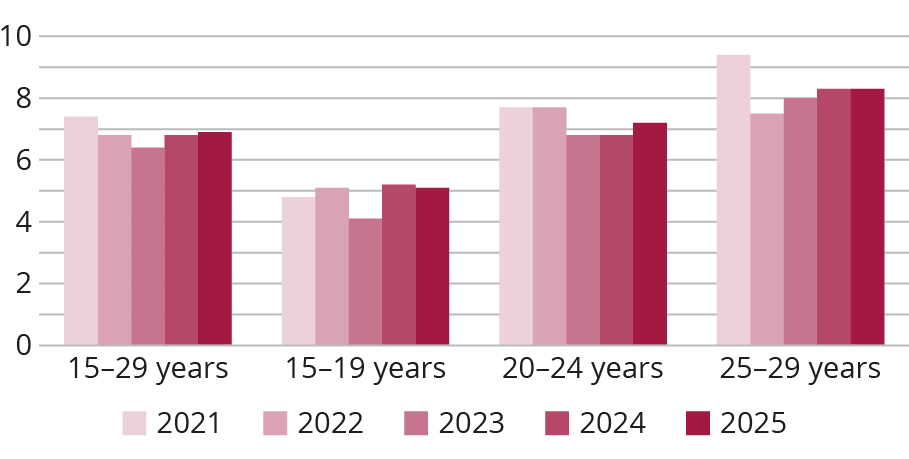
Source: Statistics Norway Labour Force Survey (LFS), 2026
Norway’s Challenges: Norway faces challenges related to an ageing population. To increase labour supply, more people outside the labour market must be mobilised, and more individuals must remain at work for a longer period.
Global Responsibility: Promoting free international trade, creating decent jobs and promoting worker’s rights, and strengthening support for vulnerable groups are key international priorities. Norway supports, among other initiatives, the Enhanced Integrated Framework and several developments programs under the International Labour Organization (ILO). Through its development mandate, Norfund is one of Norway’s most important instruments for job creation.
Main Policy Initiatives 2021–2026
- The Government has launched a packet of initiatives aimed at improving youth employment, collective referred to as the Youth Employment Initiative (‘Ungdomsløftet’).
- The Government announced in a White Paper on labour market policy that it would increase and improve the labour market measures to get more people into work and reduce the number of people on health benefits.
Assessment by Civil Society
The following organisations have participated in this assessment: Future in our hands (FIVH), Norwegian Forum for Development and Environment (ForUM), The Norwegian Federation of Organisations of Persons with Disabilities (FFO), The Norwegian Association of the Blind and Partially Sighted, Caritas Norway, Amnesty International Norway, The Norwegian Christian Counsil, The Association for International Water Studies (FIVAS).
Norway has succeeded in turning the Transparency Act into force. In 2022 the “Act relating to enterprises’ transparency and work on fundamental human rights and decent working conditions” became part of Norwegian law. This due diligence law requires all larger companies resident in Norway or larger foreign enterprises liable to tax to Norway to disclose information about their due diligence assessments to prevent, mitigate and remediate negative impacts on human and workers’ rights. In addition, the Act states that upon written request, any person has the right to information from an enterprise regarding how the enterprise addresses actual and potential adverse impacts pursuant to their due diligence assessments. This includes both general information and information relating to a specific product or service offered by the enterprise. The Act is a hallmark for human rights in global supply chains and a recent evaluation by KPMG (initiated by the Ministry of Children and Families) shows that the act has strengthened corporate governance regarding human rights and working conditions, that companies are achieving better oversight and more responsible purchasing practices, resulting in concrete actions like improved employment terms, and that businesses highly value the ability to focus efforts on areas with the highest risk of negative consequences. Norway has also incorporated article 27 in the CRPD and started initiatives to increase youth employment.
Norway’s challenge is still a lack of coherence between different policies related to SDG 8. For instance, there is a great concern that human rights, workers’ rights and environmental rights repeatedly lose out to trade interests when Norway negotiates trade agreements with countries where these rights are at serious risk. Nationally, there are vulnerable groups in Norwegian society who face exploitation in the job market. Government agencies have still limited resources to supervise businesses or regulate the market, creating opportunities for rogue actors to violate workers’ rights in order to maximise profits.
One of the most important challenges Norway is facing is how to increase labour market participation. At the end of 2024, 700,000 people of working age were outside employment and education. 114,000 young adults between the ages of 20 and 29 were outside employment and education. The employment rate is lower for people with disabilities than for the rest of the population. The proportion of young people in Norway receiving work assessment allowance and disability benefits is also higher than in other OECD countries. The absence of universal design in ICT can constitute a barrier to participation in the labour market. Universal design of ICT can contribute to increased employment among persons with disabilities.
Norway must:
- Protect and enact ambitious corporate responsibility legislation with due diligence in mandatory and gender-responsive human rights. Due diligence legislation should also include environmental risks, and the duty to inform consumers and any other enquirers on value chains and production sites. The current wave of de-regulation of human rights and environmental standards in EU must not undermine legislation in the same areas in Norway.
- Enact appropriate requirements for employers to ensure that all employees, including foreign workers, enjoy Norwegian standards of workers’ rights.
- Increase funding of governmental agencies, such as the Norwegian Labour Inspection Authority, to ensure that workers’ rights are respected and prevent worker exploitation.
- Implement stricter sustainability requirements for the Government Pension Fund Global’s investment policy, ensuring that companies breaching core ILO conventions are excluded from the fund.
- Include environmental sustainability standards and adherence to ILO core conventions in trade treaties.
- Ensure equality in the labour force for persons with special needs/disabilities and ensure that the resources and time allocated to accommodations are tailored to individual needs.
9 Industry, Innovation and Infrastructure
Government Assessment
|
9.1 |
Norway has a well-developed infrastructure that is accessible to everyone. However, it is challenging to protect this infrastructure from landslides and flooding. |
|
|
9.2 |
Norwegian industry and businesses have for many years been adapting in a more sustainable direction. |
|
|
9.3 |
The Norwegian capital market is considered relatively well-functioning, with most companies having good access to financing through banks and capital markets. Access to finance can be more challenging for small and medium-sized businesses, than for larger companies. |
|
|
9.4 |
Several measures are in place to reduce emissions from industry, including participation in the EU Emissions Trading System (ETS), and Enova’s efforts to reduce point-source emissions in industry. Emissions from passenger car traffic have declined in recent years. |
|
|
9.5 |
Norway has a high share of publicly funded research and development (R&D), but it is still far from reaching the goal of R&D investments amounting to 3% of GDP R&D expenditure as a proportion of GDP and R&D workers per 1 million inhabitants have declined. |
|
|
9.A |
Norway scores very highly on indicators such as access to a bank account and the use of digital payments. |
|
|
9.B |
Norway supports developing countries through the Alliance for digital public goods. More developing countries have joined the Alliance. |
|
|
9.C |
Over 99% of Norwegian households now have access to 5G networks, and overs 99% have access to high-speed broadband. |
|
General Status: Norway has a well-developed infrastructure for transport and digital network services. This is a prerequisite for a functioning society and a competitive and innovative business sector. In spring 2024, the Government presented the National Transport Plan 2025–2036. One of the government’s main measures in the transport plan is to shift resources in the upcoming planning period toward more operation and maintenance of infrastructure, and fewer investments. During the planning period, the Government’s approach is to take care of what we have, improve where possible, make better use of the capacity in both existing infrastructure and transport systems, and build new infrastructure where necessary.
Main Achievements: Over 99 percent of Norwegian households now have access to 5G networks, and over 99 percent have access to high-speed broadband. The Government’s goal is that all households and businesses should have access to high-speed broadband with at least 100 Mbps download speed by the end of 2025. The share of electric vehicles more than doubled from 2020 to 2024, and emissions from road traffic fell by 6.5 percent from 2023 to 2024.
Norway’s Challenges: Industry in Norway accounts for around 25 percent of the country’s total emissions, with a significant share coming from point sources. To reach climate targets, greenhouse gas emissions in industry must continue to be reduced. Participation in the EU Emissions Trading System (ETS) is the most important instrument to achieve this. The Government aims to contribute to increased value creation, facilitate profitable private investments, and support a more adaptable business sector.
Global Responsibility: Norway promotes digital solutions in developing countries to make data, such as ocean data, forest data, and health information systems more accessible. Open models for artificial intelligence should be a foundation for sustainable development. Norway supports the Global Digital Compact, adopted at the UN Future Summit on 22 September 2024. The Government also contributes to supporting investments in infrastructure—within energy, transport, and digitalisation including through core support to multilateral development banks such as the World Bank. Within innovation and entrepreneurship, Norway supports several incubators and accelerators active in Southern Africa.
Main Policy Initiatives 2021–2026
- White Paper, Meld. St. 16 (2024–2025) Industry – Competitiveness for a New Era, which outlines updated challenges and opportunities across the entire industrial sector.
Assessment by Civil Society
The following organisations have participated in this assessment: Norwegian Seafarers Union, Norwegian forum for Development and the Environment, The Association for International Water Studies (FIVAS), The Freight Transport Coalition of Norway – Towards a more sustainable freight system.
Norway has succeeded with initiatives for a rapid electrification of the carpool to reduce emissions from the transport sector and building digital infrastructure. Norway signed the Global Digital Compact in 2024 recognising the digital divide and the importance of digitalisation in societal development. Grant schemes facilitating business engagement in innovation and development projects have been a positive initiative for engaging businesses in the 2030 Agenda.
Norway’s challenge is that the long-term transportation plan proposed by the Government, National Transportation plan (NTP), in this period has not been efficient in building a sustainable transportation sector – both when it comes to building the infrastructure and how the new infrastructure affects the transport patterns in Norway. To reduce climate change and the destruction of nature, it is vitally important to make a modal shift from road to sea or railway in freight transport in Norway. Investment in already existing harbours could make sea freight more efficient and reduce the need to build new roads. By improving railways and terminals, it would be possible to increase freight transport capacity on the rail system without building new tracks. It remains to be seen if the latest NTP from 2025–2036 will make sufficient improvements regarding these challenges. Norway is dependent on importing medical specialists. Many newly approved specialists in Norway have received their specialty training in other Nordic countries or the EU. This is not sustainable in the long run and Norway should take a greater responsibility in educating the medical specialists we need. Norway is highly dependent on foreign medical companies for import of essential medical supplies in emergencies and lacks adequate production capacity to take a role in the current need for increased production of vaccines. There is also a need for more attention in medical research, innovation, and investment into addressing women’s health.
Internationally, Norway has been moving against regulations facilitating technology transfer in the e-commerce negotiations taking place in the WTO. Depriving countries in the global south the opportunity to transfer knowledge and technology from the multinational technology companies operating in these countries impedes the development of poor countries’ own digital industry.
Grant schemes financing innovation projects for sustainable development should not be used as a tool for promoting Norwegian business abroad but rather place emphasis on promoting innovation and transfer of competence to developing countries. Strict commercial requirements for Norwegian businesses in these schemes are a barrier for engaging companies in projects with considerable socio-economic benefits in developing countries.
Norway must:
- Change mode of freight transport from road to sea or rail by investing in the existing rail infrastructure and existing harbours to increase the capacity for freight transport and make it more efficient.
- Increase support to programs developing new ships that are all electric, hybrid or have hydrogen propulsion with strongly reduced climate emissions.
- Ensure better framework conditions for medical research and professional development, to ensure better quality and safety in health services provided.
- Build competence and domestic production capacity of critical medicines, infection control equipment and medical equipment, as well as strengthen Nordic and international cooperation to ensure better access.
- Focus on exporting the infrastructure and expertise we can offer to help the world’s poorest countries to benefit from new technology, such as broadband, cloud storage and server capacity, as well as supporting regional data centres.
- Support regulations in international trade agreements facilitating technology transfers to developing countries. Countries should have access to demand local storage of data collected domestically and leeway for regulation of their digital development.
- Adjust grant schemes for innovation and development projects to facilitate businesses’ engagement in sustainable development projects in partnership with NGOs.
10 Reduced Inequalities
Government Assessment
|
10.1 |
Income inequality in Norway is low, and in 2023 it was at roughly the same level as in 2014. The share of population with persistent low income has increased somewhat after 2010. Real wages fell in both 2022 and 2023 but increased in 2024. |
|
|
10.2 |
Norway has a high level of equality. However, challenges related to racism and discrimination are still present. |
|
|
10.3 |
The principles of equal opportunities and social mobility underpin the Norwegian welfare system. Social disparities in schools remain a concern. |
|
|
10.4 |
Several measures were implemented in the period 2021–2025 to increase redistribution through taxes and transfers. Taxes and duties contribute to financing public services, which also have an equalising effect. |
|
|
10.5 |
Banks have strengthened their solvency and liquidity. New regulations for bank crisis management have been implemented. |
|
|
10.6 |
Norway has supported increased representation of developing countries in decision-making processes in international economic and financial institutions. Norway supports the inclusion of participation from non-DAC countries in the work of OECD DAC. |
|
|
10.7 |
Norway has a well-functioning migration system that seeks to respond and adapt to challenges related to migration. |
|
|
10.A |
Norway provides duty-free and quota-free market access for least developed countries. |
|
|
10.B |
Norway remains among the leading providers of official development assistance relative to national income. Aid includes targeted support to least developed countries, fragile states and vulnerable groups, complemented by efforts to mobilise additional financing. One example is Norway’s contribution to IDA21, which amounts to over USD 5 billion for 2026–2028. |
|
|
10.C |
On 1 January 2025 the price for transfers to a sample of countries was about 1.9% of a payment of NOK 5 000 through banks and somewhat higher through other types of financial institutions. |
|
General Status: Norway is one of the countries in the world with the lowest social and economic inequality. This includes low-income inequality and generally high quality of life. Income inequality in Norway has increased somewhat over the past 30 years, but in 2023 it remained roughly at the same level as in 2014. 9.5 percent of the population (excl. students) had persistent low income in the three-year period 2022–2024. This share increased somewhat after 2010 but has declined slightly again following a peak in 2018–2020. The share of children living in low-income households has also decreased somewhat since the 2018–2020 period. Wealth inequality, however, remains high.
Main Achievements: The progressive tax system is a central tool for reducing income inequality in Norwegian society. Taxes and transfers help reduce income inequality by approximately 40 percent. The welfare system compensates for income loss due to illness, old age, and unemployment. Everyone has access to free education and universal health services.
Norway’s Challenges: The share of employed persons is relatively high in an international context. At the same time, many people remain outside the labour force and receive health-related benefits. The share of people receiving such benefits has increased significantly since before the pandemic. At the end of 2024, around 15 percent of the population aged 18–66 received either work assessment allowance or disability benefits.
Main challenges include keeping income disparities low and increasing labour market participation among vulnerable groups. Labour market participation among immigrant women, including Norwegian-born women with immigrant parents has increased, as shown in the figure below. However, immigrant women still have a lower employment rate than the rest of the female population. The number of children living in households with persistent low-income, particularly among families with an immigrant background and single parents, is concerning. Measures that can help prevent this include further adapting the education system to better support disadvantaged groups. The tax system and welfare schemes must also encourage value creation and participation in the labour market.
Figure 6.5 Employed Women by Immigration Category
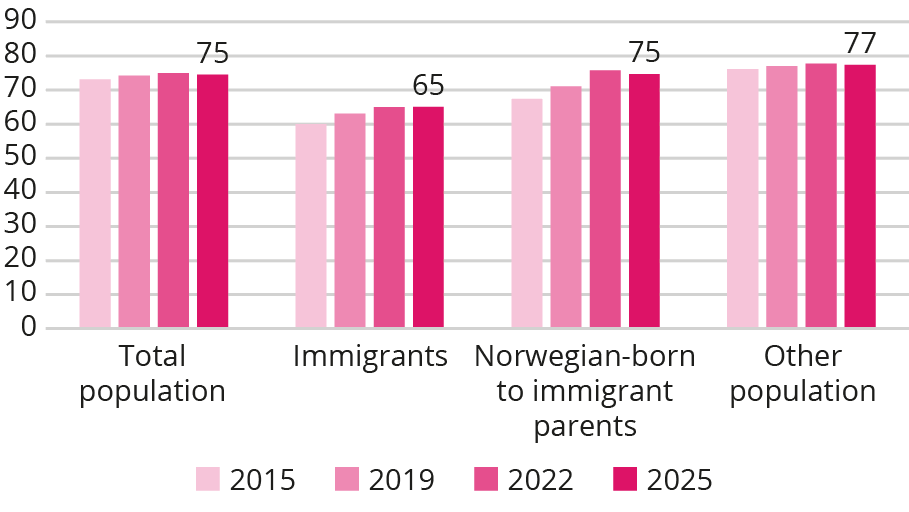
Source: Statistics Norway, table number 11711, 2026
Global Responsibility: Norwegian development policy aims to contribute to societal change by combating inequality and poverty, and by promoting economic development and welfare in developing countries. Human rights form a core foundation of Norwegian development assistance, emphasising participation, non-discrimination, gender equality and human dignity. Norway works to promote inclusive trade systems and tax rules, counteract illicit financial flows and corruption, and contribute to a fair distribution of burdens in the global response to climate change. In developing countries, Norway supports efforts to prevent and combat corruption, strengthen tax administrations, and promote inclusive welfare systems.
Main Policy Initiatives 2021–2026
Action plans:
- to Combat Anti-Muslim Racism 2025–2030.
- to Combat Harassment and Discrimination of the Sami 2025–2030.
- against Antisemitism 2025–2030.
- on Gender and Sexual Diversity 2023–2026.
- against Racism and Discrimination, renewed efforts 2024–2027.
- for Universal Design, extended until 2026.
Strategies:
- The Government is revising its Strategy for Equality for People with Disabilities.
Assessment by Civil Society
The following organisations have participated in this assessment: Tax Justice Norway, Debt Justice Norway, The Norwegian Forum for Development and Environment (ForUM), Norwegian Library Association, Press – Save the Children Youth Norway.
Norway has succeeded in maintaining a low level of economic inequality compared to many other countries. Norwegian society is characterised by high social trust, strong redistributive mechanisms, and universal access to essential welfare services. High employment rates, broad inclusion in the labour market, and robust social safety nets help prevent poverty and promote economic and social security. The Norwegian welfare state and tax system play a crucial role in reducing disparities through universal benefits and progressive taxation.
Internationally, Norway has contributed to strengthening other countries’ capacity to mobilise domestic resources by supporting fair taxation, combating tax havens, and advancing initiatives for sustainable development financing.
Norway’s challenges include several growing forms of inequality. Economic disparities in the housing market make it increasingly difficult for young people and lowincome households to enter or remain securely in the market. Labourmarket exclusion persists, particularly among young adults, immigrants, and people with healthrelated barriers. Rising prices and inflation affect lowincome groups disproportionately, while wealth and capital continue to concentrate at the top. At the same time, the tax system has become less progressive for highincome and highwealth groups, and social mobility appears to be stagnating. Additionally, the number of people living with persistently low income increased from 2023 to 2024, according to Statistics Norway.
Norway must:
- Take a leading role in the development and future implementation of the UN Framework Convention on International Tax Cooperation, ensuring that the perspectives and needs of developing countries are strongly prioritised.
- Implement a strong and comprehensive framework for countrybycountry reporting, including reporting from all jurisdictions, to address aggressive tax planning and reduce profit shifting to tax havens.
- Ensure more progressive taxation at the top of the income and wealth distribution in Norway.
- Strengthen measures to reduce labourmarket exclusion, particularly targeting young people, immigrants, and individuals with healthrelated barriers to employment.
- Pursue policies that counter widening housing inequalities and increase access to affordable and secure housing.
- Intensify efforts to reduce social health inequalities, including through preventive measures, accessible services, and strong universal welfare schemes.
- Ensure that social policies and welfare benefits adequately compensate lowincome households for rising living costs.
- Continue and strengthen international efforts to reduce global inequality, especially through fair taxation, debt sustainability initiatives, and development financing.
11 Sustainable Cities and Communities
Government Assessment
|
11.1 |
The housing market and rental market are under pressure. A record number of refugees have been settled in recent years. Low construction activity reduces the supply of affordable houses and drives prices up, making it harder for vulnerable groups to find and keep suitable housing. The number of homeless people is low but increasing. |
|
|
11.2 |
Norway has a well-developed public transport system in certain urban areas, but there are large differences both between cities and between urban and rural areas. All new transport infrastructure must be built with universal design. A key challenge in the transport sector is ensuring universal design in existing infrastructure and vehicles. |
|
|
11.3 |
The Planning and Building Act and how it is practiced need to be developed to meet ambitious goals related to climate change, nature management, and social challenges. |
|
|
11.4 |
There are well functioning management systems for cultural and natural heritage, but changes in land use and climate change put pressure on these resources. |
|
|
11.5 |
There are no complete overview of deaths and people affected by disaster in Norway. The numbers remain low and stable over time. Since 2015, the cost of natural hazard–related damages in Norway have increased significantly. The trend has accelerated in recent years, driven mainly by extreme rainfall, flooding, storms, and landslides. |
|
|
11.6 |
Urban settlements and cities periodically experience challenges with bad air quality that affect public health. |
|
|
11.7 |
Safe, open, and accessible areas for public use are relatively widespread. |
|
|
11.A |
The legal framework for regional planning is formalised in The Planning and Building Act. Furthermore, regional planning is emphasised in national expectations regarding planning and in the central government planning guidelines for land use and mobility. |
|
|
11.B |
The 2025 Municipal Survey shows that 99% of Norwegian municipalities report having a comprehensive risk and vulnerability analysis (ROS). There is a positive development in the number of municipalities with an updated ROS, however only 68 % of the municipalities meet all the minimum requirements for such analyses. |
|
|
11.C |
Norwegian support to least developed countries is channelled through multinational development banks and programs, including the World Bank, WTO and UNESCO, and UN-Habitat projects in Ghana and Mozambique. |
|

General Status: 83 percent of Norwegians live in cities and urban areas. More than 80 percent own their own home, but high prices are making housing less affordable. The majority experience a high standard of living with access to basic health and welfare services, waste management, transport systems, and good air quality. There is room for improvement for people with disabilities and strengthening crisis management in response to increased risk of floods, landslides, or pandemics.
Main Achievements: Cities and urban areas have low levels of air pollution, and local air quality has improved over the past decade. The number of people experiencing premature death due to road traffic emissions is among the lowest in Europe.
Norway’s Challenges: Increased risk of flooding, landslides, and heatwaves affects infrastructure and land use. Growing land-use pressures in built-up areas lead to more conflicts between development, protecting green spaces and outdoor areas, and managing climate-related risks, while increasing pressure on coastal areas, creates similar conflicts with nature, outdoor recreation, and climate adaptation needs. More remote areas are experiencing population decline combined with an increasing share of older residents.
Ensuring affordable, adequate, and accessible housing for low-income groups, older people, and people with disabilities is a challenge, particularly in larger cities, but also in rural municipalities where the housing supply may be limited. Low levels of housing construction over time, combined with rising prices and population growth, implies a need for increased housing construction, particularly in larger cities. Larger cities experience higher levels of air pollution. Some urban areas face challenges related to concentrations of poor socioeconomic conditions and crime.
Global Responsibility: Norwegian support for reducing emissions in cities and urban areas is channelled through the World Trade Organization, the World Bank, and the Climate and Clean Air Coalition. Norway is also an active contributor to UNESCO, both financially and through activities that support the implementation of the conventions Norway has joined – particularly the World Heritage Convention protecting cultural and natural heritage. Norway supports capacity building and the preservation of natural and cultural heritage globally through initiatives such as the World Heritage Leadership Programme, as well as measures promoting smart cities, climate adaptation, and improved living conditions for internally displaced people.
Main Policy Initiatives 2021–2026
- White Paper, Meld. St. 13 (2023–2024) The Housing White Paper, A Comprehensive and Active Housing Policy for the Whole Country.
- State Planning Guidelines for Land Use and Mobility – The purpose of the guidelines is to promote sustainable development through coordinating building of houses and infrastructure, reduced need of transport and strengthen public transport, biking and walking.
- The National Architectural Strategy Space for Quality (2025) defines national ambitions for varied neighbourhoods, a prudent use of resources, beautiful surroundings and enduring qualities.
- A new Cultural Heritage Act is currently being developed to better respond to contemporary challenges. The new act will replace the existing legislation from 1978.
- Sustainability and Equal Opportunities, A Universally Designed Norway (2021–2025) is extended to 2026.
Assessment by Civil Society
The following organisations have participated in this assessment: Habitat Norway (part of the Norwegian Housing and Planning Association), The Norwegian Federation of Organisations of Persons with Disabilities (FFO), The Freight Transport Coalition of Norway (Godsalliansen), GRID Arendal, Norwegian Housing Association (LBF), Norwegian Forum for Development and the Environment.
Norway has succeeded in local leadership and innovation. Larger cities such as Oslo, Trondheim, Stavanger, and Bergen have strengthened climate budgeting, expanded cycling infrastructure, piloted circular economy initiatives, and digital participation tools. These examples demonstrate the potential for transformative urban policy when political will and local capacity align. Research projects and other international planning initiatives are going in the right direction. Cities are engaged in larger projects, for example the EU-funded New European Bauhaus Stavanger and ReHousIn, which examines housing inequalities in Norway through case studies in three distinct types of areas. This research provides insights into housing challenges, policy responses, and the impact of economic, social, and environmental factors.
Public awareness on climate adaptation and the debate on nature loss and public participation has intensified. Some municipalities have improved ecological mapping, climate adaptation planning, and accessibility audits. Improved participation tools such as digital and hybrid participation platforms have expanded, enabling broader engagement from youth and minority residents who previously faced barriers to participation. Some cities have worked consistently with SDG localisation in recent years. These advances, however, remain isolated and dependent on local initiatives rather than national policy.
Norway’s challenges are many and civil society organisations observe that Norway has not made sufficient progress toward SDG 11 since 2021. The Nordic Sustainable Development Report (NSDR) 2025 presents Norway as a high overall SDG performer where SDG 11 is largely on track, but the CSO perspectives foregrounded here identify implementation gaps, governance incoherence, and the urban context of vulnerable groups in Norwegian cities, rather than the average national performance. While several municipalities continue to innovate, national policy remains fragmented, underfunded, and insufficiently aligned with the SDGs. Responsibilities are increasingly delegated to municipalities without adequate financial or technical support, undermining their ability to deliver sustainable, inclusive, and climate resilient urban development.
Urbanisation is accelerating globally, yet Norway’s domestic and international policies do not reflect the scale or urgency of urban challenges. While the Government published a national strategy on architecture in 2025, the lack of an equivalent or combined urban (and social housing) strategy continues to hinder coordinated action of the built environment and ensuring inclusion. Norway’s plan for the development of transport infrastructure (NTP – the National Transport Plan) is not sustainable. According to a report by The Norwegian Institute of Transport Economics, where the transition to a low-emission society requires a changed approach, the NTP process tends to deliver “more of the same”.
Norway must:
- Enhance support to international organisations advancing SDG 11, while promoting the global visibility and uptake of Norwegian best practices in sustainable urban development.
- Strengthen the capacity to absorb and apply international best practices in local planning.
- Ensure predictable and adequate municipal financing to address structural inequalities and strengthen participatory mechanisms.
- Close implementation gaps in climate and urban development policy, ensuring stronger alignment between targets and delivery.
- Align transport investments with climate and equity goals, and base transport planning on backcasting principles consistent with a low-emission society.
- Improve and integrate fragmented data systems across nature, housing, and accessibility to support evidence-based decision-making.
- Address the housing crisis through structural reforms, including affordability measures, a non-profit third housing sector, and a stronger focus on adaptation and reuse in urban areas as well as measures to combat homelessness.
- Strengthen multilevel governance and policy coherence, promoting integrated, cross-sectoral urban planning across land use, transport, housing, and climate.
- Advance inclusive, resilient, and nature-positive urban development, including participatory governance and scaled-up nature-based solutions.
- Leverage digitalisation, data systems, and knowledge exchange, alongside expanding sustainable and innovative financing mechanisms and circular economy approaches in cities.
- Deepen cooperation with cities in the Global South through partnerships, knowledge exchange, and joint urban innovation.
12 Responsible Consumption and Production
Government Assessment
|
12.1 |
Norway support 10YFP/One Planet Network. Published an action plan for the circular economy in 2024 and launched a national mission for circular economy in 2025. |
|
|
12.2 |
Material consumption per capita is far above the global and European averages. |
|
|
12.3 |
A 24% reduction in food waste was achieved in the period 2015–2024. |
|
|
12.4 |
The progress in the management of hazardous chemicals and waste is positive. However, there is still a need to strengthen regulations and measures. |
|
|
12.5 |
Norway has a high volume of waste compared with the EU and OECD. The amount of household waste has declined in recent years. |
|
|
12.6 |
The Transparency Act, introduced in 2022, has been evaluated to identify strengths and weaknesses. The EU’s Corporate Sustainability Reporting Directive (CSRD) has been implemented in Norwegian law. |
|
|
12.7 |
Legislative and administrative frameworks related to green and innovative public procurement are in place, including guidance for public purchasers. |
|
|
12.8 |
Sustainable development is integrated at all levels of education. |
|
|
12.A |
Norway supports developing countries’ scientific and technological capacity for sustainable consumption and production through funding to UNEP, the One Planet Network and the Global Environment Facility (GEF). |
|
|
12.B |
The Sustainable Destination label includes indicators that measure status, as well as performance indicators that require ongoing development and improvement for the destination to be re-certified. By 2026 the scheme includes 61 destinations and 158 municipalities. |
|
|
12.C |
Norway has no fossil-fuel subsidies. All combustion emissions from the use of mineral products are priced through a CO2 tax or EU ETS. |
|

General Status: Norway has a high standard of living and is among the countries with the highest material consumption in the world. Achieving more sustainable consumption is one of Norway’s main challenges in reaching the Sustainable Development Goals.
Main Achievements: The Government’s Action Plan for the Circular Economy (2024–2025) support the national transition to a circular economy. The new Act on Sustainable Products and Value Chains entered into force in 2024 and aims to promote more sustainable products tailored for a circular economy.
In February 2025, the National Citizens’ Panel submitted recommendations to the Government on reducing overconsumption. In May 2025, a national expert group launched its report, “Not Straightforward”, on instruments to promote a more circular economy. The Government launched a national mission for circular economy in 2025.
Norway’s Plastics Strategy (2021) aims to reduce plastic pollution and ensure sustainable use of plastic, the Action Plan for a toxic-free environment was revised in 2025, and the Action Plan for Climate- and Environment-Friendly Public Procurement and Green Innovation was revised the same year.
Norway’s Challenges: Sub-goals 12.2, 12.3, 12.5, and 12.6 have significant room for improvement. Norway is among the countries in the world with the highest material consumption per capita. Although substantial progress has been made, much work remains. Food waste remains high, natural resources must be used more efficiently, and waste volumes are still too large. The circular material use rate for Norway has remained stable at a low level over time. Further, the circular material use rate for Norway is generally lower than the Nordic countries and the EU average, as seen by the figure below.
Figure 6.6 Circular Material Use Rate, per cent
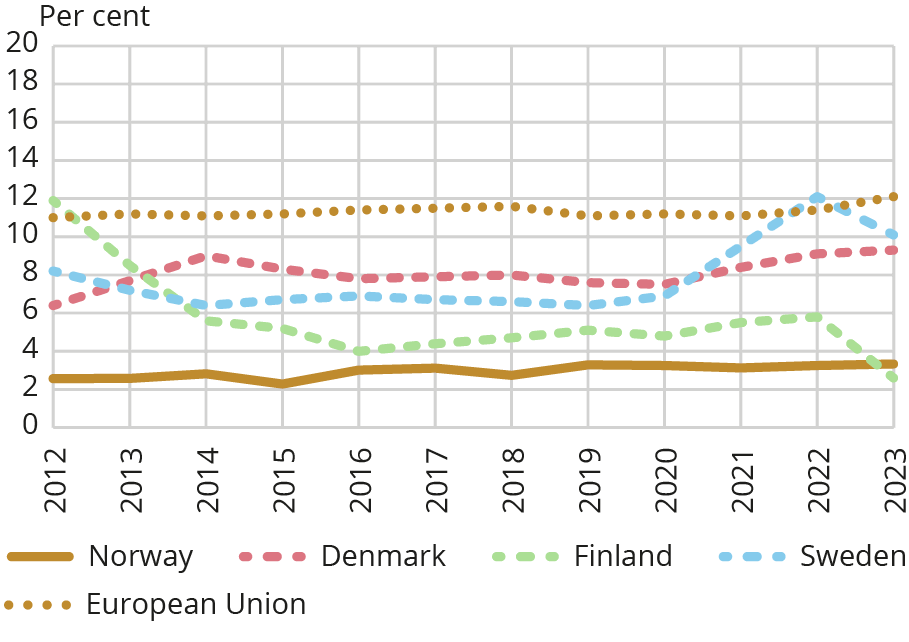
Source: Eurostat, Statistics Norway, 2024
Global Responsibility: Internationally, Norway supports several initiatives that aim to protect the environment and prioritise sustainable production and consumption. Norway is working toward an ambitious globhal agreement on plastic pollution and co-leads, together with Rwanda, a coalition of 76 countries pushing to raise the level of ambition in negotiations. Norway is a strong advocate for phasing out hazardous substances and strengthening international regulations on the control of chemicals that pose risks to health and the environment. In the period 2026–2029, UN member states, including Norway, have decided that the UN Environment Programme should prioritise sustainable consumption and production, including through circular approaches.
Main Policy Initiatives 2021–2026
- National Action Plan for the Circular Economy (2024).
- National Mission for Circular Economy (2025).
Assessment by Civil Society
The following organisations have participated in this assessment: The Norwegian Forum for Development and Environment (ForUM), Association for International Water Studies (FIVAS) Changemaker, Debt Justice Norway, Norwegian Azerbaijanis’ Youth Organization (NAYO), The future in Our Hands (FIVH), WWF Norway.
Norway has succeeded instrengthening its policy framework for the circular economy. Following the national strategy of 2021, the Government launched a Circular Economy Action Plan in 2024 and a national circularity mission in 2025, creating a more coherent foundation for systemic change. An expert group for the circular economy was also established in 2025 and has made several recommendations for circular measures that are now under consideration. Norway continues to maintain stable systems for hazardouswaste management and reporting, fulfilling international obligations under multilateral agreements. Updated national data show hazardous waste generation at 303 kg per capita in 2023, indicating consistent monitoring across sectors. The national recycling rate reached 40.9 percent in 2023, supported by wellfunctioning systems for glass and metal recycling and high collection rates through the depositreturn scheme for singleuse beverage containers. These remain strong pillars in Norway’s waste system. Circularity analyses also indicate early signs of reduced fossilfuel use and increased use of secondary materials in parts of the economy, although these improvements have not yet substantially increased the country’s overall circularity rate.
Norway’s challenge is thatNorway continues to have one of the world’s highest levels of resource consumption. The national material footprint increased by 6 percent between 2018 and 2022, reaching 208 million tonnes, of which 77 percent is imported. This shifts environmental burdens abroad and increases exposure to geopolitical and supply-chain instability. The country remains among Europe’s least circular economies. Norway is 2 percent circular according to the 2025 Circularity Gap Report, while earlier assessments showed 2.4 percent, both significantly below European averages. A growing majority of Norway’s consumptionbased emissions now occur outside its borders. According to the latest figures, 71 percent of emissions from goods and services consumed in Norway take place abroad, up from 66 percent in 2018, demonstrating the limitations of territorialbased climate accounting. Municipal waste generation remains high. Since 2016, municipal solid waste has exceeded 700 kg per capita, far above the EU average of 513 kg in 2022. Changes in reporting practices partly explain this increase, but the underlying trend still reflects a highconsumption society. Food waste remains substantial. In 2021, total food waste was estimated at around 450,000 tonnes, with the grocery sector alone responsible for more than 60,000 tonnes and significant untapped potential for feed and biogas conversion. Nordiclevel assessments show stagnation. The Nordic Sustainable Development Report (2025) identifies persistent challenges under SDG 12 across the region, and international benchmarking through the 2025 SDG Index highlights Norway’s notably high environmental spillover impacts.
Norway must:
- Prepare and implement binding measures under the 2024 Circular Economy Action Plan, ensuring strong incentives for reuse, repair, sharing and extended product lifetimes.
- Integrate consumptionbased emissions into national planning and indicator systems, given that most emissions now occur abroad.
- Develop national reduction targets for the consumption- and material footprint indicators that Norway is reporting on to EU.
- Move from voluntary to legally binding targets to reduce food waste, while scaling infrastructure for feed and biogas conversion.
- Strengthen consumer rights and circular markets by ensuring access to spare parts, the right to repair and minimum requirements for product durability.
- Reform the tax system to incentivise circular consumption models such as leasing, reuse and sharing, while discouraging resourceintensive consumption.
- Use public procurement strategically to accelerate the transition to circular and nontoxic material cycles.
- Restore and expand publicly accessible chemicalinformation systems to support safe consumer choices.
13 Climate Action
Government Assessment
|
13.1 |
Norway is relatively resilient and has strong capacity to adapt to climate change and natural disasters. Climate change will create a greater need for climate adaptation in the years ahead, and costs are expected to rise. |
|
|
13.2 |
Climate measures are integrated into national policies and strategies. A large share of emissions in Norway is covered by economic instruments. Emissions are regulated through the Pollution Control Act, standards, agreements, and subsidies for emission-reducing measures. |
|
|
13.3 |
The Government is working to make society less vulnerable to climate change, including by making knowledge available to municipal authorities and other stakeholders, for example through Klimatilpasning.no. |
|
|
13.A |
Norwegian climate finance totalled around NOK 18.7 billion in 2024. The Green Climate Fund (GCF) is fully operational, and Norway has provided about USD 1 billion to its capitalisation. |
|
|
13.B |
GCF’s Readiness Programme has a particular focus on LDCs and SIDS. Norway contributes to this through its strong and reliable support to GCF. Norway supports capacity building for participation in negotiations to LDCs and AOSIS through UNDP. Women are prioritised. Norway is a strong and reliable supporter of Global Environmental Facility (GEF) that supports Enhanced Transparency Framework (ETF) through Capacity-Building Initiative (CBIT). |
|
General Status: Follow-up of the Paris Agreement is the foundation for achieving Goal 13. Norway’s climate target for 2030 under the Paris Agreement is to reduce total greenhouse gas emissions by at least 55 percent compared with the 1990 level. This target is enshrined in the Norwegian Climate Change Act. The Government intends to continue its climate cooperation with the EU and is working on the basis that the 2030 target under the Paris Agreement will be achieved in collaboration with the EU. If necessary, Norway will use voluntary cooperation under Article 6 of the Paris Agreement to fulfil the part that goes beyond what is achieved through the climate cooperation with the European Union.
As a Party to the Paris Agreement, Norway submitted a new, strengthened climate target for 2035. In LegislativeProposition 129 L (2024–2025) Amendments to the Climate Change Act (Climate Target for 2035), the Government proposed that the new target should be to reduce emissions by at least 70–75 percent compared to 1990 levels. This was adopted by the Norwegian Parliament in June 2025 and enshrined in the Climate Change Act. Norway plans to fulfil the climate target for 2035 through domestic measures and in cooperation with the European Union in accordance with Article 6 of the Paris Agreement. If deemed necessary, achievement of the target can be supported by Internationally Transferred Mitigation Outcomes (ITMOs) acquired outside the European Economic Area (EEA).
Norway has a legally binding target of becoming a low-emission society by 2050. This means that by 2050, Norway must reduce greenhouse gas emissions by 90–95 percent compared with 1990 levels. In assessing target achievement, the effects of the EU Emissions Trading System (ETS) must be considered.
Main Achievements: In 2024, Norwegian greenhouse gas emissions totalled 44.6 million tonnes of CO2 equivalents. This is about 21 percent below the peak in 2007, and a reduction of 12.6 million tonnes since 1990. However, Norway’s cooperation with the EU means that Norwegian emissions cannot be assessed in isolation. The climate effect of Norway’s participation in the three pillars of the EU climate framework must also be included: the Effort Sharing Regulation, the Emissions Trading System, and the LULUCF regulation for forestry and land use. The instruments used to reduce emissions are described in the Government’s Climate Status and Plan and in the Climate Report.
Norway has governance systems for both climate mitigation and climate adaptation, aimed at ensuring better coordination between sectors, the development of national climate vulnerability assessments, updates to the adaptation policy, reporting, and regular evaluation of progress. The Government’s Climate Status and Plan outlines how Norway will fulfil its climate commitments for 2030.
Norway’s Challenges: Emission projections show that with the continuation of existing policies, emissions in 2030 are expected to be about 26 percent lower than in 1990. The projection is uncertain and does not reflect the Government’s targets or the effects of new climate policies but shows that more action is needed to reach the 2030 target. The Government’s Climate Status and Plan for 2026 shows that planned policies are expected to further reduce emissions. The plan demonstrates how Norway, through a combination of existing policies, strengthened measures, and flexible mechanisms, can reduce emissions covered by the Effort Sharing Regulation by 50 percent by 2030.
Global Responsibility: Support for climate action is a high priority in Norwegian foreign, development, and climate policy. At the Glasgow Climate Summit in 2021, Norway announced its goal to double climate finance to NOK 14 billion annually by 2026 at the latest, including mobilised private capital. Within this framework, support for climate adaptation is to be at least tripled. Norwegian climate finance amounted to approximately NOK 18.7 billion in 2024. Financing international climate action is becoming increasingly important for achieving the goals of the Paris Agreement, and Norway contributes through multilateral, regional, and bilateral partners.
The International Climate and Forest Initiative is Norway’s largest international climate effort. The initiative aims to reduce and reverse the loss of tropical forests, contributing to a more stable climate, biodiversity conservation, and sustainable development. In 2022, the Government established a new Climate Investment Fund, managed by Norfund. The fund aims to invest in renewable energy in developing countries with high emissions from coal and other fossil power production. In the period 2022–2024, the fund helped finance 7.9 GW of renewable capacity, which will avoid 17.6 million tonnes of CO2 annually when the power plants are operational.
Main Policy Initiatives 2021–2026
- White Paper, Meld. St. 26 (2022–2023) A Changing Climate – Together for a Climate-Resilient Society.
- White Paper, Meld. St. 27 (2023–2024) A Safer Future – Prepared for Floods and Landslides.
- The Government established an expert committee in July 2024 to gather more knowledge about the economic consequences of climate change in Norway. The report will be published before 1 July 2026.
- White Paper, Meld. St. 25 (2024–2025) Climate Report 2035 – Towards a Low-Emission Society.
Assessment by Civil Society
The following organisations have participated in this assessment: The Norwegian Forum for Development and Environment (ForUM), The Development Fund, WWF Norway, Association for International Water Studies (FIVAS), FFO, Save the Children Norway, Changemaker, Debt Justice Norway, Norwegian Azerbaijanis’ Youth Organization (NAYO).
Norway has succeeded incontinued strengthening of climate policy instruments, including raising CO2 taxes and maintaining incentives for zeroemission vehicles, which remain supported by tax exemptions and reduced road tolls. Climate targets have been revised and anchored in the Climate Change Act, which now specifies at least 55 percent emission reduction by 2030, 70–75 percent reduction by 2035, and 90–95 percent reduction by 2050. These binding targets were formally incorporated through legislative amendments adopted in 2025. Norway has also proposed a 70–75 percent reduction for the Nationally Determined Contribution to be included in the Climate Change Act, ensuring longterm alignment with the Paris Agreement. Norway has strengthened its national preparedness through the adoption of the Total Preparedness Report.
Norway’s challenges are struggles to establish coherent climate policies. While some sectoral climate measures are strong, Norway remains a major producer and exporter of oil and gas. Fossil fuel exports generate downstream emissions more than ten times Norway’s domestic emissions, actively contributing to climate change and undermining domestic efforts. Progress on domestic emission reductions has been slow. In 2024, Norway emitted 44.6 Mt CO2eq, representing only a 12.8 percent reduction relative to 1990. Emissions remain far above the trajectory required to reach the 2030 target of a 55 percent reduction and 2035 target. Reaching this target therefore means purchasing more international carbon credits, instead of transformative emissions cuts across sectors such as oil and gas, transport, and industry. Norway has not yet met its COP26 pledge to triple climate adaptation finance by 2026. An independent evaluation by the National Audit Office of Norway in late 2025 found that, although adaptation finance had increased, Norway still lacked both a complete overview of results and evidence that adaptation funding was being scaled sufficiently to meet the tripling commitment. At the same time, Norway has exceeded its 2023 pledge to double total climate finance, reaching NOK 16.5 billion in 2023, surpassing the COP26 doubling target of NOK 14 billion by 2026. However, the distribution of funds remains uneven: Mitigation receives a disproportionately large share, while adaptation and lossanddamage finance lag behind, according to the Ministry of Foreign Affairs and the Norwegian Environment Agency.
Yet the Total Preparedness Report does not explicitly mention vulnerable groups. This creates a risk that people in vulnerable situations will not be sufficiently protected.
Norway must:
- Develop a national plan for phasing out oil and gas in Norway and support a global roadmap on phasing out fossil fuels.
- Achieve the 2030 target through real domestic emissions reductions, not international offsets, while contributing its fair share of climate finance.
- Increase climate finance, particularly for adaptation, in line with Norway’s historical responsibility and its Baku-climate goal of tripling adaptation finance by 2035.
- Increase climate finance to low-income countries to a level which meets Norway’s fair share of support to climate action based on its historical contribution to global warming, and meet its commitment to a 50/50 split between finance to adaptation and mitigation.
- Redirect investments from oil and gas extraction toward renewable energy, energy efficiency and sustainable industry development.
- Cease new oil and gas exploration and reform the petroleum tax system, phasing out subsidies and tax benefits that promote unprofitable or emissionsintensive fossilfuel projects.
- Transform food production and consumption, reducing agricultural emissions and environmental impacts both domestically and globally.
- Integrate a clear human rights and gender equality perspective into all climate and preparedness work, with explicit measures for vulnerable groups.
14 Life Below Water
Government Assessment
|
14.1 |
Norway has implemented measures to prevent and reduce marine litter and microplastics from land-based sources, but data remains limited. Pollution levels are reported to be stable or declining in Norwegian marine areas. |
|
|
14.2 |
Norway pursues a comprehensive approach to ocean and coastal management that promotes the conservation and sustainable use of marine ecosystems and supports a sustainable ocean economy. |
|
|
14.3 |
The Government is working to make society less vulnerable to climate change, including by making knowledge available to municipal authorities and other stakeholders. |
|
|
14.4 |
The majority of commercial Norwegian fish stocks remain above the precautionary biomass level. |
|
|
14.5 |
Norway continues efforts to conserve important marine areas. Approximately 4.5% of Norway’s marine areas fall under protected areas, national parks, and conservation zones. |
|
|
14.6 |
No subsidies are provided to illegal, unreported, or unregulated (IUU) fishing. The World Trade Organization’s Agreement on Fisheries Subsidies entered into force September 2025 and implementation is underway according to its provisions. |
|
|
14.7 |
Norway supports small island developing states in implementing UNCLOS, building ocean-management capacity, combating IUU fishing, and adapting to climate change. |
|
|
14.A |
Norway provides extensive ocean-related development assistance that strengthens scientific knowledge, research capacity and marine technology transfer in developing countries, in particular small island developing states and least developed countries. Norway supports IOC’s secretariat and through Norad support is also given to IOC’s capacity development programs and to the UN Decade for Ocean Science. In 2025 the Government launched the large programme Arctic Ocean 2050 (NOK 100 million annually for 10 years, 18 institutions). |
|
|
14.B |
Norway supports the implementation of the Voluntary Guidelines for Small Scale Fisheries and related initiatives that promote human-rights-based, gender-equitable and climate-resilient small-scale fisheries, ensuring that small-scale fishers, fish workers and their communities are recognised, supported and included in sustainable food systems. |
|
|
14.C |
Norway has ratified the Agreement under UNCLOS on the Conservation and Sustainable Use of Marine Biological Diversity in Areas beyond National Jurisdiction (BBNJ Agreement). Norway also co-chairs the High-Level Panel for a Sustainable Ocean Economy (Ocean Panel) where one main goal is working towards sustainably managing 100% of the ocean area under members’ national jurisdiction. |
|
General Status: The ecological quality of Norwegian coastal waters and large parts of Norway’s marine areas is good. However, the oceans are affected by climate change and rising sea temperatures. Extensive regulations have been implemented to ensure sound management of marine areas, and monitoring of the ecological and chemical status of coastal waters has increased significantly in recent years. The Government will present updated management plans for Norway’s marine areas to Parliament in 2028.
Main Achievements: The Government has implemented measures to prevent and reduce marine litter and the spread of microplastics into the ocean. Enhanced fisheries control is also being established. As of 1. January 2024, new sampling requirements for industrial catches were introduced, which will lead to more accurate reporting of species composition in fisheries.
The Government aims to ensure that a representative selection of marine nature is conserved. To date, 23 marine protected areas have been established to safeguard areas representing important natural values and high biological productivity, along with four national parks that also include extensive marine zones.
Fisheries management has implemented measures to protect resources, for example through bans on certain types of gear, seasonal fishing restrictions, opening and closing of fishing grounds, and area-based regulations. In total, such area-based measures under fisheries legislation cover 44 percent of Norway’s Exclusive Economic Zone. Norway invests heavily in research, infrastructure, mapping, and monitoring of marine areas. The use of antibiotics in the Norwegian aquaculture industry has remained at a consistently low level in recent years.
Norway’s Challenges: Some marine areas still face challenges due to impacts from climate change, eutrophication, poor status of certain species, and the spread of invasive species. Data remains limited regarding the presence and impact of plastic pollution and microplastics on ecosystems and species in Norway. Climate variability in the oceans may also lead to new challenges, including in the management of living marine resources.
The aquaculture industry in Norway still faces challenges, and sea lice remain as one of the most significant. Sea lice increase mortality in farmed salmon and pose a threat to wild salmon populations. The use of chemical treatments against sea lice has been greatly reduced in recent years, largely because increasing resistance has limited their effectiveness. The aquaculture farms also release nutrients into the marine environment. However, due to strong water exchange along the Norwegian coast, the risk of substantial negative environmental impact is generally considered low.
Global Responsibility: Norway places strong emphasis on compliance with international agreements and conventions and contributes to a sustainable and inclusive ocean economy. This includes participation in the High-Level Panel for a Sustainable Ocean Economy, active engagement in the Fisheries Committee (COFI) of the FAO and the Regional Fisheries Management Organisations, work within the International Maritime Organization (IMO), and the Blue Justice Initiative, which assists member states in implementing the Copenhagen Declaration against transnational organised crime in the global fishing industry. Norway also attaches great importance to the ambitious implementation of the BBNJ Agreement, to which Norway is a Party, and will engage positively in the negotiations leading to the first Conference of the Parties in 2027.
Through the Fish for Development and Ocean for Development programmes, Norway supports partner countries in building knowledge, institutions and capacity for integrated ocean management, sustainable fisheries, marine pollution control and climate adaptation at sea. The programmes have a strong focus on small island developing states and least developed countries, and contribute to implementing international ocean commitments, including the SDGs and the UN Decade of Ocean Science. Norway is also an active member of UNESCO’s Intergovernmental Oceanographic Commission (IOC).
Main Policy Initiatives 2021–2026
- White Paper, Meld. St. 24 (2024–2025) on the Future of the Aquaculture Industry.
- White Paper, Meld. St. 8 (2024–2025) on Animal Welfare.
- White Paper, Meld. St. 21 (2023–2024) Norway’s Integrated Ocean Management Plans.
Assessment by Civil Society
The following organisations have participated in this assessment: Norwegian Society for the Conversation of Nature, NOAH – For animal rights, Rainforest Foundation Norway, The Development Fund, WWF Norway, The Association for International Water Studies (FIVAS), Norwegian forum for Environment and Development.
Norway has succeeded in integrated ocean management plans for the Barents Sea, the Norwegian Sea, and the North Sea, with generally good environmental status in large areas, supported by monitoring and regulation. Biodiversity integration in sea-use planning is supported by new tools and data, including national ecosystem accounts from 2026 and a pilot on marine ecosystem accounting around the Lofoten archipelago. Norway contributes to global ocean governance and fisheries management through multilateral processes and conventions. Biodiversity mainstreaming in sectoral ocean policies includes regular reporting to Parliament on fisheries agreements. Marine litter reduction efforts indicate declining plastic pollution in parts of the coast. Water management plans have been adopted for coastal waters in line with the EU Water Framework Directive, supporting more systematic protection of coastal ecosystems. The opening of deep-seabed mining on the Norwegian continental shelf has been temporarily halted due to public concern and major knowledge gaps regarding environmental consequences. Area-based fisheries measures protect vulnerable marine habitats, including closures to bottom trawling in coral areas and three large non-fishing areas in the Oslofjord.
Norway’s challenges include significant pressures on marine biodiversity and ecosystems. Climate change and ocean warming are increasing stress on marine ecosystems and complicating the management of living marine resources. Nutrient pollution from agriculture and municipal wastewater remains a challenge in many coastal areas. Government reporting indicates that nutrient loads to the sea have increased since 1990, largely driven by aquaculture, with high nitrogen and phosphorus emissions from fish farming. Discharges of chemicals and oil from activities on the Norwegian continental shelf continue. Marine protection remains limited. Only around 4.2 percent of sea areas under Norwegian jurisdiction are formally protected, and progress has been slow due to competing interests. Fisheries and aquaculture continue to create pressures. Ghost gear from the fishing industry remains a major problem, and stronger prevention, retrieval, and reporting systems are needed. Fish stocks are under pressure due to overfishing, climate change, and insufficient ecosystem-based management. Aquaculture remains a major source of pollution and ecological pressure, associated with disease, salmon lice affecting wild salmonids, genetic interactions with wild stocks, and animal welfare concerns. Protection of marine wildlife remains a challenge. Seabirds are affected by habitat degradation, overfishing, disturbance, and disease, and current measures remain insufficient. Marine mammals face multiple pressures, including climate change and pollution; seals are hunted despite their red-listed status for several populations, and commercial sealing remains subsidised. Whaling continues despite the International Whaling Commission’s moratorium, raising concerns regarding policy coherence and biodiversity commitments. Despite the current pause, plans for deep-seabed mining remain controversial given major knowledge gaps. Across marine and coastal governance, knowledge gaps remain, including insufficient data and tools to track ecosystem condition and cumulative impacts over time.
Norway must:
- Implement a national marine protection plan to meet the 30 percent target by 2030, and ensure MPAs are representative, well managed, and enforced.
- Strengthen prevention and retrieval of abandoned or lost fishing gear (ALDFG/ghost gear) and reduce marine litter and microplastics.
- Reduce nutrient pollution from agriculture and municipal wastewater.
- Strengthen regulation of aquaculture to reduce environmental impacts, protect wild salmonids, and improve fish welfare.
- Ensure ecosystem-based management across fisheries, aquaculture, and coastal planning based on independent science.
- Phase out subsidies and practices harmful to marine and coastal ecosystems.
- Strengthen protection of seabirds and vulnerable marine mammals, including ending hunting or culling of red-listed populations.
- Maintain the halt on deepseabed mining and refrain from reopening it until robust scientific knowledge and precautionary safeguards are in place.
15 Life on Land
Government Assessment
|
15.1 |
Plans for the conservation of ecosystems are on the right track, as are plans for the restoration of freshwater-based ecosystems. Criteria for sustainability and measures for the restoration of other ecosystems are under development. |
|
|
15.2 |
Thirty-seven percent of Norway’s land area is covered by forest, of which nearly 100% is certified under global forest management certification systems. Measures are being implemented to reduce deforestation. The Government has established the following targets for forests in Norway: Forests areas protected under the Nature Diversity Act will have ecological status close to natural condition by 2050. In other forests areas, ecological status will be improved by 2050, measured using the directorates’ indicators, while there is active and sustainable forestry on economically viable land, and the competitiveness of the forestry industry is safeguarded. |
|
|
15.3 |
Norway has a national soil protection strategy with targets for maximum land conversion, and the loss of cultivated and cultivable land has remained within national targets in recent years. |
|
|
15.4 |
Thirty-four percent of Norway’s mountain ecosystems are protected areas. A quality norm for wild reindeer has been established and a separate White Paper, presented in 2024, defines targets and measures to safeguard and improve the state of the 24 wild reindeer areas in the mountains of Southern Norway. Action plans are to be developed for the specific wild reindeer areas. |
|
|
15.5 |
Legislation for nature conservation and comprehensive land management is in place, and the updated Action Plan for Biodiversity introduces more holistic and systematic policies. |
|
|
15.6 |
National regulations enabling fair and equitable benefit-sharing have been implemented. Norway makes annual contributions to the Benefit-Sharing Fund of the International Treaty on Plant Genetic Resources for Food and Agriculture. |
|
|
15.7 |
National and international legislation has been implemented to end poaching and the trade of protected species, for example in accordance with CITES. |
|
|
15.8 |
Regulations governing the introduction and spread of invasive alien species are in place, and an action plan to combat invasive species has been adopted. Nevertheless, several alien species continue to establish themselves at a rapid pace. |
|
|
15.9 |
Biodiversity values are integrated into national and local planning processes. |
|
|
15.A |
The Norwegian Climate and Forest Initiative is extended until 2035. Norway will strive to mobilise new resources globally, in particular from the private sector. Norway will strive for more synergies between climate finance and nature finance to more efficiently and effectively achieve targets in both fields. Norway continues to provide substantial funding to the Global Environment Facility. |
|
|
15.B |
Norway has continued to provide substantial support to tropical forest countries and relevant partners to reduce deforestation and forest degradation through Norway’s International Climate and Forest Initiative. |
|
|
15.C |
The Norwegian Environment Agency and others are continuously working to strengthen information and awareness-raising, as well as on the supervision of compliance with the CITES regulation. Norway works to ensure that environmental and cultural heritage crime is on the agenda in relevant international forums and to strengthen the efforts aimed at combating environmental crime in aid programmes and development partnerships. Through the Law Enforcement Assistance Programme, implemented by Interpol and UNODC, Norway supports capacity building, enhanced investigation and prosecution of forest crime in key tropical forest countries. |
|
General Status: Significant measures have been implemented to safeguard ecosystems through knowledge-based management. The Government considers that extensive new protected areas are not necessary, but that forest protection should be expanded in line with the Parliament’s target of protecting ten percent of forests. In other ecosystems, limited protection is needed for certain habitat types that are currently not sufficiently safeguarded within existing protected areas.
Main Achievements: Comprehensive legislation for the sustainable use and conservation of nature is in place through the Planning and Building Act, regulations on environmental impact assessments, the Nature Diversity Act, and sectoral laws such as the Water Resources Act and the Forestry Act. Approximately 17.7 percent of mainland Norway is protected under the Nature Diversity Act—equivalent to 25.7 percent of the land area when protection on Svalbard and Jan Mayen is included. In 2024, the Government presented targets for the ecological condition of forests and a menu of measures to achieve these. The Government will also present a menu of measures for mountain ecosystems, and semi-natural ecosystems. Around 75 percent of rivers and lakes are classified as having good or very good ecological status under the Water Regulation. Work on soil mapping and soil conservation has contributed to strong national knowledge of soil resources.
Norway’s Challenges: Land use and changes in land use are the greatest threats to the conservation and sustainable use of terrestrial ecosystems nationally, along with climate change, the spread of invasive alien species, and pollution. Protecting threatened species and habitats is challenging, and the negative impacts of climate change on biodiversity exacerbate these challenges. An important challenge is to ensure that considerations for biodiversity are integrated into regional and municipal plans, and into the processing of cases under sectoral legislation. Long-term and sustainable management of soil resources, safeguarding cultivated and cultivable land and protecting soil as a resource remain major challenges.
Global Responsibility: In 2024, Norway contributed NOK 4.9 billion to initiatives aimed at conserving biodiversity, either as a primary objective or as a secondary goal. This represents nearly a doubling compared with disbursements in 2015. Since 2008, Norway has taken a leading role in efforts to halt and reverse deforestation and forest degradation in tropical countries through Norway’s International Climate and Forest Initiative. Reducing forest loss is essential to stopping the decline in biological diversity. Norway’s International Climate and Forest Initiative amount to NOK 3.5 billion for measures to conserve biodiversity within the tropical forest belt in 2024.
Main Policy Initiatives 2021–2026
- White Paper, Meld. St. 35 (2023–2024) Sustainable Use and Conservation of Biodiversity.
- White Paper, Meld. St. 18 (2023–2024) on Wild Reindeer was presented in 2024, and a quality norm for wild reindeer has been established.
Assessment by Civil Society
The following organisations have participated in this assessment: Norwegian Society for the Conversation of Nature, NOAH – For animal rights, Rainforest Foundation Norway, The Development Fund, WWF Norway, The Association for International Water Studies (FIVAS), Norwegian forum for Environment and Development.
Norway has succeeded in establishing a strong legal and governance framework for nature management, including the Nature Diversity Act and a planning system that supports biodiversity across sectors. These frameworks are complemented by updated national planning guidelines for land use and mobility, adopted in 2025, that strengthen biodiversity and climate considerations. Terrestrial protected areas have expanded. Around 25.7 percent of the country’s total land area (including Svalbard and Jan Mayen) is protected, corresponding to around 17.8 percent of mainland Norway, including recent voluntary forestprotection expansion. Targeted measures for species and genetic resources are in place. Legal and administrative frameworks for access and benefit-sharing have been established under the Nagoya Protocol and the International Plant Treaty (ITPGRFA). Efforts to conserve genetic resources include the Svalbard Global Seed Vault and national support schemes, and several native livestock breeds are no longer critically endangered. Internationally, support for tropical forest conservation and Indigenous Peoples’ rights is provided through the International Climate and Forest Initiative and annual contributions to the Benefit Sharing Fund under the ITPGRFA. Finally, selected invasive alien species have been controlled in specific areas through eradication and containment, while the knowledge base for nature management has been strengthened through monitoring. Targeted conservation measures have supported Arctic fox recovery through captive breeding, releases, supplementary feeding, and monitoring.
Norway’s challenges include continued biodiversity loss and ecosystem degradation, primarily driven by land-use change. Government reporting notes that land-use change affects around 90 percent of threatened species, and 21 percent of assessed species appear on the Norwegian Red List (2021). Habitat loss, fragmentation, and pressures from forestry and land development remain central drivers. The Nature Index 2025 shows declining trends in wetlands, cultural landscapes, and open lowlands, and highlights that cumulative impacts are decisive for ecosystem vulnerability, aggravated by climate change. Protection gaps remain. While overall protection levels are high due to extensive protection on Svalbard, lowland ecosystems and forests remain poorly protected. Government reporting indicates that only 5–6 percent of productive forests are protected, and management of protected areas is increasingly demanding due to vegetation encroachment, invasive species, and rising visitor pressure. Forest and land management practices are not sufficiently aligned with biodiversity and climate resilience. Civil society is concerned about intensive forestry practices, including large-scale clear-cutting and monocultures, continued declining carbon stocks, and naturenegative incentives. Semi-natural habitats face particularly serious pressures; all types are endangered or critically endangered. Semi-natural meadows are among the most threatened, facing pressures from agricultural intensification, land development, abandonment, and vegetation encroachment. Invasive alien species remain a major and growing pressure. Once established, they are expensive and difficult to remove, and preventive measures and regulations remain uneven. Pressures on threatened wildlife remain significant. Some red-listed species are subject to hunting or population-control measures. Concern persists about management of large carnivores—wolves, lynx, bears, and wolverines—where population targets are often interpreted as upper limits rather than recovery goals. This has contributed to their endangered status and raised concerns regarding Norway’s implementation of the Bern Convention. Knowledge and data gaps persist in land and nature governance. Mapping key biodiversity areas remains incomplete, and biodiversity considerations are uneven in municipal planning.
Norway must:
- Reduce landuse change and fragmentation through stronger biodiversity requirements in planning and licensing, including improved mapping, cumulativeimpact assessments, and areaneutrality.
- Ensure representative, effective protection by expanding protected areas and OECMs, particularly in forests and lowlands.
- Tighten forestry regulation and eliminate harmful subsidies to safeguard biodiversity, carbon stocks, and ecosystem health.
- Strengthen prevention and control of invasive alien species, including management plans for highrisk species and ending planting of invasive tree species.
- Strengthen recovery of redlisted and threatened species through wider use of the “prioritised species” mechanism, improved action plans and monitoring, and BernConventionaligned carnivore management.
- Strengthen international leadership on nature and forests through increased support to tropical forest protection and Indigenous Peoples, with rightsbased approaches and sustained financing.
16 Peace, Justice, and Strong Institutions
Government Assessment
|
16.1 |
Norway has a low homicide and violence rate. Partner homicide and violence against women remain significant challenges. |
|
|
16.2 |
Violence and abuse affect a substantial proportion of children and young people, and an increasing share of the abuse takes place online. The number of registered human trafficking cases is low. |
|
|
16.3 |
The rule of law is strong in Norwegian society. |
|
|
16.4 |
International illicit financial flows remain high. Rates of asset recovery in Norway have been significantly increasing over the last few years. |
|
|
16.5 |
According to international evaluations Norway has strong institutional frameworks and is among the countries with the lowest level of corruption in the world. |
|
|
16.6 |
Norway ranks high on democracy indices such as V-Dem, and public institutions are characterised by transparency, accountability, and high administrative quality. |
|
|
16.7 |
Norway ranks high on democracy indices. Work is underway to identify measures to encourage groups that never vote to participate in elections and engage politically. |
|
|
16.8 |
Norway promotes inclusive participation in global governance institutions. |
|
|
16.9 |
Birth registration and legal identity are regulated by law. |
|
|
16.10 |
The flow of information and protection of fundamental freedoms are anchored in the Constitution and other legislation, for instance the Freedom of Information Act and the Environmental Information Act. |
|
|
16.A |
Norway provides financial support to developing countries to strengthen national institutions to combat terrorism and crime. |
|
|
16.B |
Norway has strong anti-discrimination legislation in place. Minority groups, however, continue to experience higher levels of discrimination and harassment. |
|
General Status: In an international context, Norway is a relatively peaceful society with low crime rates. Democracy, human rights, and the rule of law form core pillars of Norwegian governance. Public institutions are accountable, transparent, and subject to checks and balances. An independent judiciary safeguards human rights by ensuring equality before the law and non-discrimination. Norway maintains quite high voter turnout in both local and national elections. Legislation ensures transparency, predictability, and participation in public decision-making processes.
Main Achievements: To strengthen efforts against corruption and money laundering, Norway adopted a law on a register of beneficial owners in 2019. The register was established in 2024. In December 2025, the Government proposed changes to the Penal Code to allow for non-conviction based asset recovery, with the view to deprive more criminal assets. In 2024, the courts received permanent increased funding through the Rule of Law Enhancement Initiative, including resources for secure court facilities and stable operation of ICT systems.
In April 2025, the Government proposed a new Public Administration Act. The proposal is clearer and more accessible than the current act, and the rules are better adapted to modern administrative practices and organisational structures. A new model for financial means testing, adopted in 2023, has expanded access to free legal aid and ensures that the scheme does not weaken over time. In 2022, Norway joined the Luxembourg Declaration, which includes action plans aimed at building trust and strengthening democracy. Norway is also an active participant in the Open Government Partnership, which promotes open government through cooperation between government and civil society.
In 2025, the Government allocated a permanent grant of NOK 90 million to the National Authority for Investigation and Prosecution of Economic and Environmental Crime to strengthen efforts against money laundering and corruption. Parts of these funds have been used to establish a national competence centre for anti-corruption.
Norway’s Challenges: The homicide rate in Norway is low by international standards. In 2025, a total of 19 people were victims of homicide, well below the ten-year average of 28 victims. Partner homicide and violence against women remain serious concerns. For the ten-year period 2015–2024, a total of 69 people were killed by a partner or previous partner. Violence and abuse affect a significant proportion of children and young people, and an increasing share of these incidents occurs online. The number of registered human trafficking cases is low. Criminal networks and gang-related crime remain areas of persistent concern.
A significant number of people still experience discrimination and harassment. Minorities report experiencing discrimination at significantly higher rates than the rest of the population. Reported hate crimes have also increased in recent years, with most cases targeting an individual’s skin colour or their (perceived) national or ethnic origin.
Global Responsibility: Norway actively participates in international initiatives and negotiations aimed at combating tax evasion, corruption, money laundering, and illicit financial flows. Norway is an important partner in conflict prevention, conflict resolution, and peacebuilding, including through maintaining national defence capabilities, with collective security playing a key role. Norway supports the UN and other organisations engaged in capacity-building in areas such as anti-corruption, independent judiciaries, financial transparency, accountability, and integrity. Norway also provides financial support to civil society, independent journalism, including journalist safety.
Main Policy Initiatives 2021–2026
- A national strategy against trafficking in human beings was launched in May 2025.
- White Paper, Meld. St. 15 (2023–2024) on financial crime.
- Action plan to combat harassment and discrimination of the Sami 2025–2030.
- Escalation plan against violence and abuse against children and domestic violence (2024–2028).
- Permanent partner homicide commission established in September 2024.
- A child violence investigation scheme has been established within the Norwegian Board of Health Supervision in January 2025.
- Expression Preparedness – National Strategy for Open and Enlightened Public Discourse.
- Strategy for Strengthening Resilience to Disinformation (2025–2030).
Assessment by Civil Society
The following organisations have participated in this assessment: Norwegian Federation of Organisations of Disabled People, Norwegian Library Association, Press, Tax Justice Norway, The United Nations Association of Norway, Women’s International League for Peace and Freedom – Norway, The Association for International Water Studies (FIVAS), The Norwegian Forum for Development and Environment (ForUM).
Norway has succeeded in building a strong, egalitarian democracy with a diverse civil society and has recently introduced national action plans against racism and discrimination, incorporated CRPD into law, strengthened anticorruption efforts, supported watchdogs and journalists, invested in taxcapacity building, and increased corporate transparency through a new beneficial ownership registry. Internationally, Norway is active in combating corruption, money laundering, and tax evasion.
Norway’s challenges are many and reporting lacks clear assessments of how growing militarisation, arms exports, and investments in arms production – including through the Oil Fund – as well as participation in wars and military exercises, undermine SDG implementation. This trajectory of accelerated militarisation poses a serious threat to humanity’s future by diverting critical resources from sustainable development and peace-building initiatives. Norway lacks clear safeguards to prevent contributing to the development or spread of AIdriven weapon systems, to ensure that Norwegianproduced weapon components are not misused by endusers, and to avoid granting AI systems any form of legal personhood. People with higher incomes receive significantly lighter sentences than lowincome offenders for otherwise comparable crimes. People with disabilities have limited access to legal aid, face long waits at the discrimination board, and receive decisions that set no precedent – leaving many without their rights effectively upheld. Norway has no comprehensive anti-corruption strategy and data is lacking on the volume of illicit financial flows. Capacity within oversight institutions is lacking, as is the political will to delegate resources to control- and enforcement, allowing for low detection rates. Transparency around ownership of real estate is defective. Recent allegations of corruption involving Norwegian diplomats and politicians have seriously damaged Norway’s reputation as a peacebuilding nation. Norwegian-born children of immigrants report more discrimination and lower acceptance, while voter turnout among first and secondgeneration immigrants remains significantly lower. A small group of longterm, “nonreturnable” asylum seekers are denied identity documents and thus legal work. Norway’s practice of revoking citizenship many years after they were granted undermines legal security and disproportionately harms children. Limited transparency and restricted access to investigation reports that directly affect people’s rights and livelihoods, such as the NAV socialsecurity report, undermine public trust, hinder accountability, and make it difficult for those affected to understand or challenge decisions that impact their lives.
Norway must:
- Withdraw the Government Pension Fund Global from companies violating international law.
- Establish a Ministry of Peace with a national strategy for peace-building and education.
- Ensure that Norway does not contribute to the development of AI-weapon systems, and works to reduce the implementation of such weapons through international agreements.
- Implement End-user Certificate (EUC) for Norwegian produced weapon components.
- Prohibit legal personhood for AI.
- Initiate an independent review of sentencing practices in the courts.
- Increase staffing in the AntiDiscrimination Tribunal to reduce caseprocessing times.
- Promote justice and equality before the law internationally.
- Take a leading role in the negotiations of the UN framework convention on tax cooperation, to ensure a globally inclusive and comprehensive cooperation against tax abuse and financial secrecy.
- Increase the interoperability of public registers with information on ownership, including beneficial ownership.
- Ensure more consistent enforcement of discrimination legislation, so that more cases are actually followed up and sanctioned.
- Establish a coherent system for identifying stateless and nonreturnable individuals, in line with UNHCR recommendations, including incorporating a legal definition of statelessness into national legislation.
- Introduce stricter safeguards in revocation cases, including a mandatory proportionality assessment, clear limits on how long after arrival a case can be reopened, and stronger legal protection for children.
- Secure stable funding for all libraries, enabling them to provide and offer free public access to information.
17 Partnership for the Goals
Government Assessment
|
17.1 |
Norway has surpassed the Addis Tax Initiative objective of doubling ODA to support mobilisation of domestic resources in low-income countries. |
|
|
17.2 |
The Norwegian Government provides, and remains committed to providing, 1% of GNI as ODA, and to meeting the UN target of allocating at least 0.15–0.20% of GNI as ODA to the least developed countries. |
|
|
17.3 |
Norway mobilises significant amounts of private capital for sustainable development through Norfund, Norad’s guarantee mechanism and Norway’s Climate Investment Fund. |
|
|
17.4 |
Norway contributes to ongoing processes and frameworks aimed at easing the debt burden of countries in debt crises and supports the implementation of the framework for restructuring sovereign debt (the G20 Common Framework). |
|
|
17.5 |
Norfund is Norway’s most important instrument for investing in businesses that contribute to job creation and poverty reduction in developing countries. Norway has also adopted a guarantee scheme for renewable energy in developing countries. |
|
|
17.6–17.8 |
Norway supports the Technology Mechanism under the Paris Agreement and the UNFCCC, is a co-leader of the Digital Public Goods Alliance, and supports several digital public goods accessible for education, health, and business. Norway hosted the Internet Governance Forum (IGF) in June 2025. The forum plays a central role in shaping the development of the Internet and international cooperation in the digital sphere. |
|
|
17.9 |
Norway provides technical cooperation through Norad’s Knowledge Bank to strengthen skills and institutional capacity in areas such as fisheries and ocean resource management, energy, agriculture, tax systems, anti-corruption, statistics, digitalisation, and gender equality. |
|
|
17.10–17.12 |
Norway remains actively engaged in the development dimension of the WTO, including facilitating active participation in the important reform discussions. The least developed countries and other low-income countries have free access to the Norwegian market without tariffs or quotas. |
|
|
17.13–17.17 |
Political commitment, a whole-of-government approach, and engagement from multiple stakeholders are in place to achieve a more coherent and integrated policy for sustainable development. This is supported, among other things, through the Higher Executive Forum for the SDGs. |
|
|
17.18–17.19 |
Statistics Norway plays an active role both nationally and internationally in providing data for the SDG indicators. Statistics Norway and other partners, supports capacity-building within national statistical systems in developing countries to strengthen national SDG monitoring and global reporting. Norway is also co-leading international initiatives like “FfD and the Future of Data” to strengthen national data ecosystems. |
|
General Status: Norway is an active participant in global cooperation and a strong supporter of the multilateral system. Both Norway’s national and international policies are grounded in the 2030 Agenda, the Addis Ababa Action Agenda, the Paris Agreement, the Compromiso de Sevilla and international human rights. The overarching aim is to promote societal change that reduces inequality and poverty while fostering economic development and welfare in partner countries. In fragile and conflict-affected regions, Norway prioritises integrated approaches that link humanitarian aid, long-term development, and peacebuilding, while upholding neutrality, impartiality and protection of civilians in humanitarian action.
Main Achievements: Norway is a significant contributor to development cooperation. UN member states have agreed on a target of allocating 0.7 percent of gross national income (GNI) to official development assistance (ODA). In 2025, only four countries, including Norway, reached this target. Norway ranked highest, contributing 1.03 percent of GNI, amounting to a total of NOK 58.9 billion in aid.
Nationally, the The Higher Executive Forum for the SDGs contributes to more coherent and coordinated policymaking, alongside extensive established mechanisms for integrated policy development and alignment within and beyond the Government.
Norway’s Challenges: International cooperation is under severe pressure. Interlinked crises are testing countries’ economies. Growing inequality, climate change, increasing debt challenges, Russia’s war of aggression against Ukraine, the war in Gaza, attacks on human rights and gender quality, in particular sexual and reproductive health and rights, as well as various other crises, contribute to continued high needs for assistance, particularly in the poorest countries. Global ODA levels have declined, weakening the financing of the Sustainable Development Goals. Several traditional donor countries have reduced their aid budgets and increasingly prioritise self-interest and conditionality in development cooperation.
Global Responsibility: A well-functioning and inclusive multilateral system and an international order based on international law are core interests for Norway. In pursuit of this, Norway plays an active role in advancing reforms of both the United Nations and the multilateral development banks.
Norway continues to prioritise gender equality and the advancement of women’s sexual and reproductive health and rights. Another priority is to combat inequality by addressing structural drivers such as corruption, illicit financial flows, and weak tax systems. Climate and environmental action are tightly integrated into development cooperation. Norway focuses on climate adaptation and mitigation, renewable energy, food security, and sustainable ocean management, recognising climate change as a multiplier of conflict, poverty, and humanitarian need. Norway used its participation as guest country in the G20 in 2024 and 2025 to promote the 2030 Agenda.
Main Policy Initiatives 2021–2026
- A strategy for Norway’s cooperation with the World Bank (2026–2030) was launched in March 2026.
- The Government initiated in March 2026 a comprehensive and inclusive process to develop a new Norwegian development policy in response to major geopolitical and financial shifts affecting global aid. The process will culminate in a White Paper to be presented to Parliament in the spring session of 2027.
- In our G20 participation in 2024 and 2025, we strongly supported the G20’s Common Framework for Debt Relief and the G20 Roadmap for Reform of the Multilateral Development Banks.
Assessment by Civil Society
The following organisations have participated in this assessment: Attac, Changemaker, Debt Justice Norway, Hardanger Academy – Nordic Center for Peace, Development and Environment, The Norwegian Council for Africa, UNICEF, The United Nations Association of Norway, The Norwegian Forum for Development and Environment (ForUM).
Norway has succeeded in maintaining a high level of development aid and in prioritising the initiative for a global tax convention, as well as measures against illegal capital transfers, tax evasion and corruption. Norway has demonstrated strength in advancing the development financing agenda, particularly through the process leading up to FfD4, where it served as one of the conference facilitators. Norway has shown strong support for bringing the process of developing a global consensus on principles for responsible sovereign lending and borrowing, as well as debt transparency, forward in recent years.
Norway’s challenges: The Government has to some extent improved the coordination between ministries and other stakeholders since the last report, but there is still a need to better integrate policies across sectors to achieve policy coherence for sustainable development. Norway also lacks systematic assessment of whether its contributions to SDG 17 actually support or hinder progress in partner countries, including through impacts on technology transfer, trade rules, tax capacity, and local economic development. The Government assigned more than 25 percent of the aid budget to Ukraine in 2026, cutting in projects providing food security, humanitarian aid, education, health and climate measures in the least developed countries, as well as core funding to the UN. Norway is too cautious within the UN. For Norway to lead the important discussions, and actually shift international positions, it is necessary for the country to take clearer and more principled stances on issues such as gender equality and other rights- and distribution-related questions. Norway supports important digital development initiatives, yet its trade policy pulls in the opposite direction. By backing WTO’s e-commerce moratorium that keeps digital trade tariff-free and unrestricted cross-border data flows, Norway reinforces the power of dominant tech companies, limits developing countries’ ability to regulate and tax the digital economy, and risks deepening global inequalities. This fragmented approach means that while Norway funds digital capacity-building, it simultaneously promotes trade rules that restrict developing countries policy space and undermine fair value distribution in the global digital economy. Norway has a negative spillover-effect on other countries’ abilities to achieve the SDGs. Norway’s trade agreements often lack strong, enforceable sustainability rules, while provisions on equal treatment, ISDS, and limits on public procurement restrict developing countries’ policy space. Combined with Norway’s support for plurilateral WTO initiatives (JSIs) that weaken the consensus principle, this contributes to global trade rules that risk reinforcing power imbalances.
Norway must:
- Ensure that 0,7 percent of GDP is spent on poverty reduction and aid.
- Consistently monitor, assess and align how much Norwegian contributions towards SDG17 accelerate or slow SDG progress in recipient countries.
- Continue to work to ensure strong follow-up on debt sustainability commitments stated in the Financing for Development Compromiso de Sevilla.
- Develop and adopt an updated strategy for digitalisation in development policy, which addresses the connection between technology, trade, regulation and development policy.
- Make the most of the institutional mechanisms in the sustainability chapters to ensure real participation from relevant stakeholders, especially civil society, and to strengthen the follow-up and enforcement of environmental and human rights obligations in trade agreements.
- Use its position in the WTO to strengthen the organisation’s democratic legitimacy and ensure that multilateral trade rules are developed in a way that safeguards justice, democracy and development concerns.
Message from Youth on Climate Inaction
The following is an unedited message from The Norwegian Children and Youth Council (LNU).
For today’s young people, the climate crisis is not an abstract environmental concern — it is the defining issue of their generation. They are experiencing its consequences in real time: extreme weather, anxiety about the future, biodiversity loss, and a growing awareness that political action continues to fall short of what science requires.
To youth, political climate inaction is profoundly unjust, there is no point fighting for equality if there is no liveable planet. The lack of responsibility forces us to live with the consequences of choices we did not make. It exacerbates inequalities within Norway, between countries and between those who can adapt and those who cannot. It limits life opportunities, affects mental health, increases apathy and places the greatest burden on young people in vulnerable communities.
Youth want climate policy that matches the urgency of the crisis. We want governments to stop delaying difficult decisions and start implementing concrete measures to cut emissions now, not in five or ten years. We want renewable energy scaled up, transparent climate reporting, efficient policies, protection of vulnerable nature and climate adaptation prioritised in a way that protects the most vulnerable. We also want transparency: we want to see how national policies align with climate science, how our demonstrations are heard and how decision-makers justify their choices.
But beyond policy we want power. We want youthled climate movements to be taken seriously in formal decisionmaking arenas. We want participation structures that are accessible for all young people, not just those who live in urban areas, speak confidently, or already understand political systems. We want youth representatives with real influence in negotiations, not symbolic seats with no mandate.
In order to achieve this climate justice needs to be embedded in every sector, from education and health to foreign policy and economic planning. Solutions must recognise the interconnections between climate, peace, human rights, and gender equality. Norway should lead by example internationally: advocating for stronger global commitments, supporting vulnerable countries, and acknowledging its own responsibility as a highemission nation.
Climate inaction is not just a policy failure; it is the sacrifice of our future. We expect better. Norway is a rich country, and we should take responsibility because we have the opportunity to do so.
6.4 Integration of the Economic, Social and Environmental Dimensions
The 2030 Agenda emphasises that the Sustainable Development Goals are interdependent and must be considered together. Progress in one area will affect progress in others, and it is the balance between the environmental, social and economic dimensions that determines whether development as a whole is sustainable.
The environmental dimension of sustainability concerns ensuring that social and economic development takes place within the planet’s ecological limits. The Global Resource Outlook 2024, published by the UN International Resource Panel, shows that excessive resource use is the main driver of global environmental crises. Climate change and ecosystem degradation increase our vulnerability to natural disasters, threaten livelihoods and create breeding grounds for conflict.
The social dimension concerns enabling all people to live good, safe and dignified lives. This includes the fulfilment of fundamental human rights, access to education, health and welfare services, and equal opportunities to participate in society and influence one’s own life. Peace is a prerequisite for sustainable development. Poverty and inequality are sources of polarisation and conflict. A fair distribution of resources, access to highquality public services and wellfunctioning institutions are therefore essential for building inclusive and stable societies.
The economic dimension concerns ensuring economic security for people and societies, combating poverty and reducing inequalities. Economic value creation and growth must be green and inclusive, meaning that resources are used efficiently and in ways that safeguard both the needs of future generations and the carrying capacity of nature. The economic dimension is therefore closely linked to both the social and environmental dimensions.
To make sure progress in one area does negatively impact another a coherent policy for sustainable development is needed.
6.5 Policy Cohesion for the 2030 Agenda
Norway’s action plan for achieving the Sustainable Development Goals, presented in 2021, underscores the Government’s ambition to mobilise all parts of society for a strengthened, collective effort. Achieving the SDGs by 2030 requires contributions across the public sector, the private sector, civil society, and from individuals. A new White Paper describing progress on the SDGs, main challenges and the way ahead was adopted by Parliament in March 2026. The White Paper highlight Norway’s commitment to Policy coherence for sustainable development (PCSD).
The Ministry of Digitalisation and Public Governance and the Ministry of Foreign Affairs share the responsibility for PCSD. The Ministry of Digitalisation and Public Governance is responsible for policy coherence within national policies, while the Ministry of Foreign Affairs is responsible for policy coherence between foreign and domestic policies.
For Norway, the Government has therefore chosen to integrate the SDGs into mainstream policy development rather than treating them as a separate policy domain. The responsibility for the 17 SDGs is shared among 12 ministries, and an interministerial administrative network has also been established to facilitate coordination, information-sharing and collaboration.
Norway’s Executive Forum for the SDGs was established in 2022 and consists of high-level executives from government and key stakeholder organisations. The Forum plays a strategic role in supporting a long-term and coherent approach to sustainable development policies, including policy coherence across sectors.
Efforts to strengthen policy coherence for sustainable development require awareness of potential negative impacts that national policies in various sectors may have on development outcomes. Within the framework of OECD cooperation, Norway works with other member countries to implement the OECD Recommendation on PCSD, including through peer learning and the exchange of best practices.
The Instruction for Official Studies and Reports (Utredningsinstruksen) set out rules for how policies and measures should be assessed and how affected stakeholders should be involved to ensure that decisions are well-founded, thoroughly considered and that positive and negative impacts are considered. The ministry responsible must consult all affected ministries on proposals with significant impacts. The guideline to the instruction was updated in 2024, specifying that measures with substantial climate and environmental effects must be submitted to the Ministry of Climate and Environment. This requirement strengthens systematic consideration of environmental sustainability in policy development and regulatory processes.
Despite our efforts to have a coherent policy on sustainable development, Norway faces challenges. Our actions also have global ripple effects and influence other countries’ ability to achieve their goals. The Spillover Index from the unofficial Sustainable Development Report measures such effects across three areas: environmental and social impacts through trade, economy and finance, and security. In the 2025 report, Norway is rated at 55.41 on a scale from 0 to 100, where 0 is the lowest score. This is below the OECD average. Norway’s low score can largely be attributed to negative effects linked to our high level of material consumption and extensive import of goods. Although the basis and relevance of such assessments can be debated, the findings point to dilemmas faced by a small, import-dependent economy like Norway.