1 Norway and the world in the midst of a profound technology shift
A profound technology shift
Technologies have the power to transform society, politics and the economy. Today’s technological developments will lead to major changes that can provide significant opportunities for development and growth. Many factors indicate that we are facing a fourth ground-breaking technological revolution or evolution, which will largely be driven by powerful new technologies, such as artificial intelligence (AI) and quantum technology. Active use of new, ground-breaking technology in a knowledge-based, responsible and innovative way can improve industry’s ability to increase its competitiveness and value creation.
The four technological revolutions:
- Driven by steam and hydropower, the Industrial Revolution marked a transition from manual production methods to machine-based production.
- The technological revolution led to the establishment of mass production and extensive railway and telegraph networks, as well as the introduction of electricity, which enabled faster transport of people and ideas.
- The digital revolution was characterised by a rapid transition from traditional industries to an economy centred on information technology, resulting in the emergence of the internet and the subsequent digitalisation paradigm.
- The concept of a fourth technological revolution (often referred to as Industry 4.0) is characterised by interaction between machines, equipment and people in integrated digital networks, with the use of machine learning and big data, the Internet of Things and cloud services.
The primary target group for the roadmap is the part of industry that bases its business activities on exploiting ground-breaking emerging technologies with a particular potential to bring about change in society – so-called deep technologies (deep tech). Innovations based on deep tech are often radical and can create new markets or transform existing ones; they are often motivated by a desire to solve major societal challenges and therefore also have great potential to influence people’s everyday lives.
Deep tech is expected to be a common denominator for new advances in research and innovation, and to contribute to new tools and mechanisms for addressing major societal challenges (Figure 1).2 The context in which technologies are developed and operated is changing through the interaction between technology, markets and society. This means, among other things, that technologies not currently regarded as deep or ground-breaking may become so through changes in the stakeholder landscapes and the emergence of new business models. Figure 2 shows typical examples of technology areas that fall under the definition of deep tech.2
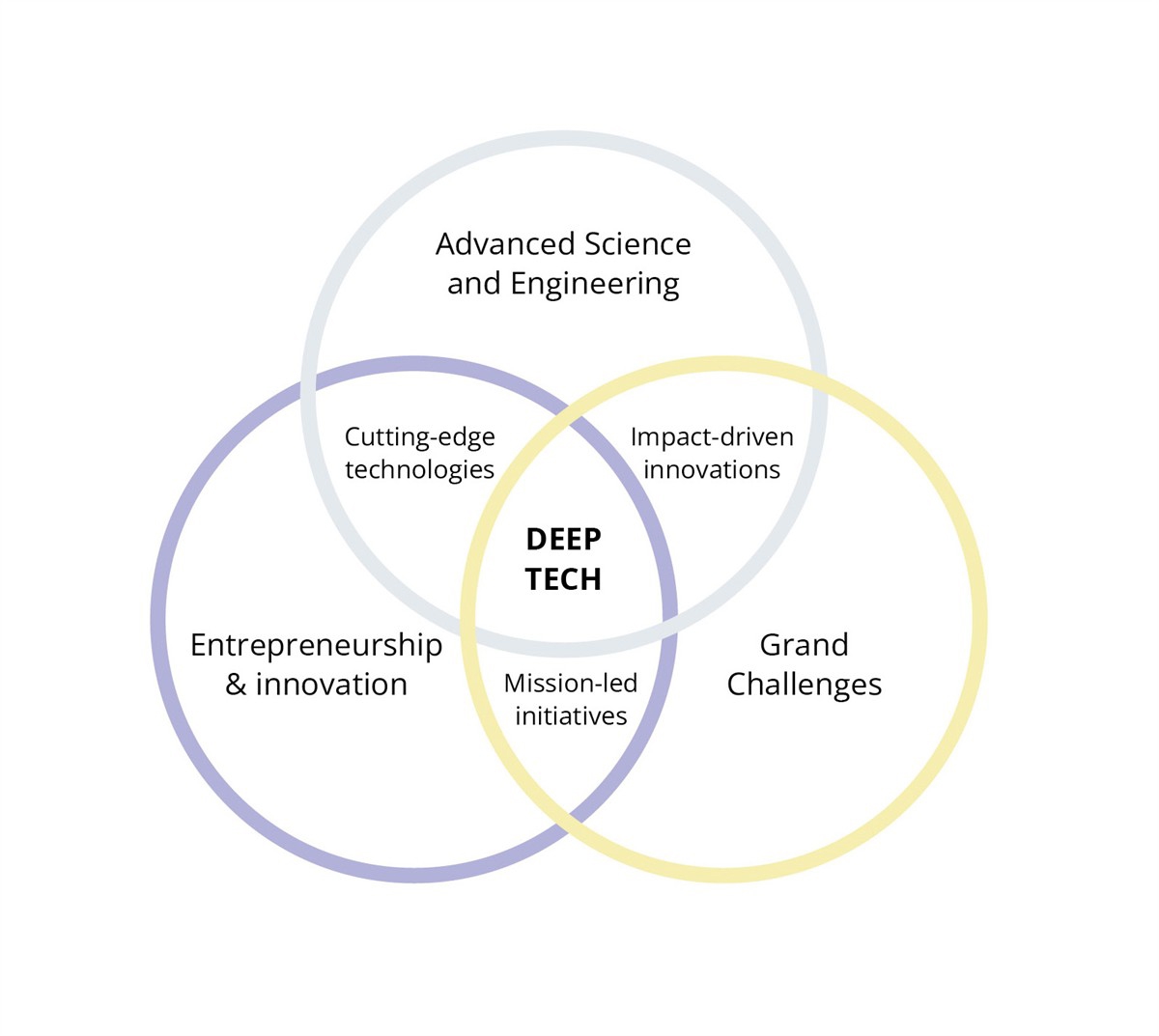
Figure 1. Deep tech combine advanced knowledge and innovation and contribute to solutions for major societal challenges.
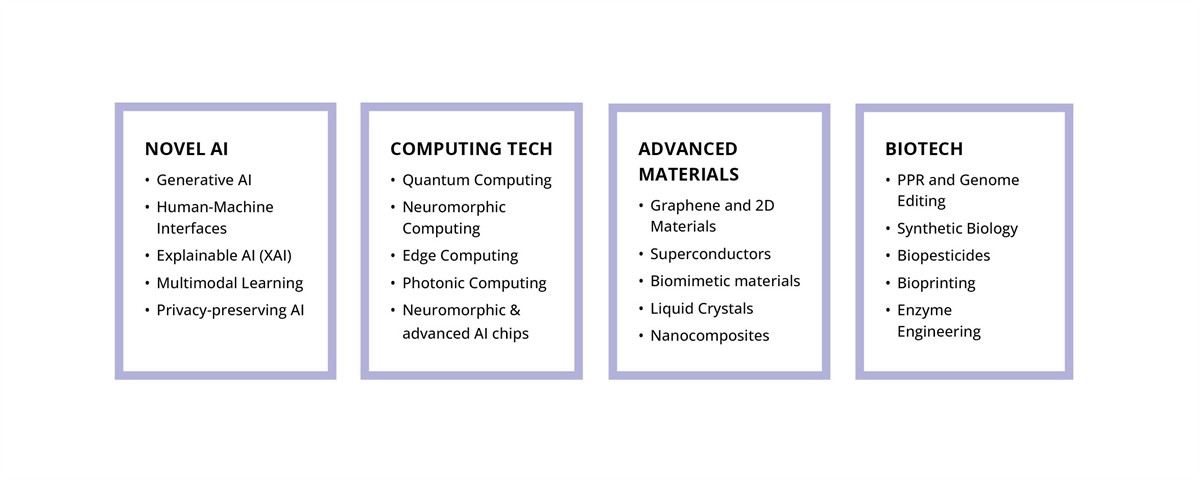
Figure 2. Examples of deep tech.
Norway in the world
The US and China are leaders in technological innovation, particularly in artificial intelligence, biotechnology and quantum technology. The US has a strong ecosystem of advanced technology companies, universities, research institutes and investors. The US government has so far supported deep tech innovation through various agencies and programmes, such as the Defense Advanced Research Projects Agency (DARPA), the National Science Foundation (NSF) and the Small Business Innovation Research (SBIR) programme. The major technology companies in the US are among the world’s most valuable; they have made significant investments and play a crucial role in US technological innovation. China has invested heavily in research, talent, infrastructure and market access, and has launched ambitious national plans and initiatives, such as ‘Made in China 2025’ and the ‘National AI Development Plan’. The rivalry between the superpowers is fuelling an intensifying technological race that will have far-reaching consequences for Norway in many ways, including for Norwegian security.
The EU plays a role both as a financial supporter of deep tech through various EU programmes and as a regulator of deep tech innovation, focusing on ethical, social and environmental aspects. The EU has identified technologies that are considered strategically important for Europe. These are technologies where dependence on foreign suppliers may pose a security risk. This development brings difficult choices for Norway regarding which technologies to prioritise and which to restrict, particularly regarding technologies from countries with which we do not have a security cooperation.
In several studies, the pace of innovation in Norway appears relatively low compared with the US and China. On the other hand, we have several industries in Norway that are already high-tech, in addition to a fully digitalised society with almost the entire population connected to the internet, a well-developed mobile and broadband infrastructure, and good data sources. Dependence on mobile, broadband, satellite and internet services is increasing across all sectors of society. Such services are fundamental for virtually all digitalisation and for the future of technology-based industry. In its digitalisation strategy, the Government set out a number of objectives and measures to secure safe and future-proof electronic communications networks and services.
In 2024, the OECD published a report highlighting that Norway is well ahead in digitalisation in several areas, particularly on indicators of the effective use of digital technologies and of trust and access.3 However, the report indicates that we are not quite managing to keep pace with rapid technology shifts and increasing international competition. Measured by the contribution of digitally intensive sectors to national value creation, Norway, at 35 per cent, lags significantly behind Sweden (74 per cent), Denmark (62 per cent) and Iceland (43 per cent). Over the past few decades, economic growth in the Norwegian ICT sector has been steady, but remains below the OECD average. A relatively low contribution to the overall economy and growth in the ICT sector is combined with weak performance in digital innovation, compared with both the OECD average and the other Nordic countries.
The dark side of technology
Technological development is often driven by an optimistic notion that technology will contribute positively to economic growth, social development and other forms of progress. However, technology can also have negative effects in several ways, whether intended or not. In particular, digital technologies have created new vulnerabilities in society, relating to privacy and data protection, the collective security of national data and communication systems, external influence on elections and decisions, as well as significant electricity consumption.
The EU, the OECD and UNESCO are all working on legislation and guidelines to manage the risks associated with the use of deep tech in general, and AI in particular. The EU has its AI Act, and the OECD is developing a framework for policy-making aimed at balancing the risks and benefits of emerging technologies in conditions of political, technological and economic uncertainty. UNESCO has launched its platform for knowledge and best practice in ethics and governance, the ‘Global AI Ethics and Governance Observatory’. The G20 has also engaged with the digital economy and AI, including through the Digital Economy Working Group, which promotes international cooperation on responsible AI development and the sharing of best practices. At the Nordic level, there are initiatives such as the Nordic Ethical AI Expert Group, which aims to make the Nordic region a leader in ethical AI, and in Norway, the Norwegian Digitalisation Agency (Digdir) has produced guidance on the responsible use and development of AI. The Government aims to incorporate the AI Act into Norwegian law by late summer 2026, and work is underway to establish a comprehensive governance structure for the new regulation. For industry, this provides a secure framework for the use and development of AI.
Data centres in general, and generative AI in particular, consume a great deal of power. The computing power required for AI has increased many times over each year since generative AI was introduced. The future need for access to power is difficult to predict, and it raises dilemmas and discussions about the climate transition and resources. The Swedish AI Commission has proposed measures to monitor electricity consumption and plan for a doubling of electricity consumption by 2045.
When developing and introducing new technology, it is crucial to maintain a good working environment. Technological changes affect not only work tasks and organisation, but also employees’ psychosocial and physical working environment. Increased digitalisation and the use of interactive technologies can lead to more fragmented and geographically dispersed forms of work, which in turn can undermine a sense of belonging, social support and opportunities for participation. To meet these challenges, organisations must take a deliberate approach to how technology is implemented and ensure that employees have sufficient autonomy, opportunities for participation and the skills to manage the changes. A good working environment is a prerequisite for innovation, productivity and sustainable transition as we face the working life of the future.