1 Introduction
The Government’s vision is for Norway to be a pioneering country in the development of a green, circular economy that reduces our overall environmental and climate impact and creates new jobs nationwide. Resources must be used and reused more efficiently in toxic-free material cycles, replacing the extraction and production of new resources.
According to the International Resource Panel, the world’s consumption of resources is the main cause of climate change, pollution and the loss of biodiversity. The extraction and processing of resources has more than tripled over the last 50 years. This has created major consequences for the climate and nature, increased air pollution, as well as water shortages and reduced water quality. Without more efficient and circular consumption, the use of resources will increase by 60 per cent over the next 40 years. Sectors such as construction, transport, food and energy can be made more circular and resource efficient, without compromising our quality of life. This is made clear in the International Resource Panel’s main report Global Resources Outlook 2024.1
- Goods are largely sold on the global market without accounting for the socio-economic costs of their environmental impact. An inadequate global regulatory framework, or failure to enforce such a framework, is hampering the transition to a more circular economy. There is a growing global interest in turning towards a more circular economy. The need for increased circularity is also a central theme in Official Norwegian Report (NOU) 2023: 25 The transition to low emissions.2
In its environmental performance review of Norway, the OECD (2022)3 points out that Norway has a high material footprint per capita compared to other countries. The OECD recommends that Norway better facilitates a transition to a more circular economy and considers the negative environmental impact in other countries caused by the consumption of goods in Norway. A faster transition to a more circular economy can help reduce Norway’s global climate and environmental footprint.
In the short term, transitioning to a green circular economy will entail transition costs for businesses. In the long term, Norwegian businesses will be able to strengthen their competitiveness while increasing the chances of achieving national and international climate and environmental goals. Many circular value chains are at an early stage of development, and the markets are characterised by a linear economy, where it is cheaper to buy new products and raw materials than to use circular solutions and materials. By acting early, businesses can seize new opportunities and increase their competitive advantage. Estimates from the EU show that their Circular Economy Action Plan4 could create around 700,000 new jobs. It is reasonable to assume that new jobs will also be created in connection with new, circular value chains in Norway.
Socio-economic profitability constitutes an important premise for the Government’s work on a circular economy. From that perspective, ‘circularity’ is not a goal in itself, but will help realise an overall sustainability ambition – economically, environmentally and socially. This not only applies on a global scale but also on a national scale in Norway. The authorities must assess which policy instruments and framework conditions effectively contribute to the desired development of a more circular economy. Research and innovation, direct and duties, public procurement requirements, competition policy, regulations, labelling schemes, standardisation, digitalisation policy and ownership policy are discussed in Chapter 2 of the action plan.
A new regulatory framework for the circular economy is currently being developed through the cooperation with EU/EEA. One of the key new measures is a strengthened framework for sustainable products and value chains. The regulations will raise sustainability standards for products throughout the single market and will be a key driver in the transition to a more circular economy. This is discussed in Chapter 3. Norway has initiated a process to implement the regulations and facilitate the introduction of new types of requirements.
Chapter 4 presents initiatives relating to competence, partnerships and monitoring to ensure that all relevant stakeholders are involved and aligned, and given the opportunity to influence and develop new skills to find the best path to a more circular economy. Transitioning to a more circular economy will help achieve regional, national and international climate and environmental goals. Indicators for measuring development will be crucial for monitoring how the transition to a more circular economy is progressing. The Government is currently assessing the indicators in the EU framework for measuring the circular economy and will consider introducing national indicators and additional targets on this basis.
The action plan complements Norway’s strategy for developing a green, circular economy, from 2021.5 The Government aims to integrate circular economy principles broadly into relevant policy instruments and measures to ensure that the work does not remain separate to other policy development. The Government therefore aims to develop circular economy policy as a part of the relevant policy documents that will be presented going forward, such as the Government’s white papers on climate and nature, respectively, and in industrial policy strategies.
Figure 1.1 What is circular economy?
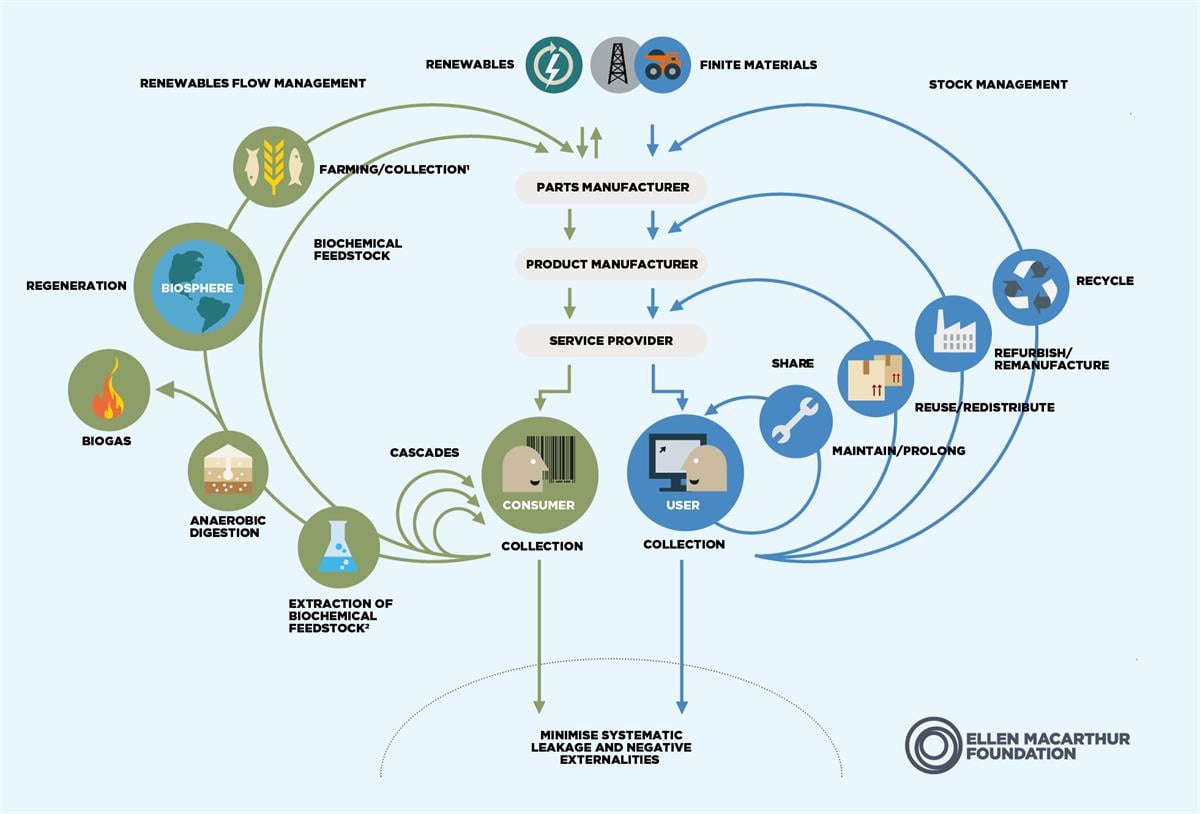
Source: Based on the Ellen Macarthur Foundation, ellenmacarthurfoundation.org/circular-economy-diagram
A well-known illustration of the circular economy describes two material cycles, one for renewable biological resources (biological cycle) and one for non-renewable resources (technical cycle).
In the biological cycle we use biological resources that, as long as they are properly managed, can grow, be harvested and renew themselves. We obtain food and bio-based materials from these biological resources. Surpluses, residues and side streams are renewable raw materials that are transformed into new products used by society before being returned to nature through, for example, composting, anaerobic digestion to generate biogas or other utilisation of the nutrients they contain. Natural processes lay the foundation for new biological resources.
In the technical cycle, products, components and materials circulate – manufactured with properties that make them suitable for reuse, easily repairable, refurbished, modernised or recycled. Materials can have both a biological and non-biological origin. A material of biological origin can first flow through the technical cycle and then be returned to the renewables flow for regeneration after its service life.