4 Competence, partnership and monitoring
To succeed in the transition to a more circular economy, competence, knowledge and cooperation are essential. A circular economy requires new approaches to production, consumption and resource utilization that go beyond traditional linear models. Performance monitoring is an important governance tool in order to ensure progress.
4.1 Competence development
Developing the circular economy requires new types of competence. In March 2023, the Government presented Report 14 to the Storting (2022–2023)13: ‘Outlook on the skills needs in Norway’ (the Skills Report). In the report, the Government indicates that the skills necessary for achieving the green transition is one of the priority areas in future education and competence policy. The report on future skills needs from the Norwegian Committee on Skill Needs: Challenges for the green transition in the workplace14 that was presented in June 2023 also provides an important knowledge base for efforts to strengthen skills related to the circular economy.
Measures to improve the competence necessary for a circular economy must be developed across organisations and value chains, with interdisciplinary cooperation playing an important role. Continuing and further education opportunities are being developed through the tripartite industry programme for competence development, and this will help increase participation in competence development. One of the goals of the scheme is to ensure that employees in relevant industries are better equipped to manage the transition. A number of industries have highlighted focus areas to address the green transition and circular economy. One of the main focuses of the industry programme for the waste and recycling industry is how the transition to a circular economy requires changes to recycling solutions.
Council for a Just Transition for Workers
The workplace plays a key role as a learning arena in achieving climate and environmental goals. Competence development initiatives for employees requiring updated or new skills can help prevent long-term exclusion and strengthen Norway’s ability to transition to a greener economy. The Government wants political decisions to be made as fairly as possible, without increasing inequality in society. It is important that we strengthen our overall efforts for a just and decent workplace by, for example, facilitating further and continuing education for smoother transitions for workers seeking employment in new green industries.
A fair climate policy is about ensuring that climate and industrial policy create profitable jobs in a low-emission society for everyone. The council the Government established for a just transition will, together with the social partners in the labour market, provide input on a just transition for workers driven by environmental and climate policy, both nationally and internationally.
4.2 Partnerships
The transformation to promote the circular economy requires better coordination and cooperation between relevant actors, including the public administration, businesses, municipal and county authorities, and relevant special interest organizations. There is a great need for information about the new regulatory framework for the circular economy.
The municipality as a facilitator
Municipalities play a key role in facilitating circular solutions. They have been assigned clear roles as drivers of community development, as procurers and as planning authorities. They can, for example, promote a sharing economy, repair, reuse and recycling, and should also use their purchasing power to choose circular goods and services. Land is a scarce resource, and circular solutions are also important in relation to land use. Municipalities can coordinate information about circular options in the local community. Although a number of municipalities wish to facilitate a circular economy in their respective areas, this can prove challenging in practice.
In 2023, the Norwegian Association of Local and Regional Authorities (KS) developed a guide on circular economy for the municipal sector. The guide aims to stimulate local and regional cooperation between businesses, public agencies, residents and organizations.
Climate partnership
The Government launched climate partnerships as an arena for structured dialogue between state and the business sector at industry level. Their purpose is to accelerate efforts in reducing emissions and transitioning to a greener economy in business and industry. Another objective of the climate partnerships is to promote increased sustainable value creation, enhanced competitiveness in Norwegian business and industry, and to increase exports of green products to international value chains. The efforts towards a circular economy are an integral part of this work.
The initiative aims to identify and secure support for the necessary emission reductions and to identify the potential for other green transitions in business and industry, including energy and resource efficiency and increased circularity. Climate partnerships are intended to facilitate a systematic exchange of experience regarding the effect of policy instruments and any required changes in their use, without reducing the state’s overall scope of action in climate policy. A dialogue on climate partnerships has been initiated in three sectors: the maritime industry, the construction and real estate industry, and the processing industry. The Government is now working to establish industry-specific agreements with these industries.
Partnership on plastic
The Ministry of Climate and Environment has reached an agreement with the business community on a partnership focused on reducing consumption of certain single-use plastic products. The private parties are the Confederation of Norwegian Enterprise, Virke – the Federation of Norwegian Enterprise, FoodDrinkNorway, the Norwegian Hospitality Association, the Norwegian Federation of Service Industries and Retail Trade, the Union of Employees in Commerce and Offices, and the Norwegian Packaging Association. The partnership is based on the UN Sustainable Development Goals (SDGs) and Norway’s obligations under the EU’s Single-Use Plastics Directive.
The purpose of the plastic partnership is to cooperate in achieving an ambitious and sustained reduction in the consumption of disposable fast-food containers and take-away food and beverage cups with lids, which are made wholly or partly of plastic.
The parties will work to promote better resource utilization and more sustainable and circular solutions for the products in question. They will also contribute towards efforts to raise awareness to promote reduced consumption of these product groups and other single-use plastic products. The parties will work to recruit private and public enterprises to the partnership. Affiliated enterprises will make their own assessment of how they will help reduce the consumption of the plastic products in question and must report on the achieved reduction. The partnership will be managed by a coordination group that will meet regularly. The parties are committed to further developing the partnership in the time ahead.
Social missions
The Government will use a range of tools to promote the circular economy, including social missions.
Missions are groundbreaking initiatives aimed at finding solutions to defined technological and/or societal problems within a specified timeframe. The major societal challenges that social missions aim to address rarely have simple solutions. Social missions must be firmly grounded at a political level. They often span multiple policy areas and require cooperation and broad involvement from relevant stakeholders across different sectors. In order for a social mission to mobilise sufficient efforts from all parties involved, the goal must be well defined so as to know whether it has been achieved within the specified timeframe. The goal of a social mission will thus be a quantitative measure or a clearly defined qualitative objective. This approach provides an opportunity to involve various stakeholders, including businesses, public service providers, regulatory authorities, researchers and the general public. The social missions will also utilize existing knowledge and the results should be implemented in society.
The European Commission has launched five EU missions in its research and innovation programme Horizon Europe. Four of the five social missions, Adaptation to Climate Change, including Societal Transformation; Healthy Ocean, Seas, Coastal and Inland Waters; Climate-Neutral and Smart Cities; and Soil Health and Food, are linked to the EU’s political ambitions for a green transition, the SDGs and the Paris Agreement. All of these are directly or indirectly relevant for promoting circular solutions. Government policy is aligned with Norway’s participation in the EU’s social missions, and the European Commission places great emphasis on social missions being implemented at national, regional and local levels. The ministries have a clear role in following up the EU’s social missions because there is a significant need for cross-sectoral coordination, there are close connections between our national and international agenda, and because the ministries are to contribute to developing regulations that support the goals. Furthermore, national initiatives and activities should be linked to activities at the EU level.
In the Long-Term Plan for Research and Higher Education 2023–2032, the Government launched a social mission relating to sustainable feed with the aim that all feed for farmed fish and livestock should come from sustainable sources and help to lower GHG emissions in food systems. The social mission is relevant for promoting circular solutions in food systems. The production of fish feed and concentrate feed for livestock currently constitutes a significant portion of GHG emissions from food systems. As such, new feed resources must be developed that provide good feed for animals, safe food for consumers and cause less harm to the environment. At the same time, resources must be used more efficiently and in a circular manner, which requires good cooperation and coordination, from foundational knowledge-building to the implementation of new innovations and technological solutions. In 2023, the Research Council of Norway led the effort to further develop the social mission and, in November 2023, submitted proposals for goals and further organisation. The work will commence in 202415 and five ministries will be involved in the follow up.
Assessment of a national social mission on the circular economy
In Recommendation No. 170 S to the Storting (2022–2023) on the Long-term plan for research and higher education, the majority of the Education and Research Committee stated that a social mission targeting circular solutions and more sustainable use of nature should be developed. The Government is following up this proposal and will investigate in 2024 how a social mission could contribute to solutions towards a more circular economy and society, in line with the priorities of the Hurdal Platform. The Ministry of Climate and Environment is leading the work in cooperation with the other ministries involved. The intention is to have broad involvement, with both underlying enterprises and other interdisciplinary knowledge environments contributing to the work.
The assessment will gather experience from, and be seen in conjunction with, national and European social missions that have already been initiated. It will be particularly important to assess how the social mission is structured, to ensure that the direction of the work is comprehensive and measurable, while promoting circular solutions and broad involvement.
4.3 Monitoring
Goals and indicators
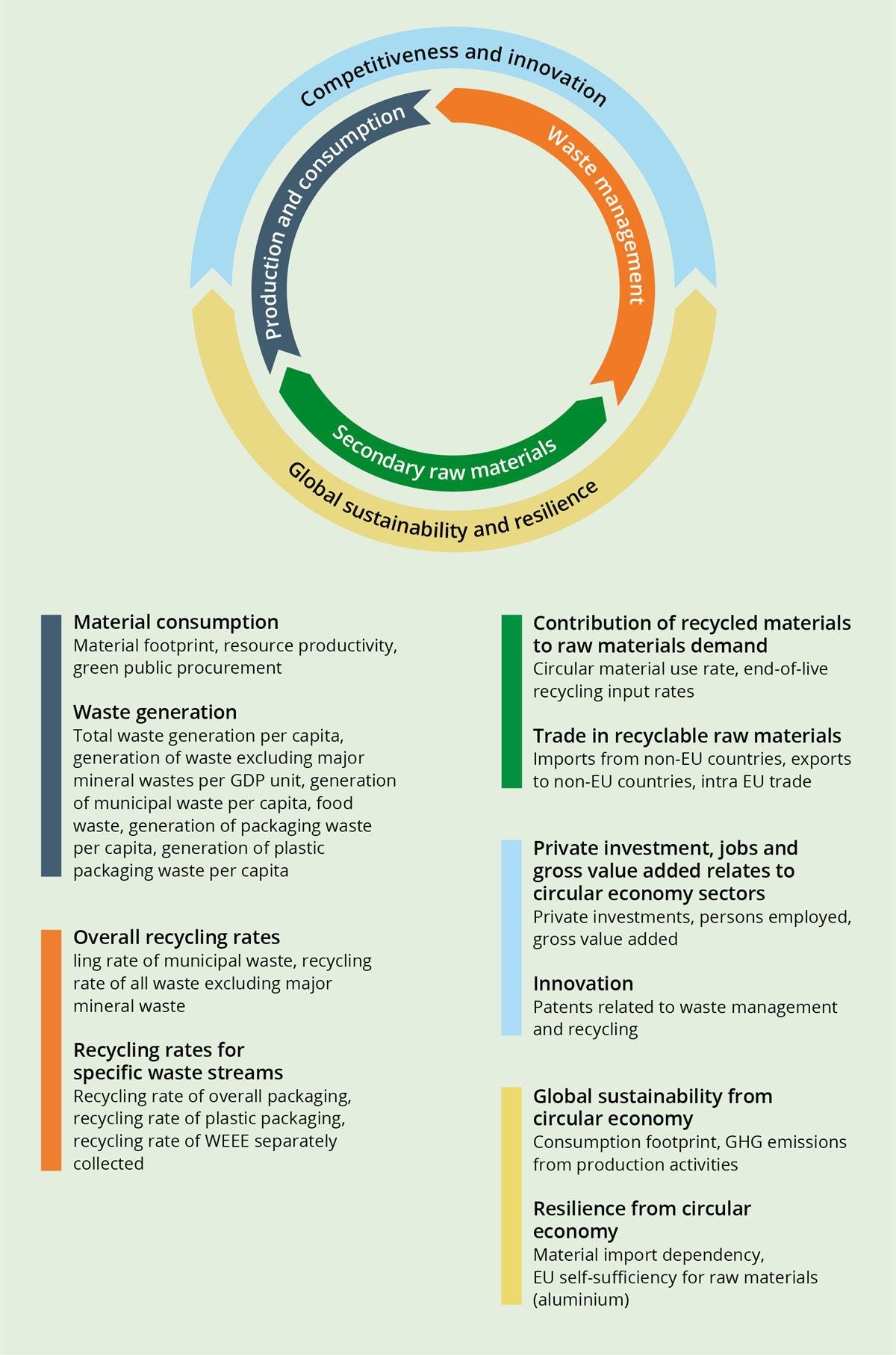
A circular economy is complex and extensive, and measuring the progress of the transition to a more circular economy requires a broad set of indicators. In May 2023, the EU launched an updated framework for measuring circular economy in the EU as a whole and in individual member states. The framework was updated to illustrate more clearly the links between circular economy, climate neutrality and the EU’s vision of zero-pollution. A prerequisite when the indicators were designed is that they should be relevant, credible, user-friendly and robust, and that they should not impose an increased reporting burden on member states. The new indicator framework largely builds on the same thematic areas as before: production and consumption, waste management, secondary raw materials, competitiveness and innovation. In addition, global sustainability and resilience has been added as a new focus area. Together, the indicators say something about the overall status of circularity in the EU and the development of individual indicators over time. The Norwegian Environment Agency has assessed the indicators in the framework and recommended which of them should be used as national indicators. The Government is continuing to work on these recommendations and will assess national indicators on this basis.
Following the expert group’s overall assessment of instruments that can promote circular activities, the Government will assess whether there is a need for additional national goals for the circular economy. This is to ensure a holistic approach to the circular economy. The Government wants any new national goals to encompass the breadth of the circular economy and to provide a clear and long-term direction for the transition.
Currently, the EU indicator framework includes figures for Norway where data is available, but several of the indicators lack data for Norway. The Government is therefore aiming to provide figures for priority indicators by the end of 2024.
Statistics
In addition to the statistics included in the indicator framework, there is a need to develop more detailed statistics within specific sectors, industries or other areas of the circular economy. The National Programme for Official Statistics (2024–2027) contains priority statistics in several areas, including the circular economy. Funding for developing statistics relating to plastic has increased but beyond that, there remains a significant need for development. For example, the current official statistics relating to waste are inadequate. The Government therefore intends to strengthen the work on developing statistics for the circular economy. National statistics of sufficient quality are essential for assessing whether we are on the right track towards the goals for the circular economy.
Figure 4.1 The EU framework for measuring the circular economy
Action points
- Use Climate Partnerships as an arena for increased cooperation on circularity in business and industry
- Make circular economy information and guidance more accessible
- Use the Council for a Just Transition to further develop the dialogue on the circular economy between the Government, the social partners and relevant organisations
- Prioritise research and research-driven innovation for circular solutions and the safe use of bioresources across industries, sectors and disciplines
- Implement the sustainable feed social mission to develop bio-nutrients that have greater circularity
- Assess a social mission for a circular economy
- Update Norwegian data for the EU’s indicators by the end of 2024
- Develop national indicators based on the EU framework for measuring the circular economy
- Strengthen the work on developing statistics that are crucial for measuring the development of the circular economy
- Assess the need for additional national targets for the circular economy based on the expert group’s assessment