4 Areas of action
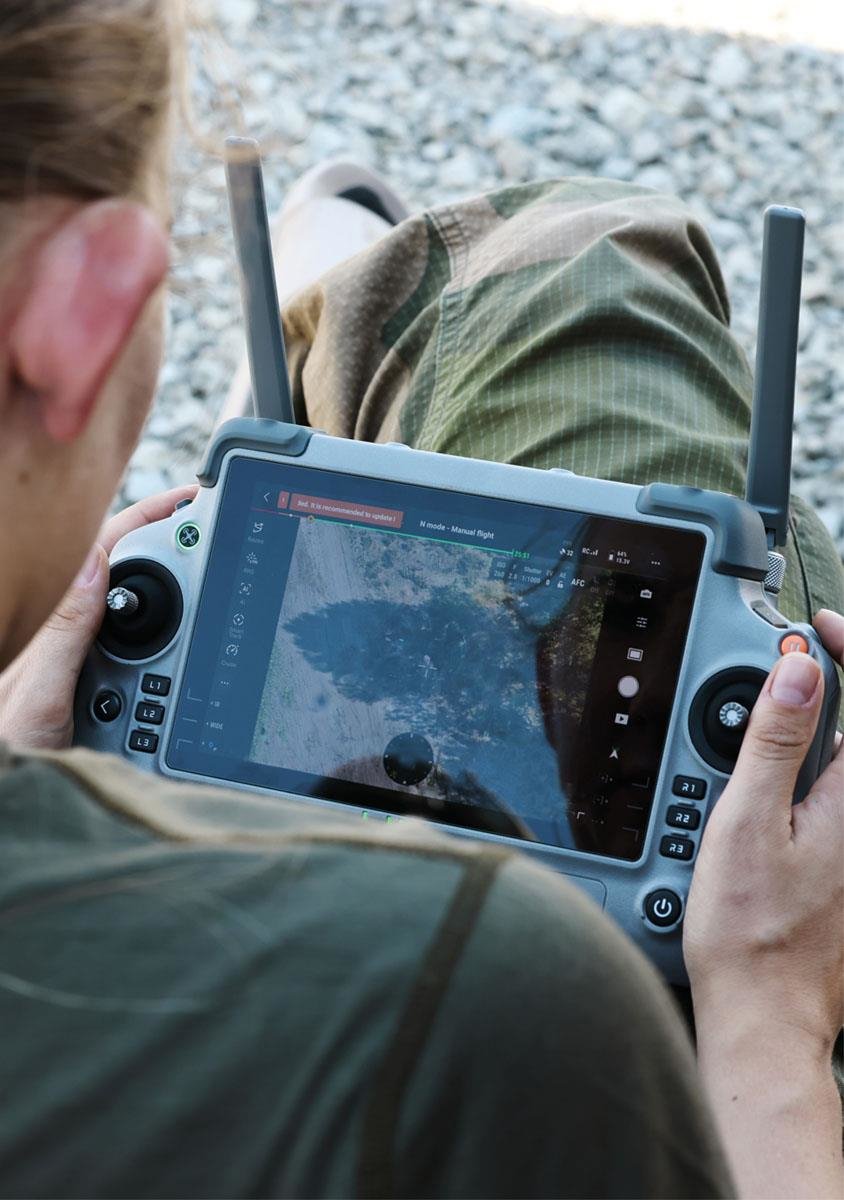
In accordance with the overarching objectives, this strategy facilitates enhanced counter-drone capabilities, increased uncrewed systems deployment within the Norwegian Armed Forces, and the development of an ecosystem for drones and counter-drone measures. To achieve these objectives, the Government will take action in five areas.
4.1 Develop the Norwegian Armed Forces’ drones and counter-drone capabilities
Acquire materiel and expertise
Experience from recent conflicts indicates a significant need for counter-drone capabilities. Responsibility for military counter-drone capabilities and the handling of illegal drone operations is shared between the Norwegian Armed Forces and the Norwegian Police. The Norwegian Police are tasked with maintaining the basic safety and security of the population across the entire crisis spectrum below the threshold of armed conflict. The Norwegian Armed Forces, for their part, are responsible, among other things, for defending Norway against threats, hostile acts, and attacks.
The capacity to detect drone activity is of common interest throughout the entire conflict spectrum. This is being followed up, among other things, through further work on the recommendations from the white paper on Drones and Advanced Air Mobility (Meld. St. 15 (2024–2025)).
Several measures are already underway in the Norwegian Armed Forces; however, it is necessary to strengthen the development of the Norwegian Armed Forces’ drones and counter-drone capabilities. The detailed assessment of investment needs is being carried out through continuous long-term planning and force development in the defence sector. Emphasis will be placed on developing the capacity to use smaller UAVs, as well as maritime uncrewed systems. The aim is to strengthen the capacity for situational awareness and the monitoring of critical infrastructure; the use of drones as weapons and armed drones, including in response to adversary countermeasures; and the capacity to conduct electronic warfare.
Both military and civilian personnel are needed to operate, maintain, and utilise drones. The defence sector depends on research expertise to further advance operational concepts and technology for military purposes. Educating military personnel with competencies on planning and leading the integrated use of drones in military operations takes time and requires an up-to-date conceptual understanding of drone use and counter-drone capabilities. Therefore, the Norwegian Armed Forces need to develop, recruit, and retain core expertise related to the development and use of drones. Which types of expertise must be produced within the Norwegian Armed Forces, and which types of expertise can be provided by cooperating with military partners or civil sectors, must be based on whether the systems are unique to military use, whether cooperation is feasible and more cost-effective, or whether strategic and allied cooperation provides an added value. The Government’s ongoing efforts to develop a strategy for special areas of expertise within the defence sector will address these questions.
Civil sectors possess valuable expertise and modern drone materiel. Requisitioning civilian uncrewed systems through the Norwegian Armed Forces’ requisitioning system and mapping civilian expertise for use in the Norwegian Armed Forces can rapidly enhance access to materiel, personnel, and expertise. The use of these measures is subject to specific conditions that balance the needs of the Norwegian Armed Forces with those of civil sectors to maintain civil societal functions.
Organise for continuous development
The Norwegian Armed Forces must facilitate continuous testing of new technology and operational concepts on a smaller scale across the organisation to drive continuous innovation. The Norwegian Armed Forces are, through their warfare centres, among others, well organised to test new technology and develop new operational concepts. The pace of innovation will accelerate when actors from the civil expertise and business sectors engage with the defence sector’s expert communities.
At the same time, it is crucial that the defence sector gathers and operationalises experience from technological, doctrinal, and conceptual developments in other countries. In the white paper on the Nansen Support Programme for Ukraine (Meld. St. 8 (2023–2024)) (available in Norwegian only), the Government explicitly outlines the need to learn from the war in Ukraine. As a result, the Norwegian Armed Forces have established mechanisms to learn from Ukraine’s experiences and are enhancing their capacity for experience-based military learning. Several projects have been launched in the defence sector as a result of experience from cooperation, donations, and drone development. Through support for Ukraine’s defence against Russian aggression, Norwegian actors have gained valuable experience in organising for continuous development. Norwegian industry, defence sector agencies, and other defence actors have collaborated closely to deliver innovative, timely support in step with Ukraine’s evolving military and civilian needs. The Government will use this experience to ensure that the organisation and processes that contributed to the rapid development and procurement of important military capabilities in support of Ukraine can also be adapted nationally for drones and counter-drone capabilities.
To ensure a comprehensive approach to uncrewed systems in the defence sector, including experience-based learning, coordinating initiatives across the branches of the Norwegian Armed Forces and with allies, and engaging with the knowledge and business sectors, there is a need for a central coordinating function. Through close cooperation with relevant actors in the Norwegian Armed Forces, this central function shall establish clear priorities. The function shall serve as a catalyst for innovative thinking and changes in operational concepts concerning the use of drones, in collaboration with the Norwegian Armed Forces’ warfare centres, the Norwegian Defence University College, the Norwegian Defence Research Establishment, civil sectors, allies, and partners. It shall also provide guidance for research and development related to military drones. This will help ensure that experience, knowledge, and expertise are collected and shared, and that the requisite security is maintained.
Establish facilities for testing, training, and exercises
Developing effective counter-drone capabilities necessitates realistic counter-drone training. There is a need for better facilities for testing counter-drone measures against target systems. It is necessary to explore options for test and training ranges specifically adapted for military use of drones. To facilitate greater cooperation with the research and business sectors, their testing needs shall also be taken into account in the assessment.
Adapting existing or establishing new test and training ranges for the operational use of drones will strengthen opportunities to experiment with immature systems and test and evaluate mature systems in a secure environment. Norway has unique conditions for test and exercise areas for uncrewed systems operation in Arctic conditions. The establishment of 17 new restricted areas for UAV training and exercises is under consideration. These areas will provide increased and more flexible access to airspace for UAV use, while also occupying less airspace for military use than is currently the case. Experimenting with physical systems can be complemented by simulation to test options involving larger quantities or functionalities that are not yet developed.
The Government will
- develop drone and counter-drone capabilities through further defence planning and force development in the defence sector
- ensure that experience gained from the rapid development and procurement of military capabilities for Ukraine is adapted nationally for drones and counter-drone capabilities
- establish a central coordinating function in the defence sector for the development of military use of drones
- rapidly investigate options for test and exercise ranges, specifically adapted for military use of drones and counter-drone capabilities. The testing needs of the research and business sectors shall be taken into account in the investigation
- Identify civilian drone materiel and civilian drone expertise for military use under the requisition scheme and compulsory military service.
4.2 Cross-sectoral and multinational cooperation
The pace of innovation is a crucial factor driving the increased prominence of drone and counter-drone capabilities in modern warfare. This is partly due to the widespread availability of affordable drone materiel, which can be adapted from civil systems for military purposes. Having sufficient capacity for both production and continuous adaptation and development of drones is crucial.
Cross-sectoral cooperation
Uncrewed systems are expected to improve the efficiency of task performance across various sectors of society, leading to positive effects on the Norwegian economy and enhancing the accessibility of basic and essential services, cf. the white paper on Drones and Advanced Air Mobility (Meld. St. 15 (2024–2025)). The technological requirements for civilian drone use might be relevant to military drone applications. Existing and future drone use, for example, in research, the emergency services, agriculture, the energy sector, the health sector, and the maritime industry, should be continuously assessed for potential military applications. Just as technological advancements in civilian drone use can benefit the Norwegian Armed Forces, innovations driven by the Norwegian Armed Forces’ needs can also benefit civil sectors. Opportunities exist to strengthen military capabilities and benefit civil society by developing solutions for the use of civilian drone resources alongside military resources.
Norway and the Norwegian Armed Forces will benefit from greater interaction and coordination of solutions between actors in the drone industry. Building close cooperative relationships is time- and resource-intensive. There is a need for arenas where the needs of the Norwegian Armed Forces can be promoted and where actors can collaborate to develop solutions. Relevant actors include the Norwegian Armed Forces, other parts of the public sector, expert and research communities, and business. By further developing existing interaction arenas and establishing new ones, greater standardisation and interoperability between systems can be achieved. This can also facilitate dual-use solutions relevant to the Norwegian Armed Forces, other public actors, and the civilian market.
The Government will establish an open, cross-sectoral interaction and innovation arena for drones and counter-drone capabilities. This arena will serve as the backbone of a testing and expert network for the drone industry as a whole.
There is also a need for a classified interaction arena for security-cleared actors, where the public sector, particularly the defence sector, plays a central role. Such an interaction arena will strengthen cooperation between business, research and development actors, the Norwegian Armed Forces’ operational units, and other government agencies. This will facilitate comprehensive assessments related to research and development, procurement, innovation, use and upgrades, as well as production.
The white paper on secure knowledge in an uncertain world (Meld. St. 14 (2024–2025)) (available in Norwegian only) describes the need to coordinate civil and military research systems into a common national research system for open, sensitive, and classified research. An open, unclassified interaction and innovation arena for the drone industry, together with an arena for interaction and innovation that involves sensitive and classified activities, is an extension of this.
To capitalise on the opportunities offered by uncrewed systems technology, expertise in its use, maintenance, and further development is essential. The ongoing work on a strategy for specific areas of expertise will clarify which measures can be used to meet the defence sector’s needs in selected technology domains, including uncrewed systems technology. Drones represent a dual-use technology that is developing at a rapid pace, and mutual benefits will be unlocked by linking civil and military educational institutions more closely in this area.
Developments in uncrewed systems indicate an increased need for expertise in areas such as autonomy, artificial intelligence, sensor technology, and cybersecurity. At the same time, there are unique aspects of military drone use and the development of drones for military purposes that complement civilian expertise. This applies in particular to the planning of operations involving drones and counter-drone capabilities, which in turn places demands on the features of drone technology. The Government will work to strengthen educational cooperation between civil and military educational institutions in the areas of drones and uncrewed systems technology. Schemes for sharing expertise across sectors will be explored, while the defence sector’s existing expertise must be utilised effectively and further developed.
It is important that a sufficient number of personnel with relevant drone expertise choose the Norwegian Armed Forces as their career path and that the expertise is retained. The Government will improve access to technological expertise by prioritising enrolment in engineering disciplines and ICT in allocations to tertiary vocational colleges, university colleges and universities, cf. the Roadmap for Technology-Based Business It is also an important objective for the Government to work to ensure that the public sector, including the defence sector, increasingly offers apprenticeships to upper secondary pupils, cf. the white paper on Drones and Advanced Air Mobility (Meld. St. 15 (2024–2025)).
The introduction of the military open category more closely harmonised the requirements for operating certain types of military UAVs with civil requirements. Basic training through the Civil Aviation Authority Norway’s schemes, followed by a military supplementary course, provides certification to operate in the military open category. The Government will work to ensure further harmonisation of requirements and certifications for military and civil drone operators where appropriate.
International cooperation
NATO is crucial for the defence of Norway and Norwegian security interests. Combined defence planning within the NATO framework has resulted in new capability targets for Norway and the Alliance. This includes targets to develop the capability to use and defend against drones in the short and long term. Multinational cooperation within the NATO framework includes combined defence planning, concept and doctrine development, research and development, innovation, rapid adoption, defence industry development, standardisation, expert cooperation, joint procurement, and joint and multinational operation of military capabilities. The coordinating function to be established centrally in the defence sector will serve as the national focal point for NATO on drones and counter-drone capabilities.
The war in Ukraine is bringing to the fore and accelerating NATO cooperation. For example, a joint NATO-Ukraine Council has been established as part of the developing cooperation between NATO and Ukraine. Another example is NATO’s Joint Analysis, Training and Education Centre (JATEC). JATEC identifies and contributes to implementing lessons learned from the war in Ukraine, enhancing interoperability between NATO and Ukraine, and developing NATO and Ukraine’s deterrence and defence capabilities. Norway will actively utilise NATO cooperation to enhance its capacity to develop, procure, and use drones, as well as to defend against them.
Most European NATO countries are also members of the EU. The EU’s defence efforts are harmonised with and complement NATO’s role. In March 2025, the European Commission launched a significant defence package to increase member countries’ defence budgets and European arms production. Drones and counter-drone measures are one of seven priority areas. Through EEA membership and the 2024 EU-Norway Security and Defence Partnership, Norway has access to several EU mechanisms. Norway will seek to utilise and contribute to capability development in the areas of drones and counter-drone capabilities through, among other things, the European Defence Fund R&D programme, and will support Norwegian industry in competition for contracts where relevant.
Norway participates in multinational cooperation on the development of military capabilities through the German-led Framework Nations Concept, the United Kingdom-led Joint Expeditionary Force, the Nordic Defence Cooperation, and bilateral agreements with several European countries. These constellations involve cooperation on expertise, procurement, training, and exercises related to drones and counter-drone measures.
Norway has formalised cooperation with the United Kingdom to develop expertise in long-range UAVs for maritime surveillance. Norway has strong expertise in operating smaller UAVs, but there is a need for additional expertise in the capabilities of long-range surveillance UAVs to operate year-round in challenging climatic conditions in the High North. It is important that the partnership with the United Kingdom is utilised to develop Norwegian expertise and experience in operating large, long-range UAVs in our region.
Assessments are also underway regarding a possible Nordic cooperation on armed drones. Such cooperation could include the exchange of experiences, the joint development of tactics and procedures, and joint procurement. Concluding larger framework agreements for small and medium-sized drones may be relevant in various multinational frameworks and can provide shared benefits in operational interoperability, further development, operations, and lessons learned. Several of the larger materiel procurements in the future, such as submarines, frigates, and tanks, will be carried out in cooperation with other countries. In this context, cooperation on drones and counter-drone capabilities will also be considered. The Government will strengthen Norwegian participation in relevant multinational cooperation on drones and counter-drone capabilities with a view to ensuring the transfer of experience and expertise, cost-effective procurement, and interoperability with allies.
Participation in multinational cooperation for Ukraine’s defence against Russian aggression contributes to the development of drones and counter-drone measures for Ukraine, while also serving as an important arena for experience-based military learning and the development of Norwegian industry. The Government is facilitating closer cooperation with Ukraine on uncrewed systems technology, including by establishing production capacity among Norwegian suppliers in support of Ukraine’s defence struggle. In addition, Norway supports the development and production of maritime uncrewed systems using technology from Norwegian industry for production in Ukraine through the Maritime Capability Coalition, which Norway co-leads with the United Kingdom. Norway also participates in the capability coalitions for air defence, air power, drones, and electronic warfare. These cooperative experiences will be built upon to enhance Norway’s defence capabilities.
The overall military application, development, innovation, and international cooperation related to drones shall be managed through the coordinating function that will be established centrally in the defence sector.
The Government will
- establish arenas for both open and classified cross-sectoral interaction and innovation for drones and counter-drone capabilities for a unified drone industry
- strengthen bilateral defence cooperation with close allies to develop drones and counter-drone capabilities
- strengthen Norwegian participation in relevant multinational cooperation on drones and counter-drone capabilities
- facilitate an increase in the number of apprenticeships in the defence sector related to uncrewed systems
- strengthen educational cooperation between civil and military educational institutions in the area of drones and uncrewed systems technology
- continue to harmonise requirements and certifications for military and civilian drone operators where appropriate.
4.3 Targeted innovation, research and development across sectors
The defence sector must have the capacity for rapid, targeted innovation to increase the Norwegian Armed Forces’ operational capability. New ideas must be swiftly and properly converted into defence capabilities. The development of uncrewed systems and their increasingly diverse use in military operations heighten the need for innovation capacity in the defence sector. Experiences from Ukraine demonstrate that the ability to innovate and adapt quickly is crucial. Any developments in the use of drones are swiftly met with tailored countermeasures. Therefore, it is necessary to quickly identify new ways to use drones and improve their capabilities. Through user-centric innovation, new solutions shall be identified and existing solutions further developed.
Research, development, and experimentation in uncrewed systems technology and concepts are essential for understanding opportunities and limitations. Through research and development in Norway and in the defence sector, the necessary expertise is established and maintained to make sound choices, act as a competent client in procurements, and continuously develop solutions that meet the needs of the Norwegian Armed Forces.
Research and development (R&D) and innovation aimed at meeting the needs of the Norwegian Armed Forces
There have been notable advancements in uncrewed systems and associated technologies. This presents opportunities that the Norwegian Armed Forces have not yet fully leveraged. Promoting and harnessing future opportunities effectively and safely requires technological and conceptual development and maturation. In Norway, efforts must focus on both the overall system and individual technologies.
Keeping pace with developments is a necessary, but not sufficient, prerequisite for achieving military advantage. In Norway, we have the prerequisites to be at the forefront in areas such as technology for operations in Nordic conditions, autonomy, interoperability, and resilience against electronic warfare. At the same time, Norway must utilise and contribute to developments occurring in other countries.
As part of the implementation of the R&D pledge in Prop. 87 S (2023–2024) Long-term Defence Plan, priority will be given to research, development, and innovation in technology that enhances autonomy and improves the ability to interact with and between uncrewed systems. Efforts to develop solutions that enhance availability, performance and safety in drone operations under challenging Nordic conditions and in the face of an adversary’s denial in the electromagnetic spectrum shall be strengthened. Drones introduce greater complexity and add to existing threats. This requires effective command and control systems with increased use of automated operator support and autonomy. Further efforts in this area are anchored in the areas of technological expertise, cf. the white paper Cooperation for Security (Meld. St. 17 (2020–2021)) and Prop. 87 S (2023–2024) Long-term Defence Plan. Investment in these areas will unlock opportunities for both the Norwegian Armed Forces and business.
Norway has a wide range of research and development activities across the research institute, academic, and business sectors, and is at the forefront in several areas. However, many communities associated with research and development in general, and with uncrewed systems in particular, are small. Norway does not have the capacity to drive development in all relevant areas on its own, and enormous resources are being invested in other countries in fields such as artificial intelligence and semiconductors. Norway is well-placed in drones and counter-drone capabilities, and this can be further advanced through more targeted and coordinated research and development. This must be achieved through increased cooperation between user communities, research communities, the knowledge sector, and business.
The trajectory from research to military application must be expedited. With clear priorities and targets, coordinated use of resources can increase the pace. It will be possible to accelerate development, particularly for low-complexity, affordable drones. Furthermore, the opportunity to experiment and test under realistic conditions is an important prerequisite for achieving the necessary pace. Alongside acquiring technology, the Norwegian Armed Forces and the defence sector must improve their ability to utilise it. New uncrewed systems need to be developed alongside the further enhancement of existing ones. The way the systems are utilised must be adapted to needs, threats, and protection measures. A central coordinating function for drones in the defence sector will help clarify the Norwegian Armed Forces’ needs and contribute to better interaction between actors within the sector and external communities. Allocating a larger portion of the defence sector’s resources to research, development, and innovation via civil actors in the policy instrument system, such as the Research Council of Norway and Innovation Norway, will also promote such cooperation.
Research and development activities aimed at meeting the Norwegian Armed Forces’ needs will, in many contexts, require personnel with security clearance. Therefore, it is necessary to facilitate targeted education and recruitment of individuals who can obtain a security clearance in relevant disciplines at all levels. For example, students who can obtain a security clearance should be encouraged to write master’s theses and doctoral dissertations that can be linked to military needs and relevant research at the Norwegian Defence Research Establishment and the Norwegian Defence University College. The Government will work to increase the number of researchers and engineers with security clearance in relevant disciplines.
Technological development and commercial activity in the drone industry involve financial risks due to unpredictability related to progress, costs, and market risk. Simultaneously, innovation activities reduce the risks associated with the defence sector’s strategic decisions and investments. It is mutually beneficial for the defence sector to clearly describe its needs and be a predictable customer. In addition, there is potential in the defence sector for setting requirements for business, providing resources for implementation, and being willing to take risks by acting as a first user. The Government will work to ensure that the defence sector more frequently acts as a pilot customer and a participating early user.
The pace of innovation in drones and counter-drone capabilities indicates a need to rapidly transform the entire spectrum from basic research to finished systems and operational effectiveness. A significant proportion of investments in uncrewed systems technology will likely not yield profitable products. The risk is perceived as particularly high for small enterprises lacking strong margins. The Government will consider using innovation and development funds to strengthen drones and counter-drone development across all levels of technological maturity to mitigate such risk. Examples of possible policy instruments for reducing risk include innovation partnerships and the use of innovation contracts.
The need for increased innovation capacity is being addressed through, notably, the 2025 Action Plan for Innovation in the Defence Sector (available in Norwegian only), developed by the Norwegian Armed Forces in cooperation with other defence-sector agencies.
Long-term initiatives with wide-ranging potential
The scope for drone use is growing. Changes in sub-technologies unlock opportunities for the continuous further development of drones and counter-drone capabilities. In this context, it is important to invest not only in R&D activities that directly support planned procurements, but also in R&D activities that develop knowledge and expertise that may be beneficial in the longer term, both in the defence sector and across sectors.
One example is the Government’s investments in quantum technology, which will help Norway develop expertise and capacity in this area. The Government is developing a national strategy for quantum technology, which is expected to be ready in 2026. Quantum technology remains nascent, but it is regarded as a vital enabler of other technological advances and innovation, with potential significance for uncrewed systems technology.
The Government will
- work to increase the number of researchers and engineers with security clearance who are recruited and educated in relevant disciplines
- strengthen cross-sectoral cooperation related to uncrewed systems technology and associated technologies by assessing whether a larger share of the defence sector’s resources for research, development, and innovation should be allocated through civil actors in the policy instrument system, such as the Research Council of Norway and Innovation Norway
- consider using innovation and development funds to strengthen drones and counter-drone development across all technology readiness levels
- work to ensure that the defence sector more frequently acts as a pilot customer and a participating early user.
4.4 Strengthen the national drone industry
The war in Ukraine underscores the importance of being able to continuously procure large quantities of up-to-date drone materiel and of national production capacity. The defence industry itself bears the main responsibility for expanding its production capacity. As part of the implementation of Prop. 87 S (2023–2024) Long-term Defence Plan,the central government can support increased production capacity by entering into binding procurement contracts with industry actors. Such contracts provide enterprises with the predictability they need to invest in their own capacity.
A strengthened national drone industry must support the Norwegian Armed Forces’ priority tasks and needs. Norwegian industry is a subcontractor for a wide range of advanced military systems. Norway has world-class missile production, a market-leading position in missile air defence, and a technologically advanced maritime offshore and subsea industry. Certain types of drones can be produced quickly at low unit cost. This means that volume and endurance can be introduced through a larger number of small drones, such as sensor and weapon platforms. Volume and scalability are desirable attributes of the Norwegian Armed Forces’ combat capability. It is desirable to maintain a moderate peacetime capacity and to increase the amount of drone materiel at short notice when needed. With affordable drones that can be produced quickly, it is possible to increase the number of drones at short notice through rapid national production, international cooperation, and the requisitioning of civilian drone materiel. To achieve such scalability, it is important that we have a domestic business sector with the necessary technological expertise.
Overall, Norway is well-positioned to increase its capacity to develop and produce drones and counter-drone technology for use in the defence sector. However, the drone industry in Norway is fragmented. Building on clear priorities from the Norwegian Armed Forces and through participation in open and classified interaction arenas, companies will be involved and can collaborate, leverage synergies, and identify comprehensive solutions to the Norwegian Armed Forces’ needs for drones and counter-drone capabilities.
The Government published its National Security Strategy in spring 2025. The strategy emphasises the importance of business for national security and the need for their participation in planning and emergency preparedness. This will also apply to the area of drones and counter-drone capabilities, as part of the National Security Strategy’s first main strategic priority of rapidly enhancing defence capabilities.
Secure supply chains
A significant proportion of global drone production is either Chinese or dependent on components manufactured in China. However, production is increasing in other countries and among close allies. The trend is moving towards less reliance on individual sources and greater emphasis on secure supply chains.
Strengthening national capacity to produce drone materiel and associated technology will provide more secure access to materiel, the opportunity to influence and protect critical technology, and control over how the systems can interact with the Norwegian Armed Forces’ systems and operations. Strong export enterprises in the drone sector will help establish robust, flexible national value chains. At the same time, the development of drones and uncrewed systems technology is an international priority, and it is important to leverage opportunities to purchase drone materiel from other countries and pursue industrial cooperation across national borders.
Scaling up as needed
The demand for drone materiel during wartime is substantially greater than in peacetime. Given the rapid pace of technological development, fluctuations in international trade relations, increased demand, and disruptions in production, it can be challenging to ensure access to a large quantity of up-to-date drone materiel.
During peacetime, domestic production can support the Norwegian Armed Forces’ operational requirements and a substantial part of the needs associated with experimentation and development work. Measures must be taken to ensure that the industry maintains its expertise and infrastructure, enabling it to increase production and rapidly develop existing systems. Increased cooperation between industry actors, particularly focused on production capacity, and innovation actors can contribute to the national capacity to produce a greater number of updated drones.
It is not expedient to produce large numbers of drones or counter-drone capabilities that, given the current pace of development, may be rendered obsolete within a short period of time. The ability to keep pace with developments in uncrewed systems technology, with the capacity for rapid production, updates, and materiel procurement, is therefore prioritised. At the same time, a certain level of contingency stockpiling is necessary to ensure the ability to respond and maintain a degree of resilience in the event of crises or conflict. The Norwegian Armed Forces must also develop expertise to enable the receipt of a larger number of drones if the need arises.
Challenges associated with lower production requirements in peacetime do not only apply to drones and counter-drone capabilities. In some cases, the Norwegian Armed Forces have established contingency clauses with suppliers under which the latter undertake to increase their production rate on short notice. In such agreements, the authorities normally provide financial resources as security for additional production lines and raw materials. It should be assessed whether similar arrangements could be relevant to ensure rapid upscaling of production in line with the Norwegian Armed Forces’ drones and counter-drone capability needs across the entire conflict spectrum.
In its roadmap for increased production capacity in the defence industry, the Government has prioritised investing in cutting-edge technologies that can provide significant operational advantages. Uncrewed systems technology is included in this priority. As part of its continuous long-term planning and the ongoing review of the National Defence Industrial Strategy, the Government will therefore consider measures to increase production capacity for drones, with an emphasis on national development, production, and the ability to scale up production. Part of this endeavour involves the ongoing establishment of uncrewed systems development and production in Norway to support Ukraine’s defence against Russian aggression. Here, Norwegian industry is closely linked to technology development and experiences from the war in Ukraine, while production capacity is being established in Norway for the donation of relevant drones to Ukraine. This initiative will also contribute towards developing a drone industry prepared to meet national needs.
Prioritised areas in uncrewed systems technology
Uncrewed systems consist of several subsystems and components. These systems must, as far as possible, have standardised interfaces to enable continuous upgrading. By maintaining an overview of key areas of uncrewed systems technology that are of particular importance, relevant national actors will be able to prioritise especially critical technologies and systems. This enables the prioritisation of development in key areas for the whole and the protection of especially sensitive technology. In line with the need for national control and expertise, cf. the white paper on Drones and Advanced Air Mobility (Meld. St. 15 (2024–2025), the Government will assess the need for measures that can contribute to national control of key subsystems and components where appropriate.
Prioritising specific areas within uncrewed systems technology does not necessarily mean they have to be developed or produced in Norway. However, domestic development and production capabilities will help ensure that particularly important elements are available and utilised effectively, regardless of fluctuations in market availability and international suppliers’ priorities. The priority areas within uncrewed systems technology will be continuously developed through cooperation between the defence sector and industry.
Boks 4.1 Prioritised areas in uncrewed systems technology
To contribute to the effective and safe development and use of uncrewed systems, there is a need for a comprehensive, robust architecture for drone capabilities in Norway. By prioritising certain areas within uncrewed systems technology, we can contribute to national control over key technologies, while maintaining the flexibility to integrate solutions from a wide range of national and international suppliers. This will enhance both quality assurance and innovation and help ensure that drones effectively serve the needs of the Norwegian Armed Forces, public emergency preparedness, and civil use.
Prioritising specific aspects of uncrewed systems technology will help ensure that drones are used effectively within a comprehensive system approach. This provides a framework for relevant actors to focus on the development of critical technologies and systems, and to protect sensitive capabilities that are crucial to national security.
The core components include:
- System integration capabilities, including the development and management of architecture and the selection of standards for interfaces between systems
- Command and control systems
- Autonomy software
- Robust and jam-resistant communication
- Information security
- Navigation and positioning systems
Expertise and capabilities in these areas of uncrewed systems technology will facilitate flexibility in supplier selection, while providing clear guidelines for system integration, development, and innovation. It shall ensure that new technologies, such as drones and artificial intelligence, are seamlessly integrated into the Norwegian Armed Forces’ existing system portfolio and support closer military-civil cooperation.
The Government will
- consider measures to increase and scale up production capacity for drones and counter-drone capabilities, with an emphasis on domestic development and production, as part of the continuous long-term planning and ongoing review of the National Defence Industrial Strategy
- identify and reduce risks and vulnerabilities in value chains for uncrewed systems and drone materiel
- facilitate the development of key areas of uncrewed systems technology by relevant national actors.
4.5 Utilise the scope for action in regulation and administration
Developments in uncrewed systems technology are rapid and have long outpaced both legislation and administrative practices. For the defence sector to benefit from drone opportunities, existing legislation must be applied more flexibly and further developed in line with technological advances.
Procurement legislation and investment projects
The defence sector will make greater use of differentiated processes for procuring and operating drones and counter-drone capabilities. Procurement processes can be differentiated by factors such as size, complexity, cost, area of use, and operation.
The Government wants the existing legislation to be applied as flexibly as possible. Where there are opportunities for simplification or parallel processes, these shall be utilised. Flexibility and adaptability must be actively utilised to ensure the necessary progress. At the same time, the defence sector must further develop and enhance its expertise and capacity in the area of procurement so that the full range of procedures can be used when preparing procurement strategies.
The procurement of defence materiel, including drones and counter-drone capabilities, is regulated by the Public Procurement Act and the regulations issued pursuant to it. Relevant regulations include the Defence and Security Procurement Regulations (FOSA) and the Public Procurement Regulations (FOA). Both contain national and EEA-based provisions. The EEA law component is based on EU directives and places certain limitations on the national scope for action.
A study of a new act relating to defence and security procurements has been carried out. The study identified areas that could be simplified and contribute to more efficient procurement processes, and provides guidance on when Article 123 of the EEA Agreement can be applied with reference to national security interests. The recommendations from the study will be followed up in further work to streamline procurement processes.
In addition to the overarching legal guidelines, there is a comprehensive set of internal sector regulations that sets requirements for investigation, planning, quality assurance, and the management of materiel. The regulations are important governance tools for the defence sector, but within the framework of the law, they can be adjusted and adapted as necessary to better support drone procurement and projects.
Investment projects in the defence sector are currently implemented primarily according to the PRINSIX project model, which is the defence sector’s operationalisation of the central government’s project model. For drone procurement, it is important to be able to respond quickly to changing needs and support innovation and development in line with the Norwegian Armed Forces’ requirements.
PRINSIX allows for differentiation between investment projects. Within the constraints of the Security Act, it is possible to balance progress and risk management while retaining the necessary flexibility and speed to advance drone development. The Norwegian Defence Materiel Agency has begun efforts to determine how the scope for action in PRINSIX can be more precisely applied in relation to drone projects.
Safe use of drones
Air, maritime, and land traffic are subject to stringent regulation. Owing to these regulations and a safety culture developed over decades, there is now a very high level of safety in both the military and civil sectors. However, the use and interest in drones have challenged both legislation and safety culture.
The Government wants the legislation to be as simple as possible and as consistent as practically possible across sectors and between the civil and military sectors. Norway will also look abroad to assess whether Norwegian legislation can be harmonised with that of our allies.
A large proportion of drone activity has so far been subject to strict restrictions to ensure the safety of crewed systems. This imposes limitations on the kind of training and experimentation that can be conducted with uncrewed systems.
In a defence context, it is natural that uncrewed systems in the air, on land, at sea, and underwater should be operable in the same operational area as crewed platforms, and in close coordination with them. Segregation of airspace and other operational areas will, for the foreseeable future, often remain the simplest solution. Work is underway to make such segregation more flexible, and the Government will work to make it easier to use crewed and uncrewed systems in the same operational area. This means that legislation and necessary solutions will be developed to ensure uncrewed systems usage is safe when operated alongside crewed systems and to lessen the dependence on segregated areas during experimentation, exercises, and operations.
The Norwegian Armed Forces’ and Norwegian Police’s responsibility for handling illegal drone activity
Responsibility for handling illegal drone operations is clearly divided between the military and the civil sector.
The Norwegian Police are responsible for ensuring the basic safety and security of the population. In crisis situations below the threshold of armed conflict, the illegal use of drones is considered a criminal offence and is handled by the Norwegian Police. The Norwegian Armed Forces may assist the Norwegian Police with their resources upon request.
Requests for assistance from the Norwegian Armed Forces to the Norwegian Police may be granted if necessary for the prevention and combating of acts of a particularly damaging or extensive nature, including guarding and securing objects or infrastructure, and the Norwegian Police’s resources are considered to be exhausted or insufficient. In principle, all Norwegian Armed Forces resources may be considered for assistance to the Norwegian Police. Assistance may be provided by assigning Norwegian Armed Forces personnel limited police authority to carry out a police mission on behalf of the Norwegian Police, or by the Norwegian Armed Forces lending equipment and, if necessary, seconding expertise so that the Norwegian Police can carry out the mission themselves without delegating limited police authority. However, the Norwegian Armed Forces are not primarily dimensioned or resourced to provide support to the Police or to civil society.
The Norwegian Armed Forces ensure security in military areas in accordance with the Military Police Authority Act. In this context, the Norwegian Police’s capabilities can also support the Norwegian Armed Forces’ tasks. If illegal drone activity is considered a violation of sovereignty, such as violations of airspace, this is handled by the Norwegian Armed Forces in accordance with current defence plans.
Military Aviation Authority
UAVs are a natural and integral part of aviation and are covered by the regulations issued pursuant to the Aviation Act. Norway has two aviation authorities, one responsible for civil aviation and the other for military aviation. The Military Aviation Authority enforces and administers the provisions of the Aviation Act that apply to Norwegian military aviation. The purpose of the aviation authorities is to contribute to safe aviation and to supervise compliance with aviation legislation. This is achieved, among other ways, through the development of legislation and the approval of aviation stakeholders and materiel.
In some cases, civil operators have been unsure about which aviation authority regulates and administers matters related to UAVs. Civil operators need predictability and clarity on which aviation authority they are accountable to. Under current legislation and practice, air activity for military purposes is considered military aviation and falls under the responsibility of the military aviation authority. This also applies to civil stakeholders conducting research and development activities with UAVs with military applications, such as armed UAVs. UAVs and other aviation activities without a military application are regulated by the Civil Aviation Authority Norway.
Effective regulatory development and administration help establish the necessary predictability for civil stakeholders. This involves early and continuous involvement and dialogue with affected actors. This also includes a requirement that relevant regulations issued by the Military Aviation Authority must comply with the Public Administration Act, where applicable, including consultations and publication.
The Government wants to ensure regulations that support the pace of development in UAVs, both in terms of technological advancement and in their military use. The Government will therefore assess whether there is a need to amend acts and regulations relating to military aviation.
Boks 4.2 Organisational approval
The Military Aviation Authority has implemented European Military Airworthiness Requirements part 21 (EMAR 21). EMAR 21 is a set of regulations governing military airworthiness and the approval of organisations and processes involved in the design, production, and certification of military aircraft and components. The requirements also apply to civil stakeholders to the extent that they engage in military aviation.
Along with the implementation of EMAR 21, the Military Aviation Authority has established procedures and systems for organisational approval. On 27 June 2025, the Norwegian Defence Research Establishment received its first organisational approval under EMAR for the design and testing of Military Unmanned Aerial Systems (MUAS). This approval allows the Norwegian Defence Research Establishment to accelerate technology development and testing of MUAS without needing the Military Aviation Authority or others to approve each variant or iteration.
Norwegian industry seeking to fly and test MUAS that fall under the remit of the Military Aviation Authority can apply for organisational approval through the established procedures at https://www.fma.no/maanor
Early clarification of international legal issues
The use of uncrewed systems with a growing level of autonomy raises legal and ethical issues. Therefore, there is a need for clear guidelines and frameworks for the use of such systems. The role of humans in interacting with autonomy will continuously be redefined; however, responsibility for decisions will always clearly rest with a human being. This includes, among other things, responsibility for compliance with the law of armed conflict (LOAC). At the same time, the Norwegian Armed Forces must be able to continuously adapt and develop the technology used and its application. This requires enhanced capacity for innovation, further development of complex systems, and rapid utilisation of new research and development, without compromising laws and ethical principles.
Our obligations under international law shall be upheld. This includes the requirement to carry out legal assessments of new weapons or methods and means of warfare in accordance with Article 36 of Protocol I to the Geneva Conventions (1977). The requirements include assessing whether the intended use, in general or in specific cases, would be prohibited under LOAC or other applicable rules of international law. This applies to the study, development, acquisition, or adoption of new weapons, means or methods of warfare, including the use of drones. This can be challenging amid the rising use of autonomy and artificial intelligence. Both technological developments and new drone applications can give rise to ambiguities regarding risk and international law. This could result in a slower-than-desired pace of development in the drone area.
It is necessary that issues related to our obligations under international law are clarified at the earliest possible stage. Identifying and subsequently clarifying issues requires knowledge of our international legal obligations in business and good cooperation between actors in the defence sector through research and development. In particular, guidance and assistance must be provided to prepare start-ups and small and medium-sized enterprises for regulatory requirements related to the ethical and responsible use of drones and associated technology. The agencies in the defence sector are subject to the Ministry of Defence’s guidelines on assessments under international law and are obliged, as far as possible, to assist with information or other measures to help carry out assessments under international law.
The Government will
- work to ensure that legislation and underlying regulations facilitate the introduction of new technology at an adequate pace and with sufficient flexibility
- follow up on the recommendations from the study on a new act relating to defence and security procurements, and facilitate greater use of differentiated procurement methods
- clarify the Military Aviation Authority’s area of responsibility in relation to civil stakeholders that operate and conduct R&D activities with drones for military purposes
- assess whether there is a need to amend acts and regulations, particularly regulations relating to military aviation, to ensure regulations that set clear frameworks and support the pace of development in the area of drones
- work to involve and engage affected actors in dialogue when drafting relevant legislation, through consultations and publication
- work to enable easier use of uncrewed and crewed systems in the same area of operation
- work to ensure that international legal issues related to drones are identified and clarified at the earliest possible stage in line with our obligations under international law.