Part 2
Children and young people’s use of digital tools – Opportunities, challenges and rights
2 Characteristics of children’s upbringing in a digital society
Children’s everyday lives are characterised by the constant presence of digital tools that influence how they learn, play, communicate, and experience the world. Children use the internet to contact support services, meet friends, watch films, play games, watch the news, express their political views, do their homework, buy bus tickets, or go to the cinema. Pupils find both subject material and assignments online. The internet is used to collaborate, submit homework, and contact teachers and other school staff. If children experience digital exclusion, this can affect their social life, leisure time, schoolwork, and access to services. A participatory upbringing ensures that children feel included and heard in digital spaces, where they can express themselves and connect with others. A digital society requires the active participation of children and others. It is crucial to recognise and value the importance of such an upbringing in order to prepare children for participation in today’s and tomorrow’s society. The UN Committee on the Rights of the Child points out in General comment No. 25 that the digital environment is becoming increasingly important in most aspects of children’s lives, including in times of crisis, as societal functions such as education, public services, and commerce rely on digital technology.
2.1 A changed upbringing
Children and young people’s upbringing has changed significantly in recent decades due to digital developments. In the book Ungdommen (Youth), researchers describe the development of a digital youth culture.1 From the 1990s to the present day, increasing aspects of everyday life have shifted online. In the mid-1990s, just over half of young people had access to a PC at home, and very few had access to the internet. However, this changed rapidly.
In the 2000s, using the internet was relatively expensive. In addition, young people had to stay at home in order to be online. Gradually, more and more young people acquired their own PCs, and between 2000 and 2010, a new youth culture emerged. Digital gaming platforms became more accessible. Young people could sit alone in their rooms, but still be in contact with each other and the outside world. A number of blogs and sharing services provided new opportunities to connect people, share content such as images, music, thoughts, or opinions, and give feedback. The 2000s saw the advent of smartphones, with the launch of the iPhone in 2007 marking a turning point. With cheaper and faster internet access than before, mobile data and smartphones, it became common to go online outside the home. Screen use increased. In 2010, 97 per cent of young people in Norway accessed social media daily, and the proportion who spent at least three hours a day in front of a screen rose from 50 to 65 per cent. As young people’s screen use has increased, there has been a marked decline in the time they spend together in person at home.
In 2020, Norway and the rest of the world were struck by a pandemic, and the digitalisation of society and children’s everyday lives accelerated. Infection control measures led to periods of school closures, interruptions in organised leisure-time activities, and limited physical interaction with others. Video games and audio and video calls became more important for children’s social interaction than before. The digitalisation of schools also accelerated during the pandemic. It became more common for each pupil to have their own digital device.2
Today, almost all children over the age of nine have access to a smartphone. In 2024, the proportion of people aged 13 and over who used social media was close to 100 per cent. Social media use was also high among those under the age of 13. Fifty-three per cent of nine-year-olds have used one or more social media platforms. Among 12-year-olds, the proportion was 91 per cent.3
2.2 Children’s digital everyday life
Today, digital tools and media are an integral part of children’s upbringing. Smartphones, computers, and the internet are present in and influence most children’s lives. In everyday life, children and young people often do not distinguish between analogue and digital activities. School, leisure-time activities, communication and socialising with family and friends, searching for information, expression, and entertainment often take place digitally.
Children and young people use the internet to seek out and contact public services. Many young people receive an electronic identification when they apply for upper secondary education and training. When they turn 16, young people log in to Helsenorge (the official Norwegian health portal) themselves if they want to book a doctor’s appointment or access their prescriptions.
The internet and digital tools are also a source of knowledge and skills for creative leisure-time activities. In recent years, digital and online services and teaching methods have gradually been incorporated into the development of cultural schools. Digital media offer children and young people the opportunity to create, share, and engage in a variety of cultural expressions, such as music, games, video, digital art, animation, and much more. Young people have the opportunity to reach a large audience, find communities of interest, and collaboration partners. Algorithms play a key role in determining what content is offered to users. They help children easily access content they find interesting. However, this results in them receiving less variety in information and viewpoints, leading to what is known as echo chambers. Additionally, children who search for something harmless may be led deeper into a specific topic, a process often referred to as a rabbit hole. Such rabbit holes can be harmful if the child is exposed to increasingly extreme or radicalised content.4
Digital media has also contributed to making various communities and activities more accessible, for example, for children and young people who have physical barriers to participation, and where geographical distance is an obstacle to participation.
The internet also poses a risk that children and young people may come into contact with and be exposed to crime. There has been a sharp increase in reported abuse of children on the internet in recent years (see Chapter 5).
2.2.1 Time spent in front of screens
Norwegian children spend more time on screens than other European children, and screen use has increased rapidly and significantly over time. In 2016, 9–15-year-olds spent 1 hour and 56 minutes on screens on a typical day, while in 2023, this had increased to 4 hours and 32 minutes per day. Sixty-eight minutes of screen use occurred in a school context.5
In 2024, the Norwegian Media Authority surveyed how much time children and young people spend on various mobile activities each day.6 Among 9–18-year-olds, 36 per cent were what is known as heavy users of social media, 28 per cent were heavy users of series and videos, and 20 per cent were heavy users of mobile games. Heavy users are defined as individuals who spend at least three hours a day on a single mobile activity. In addition to this time spent, there was other screen use and mobile phone use. Only 30 per cent of those surveyed believed that they spend too much time on their mobile phones. Statistics Norway’s Norwegian Media Barometer surveys, among other things, Norwegians’ use of the internet.7 As Figure 2.1 shows, the amount of time children and young people spend online has increased over the last 13 years. How much time children and young people spend in front of screens, and what they use them for, varies by age and gender.
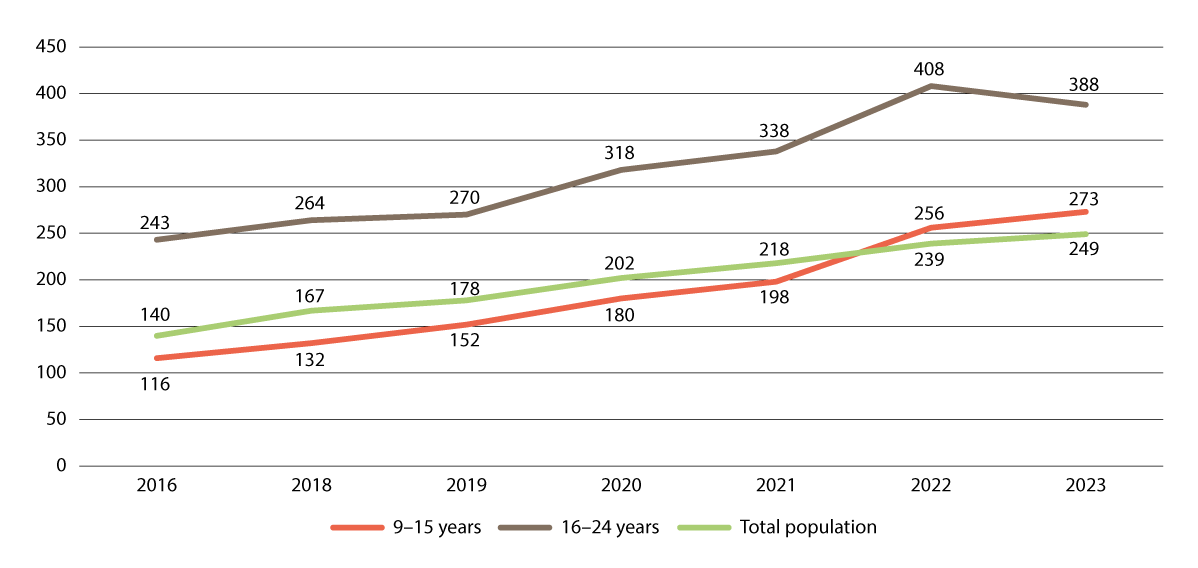
Figure 2.1 Number of minutes spent on the internet on an average day among 9–15-year-olds and 16–24-year-olds.
Source: Bekkengen, 2024, Table 8.1.
In a NOVA – Norwegian Social Research report, researchers divided young people into five groups based on their leisure-time activities, including internet use, and examined developments since 2014.8
-
“Those who most often spend time with friends” are social both online and in person, participate in organised activities, and attend youth clubs. This group has seen the second-largest increase and now accounts for 33 per cent of all young people.
-
“The most home-oriented” use digital media frequently. They play video games, use social media, and watch television, but rarely go out or participate in organised leisure-time activities. This group has grown the most and now accounts for 26 per cent of all young people.
-
“The least digital” spend little time on screen activities, but a lot on school, reading, and organised leisure-time activities. This group has seen the largest decline and now accounts for 19 per cent of all young people.
-
“The most risk-oriented” are social, both physically and digitally, play more video games, and watch more television than the average person. They report more substance use and rule-breaking than others. This group has grown in size and now accounts for 13 per cent of young people.
-
“The most culturally engaged” participate in creative activities, often attend youth clubs, and spend relatively little time in front of screens. This group has decreased and now accounts for 9 per cent of all young people.
Overall, much of the shift in group sizes can be explained by the fact that digital activities have become a larger part of the leisure time of many children and young people.
2.2.2 Artificial intelligence
Artificial intelligence (AI) has quickly become a part of children’s and young people’s lives. Generative AI enables rapid retrieval and compilation of information, as well as the production of synthetic content, and is actively used for both education and play. In Kantar’s 2024 media usage survey, almost half of 15–24-year-olds reported using ChatGPT in the last seven days.9 However, the use of AI starts earlier and is becoming increasingly common in apps and learning tools for children. Many children encounter technology that uses advanced algorithms before they have learned to read, evaluate content, or understand how the technology works.
Although knowledge of how AI affects younger children remains limited, some studies provide insight into how children interact with such technology. They show that many children interact with AI in ways that resemble social relationships.
AI is present in social media, for example, in the form of chatbots that children can talk to or form friendships with. This may be entertaining, but it can also challenge the formation of opinion and influence children’s behaviour in various ways. Children can develop close bonds with AI assistants and digital conversation partners.10 This is especially true for younger children who have not yet learned to distinguish between humans and machines. Children between the ages of three and ten may treat AI assistants as if they were real people. Some talk to them as if they were friends, saying that the technology “knows everything”, “never gets angry,” or “always listens”. Such statements suggest that children attribute emotions and intentions to the technology. This type of bond is referred to as a parasocial relationship. The child experiences attachment, even though the technology has no feelings or understanding of its own. Bonding with a digital conversation partner can affect children’s understanding of friendship and interaction. Furthermore, children and young people are particularly vulnerable to manipulation when using AI. There have also been cases where AI-based chatbots have developed emotional or sexual relationships with children and young people. In some cases, this has had serious consequences. Lawsuits have been filed where relatives believe that the technology contributed to psychological distress and, in some cases, suicide.11 This highlights the dangers of children becoming attached to technology that lacks empathy or understanding.
AI is also integrated into children’s lives in “partially covert ways”12 in recommendation systems and personalised services in social media and games. AI helps provide content tailored to what the user is interested in and engages with. At the same time, there are several examples of undesirable use of AI, whether in connection with schoolwork, the production of fake and harmful images, audio, or videos, or the production of sexualised content.
There are currently few statistics and little knowledge about children’s use of AI, and it is difficult to predict how AI will affect children’s upbringing in the future.
2.2.3 Digital leisure time – social media and video games
Various digital activities form a key part of most children and young people’s leisure time, and many are particularly active users of social media and video games.
Digital media
Seventy-five per cent of children between the ages of nine and 13 report using screens for social media (see Figure 2.2). Among 9–18-year-olds, the most used platforms are YouTube (83 per cent), Snapchat (70 per cent), TikTok (58 per cent), Instagram (46 per cent), and Discord (20 per cent).
Half of 9–18-year-olds report that humour, memes, and funny videos are what they watch most. Music, sports, exercise, food, and fashion are mentioned by a third as the most popular types of content from influencers.13Skeiv Ungdom (Queer Youth) has pointed out that many queer young people meet through social media, and that social media has made it possible to find information about being queer and to build networks. Twenty-nine per cent of 9–17-year-olds find it easier to be themselves online than when they are with others face-to-face.14
Textbox 2.1 Comments from children and young people: Gender differences in digital leisure time
Young people in the county authorities’ youth councils experience that gender differences in children and young people’s digital leisure time are “absolutely real”. They believe that there must be room for different interests, and that boys are often more interested in video games and girls in social media. At the same time, they believe that everyone should be allowed to pursue their interests, regardless of gender. They believe it is unfortunate that some digital arenas, such as video games, are more open to one gender than another. They find that many girls avoid video games because of social pressure and stereotypes, and the risk of being harassed. They report that “playing like a girl” is a common expression in gaming culture.
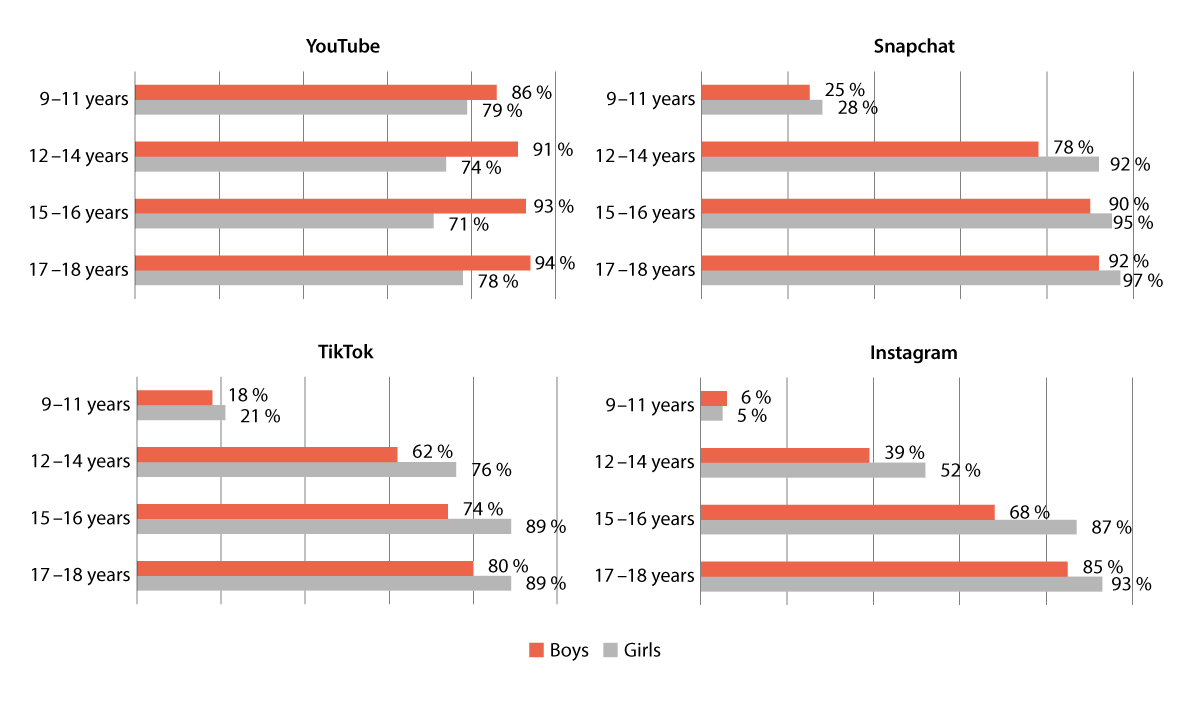
Figure 2.2 Percentage of users of Snapchat, TikTok, Instagram, and YouTube by gender and age.
Source: Norwegian Media Authority, 2024, Figure 10.
Video games
Most children play video games (Figure 2.3). In a 2024 survey, 86 per cent of 9–18-year-olds reported playing games on a PC, game console, mobile phone, tablet, or similar device.15 This applied to 93 per cent of boys and 79 per cent of girls. The frequency of gaming decreases with age for both boys and girls. A total of 72 per cent of boys aged 9–10 reported playing daily, while 57 per cent of 15–16-year-olds and 47 per cent of 17–18-year-olds reported the same. By age 17, a larger proportion of boys reported playing weekly or less frequently. Among girls, the trend is different, as a larger proportion of girls play weekly or less frequently. Thirty-six per cent of 9–10-year-olds play daily. The proportion who reported playing daily is only 16 per cent when girls turn 17, 30 percentage points lower than boys.
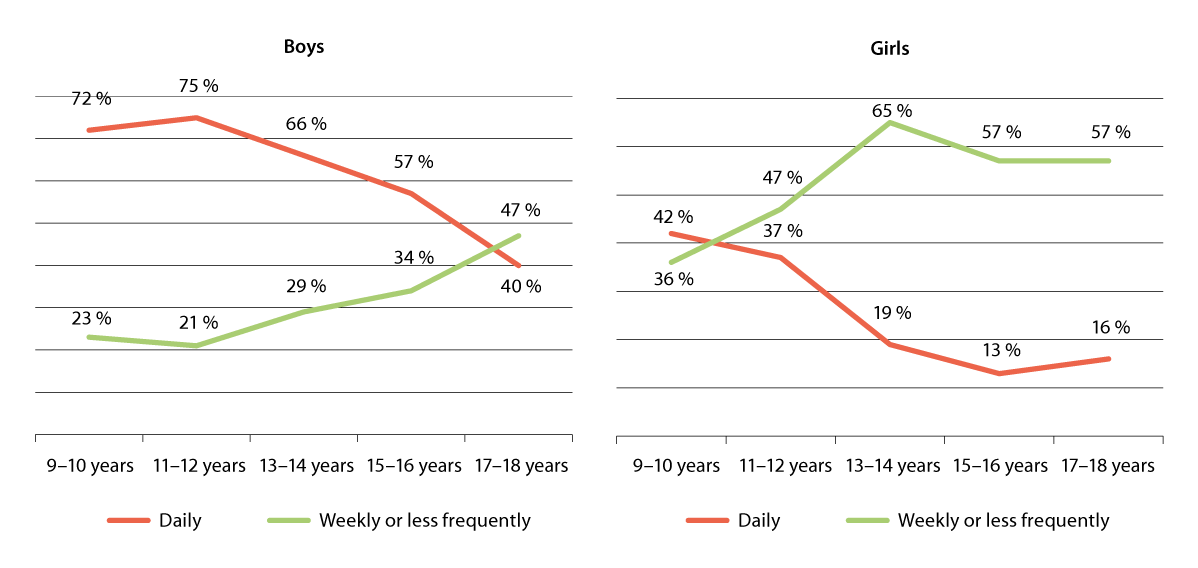
Figure 2.3 Percentage who reported gaming “daily” and “weekly or less frequently” by gender and age.
Source: Norwegian Media Authority, 2024k, Figure 3.
2.2.4 Screens at school
Norwegian pupils use a lot of educational technology at school, both for academic work and other purposes. In the 2023 International Computer and Information Literacy Study (ICILS),16 72 per cent of Norwegian Year 9 pupils reported using digital technology daily for schoolwork while at school. This percentage is lower than in Denmark and Sweden, but higher than the international average and in Finland. The use of digital technology varies across subjects, with Norwegian language and social studies being the subjects in which it is used in most lessons. Pupils use general digital tools such as presentations, word processing, and information websites in most lessons at school. The use of spreadsheets or tools developed specifically for classroom use (such as simulations and modelling, multimedia productions, or data logging) is less common. When educational technology is used effectively in teaching, it can provide opportunities for more tailored instruction and greater variety in teaching methods and sources of information.
Textbox 2.2 Mapping of pupils’ digital competence in Year 9
The International Computer and Information Literacy Study (ICILS) is an international comparative study of digital competence and algorithmic thinking among Year 8 pupils (Year 9 in Norway). The survey has been conducted in 34 countries. Norway participated in the study in 2013 and 2023. The study provides insight into the use of digital technology in schools and how schools use technology to develop pupils’ digital competence.
Studies show that pupils in primary and secondary education and students in higher education have poorer reading comprehension when reading a text on screen than on paper. The Screen Use Committee, cf. NOU 2024: 20, points out that screens are particularly unsuitable for reading longer, coherent informational texts. Reading longer texts is particularly important for developing good reading proficiency, as well as cognitive skills such as critical thinking. Screens and digital devices can also be disruptive to teaching.17
The Screen Use Committee points out that using multiple media simultaneously (known as media multitasking), which involves constantly shifting attention between different media, can be linked to concentration difficulties. Media multitasking at school is associated with poorer learning outcomes and academic performance, and is distracting for both those who do it and those around them. The ICILS survey shows that Norwegian pupils are above the international average in terms of performing multiple activities at the same time while doing schoolwork at home.18 For Nordic pupils, multitasking is significantly negatively correlated with the results of the tests they took in the survey.19
2.2.5 Use of digital media in different age groups
Children and young people’s screen use changes as they grow up, both in terms of how much time they spend on screens and what content they consume. Over the last decade, there have been major changes in what young people do in their leisure time, and digital activities have become increasingly important to their everyday lives. At the same time, young people are spending less time on schoolwork, fewer are reading books, and more are working out at the gym.20
The youngest children
The digital activity of the youngest children is largely controlled by their parents and relatively limited. Thirty-eight per cent of parents with children aged one to four report that their child has access to a tablet.21 Within the same group, 10 per cent report that their children had access to screens independently before age one. According to their parents, the youngest children mainly use digital devices for entertainment. For the youngest children, screens can serve as a ‘babysitter’ and provide relief for parents. Among children aged 1–4 with access to tablets, 76 per cent watch video entertainment, and about half use gaming apps.22
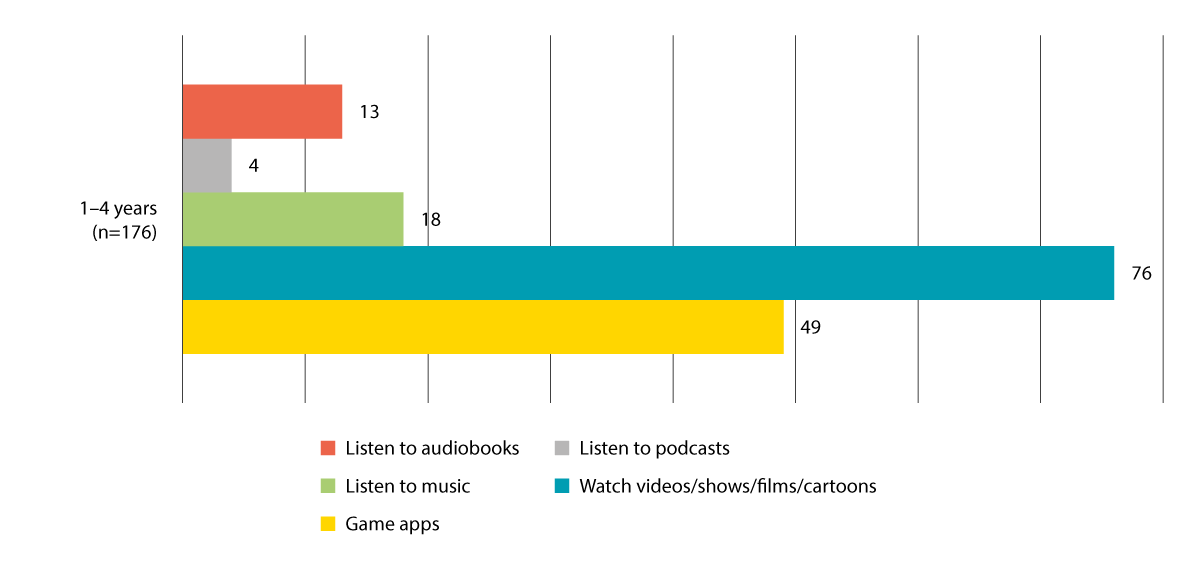
Figure 2.4 The digital activity of the youngest children
Source: Norwegian Media Authority, 2024g, Figure 10.
Children in middle childhood
The older the children get, the more the internet occupies in their lives. A total of 95 per cent of 9–12-year-olds use the internet every day. Children in this age group spend an average of 204 minutes a day online.23 The Norwegian Media Authority’s 2024 survey on children and media shows that when children are between five and eight years old, 20 per cent have a mobile phone and nearly a third use a smartwatch. Half have access to a game console, and 75 per cent have access to a tablet. The vast majority get their first mobile phone when they are between seven and ten years old, and 94 per cent have their own mobile phone when they are 9–11 years old.24
Games are an important part of children’s everyday digital lives, and the use of gaming apps on mobile phones or tablets is highest among children aged 5 to 10. A total of 81 per cent of parents report that their children in this age group play games on mobile phones or tablets.25 The use of social networking services increases sharply at the age of nine. This is especially true for girls. A total of 73 per cent of parents of boys aged 5–8 report that their child plays video games daily or weekly.26 The youngest users use social networking services to talk to friends, comment on other people’s posts and images, and create and share images. In the 2024 survey on children and media, two out of ten children aged nine to eleven report using TikTok, and just over 80 per cent report using YouTube. The use of Snapchat and Instagram increases among children aged 12–14.27
Young people
Young people aged 16 to 19 spend an average of 397 minutes online each day, i.e., 6 hours and 37 minutes.28 Almost all pupils have access to their own digital device in lower secondary school and upper secondary education and training. From lower secondary school onwards, laptops become more common, while tablets become less so. In Year 10, 55 per cent of pupils have access to a PC or Mac, 27 per cent have a Chromebook, and 16 per cent have a tablet. These figures remain roughly the same throughout lower secondary school.29
During adolescence, the differences in digital use between girls and boys become more pronounced. A higher proportion of boys use Discord and YouTube, while girls are more likely to use TikTok and Instagram. Girls aged 15–18 are the most likely to share images and videos on social networking services.30
Many young people explore their sexuality online. In the 2022 survey on children and media, 55 per cent of 13–18-year-olds who had watched pornography online responded that they first saw pornography before age 13. More boys than girls have watched pornography online.31 In the Norwegian Media Authority’s 2024 survey on children and media, 30 per cent of 13–18-year-olds responded that they had been sent naked images of others. This applies to more girls than boys. Over half have received such images from a stranger, and nearly a quarter from their boyfriend or girlfriend.32 The survey did not inquire whether the incidents were solicited or unsolicited. In the 2021 Ung i Oslo survey, 34 per cent of young people reported at least one experience of digital sexual violations in the past year.33 The Norwegian Media Authority reports that 22 per cent of 13–18-year-olds have received unwanted sexual comments online in the past year.34
2.3 Prerequisites for participating in the digital environment
Being able to participate in the digital environment is important for social relationships and a sense of belonging. When young people lack access to equipment or are otherwise digitally excluded, this has consequences for their social lives, leisure time, schoolwork, and access to support services. This may also be the case for children and young people whose mother tongue is not Norwegian, such as the Sámi, when digital resources have not been developed in their language. The Sámi Pupil Forum, which has provided input to this white paper, reports that there are few opportunities to use Sámi digitally. The UN Committee on the Rights of the Child emphasises in General comment No. 25 that all children must have equal and effective access to the digital environment in ways that are meaningful to them. The Committee calls on States parties to take all necessary measures to combat digital exclusion.
In NOU 2022: 9, the Freedom of Expression Commission stated that several groups face barriers to connection and participation in the public sphere. In particular, the Commission highlighted that access to the public sphere is insufficient for persons with disabilities and that various minority groups face issues related to harassment and vilification when engaging in the public sphere. A common theme in comments to the Commission from young participants was that harassment and vilification can hinder self-expression.
Textbox 2.3 Action plan for increased inclusion in a digital society
In June 2023, the Government presented an action plan for increased inclusion in a digital society. The aim of the action plan is to combat digital exclusion and ensure that as many people as possible are included in the digital community. The action plan is primarily aimed at groups experiencing digital barriers and digital exclusion. The action plan includes measures to ensure that those who want to participate digitally can more easily find support and assistance in acquiring the necessary digital tools and skills.
2.3.1 Access to equipment and infrastructure
The vast majority of children and young people today have access to connected digital devices at all times and use them actively. However, there are still children who grow up in low-income families, and neither have access to nor can afford the equipment they need or want to participate digitally on an equal footing with other children. In the EU Kids Online survey, the majority of parents report that there are financial aspects of internet use that can be problematic.35 The proportion of parents who find that various media and internet access are too expensive increases as the household income of the family decreases. In the action plan for inclusion in a digital society, one of the measures is to establish more schemes for the reuse of used equipment, including considering schemes for the lending of ICT equipment that include children and young people.
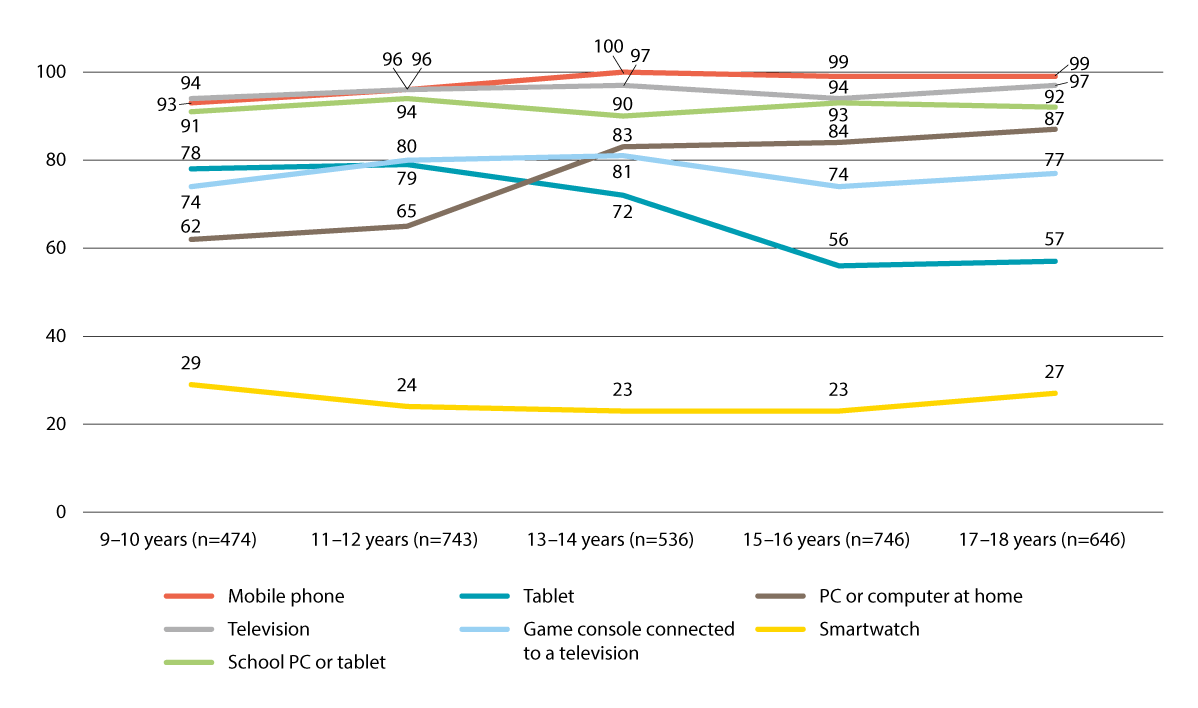
Figure 2.5 Percentage with access to equipment. Grouped by age
Source: Norwegian Media Authority, 2024b. Figure 2.
Internet access is generally very good in Norway. Few households lack access to fixed broadband or mobile networks with acceptable data speeds.36 In its digitalisation strategy The Digital Norway of the Future. National Digitalisation Strategy 2024–2030, the Government has set a target that everyone in Norway shall have access to broadband with a download speed of at least 1 gigabit per second by the end of 2030. The Government allocated NOK 400 million in 2024 to support the expansion of broadband in areas lacking commercial viability.
The Youth Network has called for accessible digital leisure time. They note that many children consider video games to be an important leisure-time interest. For all children to have equal opportunities to participate in digital leisure time, they must have access to physical meeting places that offer such activities. Physical meeting places, such as youth clubs and events organised by voluntary organisations, must be adapted to offer digital leisure-time activities for all children. The Youth Network and youth councils have emphasised the importance of digital services and platforms being accessible to all children, regardless of their economic background.
2.3.2 A good culture of expression
Children and young people’s participation in the public sphere necessitates that they have access to channels for self-expression, the skills to participate across various platforms, and knowledge of how digitalisation in society affects the conditions for democracy and freedom of expression.37 The culture of expression online influences whether children and young people dare to express themselves and participate in public discourse. Cyberhate and hate speech cause young people to withdraw from public discourse.
According to a report on the climate of freedom of expression in Norway, young people between the ages of 16 and 24 are more vulnerable to cyberhate than adults.38 This is related to how active they are in sharing their views and opinions on social media. In the report, 25 per cent of respondents report participating more in the debate after experiencing cyberhate, while 32 per cent state that they have become more cautious.
2.3.3 Adults to rely on
Parents and other close caregivers are the most important people when it comes to looking after children’s interests and needs. Parents are responsible for creating a safe environment for their children in their everyday lives. This is crucial for the emotional, cognitive, and social development of the child. Online, as in other aspects of a child’s upbringing, parents should monitor their children’s needs according to their maturity and age.
Textbox 2.4 Parental supervision of their own children online
In a 2023 survey by Sentio, commissioned by the Norwegian Directorate for Children, Youth and Family Affairs, parents and children were asked about parents’ supervision of their own children online.1 When asked if there is anything that prevents them from supervising their child’s online activities, parents responded as follows:
-
One in three reported that there were no obstacles preventing them from monitoring their child’s online activities. This group consists mainly of young parents under the age of 35 with the youngest children.
-
One in three reported that their child’s privacy is an obstacle to monitoring their child online. This category mainly consists of parents with children over the age of 14.
-
Just over one in four consider it as an obstacle that their child does not involve their parents. This is again related to the child’s age.
-
Thirty per cent report they lack the knowledge to monitor their child’s online activities.
-
Sixteen per cent report they do not have time to monitor their children. Parents of children in the early school-age group (7–10 years) are overrepresented in this group.
-
Only seven per cent report that their child does not follow the family’s rules for internet use.
When asked whether they talk about what their children do online, parents and children respond differently:
-
Seventy per cent of parents report that they talk to their children about what they experience online, while 57 per cent of children report that they rarely talk to their parents about what they do online.
-
Fifty per cent of parents report that they often or very often talk to their children about what they do online, while only 20 per cent of children report that their parents do so either often or very often.
1 Sentio, 2023.
High digital competence, for both children and adults, is essential for children to navigate the internet safely. Safe adults with sufficient knowledge, digital skills, and literacy play a major role in guiding and monitoring children in their everyday lives, including on digital platforms. However, some parents find it challenging to keep track of the content of their children’s online communication and to balance their parental role with their children’s right to privacy (see Box 2.4).
Children may also need support and advice in unfamiliar or difficult situations that arise online. Parents and guardians have a particularly important role in being people children can safely turn to with questions and concerns. However, figures from the European survey EU Kids Online39 show that only 35 per cent of Norwegian children say they talk to a parent when they experience something negative online. Fifty per cent spoke to a friend of the same age, and 25 per cent did not talk to anyone. Young people also believe that parents and media platforms should take greater responsibility for ensuring that age limits are enforced, so that younger children are not on social media before they are mature enough to handle content intended for older users or hate speech.40
Families are different and may have different capacities for guiding and enabling children to handle digital challenges. If the policy is based solely on parents having the digital competence to guide and set limits for their children’s internet use, this could potentially contribute to reinforcing social inequalities. The Screen Use Committee highlights that many parents feel disconnected from their children’s schoolwork, and parents’ lack of digital competence can be an obstacle to using the school’s digital solutions. It is particularly those parents who report low digital skills who feel there is little cooperation with schools regarding the use of digital technology. Some parents may face a double challenge if they also have poor Norwegian language skills.
The action plan for a safe digital upbringing expresses a need to strengthen digital competence among the professions that work with children and young people. The includes employees who work with children in the health sector, child welfare services, family counselling services, and crisis centres. These are employees who, by virtue of their role, are responsible for helping to ensure that the rights of children and young people are safeguarded. To do this, they also need sufficient knowledge about the digital context in which the child lives.
2.3.4 Digital competence to participate
Children and young people develop digital competence by using the internet and digital tools themselves, learning from friends and parents, and through kindergarten and school. Children start using the internet and social media at an early age. The Youth Panel for Møre og Romsdal County has submitted comments on the importance of age-appropriate training, including on internet safety, safe internet use, source criticism, and the advantages and disadvantages of using digital tools.
Digital competence involves both knowledge and skills, as well as the ability to reflect and engage in critical thinking. It also includes digital judgement, which helps children to participate safely in a digital society. In order to navigate the internet safely, children must be able to distinguish between true and false information, identify risks, detect attempts at fraud, distinguish advertising from other content, and protect their own and others’ privacy. They must also be familiar with social rules for online behaviour. Unpleasant experiences or exclusion can limit children’s opportunities for participation, and digital technology can adversely impact relationships. The Youth Network points out that digital technology can thereby get in the way of relationships with others.
The ICILS survey maps 14-year-olds’ digital competence and algorithmic thinking skills in 34 countries. Norwegian pupils perform above average in digital competence and average in algorithmic thinking. Compared to the 2013 survey, Norwegian pupils’ digital competence has declined, as evidenced by more pupils now scoring at the lowest level (an increase from 24 to 40 per cent). The survey also shows that pupils’ home background, including socio-economic conditions and access to digital resources, is clearly correlated with their performance.41
2.3.5 Available services and teaching aids
Digital services must be accessible. Children and young people who require special adaptations, for example, because they have hearing, vision, speech, or reading difficulties, depend on specially adapted programmes, games, and learning tools.
Digital teaching aids are covered by the legislation governing the universal design of ICT. Local school authorities are responsible for conducting the technical and legal assessments of digital solutions. There are a number of requirements for digital teaching aids and other digital solutions that must be met before they can be purchased and used. The Norwegian Authority for Universal Design of ICT monitors digital solutions in the school sector and follows up on breaches of the Regulations on use of information and communication technology (ICT Regulations) by issuing corrective orders. The agency has the authority to impose daily fines if corrective action is not taken within the deadline. In addition, the agency engages in dialogue with suppliers and interest groups to contribute to learning and improvement in the sector.
In 2023, the Norwegian Authority for Universal Design of ICT conducted sectoral inspections of primary and lower secondary schools concerning digital teaching aids. Breaches of the ICT Regulations were uncovered across all solutions.42 To strengthen learning and improvement in the sector, inspection results are shared with relevant actors. All inspection reports and analyses are published on uutilsynet.no.
3 Digital development challenges privacy and consumer protection
On the internet, personal data can easily be collected, stored, shared, and sold. Children and young people are particularly vulnerable in relation to privacy, as they often lack the necessary knowledge and experience to protect themselves online. Questions may be raised about children’s ability to understand what they are consenting to when they agree to surrender personal data. This is particularly true in contexts where consent is given quickly and without sufficient understanding of what it entails or of the long-term consequences for the child’s privacy and rights. Furthermore, children and young people are growing up in a digital, commercial market that challenges their consumer protection. In addition, children are exposed to advertising when they use digital services such as games and social media. In General comment No. 25, the UN Committee on the Rights of the Child has highlighted the risks of violation or abuse of children’s rights when children’s personal data is processed as part of commercial activities.
3.1 Children’s privacy
Data processing when children and young people use digital solutions and social media is a central focus of the Privacy Commission’s report, cf. NOU 2022: 11. The Commission notes that the commercialisation of personal data has created strong economic incentives to collect as much data as possible, and children’s personal data is often collected on the same scale as that of adults. The Privacy Commission believes that the digitalisation of society has come at the expense of privacy and that a range of privacy challenges affect children’s digital upbringing. Children are less capable than adults of managing their own privacy and safeguarding their rights. Younger children especially need protection and guidance from their parents. The use of personal data can contribute to creating or reinforcing unintended biases that can particularly affect vulnerable individuals and groups. Children and young people are particularly vulnerable because they are more easily influenced by their surroundings and are still exploring their identity. The Government believes that children’s personal data should not be subject to commercial exploitation.
Often, it is someone other than the child who makes decisions about how their data will be used. It follows from Articles 5(2) and 24 of the General Data Protection Regulation that all those who process personal data are responsible for safeguarding data protection and complying with data protection legislation. All organisations across the sectors, such as the school and kindergarten sector and the health sector, must independently carry out sound data protection impact assessments. Strong privacy protections are vital for trust in society, and lay the foundation for freedom of expression, freedom of information, and opinion-forming. Having knowledge of people’s lives, thoughts, and secrets holds significant power. Uses of personal data include tailoring messages, making decisions based on assumptions about individuals and groups, adapting and pricing products, and developing new services. The right to privacy and data protection is central to ensuring that people can seek information, form opinions, and express themselves without being subject to control or surveillance.
3.1.1 Regulations on children’s privacy
The right to privacy is crucial for a safe digital upbringing. Article 102 of the Constitution states that “[e]veryone has the right to the respect of their privacy and family life, their home and their communication” and that: “The authorities of the state shall ensure the protection of personal integrity.” Article 104, third paragraph, of the Constitution states that “[c]hildren have the right to protection of their personal integrity”. The right to privacy and data protection is enshrined in Article 8 of the European Convention on Human Rights (ECHR) and Article 17 of the UN Convention on Civil and Political Rights (ICCPR). According to Article 8 of the ECHR, everyone has the right to respect for their private and family life, their home, and their correspondence. Interference by public authorities with the exercise of this right may occur only if the measures are in accordance with the law and necessary in a democratic society. Furthermore, children’s right to privacy and data protection is enshrined in Article 16 of the UN Convention on the Rights of the Child. Children’s right to privacy is also proposed to be highlighted through a new provision in the bill on a new Children Act (Prop. 117 L (2024–2025)). See further discussion in section 6.1.1.
Data protection is regulated in more detail in the Personal Data Act, which stipulates that the EU’s General Data Protection Regulation applies as Norwegian law. The data protection legislation contains few provisions specifically aimed at children, but it follows from recital 38 of the General Data Protection Regulation that children merit special protection, as they may be less aware of the risks, consequences, and safeguards concerned, as well as their rights. They should be particularly protected when personal data is used for marketing purposes, when personality or user profiles are created, and when personal data is collected when they use services offered directly to children.
The General Data Protection Regulation requires that consent must be a “freely given, specific, informed and unambiguous indication of the data subject’s wishes by which he or she, by a statement or by a clear affirmative action, signifies agreement to the processing of personal data relating to him or her”, cf. Article 4(11). However, children have different capacities than adults to understand and be aware of the risks and consequences of their actions and to know their rights. Therefore, the Personal Data Act requires providers to obtain the consent of parents or guardians for children under the age of 13 to consent to the processing of personal data when using information society services, such as social media, cf. Section 5 of the Personal Data Act. If the child is under the age of 13, parental or guardian consent is required for the processing of the child’s data. In practice, however, the major social media platforms do not have effective solutions for obtaining parental consent.
The right of children to independently consent to the processing of personal data, outside of the use of information society services, is not specifically regulated under the Personal Data Act or the General Data Protection Regulation. Therefore, the main rules regarding children’s capacity to consent in the Guardianship Act, the Children Act, and any other special regulations will apply.
Textbox 3.1 Comments from children and young people: Protection of children’s privacy
The county authorities’ youth councils are concerned with the protection of children’s data protection. They believe that there should be clear guidelines on how their personal data may be collected and used. They propose evaluating existing legislative provisions to ensure that they are effective and sufficient to protect children’s interests on digital platforms. Data protection challenges are a concern that youth councils across Norway highlight as a negative aspect of growing up online. They express a desire to know more about these challenges and to make them a larger part of education in primary and lower secondary schools.
3.1.2 Children’s privacy in school
The Privacy Commission points to privacy challenges posed by the dominance of big technology companies in schools and the use of kindergarteners’ and pupils’ personal data for commercial purposes. Many schools and municipalities have limited knowledge of how to protect pupils’ privacy, and the risk of breaches of children and young people’s privacy is therefore high. The Privacy Commission also notes that pupils are exposed to algorithms from commercial actors through the use of digital technology in education. This influences students’ media habits and time management, both during and outside school.
Knowledge and information from schools and local school authorities are necessary for pupils and parents to be able to engage in and participate in decisions about their education. An important prerequisite for the use of digital solutions in the dialogue between parents and the school is that local school authorities have established effective procedures to safeguard the privacy of pupils, staff, and parents. Under the General Data Protection Regulation, kindergartens and schools are obliged to provide data subjects (kindergarteners and pupils) with information about the processing of their personal data. This means that information must be provided to parents and, where appropriate, to pupils, depending on the pupil’s age. In addition, parents and pupils have the right to access the personal data that is being processed. Parents and pupils also have the right to have incorrect data erased or rectified. This is particularly important for data concerning children with disabilities, who require special adaptations, who have allergies, or who need medication, and for parents’ contact details. Information and access are essential prerequisites for parents to protect their children’s privacy and for pupils, depending on their age, to safeguard their own privacy. Both the Norwegian Directorate of Education and Training and the Norwegian Association of Local and Regional Authorities (KS) have published guidance for local school authorities and schools on how best to protect the privacy of staff and pupils.43
There are several requirements for digital teaching aids and other digital solutions that must be met before they can be purchased and used. The requirements for data protection and information security are laid down in law, and assessing the quality of digital solutions also involves considering their legal and technical aspects. It is the responsibility of local school authorities to carry out the technical and legal assessments of digital solutions. Compliance with data subjects’ rights is part of all assessments in the procurement process for digital solutions. These are requirements that all data controllers must comply with, and which are intended to ensure that data processing is legitimate and properly founded. In order to strengthen work on data protection, information security, and universal design in schools, the Norwegian Directorate for Education and Training has prepared a report on how best to establish common support services on such matters for local school authorities and schools. The report presents models for the organisation and content of the support services. The Ministry of Education and Research will follow up on the report.
3.2 Children’s consumer protection
The commercial influence on children and young people’s everyday digital lives has become more personal, complex, covert, and ubiquitous.44 This raises the risk of them being exposed to marketing that may be inappropriate, harmful, or have an impact on their physical or mental health. Children and young people enjoy special consumer protection, including through provisions of the Marketing Control Act and the Broadcasting Act.
3.2.1 Significant commercial pressure
The Norwegian Media Authority’s survey on advertising pressure on children shows that 6 out of 10 children and young people aged 9–18 who use social media feel they are exposed to too much advertising.45 The Ombudsperson for Children’s expert group on a safer digital everyday life reported that children might experience commercial pressure from influencers they follow on social media without even realising it.46 This could be influencers who advertise various products and services. It may be difficult for young people to know whether influencers are advertising something they like or posting because they are being paid to do so. A Consumption Research Norway (SIFO) report on children and young people’s digital competence47 summarises previous research findings as follows:
“Influencers promote an entire lifestyle; that is, not just individual products, but a variety of (often luxurious) identity products that convey status. As influencers appear as role models for young people, whom they trust highly and perceive as friends, it is very difficult for young consumers to distinguish between the market and everyday life in this type of commercial relationship, and for young people to realise how they are being influenced and manipulated.”
The young people who participated in consultation meetings in connection with this white paper stated that cooperation between the authorities and the technology industry is necessary, including to develop guidelines and tools that promote a safe online experience for children.
Exposure to overt and covert advertising
A study of what influencers communicate to their followers shows that 45 per cent of posts from the influencers that children and young people most like to follow contain advertising.48 For foreign and Norwegian influencers combined, 17 per cent of posts containing advertising are not labelled as such. Foreign influencers post the most covert advertising, while Norwegian influencers are generally good at labeling posts that contain advertising. When it comes to Norwegian influencers, only 15 out of 340 posts containing advertising were not labelled. The Norwegian Consumer Authority participated in a joint European inspection in 2023, which found that 60 per cent of the influencers inspected were inconsistent in their advertising labelling for their own products and services.49
Marketing with an impact on health
A 2018 SIFO report found that children in Norway are exposed to significant amounts of advertising for harmful and inappropriate products on social media.50 The survey showed that 80 per cent of children have been exposed to gambling advertisements, one in four children have been exposed to alcohol advertisements, and almost half have been exposed to advertisements for plastic surgery or cosmetic procedures. The children state that they would prefer to avoid this type of marketing. During an inspection in the spring of 2023, the Norwegian Consumer Authority, the Norwegian Board of Health Supervision, and the Norwegian Medical Products Agency uncovered extensive illegal marketing on social media by clinics offering cosmetic procedures.51
Studies conducted by Retriever for Actis and the Norwegian Cancer Society have shown that there is widespread exposure of children to social media content featuring alcohol, tobacco, and nicotine products.52 It is not always disclosed whether such content is produced to market the products in question. Positive references to, for example, alcohol, tobacco, and nicotine products, energy drinks, the use of tanning beds, and products for building muscle or bodybuilding can affect mental health and quality of life.
Behavioural advertising
A large amount of personal data is gathered about consumers when they use various digital services. This information is used to create profiles for individual consumers or to sort consumers into categories and segments. The SIFO study mentioned above on marketing and data protection in social media showed that the digital marketing children encounter in social media is, to a significant extent, tailored to their personal data such as gender, location, age, ethnicity, and digital activities.53 Since the survey was conducted, the amount of data collected on users has increased, and targeting options have become more advanced.
In NOU 2019: 19 on gender equality challenges among children and young people, the UngIDag Committee writes that stereotypical representations of boys and girls dominate advertising. Massive and highly gender-stereotypical marketing contributes to narrower frameworks for how children and young people develop gender identity and what perceptions they have of what it means to be a girl or a boy. Research shows that girls are exposed to advertising that portrays the ideal as thin, beautiful girls with flawless skin and shiny hair, while boys are exposed to advertising that depicts active, strong, athletic bodies, defined abdominal muscles, and large biceps.54 Girls are exposed to far more advertisements for beauty and cosmetic products and services than boys.55 The UngIDag Committee also believes that marketing can contribute to increased body image pressure. The Ombudsperson for Children’s expert group pointed out many of the same things, arguing that unrealistic body ideals in advertising can create pressure. Some of the girls felt that the advertising played on their emotions and insecurities.56 Behavioural advertising can reinforce this trend by recommending content that is more extreme or harmful than what the user would have searched for themselves.
Schools shall be free of advertising
Children are also exposed to advertising in a school context, including through digital media, apps, and programmes on the school’s digital devices.57 The Privacy Commission’s report points out a particular risk that free teaching aids may be funded through advertising. These issues are addressed in the Government’s strategy for digital competence and infrastructure in kindergartens and schools, which was presented in 2023. The Education Act clearly stipulates that pupils shall not be exposed to advertising that may exert commercial pressure, or that may substantially influence attitudes, behaviour, and values. The Government believes that children and young people should be able to enjoy school as a place where they are free from commercial pressure.
3.2.2 New technology challenges children’s consumer protection
The prevalence of social media used by children and young people has emerged alongside a new business model for internet-based services. YouTube, TikTok, Snapchat, and Instagram, which young people use extensively, are, like most other social media, funded through advertising. The business model is based on the collection of large volumes of personal data, categorisation into interest profiles, and the use of recommender systems. The providers’ revenue streams are directly related to the amount of exposure users receive to advertisements. This means that providers have an interest in users spending as much time as possible on their platforms, and the system being designed for this purpose. The Screen Use Committee points out that when the service is free, the user is the commodity.
Addictive mechanisms
The Screen Use Committee states that social media features and design choices can lead children and young people to spend more time on the platforms than they intend. They believe there is a need to regulate mechanisms of addictive design, such as endless streams of content, infinite scroll, and autoplay, and that the Norwegian authorities should contribute to international efforts in this area. The Norwegian Consumer Council has pointed out that recommendation algorithms can continuously optimise content based on what generates the most engagement on the platform, prioritising addictive, dopamine-triggering content that keeps users scrolling, clicking, and watching. To ensure that users return to the platform, mechanisms such as notifications or streaks are often used.58
Textbox 3.2 Manipulative design, skins, streaks and loot boxes
Manipulative design is an interface or design feature that controls, deceives, or pressures consumers into making choices that are primarily in the interest of the enterprise.1 There are many forms of manipulative design, for example, when a choice or information is particularly emphasised through placement, size, or colour, or when costs are hidden or do not appear until the end of a purchase.
Skins are cosmetic items in games. Players can give characters or objects in a game new clothes or appearances. This does not affect how they function in the game. Skins can be bought and sold between players, much like collectibles. Some skins are rare and can be valuable, with players spending real money to buy or sell them to other players.
Streaks are used by platforms to create habits, engagement, and continuity. A streak can be the number of consecutive days two people send pictures to each other, or the number of consecutive days a user is logged into a platform. Breaking a streak means that the accumulated series is reset to zero. Streaks are used in social media, games, fitness apps, and learning apps.
Loot boxes in video games are virtual boxes, a form of surprise package, that can be purchased for real money or virtual currency, or won in-game, and whose contents are unknown until the box is opened. The contents of the box give the player advantages in the game or provide items that serve as cosmetic accessories for the game character. These can be weapons, new skills in the game, skins, or the game’s own virtual currency. Information about the contents and odds of winning is often absent.
1 Norwegian Consumer Council, 2022b.
Manipulative design and in-game purchases
Manipulative design can cause users to purchase something they did not intend to buy, or spend more time than they intended. Manipulative design can be found across all online channels, including streaming services, social media, and games. In recent years, in-app purchases, virtual currencies, loot boxes, and so-called pay-to-win mechanisms have become common ways to monetise players. This contributes to more time spent and higher revenue generated from players, as well as algorithms and recommendation systems being increasingly designed with a commercial purpose in mind. Pay-to-win mechanisms involve purchasing advantages in the game. Loot boxes are generally not considered gambling and are therefore not covered by the new Gambling Games Act (see discussion in section 9.5.4).
The gaming experience can be tailored so that the player is led into the game shop or gambling-like mechanisms, such as loot boxes, without being able to identify or resist them.59 Games can incorporate designs that make shopping and consumption seem like play and reward. Children may be more vulnerable than adults to manipulative design.60
In video games, spending money and gambling-like elements in games can become a problem for young users, as the Screen Use Committee also pointed out in its report. Skins and loot box winnings are examples of video game elements used as deposits and winnings in the unregulated gambling market known as skin betting. Several websites that offer unregulated gambling in Norway allow players to use various payment methods as stakes or to withdraw winnings, giving players the choice of which payment method to use to participate in the gambling. These can be ordinary currency, various forms of cryptocurrency, and virtual gaming currency, such as Robux from Roblox or skins, particularly from the video game Counter-Strike. There is concern that such websites could act as a recruitment channel for other unregulated gambling sites offering high-risk games, which might lead to more young players developing gambling problems. See also the discussion of gaming disorder in section 4.2.3.
Humanisation and generative artificial intelligence
Several social media providers and internet platforms offer generative AI solutions as part of their service, such as Snapchat’s MyAI chatbot. People can develop friendships with bots, which implies a form of trust.61 See also the discussion of AI in section 2.2.2. The Norwegian Consumer Council is concerned that humanising user interfaces, in which the service appears as a human being in its interactions with consumers, may challenge children’s privacy and consumer protection.62 The Norwegian Consumer Council emphasises the risk of unhealthy emotional attachment, manipulation, data collection about children, and the potential for this to be exploited commercially.
A Danish government-appointed expert group on big technology companies has addressed the issue of children and young people in its latest interim report on limits to the development and use of artificial intelligence by technology giants.63 The report makes four recommendations:
-
Chatbots should be disabled by default, free of charge, and free from manipulative design.
-
The design of AI should take into account children as vulnerable consumers.
-
Children and young people must be protected from the use of AI in toys.
-
There is a need for a sharper focus on the risks posed by AI to children and young people.
4 Harmful content and use
Both the content of digital services and how they are used can be harmful to children’s development, their physical and mental health, and their safety. It can also create addictions. Harmful content and use are exacerbated by the fact that most social media platforms rely on recommendations powered by artificial intelligence, machine learning models, and algorithms. In this sense, the platforms are ‘walled gardens’ on the internet, where providers have considerable influence over the content users are exposed to, and also collect and reuse data on users’ interests and behaviour. The platforms have changed the internet from a neutral space to one that offers content tailored to individual users.64 The platforms are designed to achieve commercial goals of exposure to advertisements and prioritise engaging content in order to maximise time spent on the platform (see also section 3.2). In General comment No. 25, the UN Committee on the Rights of the Child calls on States parties to protect children from harmful and unreliable content and to require relevant enterprises and other providers of digital content to develop and implement guidelines to enable children to safely access a diversity of content.
4.1 Risks
School-age children are particularly vulnerable to social influence, while the risk of such influence decreases in the transition to adulthood.65 Through social media, children and young people can seek out and participate in environments that negatively influence them, where it is difficult for adults to identify risks and prevent participation.
The central government has a duty to protect children and young people from harmful content and to help them safely navigate the media landscape. It is a challenge that the legislation does not sufficiently regulate social media. The Act relating to the protection of minors against harmful audiovisual programmes defines harmfulness based on traditional platforms for the dissemination of moving images, such as cinema and television, and sets rules for age limits on these platforms, among other things. The assessment shall be based on whether the content may be harmful to children and young people below the relevant age limit. The assessment is based on a precautionary principle, taking into account what children in different age groups can tolerate.
When assessing whether something is ‘harmful’ under the Act relating to the protection of minors against harmful audiovisual programmes, it is not a question of concrete evidence of psychological harm, but rather of how the content may affect children emotionally or cognitively. Harmful content may be content that causes fear, discomfort or that conflicts with children’s own norms, such as violence and pornography. The assessment shall also take into account children and young people’s right to information and access to media content. The definitions of harmful and seriously harmful content in the Act are legal standards. The interpretation of these terms may evolve in line with new research on harmful effects and societal norms. See also the discussion of the Act in section 9.2.5.
4.1.1 Exposure to violent content
The Norwegian Media Authority’s 2024 survey on children and media reveals that more than half of young people aged 13 to 18 report seeing violent content at least once in the past year. One third have seen fighting or the planning of fights.66 The survey shows an increase in the proportion who have been exposed to harmful content compared to 2022 and 2020.
In a qualitative study conducted by the Norwegian Media Authority, 11 young people aged 13–15 were asked about the content they found most harmful.67 The young people particularly highlighted violent content. This applied in particular to brutal videos of youth violence, though videos of murder, suicide or animal abuse were also mentioned. Several stated that they were often exposed to violence on social media and that it was difficult to avoid, as it was often shared in chats or groups. Almost all of the young people in the survey said they had seen things they wished they had not. Some said they had already come across such content when they were younger. Furthermore, several of the young people in the same survey highlighted that they found ‘exposed’ accounts, or public shaming accounts, to be harmful. These are closed accounts where images and videos are shared, often submitted by the account’s followers. Exposed accounts are mainly used for spreading rumours, vilification, and similar activities, but are also utilised to share pornography and abuse material.
4.1.2 Pornography
It is widely recognised in society that pornography is unsuitable for children. It follows from Section 317 of the Penal Code that anyone who supplies pornography to persons under 18 years of age is liable to punishment. Pornography can be frightening for younger children. For young people, pornography can be a source of exploration and pleasure, but it can also be addictive and influence their thoughts and attitudes towards sex.68
In the Norwegian Media Authority’s survey on harmful content (see above), several young people felt that pornography was too readily available on the internet. In its report, the UngIDag Committee points out that pornography can be problematic in terms of stereotypical representations of gender, unrealistic representations of how bodies should look, and sexual acts that can cause stress and pressure to perform. At the same time, the Committee emphasises its concern that there is very little knowledge about younger children’s sexual media practices, such as how early children seek out and are exposed to pornographic and other sexual content online. The Social Media Harms Committee, cf. NOU 2021: 3, noted in its report that children’s exposure to sexual and pornographic content often raises concerns among adults. Pornography with aggressive, offensive or violent elements can have a negative impact on attitudes and sexuality, especially for boys, and lead to problematic and harmful sexual behaviour.69 A study covering five European countries, including Norway, found a correlation between regular use of pornography among boys and gender-discriminatory attitudes or a tendency to sexually objectify women.70 Young people who are more exposed to pornography are more likely to engage in sexual harassment of their peers than young people who are less exposed to pornography.71 Young people themselves also point to pornography as a possible contributing factor to the extent of sexual harassment among young people.72 In its concluding observations on Norway’s tenth periodic report, the UN Committee on the Elimination of Discrimination against Women noted with concern reports of an increase in cases of sexual abuse of teenage girls by teenage boys and the possible link to the sexualisation of women online and the availability of pornography.73
4.1.3 Bullying, vilification, and harassment
The internet provides children and young people with greater opportunities to express themselves, but it also increases the risk of them either exposing others to, or becoming victims of, bullying, vilification, and harassment.
Bullying
The 2023 Pupil Survey showed that 3.8 per cent of Year 7 pupils had experienced digital bullying in recent months. This marks a doubling since 2017.74 The Government has taken several measures to create a good and safe learning environment that promotes learning, for example, through a clear professional recommendation from the Norwegian Directorate for Education and Training to ban mobile phones. The survey on questions for Norwegian schools and school leaders conducted in the spring of 2024 shows that 96 per cent of schools now have some form of such regulation.75 See also the discussion of mobile-free schools in section 7.4.
Textbox 4.1 Cyberbullying
The Pupil Survey defines bullying as repeated negative actions by one or more individuals towards a pupil who may find it difficult to defend themselves. Bullying may involve calling someone hurtful names, teasing, excluding them, talking behind their back, hitting, pushing, or restraining them. Cyberbullying has brought new dimensions to bullying. Cyberbullying can further exacerbate power imbalances, where the victim might not know who is perpetrating the bullying. At the same time, a greater number of people might become aware of the bullying. This can lead to significant uncertainty. A comment, message or image can be repeatedly displayed and shared with many people. Furthermore, cyberbullying or digital violations do not only occur during the school day, but they can also persist once the school day has ended, leaving the victim with no relief from the bullying.
Vilification and harassment
The internet provides children and young people with greater opportunities to express themselves, but it also increases the risk of them becoming victims of vilification and harassment. In the Norwegian Media Authority’s 2024 survey on children and media, 11 per cent of children and young people report that they often receive hurtful comments while playing video games. Of these, 22 per cent state that it upsets them. Seven per cent state that they are often excluded from games by their friends.76 Many websites provide options for reporting, blocking, muting, or banning other users. These can be useful tools for preventing bullying and ending unwanted encounters. At the same time, they can be exploited for unwarranted exclusion and bullying. It may be easier to exclude someone digitally than face-to-face, but that does not necessarily make it any less painful for the person being excluded.
Members of Dyslexia Youth (part of Dyslexia Norway) have commented that dyslexia becomes highly visible in the form of spelling mistakes in comment sections, and many experience being commented on and bullied because of this. Members of the Sámi Pupil Forum, who have provided comments in connection with the work on the white paper on Sámi language, culture and community life – public health and living conditions in the Sámi population (Meld. St. 12 (2023–2024)), have reported instances where Sámi children have made mistakes in Norwegian and been vilified and bullied because of this.
A larger proportion of 16–24-year-olds have experienced vilifying or derogatory comments online than other age groups in the population. Of these, 32 per cent in the 16–24 age group say they have become more cautious about participating in debates and discussions online.77 In its report, cf. NOU 2022: 9, the Freedom of Expression Commission states that it considers it a “clear and worrisome trend where vulnerable minorities in society are subjected to considerable harassment when expressing themselves in public”.
Textbox 4.2 Cyberhate against Sámi people
The matter of wind farm development in Fosen, Trøndelag, is an example of a debate that has generated cyberhate. A report by Amnesty International Norway1 shows that negative comments about Sámi people increased by almost ten per cent as a direct result of the discussions on the matter. Sámi youth have also reported vilification and hate speech online and on social media, which makes it difficult for them to be open about their identity, cf. the white paper Meld. St. 12 (2023–2024). They want more positive Sámi stories in the media to reduce vilification and improve understanding and acceptance of Sámi culture. The action plan against vilification and discrimination of Sámi people (2025–2030), presented by the Government in 2025, addresses vilification and hate speech against Sámi people on social media. The action plan contains a total of 32 measures to prevent and combat racism and discrimination against Sámi people, and includes several measures aimed specifically at children and young people.
1 Analysis & Figures, 2023.
Sexual harassment
There is limited knowledge about how sexual harassment impacts children and young people, but some studies suggest that it restricts young people’s access to social arenas. Digital sexual harassment among young people is widespread. In the gaming world, girls in particular face sexual harassment, homophobia, and gender stereotypes. This may be one reason why young people withdraw from gaming and are deprived of the opportunity to engage in an activity they enjoy.
The Government has presented a white paper on sexual harassment (Meld. St. 7 (2024–2025)). The report defines seven goals for the work against sexual harassment going forward, several of which are aimed at young people. Among other things, the Government is working to ensure that schools, education, culture and leisure activities, sports, voluntary work, and everyday digital life are free from sexual harassment. The white paper also points out that more knowledge is needed about the social contexts in which digital sexual harassment occurs, how young people themselves can contribute to preventing violations, and what they consider to be acceptable sexual communication.
The Youth Network points out that parts of online culture are characterised by a harsh and sometimes discriminatory culture. The Youth Network believes it is important to take action against online harassment and hate, including in gaming culture and the tone of public debate.
Queer Youth have commented that many queer people find a community online, but are also exposed to cyberhate and threats. Vilification and hate speech are forms of discrimination and can prevent children from participating digitally.
The UN Committee on the Elimination of Discrimination against Women78 is concerned that young women are subjected to gender-based hate speech online. The Committee has established that violence against women, including sexual harassment, occurs in all spheres where people interact, including on the internet and in other digital contexts.
4.1.4 Misinformation and disinformation
The internet is a great source of information, but also an arena for misinformation and disinformation, which the Freedom of Expression Commission considers to be a major challenge today, cf. NOU 2022: 9, page 18:
“The Commission believes the scale of disinformation that has been uncovered in several countries is cause for concern and increased vigilance in Norway as well. At the same time, it is important to remember that Norway is relatively well-equipped. Compared to many other countries, Norway’s polarisation is not considerable, its media system is robust and trusted, and the critical media understanding is strong. These are some of the factors that studies have found to be of major significance in terms of how vulnerable a country is to disinformation.”
The Norwegian Police Security Service (PST) warns against attempts at influence operations, particularly from Russia and China. Such operations may seek to change perceptions, create divisions or sow mistrust. Influence operations are often carried out using disinformation and half-truths that are spread rapidly through social media. Disinformation and misinformation particularly affect children and young people because they may find it difficult to distinguish truth from falsehood online. The most common way for children to get their news is from social media.79 Therefore, this group is more exposed to disinformation and fake news. In a survey conducted by the Norwegian Media Authority, 68 per cent of those aged 16–24 responded that they had come across false information in the past year.80
4.1.5 Radicalisation
In its National Threat Assessment for 2025, the Norwegian Police Security Service (PST) highlights that an increasing number of children and young people in Norway are becoming radicalised, particularly through digital platforms. PST notes that digital platforms and digital networks are the main arenas for radicalisation and recruitment to extremism, with an increased spread of extremist content on popular commercial platforms. PST also observes a negative trend whereby more young people are consuming violent content online. This increases the risk of radicalisation and recruitment to extremism among young people in Norway. PST raises concerns that some individuals might escalate extreme views into acts of terrorism.81
In NOU 2024: 20, the Commission on Extremism pointed out that extremists use the extensive reach of gaming platforms and gaming culture for recruitment, spreading propaganda, mobilisation, and violence. Minors in Norway take part in both open and closed, national and transnational extreme digital networks. Much of the extremist propaganda in these networks is designed and distributed to appeal to younger audiences. Algorithms in web searches and social media can quickly lead users to more extreme content. Minors who are drawn to such networks and propaganda may have challenges that make them vulnerable and thus easily receptive to extremist messages. Children generally have a lesser understanding of consequences than adults. In March 2025, the Government presented the white paper Prevention of extremism – Safety, trust, cooperation and democratic resilience (Meld. St. 13 (2024–2025)).
4.2 Health consequences of screen use
Children and young people spend considerable time in front of screens, both at school and in their leisure time. There is general concern about how this may affect their health. However, little is known about the health consequences of such screen use.
4.2.1 Screen use and child development
Children are surrounded by screens from a very early age, both because of their parents’ screen use and as users themselves. There is little knowledge about the consequences of such screen use, but there are some indications that screens have an adverse impact on young children’s neurodevelopment and that children with low socio-economic status are more affected by serious, harmful screen use. In its report, the Screen Use Committee states that socio-economic context, among other factors, may play a role in how screen use affects children. It is important to be cautious about drawing definitive conclusions, but some researchers recommend a precautionary approach.82
Consequences of early screen use
In the first years of life, the brain is particularly receptive to influence. When screens compete with other necessary activities, such as play, sleep, and interaction with adults, this can disrupt the development of language, soft skills, and emotion regulation. Research shows, among other things, that there is a link between using mobile phones to calm children down and emotional regulation difficulties.83 In addition, links have been found between early screen use and delayed language development, fewer language exchanges between children and caregivers, and difficulties with social interaction.84 A link has also been documented between screen use and an increased incidence of attention difficulties, learning difficulties, and symptoms of neurodevelopmental disorders such as ADHD and autism spectrum disorders. Children from low socio-economic backgrounds appear to be particularly vulnerable to the negative consequences of screen use. However, the causal relationships are uncertain.85
Parents’ screen use
In 2022, the Norwegian Institute of Public Health summarised international studies on parents’ screen use in interaction with children aged 0 to 6 years.86 The results provided some support for caution regarding screen use when interacting with children, but nevertheless concluded that it is difficult to draw conclusions about the consequences of screen use. In 15 of the studies, nine showed increased stress and negative emotions in children, as well as lower sensitivity and responsiveness in parents, and poorer overall interaction in the group where parents used screens, compared to the group where they did not. In five naturalistic observational studies of interaction situations in playgrounds, cafés, and similar settings, the authors reported some correlations between mobile phone use and poorer responsiveness, although other factors may also influence the results. The Department of Psychology at the University of Oslo investigated infants’ reactions to their caregivers’ reduced responsiveness caused by mobile phone use. After just one minute, the children showed reduced positive engagement and increased negative behaviour, leading to stress and discomfort. This is the same as what was observed in the Still-Face Effect, where the caregiver stares rigidly through the child without modulating their gaze.87
In its 2024 knowledge review, the Public Health Agency of Sweden refers to a study from the United States showing that parents’ use of mobile devices can have a negative impact on children’s mental health.88 Mobile phone use can lead parents to become less attentive to their children’s needs. According to the Screen Use Committee, frequent mobile phone use, especially when it leads to reduced attention and interaction with children, may negatively affect children’s well-being and sense of belonging.
In its research review, the Screen Use Committee found no strong negative correlations in the research between screen use and young children’s development. However, the Committee emphasised that when parents look at screens rather than at their children during play and interaction, this can have an immediate negative impact on interaction. What children do and watch on screens, and whether they do so with an actively participating adult, seems to have a significant impact on how screen use affects children. Nevertheless, it is uncertain how this affects children’s development and attachment in the long term. The Committee stated that, although the research does not provide clear results, there is reason to be cautious about screen use around young children. Much more research is needed, but from a precautionary perspective, there is every reason to exercise caution and for caregivers to be aware of the possible negative consequences for interaction with children.
4.2.2 Screen use and mental health
The Screen Use Committee highlights that certain trends are heading in the wrong direction, including a rise in self-reported mental health problems and a decline in school performance observed in various studies in recent years. At the same time, the Committee points out that screen use is not the only factor affecting the well-being of children and young people. There has been a rise in mental health problems among children and young people over the past decade, especially among girls, and questions have been raised about whether there is a connection between screen use and poor health.89 However, the results of studies are not conclusive90, and there is limited knowledge about the causes of the increase in mental health problems among children and young people.
Many young people have reported increased body image pressure and low self-esteem from encountering a filtered reality on social media.91 It is likely that body image pressure can contribute to low self-esteem and mental health problems, but relatively few Norwegian studies have so far been able to clarify the causal relationships. International studies conclude that limiting time spent on social media may be preferable, but recognise that this is difficult. Therefore, researchers recommend increasing young people’s knowledge and awareness of the negative consequences of using social media so that they limit their own use.
A study by the Norwegian Institute of Public Health shows that young people who experienced negative events, such as receiving unwanted attention from strangers, being sent naked images against their will, being excluded from groups, or receiving negative comments on their posts, had a higher risk of symptoms of anxiety and depression.92 Another study from the Norwegian Institute of Public Health shows that young people who frequently feel that others are monitoring them on social media to see what they are doing, where they are, or who they are with, also display symptoms of anxiety and depression more often than their peers.93
The Social Media Harms Committee reviewed research on social networking services and mental health and found that it was difficult to provide clear answers about the consequences of these on the mental health of children and young people. The Screen Use Committee states that time spent on social media has a weak, negative correlation with mental health. They believe it is difficult to say why, and that the correlations are complex. Who you are, what media you use, what content you view, and other factors probably play a role. Among other things, they note that teenage girls and children from lower socio-economic backgrounds may be more vulnerable.
Algorithms that increase exposure to harmful content can have negative effects on children and worsen mental health problems. Such algorithms may contribute to selective exposure of content to users. According to Amnesty International, for example, TikTok’s algorithms increase the exposure of children with mental health challenges to content about self-harm and suicide.94 Research shows that young people who struggle with self-harm or suicidal thoughts often use the internet, both in constructive ways – such as seeking support and coping strategies – and in ways that can be harmful. The internet can contribute to normalising self-harm, preventing openness and professional help, and exposing young people to violent methods of self-harm and suicide.95
Textbox 4.3 ABC for good mental health
The public health campaign ABC For Good Mental Health provides tools to offset the negative effects of screen use and social media presence and to strengthen important relationships in life. The aim of the campaign is to increase people’s knowledge of what strengthens mental health and what each individual can do to look after their own mental health. The campaign is based on three approaches: doing something active, doing something together with others, and doing something meaningful. Trøndelag County Authority has tested a pilot project, and the Norwegian Directorate of Health is responsible for implementing the campaign. The campaign will be embedded in each county, while the Directorate will implement national information measures to support the counties’ implementation. The campaign targets kindergartens, schools, and workplaces, among other places, and aims to inspire people to make active choices for their mental health. In 2025, NOK 25 million has been allocated for this purpose.
4.2.3 Ambivalence about disconnecting
Children and young people express that online use can become excessive. Both the youth councils and the Youth Network report that some children experience fatigue from being constantly connected; however, society’s infrastructure makes it impossible for most to disconnect. About three in ten children and young people wish they could log off more often.96 The Youth Network believes there should be clear rules about when the school expects pupils to be accessible.
Because young people are at a stage in their lives where they are developing their identity alongside their peers, it can be particularly challenging for them to balance the time they spend on social media with other needs. Much of their contact with peers takes place on social media, and they may therefore feel a fear of missing out when logged off. Research shows that young people have ambivalence about disconnecting: on the one hand, they are expected to regulate their own screen use, while at the same time they experience clear expectations that they should be connected and present. Digital media reinforce this ambivalence by providing a sense of freedom alongside the pressure to be constantly digitally present.97
Young people who use social media in moderation report fewer mental health problems on average compared to those who spend more than three hours a day on social media.98 At the same time, some research shows that the correlation between screen use and life satisfaction, or risk behaviour, sociality, or physical activity is not straightforward.99
The Norwegian Directorate of Health advises that children under two should not use screens, and that children aged two to five should have limited screen use. For those aged 6–17, the Directorate recommends limiting sedentary time, especially passive screen use, during leisure time.100
Gaming disorder
Video games are an important and rewarding part of everyday media life for many children and young people. For some, however, gaming can become all-consuming and problematic. Previously, concerns about gaming mainly centred on the content of games – whether gaming made players more violent or aggressive. Now, the main concern is how much time gaming consumes. In the Government’s action plan on problematic gaming (2022–2025), children and young people are given special priority. Among other things, the action plan refers to the prevention campaign Snakk om spill (talk about games), which aims to prevent gaming-related problems among children and young people. The campaign is aimed at parents, relatives, and adults who work with children. The campaign also provides information about the grey areas between gambling and video games. The action plan includes measures to strengthen research, knowledge, and skills in the services and to further develop the available treatment options.
Gaming disorder is characterised by impaired control over gaming, increasing priority given to gaming over other activities to the extent that gaming takes precedence over other interests. Furthermore, gaming disrupts school, family, career, and social life. It is also characterised by a continuation or escalation of gaming despite the occurrence of negative consequences. Young people in upper secondary education and training, or students in particular, may have problems managing the amount of time they spend gaming. Younger children are typically supervised by the adults around them, but as they grow older, they are granted more independence. The Screen Use Committee points out that, in some instances, young people drop out of school or higher education and devote most of their time to gaming. See also the discussion of addictive mechanisms and design, which also applies to games, in section 3.2.2.
Children and young people who struggle at school may experience low self-esteem, lack of motivation, and social isolation. For some, video games can become a space where they experience accomplishment, a sense of belonging and social contact. Video games provide an opportunity to develop skills and achieve goals. Games include several social elements, such as forming friendships and collaborating with other players, which can counteract feelings of isolation. Gaming offers both benefits and drawbacks for children and young people.
In a population study carried out by the University of Bergen in 2022, 0.7 per cent of the 16–74 age group are classified as having a gaming disorder, while five per cent are described as exhibiting problematic gaming behaviour. This is a slight decrease from 2019. The occurrence of gaming disorder or problematic gaming behaviour is overrepresented among men. A total of 8 per cent of men fall into one of these categories, compared with 3.2 per cent of women. In the youngest age group, 16–26 years, 16.8 per cent are classified as having a gaming disorder or exhibiting problematic gaming behaviour.101
5 Violence and crime on the internet
Rapid technological developments provide criminals with new tools, means, and methods. When criminals use digital tools and new platforms, crime can be more difficult to detect. In an increasingly digital world, specific forms of crime are evolving as well. This includes various forms of sharing of illegal content, digital violations such as sexual harassment, sexual assault or sexual abuse and exploitation. The extent of digital sexual abuse of children and young people is significant and growing.
5.1 Digital violations
A report on digital sexual abuse against children and young people shows that almost one in three girls and one in ten boys have received unwanted requests to discuss sex online or via mobile phone, or to perform sexual acts.102 Child victims are often afraid to tell their family and friends about such incidents. In cases that reach the courts, the victims have, in many instances, themselves performed the acts on which the conviction is based, which adds an additional layer of shame. The report also states that many victims have reported low mood, sleep issues, concentration problems, self-esteem issues, and anxiety following the abuse. Some have also developed post-traumatic stress disorder, depression, or begun self-harming.
A survey conducted by the Norwegian Media Authority in 2024 shows that 22 per cent of children aged 13–18 have received unwanted sexual comments online in the past year.103 Among pupils in upper secondary education and training, 24 per cent have experienced at least one form of digital sexual violation, and in Oslo, 34 per cent of young people have experienced this. Violations include unwanted sexual comments, images, rumour spreading, sharing or threats to share naked images, and pressure to send sexual images or participate in digital sexual acts. Girls report experiencing digital sexual harassment more frequently than boys, while young people with parents born outside Europe report such experiences less often. Experiences of digital sexual violations tend to rise with age and are most frequently perpetrated by peers.104 Online habits, such as time spent on mobile phones and social media, sexting, and communicating with strangers online, influence the risk of being exposed to unwanted sexual attention on digital media.105
5.2 Sexual abuse
Digital solutions can significantly exacerbate online sexual abuse of children and the sharing and distribution of abuse material.106 Gaming and social media platforms have broadened the opportunities for perpetrators to interact with children. Digital solutions also enable sharing large volumes of material. In recent years, there has been a significant increase in the number of online sexual offences against children and young people. Figures from the National Crime Survey show that around seven per cent of young people aged 16 to 19 were subjected to digital sexual violence in 2022. There are notable differences in vulnerability, affecting 12 per cent of women and 2.6 per cent of boys in that age group.107 In this report, digital sexual violence refers to the taking, sharing, and streaming of images and videos against a person’s will, threats to do so, and being forced to perform sexual acts over the phone or the internet.
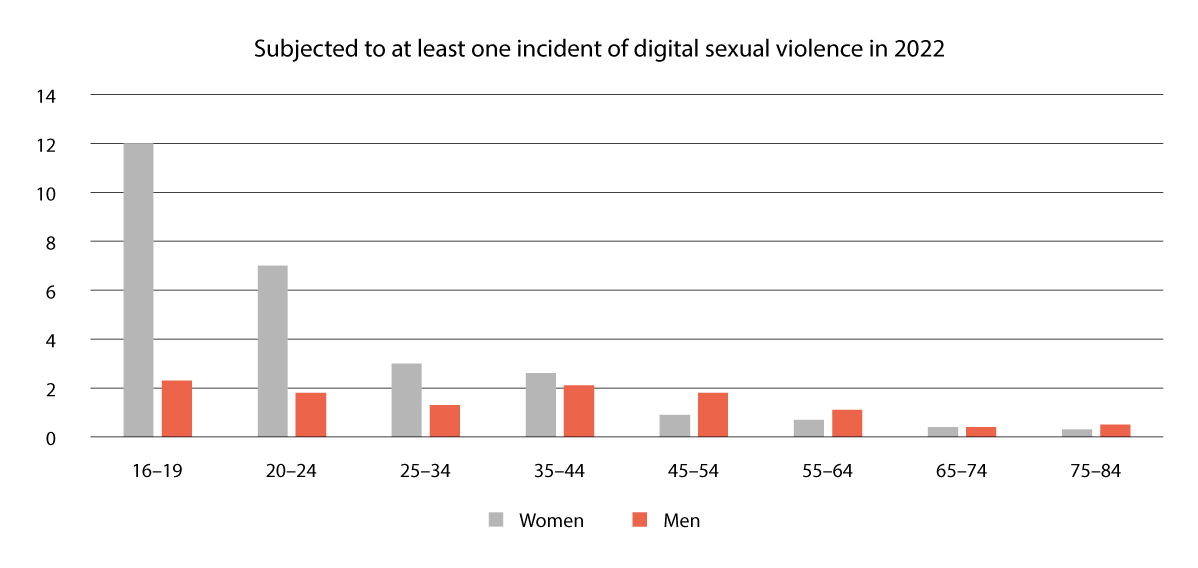
Figure 5.1 Victims of digital violence by age
Source: Løvgren et al., 2023, p. 58
In 2021, one in four reports of sexual assault involving children under 14 and 11 per cent of reports of sexual intercourse with children aged 14 to 16 involved digital abuse. A report from Statistics Norway (SSB) on cases concerning sexual offences in the judicial system reveals that digital tools were used in approximately 30 per cent of all sexual offences against children and young people reported to the police between 2010 and 2022. However, a large proportion of abuse cases are not reported to the police, and it is believed that there are significant numbers of unreported cases of digital abuse against children. The UEVO Study on Childhood Experiences of Violence and Abuse showed that among the young people who had been subjected to sexual abuse, only ten per cent responded that the abuse had been reported to the police.108 When the abuse was committed by a peer, only two per cent was reported to the police. A survey of 508 people who had experienced sexual abuse as children revealed that, on average, 17 years had passed between the first time they were abused and the first time they told someone about the abuse. Fear and guilt are among the reasons why victims do not talk about what they have experienced.109
The number of tips from internet service providers about child sexual abuse has also increased. In the United States, these companies report to the National Centre for Missing and Exploited Children (NCMEC). In 2022, NCMEC received over 80 million tips about child sexual abuse in the form of images and videos. In 2023, the number had more than doubled. In 2023, the National Criminal Investigation Service (Kripos) received more than 13,000 NCMEC tips regarding Norwegian nationals, and the number has increased each year since 2019. The tips include young people who download or share abuse material. The content reported varies, from relatively innocent videos and images taken by children of themselves to documented sexual assaults committed by Norwegian perpetrators. However, most tips concern various forms of abuse material, including uploading, downloading, sharing, possession, or other activities.
Digital solutions provide anonymity to perpetrators or make the identification of digital material difficult.110 These solutions allow perpetrators to mask their identities and the digital traces of their activities, for example, through VPN connections, the dark web, end-to-end encryption, and cryptocurrency payments, to prevent the police from identifying them. At the same time, digital solutions that identify digital fingerprints of abuse material (known as hashes), and machine learning solutions that make it possible to identify new abuse material, represent the most important countermeasures against online child sexual abuse. According to the report, the use of technology that enables rapid searches of large volumes of data is the only way forward to counter the scale and technological advances in the distribution of abuse material.
Textbox 5.1 AI-based crime
Artificial intelligence (AI) may result in increased exposure of children and young people to crime. AI can be used, among other things, to produce fake naked images, which can then be used for extortion purposes, both for financial gain and to pressure children into sending sexualised images and videos of themselves. In addition, such fake naked images can be spread by peers, for example, as a form of bullying. A concerning development is the use of what is known as deepfake technology, where AI is employed to manipulate images and videos to make it appear as if children are involved in sexual acts – without this actually occurring. Such manipulated media can be difficult to recognise as fake. AI can also be used to tailor communication with children and create realistic but fake content on social media. In this way, AI broadens opportunities for exploitation and enables more children to be exposed to digital sexual abuse, as language barriers are removed and highly credible content is presented to children.
Digital platforms also enable live-streamed, ordered abuse, where buyers in one country order sexual abuse of children to be live-streamed from another country via video online. In 2024, Kripos reported that between 400 and 2,000 Norwegians had probably purchased live-streamed ordered abuse over the past year. The people who purchase live-streamed ordered abuse are almost exclusively men. Live-streamed ordered abuse is sold from several continents and countries, but a disproportionate amount of such offences take place in the Philippines.
Sexual extortion for financial gain
The police are reporting an increasing number of cases of sexual extortion for financial gain.111 Such offences are often carried out by professional criminal actors located in other countries. Among other things, well-organised global contact centres have been uncovered. The extortion takes place through the use of fake accounts, where a person is tricked into taking naked images or filming themselves while performing sexual acts. The person is then pressured to pay to prevent the perpetrator from sharing the material with, for example, friends, family, or followers on various social media platforms. The majority of those who are subjected to sexual extortion for financial gain are boys and young men between the ages of 15 and 25; however, girls have also been targeted. The extortion takes place on most social media platforms where young people are active. Snapchat, Instagram and Discord are the most commonly used platforms.
Human trafficking
Children and young people can be exploited for prostitution or other sexual services through human trafficking. Sexual services refer to the sexual exploitation of children and young people for one’s own or others’ benefit. They may be coerced, exploited, or deceived through digital platforms. Under the Penal Code, exploiting children for sexual purposes is considered human trafficking, even if no violence or threats are used, the child’s vulnerable situation is not exploited, or other improper behaviour is not employed. Children and young people may be vulnerable to recruitment on various internet platforms, especially social media. The exploitation itself may take place both online and offline.
Human trafficking is a serious crime and an attack on fundamental human rights. Exploitation in human trafficking has a severe impact on victims, and human trafficking targeting children is particularly serious. In May 2025, the Government presented a national strategy against human trafficking 2025–2030.
5.3 Sharing of illegal content
The police report a trend whereby children and young people are increasingly sharing more extreme content on social media. Such content includes both sexually explicit material and videos depicting violence. The sharing occurs rapidly and on a wide scale, and the consequences for the victims can be very serious. Both boys and girls share sexualised material, but boys do so more frequently. Those who exchange such content often know each other, for example, through school. In several cases, those who shared sexualised material filmed it themselves and also appeared in the material. In the past year, the police have also reported that several girls have had ordinary images converted into naked images using AI-based mobile applications, and that such material has been forwarded to others. In these cases, too, it is usually young people who know each other through school, and the distribution is mainly local.
As a general rule, it is a criminal offence to take, possess or share naked images or videos of anyone under the age of 18. In exceptional cases, the penalty may be waived if the boy or girl has a naked image of someone who consents to them having the image. This could, for example, be a boyfriend or girlfriend, provided they are of similar age and development, and the person depicted is over 16 years of age. In any case, it is prohibited to share such images with others.
The police have found that many young people are unaware of the legislation governing such acts and do not know where the boundaries lie. Only afterwards do they realise that they have no control over what they have shared – and by then it is usually too late. naked images and sex videos shared online are difficult to remove. Knowing that a naked image of yourself is being spread online is a heavy burden, especially for children and young people.
In December 2023, the Government presented a draft resolution on violence and abuse against children and violence in close relationships (2024–2028) (Prop. 36 S (2023–2024)). The plan aims to enhance prevention and protection, identify more cases, and provide better care for victims. The police’s preventive actions, investigations, and criminal prosecutions are central to the plan. The investigation of internet-related abuse of children will be strengthened, and minors under the age of 16 who are suspects in sexual abuse cases will be interviewed at government children’s houses (multidisciplinary centres for child victims and witnesses of violence and abuse).
5.4 Negative social control and honour-related violence
Honour-related violence is a form of violence triggered by the family’s or group’s desire to protect or restore its honour and reputation. This occurs in families and groups where individuals are expected to conform and where patriarchal norms regarding honour are strong. Honour-related violence may include negative social control, forced marriage, threats, ostracism, and other psychological violence, physical violence, and murder. Negative social control comprises various forms of supervision, pressure, threats, and coercion exercised to ensure that individuals live in accordance with the norms of the family or group. Negative social control can be exercised by preventing or controlling access to the internet. A report by Proba samfunnsanalyse, prepared for the Directorate of Integration and Diversity (IMDi), shows that digital negative social control is largely exercised through control over the digital devices of victims, or by gaining access to profiles and messages.112 The report shows that social media can be used as a tool for surveillance and control, and that the consequences of negative digital social control can be serious. At the same time, the report cites studies showing that social media can also serve as a tool for liberation for those living under such restrictions. In May 2025, the Government presented the action plan In Charge of Your Own Life – Strengthened Efforts against Negative Social Control and Honour-Motivated Violence 2025-2028.
5.5 Purchase and sale of drugs
The buying and selling of drugs occurs on social media. A survey shows that 33 per cent of 13 to 18-year-olds have encountered content about the sale of drugs online one or more times in the past year.113
There has been an increase in the use of nitrous oxide for recreational purposes in European countries since 2010.114 There are several websites aimed at Norwegian customers, with pages in Norwegian, delivery available to Norway, and information provided on the regulations for buying and possessing nitrous oxide in Norway.
The Ministry of Health and Care Services has circulated proposals for consultation to ban the recreational sale of nitrous oxide, prohibit the sale of nitrous oxide to those under 18, limit the amount that can be sold to a consumer daily, require suppliers to monitor compliance with sales restrictions, and impose the same age and quantity restrictions on imports.115
The easy accessibility of drugs online also poses a challenge for child welfare institutions, where employees feel they have little control over what children do on social media and what they are exposed to. Employees are calling for updated legislation to address these challenges.116 A lack of insight into and control over the digital communication or activity of children living in institutions can mean that children and young people do not receive the care and protection to which they are entitled. In Prop. 83 L (2024–2025), the Government proposed amendments to the Child Welfare Act. The bill includes a proposal to make it a legal requirement that, if there is reasonable suspicion that a child is being exposed to danger or harm through the use of electronic communication, the institution can decide to access the child’s communication. In addition to the requirement of reasonable suspicion that the child is exposed to danger or harm through the use of electronic means of communication, there is a requirement that access is a necessary measure to provide the child with proper care, protection, and treatment. A clear legal basis will reduce ambiguity for employees at institutions, children, and parents regarding when the institution can demand access to the child’s electronic communications. See also the discussion of child welfare services in section 8.1.
5.6 Recruitment to crime
Children and young people are not only victims of crime, they can also be perpetrators. Children and young people are recruited into crime via digital platforms, including to perform services for others. This may include drug-related offences, theft, or other acquisitive crimes. They may have been coerced, exploited or tricked into the situation, and in some cases, this can be considered human trafficking. Exposure to and sharing of, for example, violent videos or sexualised images can contribute to the normalisation of such acts. The Police Threat Assessment for 2024 indicates that in the battle for market share and territorial control in Sweden, criminal networks have deliberately used inexperienced young people below the age of criminal responsibility to commit murder and other serious acts of violence. Recruitment has taken place on social media and encrypted communication platforms, including criminals using social media to show off and boast about their gains. Criminal networks post violent acts for tender on digital platforms, and the assignments are carried out by young perpetrators. Vulnerable children and young people may be susceptible to recruitment and exploitation for criminal activities. The Norwegian police have long expressed concern that young Swedish nationals are travelling to Norway to commit acts of violence, but so far, no such targeted recruitment of Norwegian children to carry out acts of violence has been observed.
Footnotes
Bakken et al., 2021.
Munthe et al., 2022.
Norwegian Media Authority, 2024b.
Norwegian Consumer Council, 2024.
Schiro, 2023.
Norwegian Media Authority, 2024b.
Bekkengen, 2024.
Bakken et al., 2024.
Berg, 2024.
Hoffman et al., 2021.
Mongomery, 2024.
Slettemeås et al., 2025, p. 19.
Norwegian Media Authority, 2024a.
Staksrud & Ólafsson, 2019.
Norwegian Media Authority, 2024c.
Rohatgi et al., 2024.
OECD, 2023.
Rohatgi et al., 2024.
Fraillon, 2024.
Bakken et al., 2024.
Norwegian Media Authority, 2024g. The figures were based on responses from parents, only a small proportion of whom have children aged 1 to 5.
Norwegian Media Authority, 2024f.
Schiro, 2023.
Norwegian Media Authority, 2024b.
Norwegian Media Authority, 2024g.
Norwegian Media Authority, 2024f.
Norwegian Media Authority, 2024b.
Schiro, 2023.
Norwegian Directorate for Education and Training, 2022.
Norwegian Media Authority, 2024b
Norwegian Media Authority, 2023b.
Norwegian Media Authority, 2024d.
Bakken, 2023.
Norwegian Media Authority, 2024d.
Elvestad et al., 2021.
Norwegian Communications Authority (NKOM), 2023.
Ministry of Children and Families, 2021.
Norwegian Media Authority, 2024j.
Smahel et al., 2020.
Norwegian Media Authority, 2022.
Rohatgi et al., 2024.
Norwegian Authority for Universal Design of ICT, 2024.
KS, 2024; the Norwegian Directorate for Education and Training, 2024b.
Slettemeås et al., 2023
Norwegian Media Authority, 2024e.
The Ombudsperson for Children, 2019.
Reich et al., 2022, p. 22.
Retriever, 2023.
Norwegian Consumer Authority, 2024.
Rosenberg et al., 2018.
Norwegian Consumer Authority, 2023.
Retriever, 2020; Retriever, 2021.
Rosenberg et al., 2018.
Steinnes et al., 2019.
Rosenberg, 2018.
The Ombudsperson for Children, 2019.
Falch, 2022.
Norwegian Consumer Council, 2024.
Norwegian Consumer Council, 2022a.
Steinnes et al., 2023.
Brandtzaeg et al., 2022.
Norwegian Consumer Council, 2023.
Ministry of Industry, Business and Financial Affairs (Denmark), 2024.
Rasmussen, 2021.
Monahan et al., 2009.
Norwegian Media Authority, 2024e.
Norwegian Media Authority, 2024i.
Norwegian Resource Centres on Violence, Traumatic Stress and Suicide Prevention (RVTS), n.d.
Norwegian Directorate of Health, 2021.
Stanley et al., 2018.
Bendixen et al., 2016.
The Ombudsman for Children, 2018.
UN Committee on the Elimination of Discrimination against Women, 2023.
Norwegian Directorate for Education and Training, 2023b.
Bergene et al., 2024.
Norwegian Media Authority, 2024c.
Norwegian Media Authority, 2022.
UN Committee on the Elimination of Discrimination against Women, 2023.
Norwegian Media Authority, 2023a.
Norwegian Media Authority, 2024j.
Norwegian Police Security Service, 2025.
Tryti et al., 2024.
Coyne et al., 2021.
Brushe et al., 2024.
Lunde et al., 2025.
Nøkleby et al., 2022.
Tidemann et al., 2022.
Public Health Agency of Sweden 2024a.
Bang et al., 2024.
Giske et al., 2024.
Eriksen et al., 2017.
Skogen et al., 2023.
Finserås et al., 2023.
Amnesty International, 2023.
Daine et al., 2021.
Norwegian Media Authority, 2024e.
Agai, 2022.
Eriksen et al., 2017.
Bakken et al., 2024; Milosevic et al., 2022.
Norwegian Directorate of Health, 2019.
Pallesen et al., 2023.
Hellevik et al., 2023.
Norwegian Media Authority, 2024e.
Frøyland et al., 2023.
Norwegian Media Authority, 2024e.
Dorotic, 2023.
Løvgren et al., 2023.
Hafstad et al., 2019.
Steine et al., 2017.
Kripos, 2023.
Kripos, 2023.
Proba samfunnsanalyse, 2022.
Norwegian Media Authority, 2020.
EMCDDA, 2022.
Ministry of Health and Care Services, 2024.
Minde, 2021.