Part 3
The Government’s goal for a safe, active and participatory upbringing
6 Parents shall be knowledgeable about their children’s everyday digital lives

Figure 6.1
Parents are responsible for ensuring a safe environment for their children in their everyday lives. It is a challenge that children, even at a very young age, explore the internet on their own and are left to process content and usage that they are not necessarily mature enough to understand. Artificial intelligence and algorithms mean that children and young people are increasingly moving into digital arenas without their parents being there to guide them and set boundaries. Another challenge is that screen time detracts from other daily activities. Parents’ screen use can also have consequences for children, both in terms of parent-child interaction and in safeguarding children’s privacy, when adults share images and other information online.
The Government’s goal is for parents and caregivers to actively participate in children’s everyday digital lives. This is crucial for the child’s quality of life and development, and to protect them from the negative aspects of screen use. Parents are the most important people when it comes to looking after their children’s interests and needs. Good information, advice, and guidance will help parents become knowledgeable about and involved in their children’s internet use, while recognising their responsibilities as parents and making informed choices in the best interests of the child. Parents’ care for their own children is a prerequisite for achieving other goals, such as protecting children in the digital society, facilitating their participation, and ensuring their involvement. For the purposes of this paper, parents include both parents and caregivers of children.
The Government will:
-
Strengthen the dialogue with parent councils on the use of digital technology in kindergartens and schools and in cooperation with homes, including considering measures to support schools and parents’ working committees in their efforts to create a safe digital everyday life
-
Further develop the content of foreldrehverdag.no to strengthen parents’ skills in caring for children in a digital society, including safeguarding children’s right to privacy
-
Develop and publicise national professional advice on screen use for different age groups
-
Facilitate increased international cooperation and knowledge development in order to prepare evidence-based advice and recommendations on children’s digital upbringing
-
Provide foster parents with access to digital services on behalf of the children in their care
6.1 Children’s everyday digital lives present challenges for parents
Parents face various digital challenges in everyday family life, depending on the child’s age and the parents’ digital competence. Some parents struggle to find a good balance between screen use and other activities while trying to protect their children from harmful content, online bullying, and social pressure on digital platforms.
6.1.1 Parental responsibility
The responsibility and duty of parents to care for their children are established in the Children Act. Those who have parental responsibility shall show care and consideration for the child and exercise parental responsibility based on the child’s interests and needs. They shall bring up and maintain the child properly, contribute to the child’s education, and protect the child from physical and psychological violence. Parents make decisions on behalf of their children in personal matters. They shall gradually expand the child’s right to make his or her own decisions according to the child’s age, up until the child reaches the age of 18. In addition, they shall allow the child to participate in decisions that concern them by informing and listening to the child’s opinions.
In the bill on a new Children Act, cf. Prop. 117 L (2024–2025), the Government mainly proposes a continuation of the duty of care. The Government also proposes to specify that when assessing what is in the best interests of the child, parents must recognise that this may change during the child’s upbringing. Furthermore, it is proposed to add a cooperation provision clarifying that parents shall, as far as possible, cooperate to safeguard the child’s health, quality of life, and development. The rules on decisions falling under parental responsibility are proposed to be continued.
Textbox 6.1 Comments from young people: Parents should get involved in young people’s everyday digital lives
Young people from the youth councils and the Youth Network want parents and adults to try to understand what it is like to grow up in a digital world and how digital technology is an integral part of their lives. The youth councils are concerned that parents must strike a balance between keeping track of what their children are doing online to protect them from various risks and showing trust in young people rather than monitoring them.
Young people also believe that parents must recognise that phones and computers are not just a pastime but also an important way to socialise with friends and learn new things. Parents must also recognise that they themselves are users of digital tools. Young people have the following recommendations for parents:
-
Show interest in what young people do online and keep an open mind.
-
Learn about the apps your children use by trying them out yourself.
-
Talk to your children about what they do online and trust that young people know their digital everyday life best. Good communication and trust are important.
-
Digital competence is important in order to be able to advise and help young people when they encounter challenges online. This makes it easier to get involved.
-
Create a parent account for the apps that younger children use to keep track of their activity.
6.1.2 Parents’ knowledge of children’s everyday digital lives
Research based on data from EU Kids Online shows that many parents want to know how they can best help and support their children online and ensure their safety. Parents may feel that they lack information and guidance on how to do this. Most would like to receive information and advice from schools or from national or local authorities. Few parents say they receive information from the authorities. At the same time, few children say their parents have talked to them about what they do online.1 Parents also say that different life situations and hectic everyday lives make it difficult to keep up with their children’s digital lives.2
Providing parents with up-to-date knowledge on how they can best support their children and help equip them for the digital world can help mitigate concerns and address dilemmas. Knowledge enables parents to better balance protection and control in a way that safeguards children’s autonomy, right to co-determination, play and leisure, privacy, and protection from harmful content.
Parental controls are tools that help parents manage and restrict the use of digital devices and content. Such solutions allow parents to set limits on time spent, purchases, apps, communication, and website visits on their child’s mobile phone and tablet. However, only 38 per cent of fathers and 32 per cent of mothers use parental controls to manage their children’s online activities,3 which suggests that it may be difficult for parents to familiarise themselves with the possibilities offered by parental controls.
A lot of work is being done by the authorities to give parents the knowledge they need to manage their children’s everyday digital lives. Foreldrehverdag.no is an online resource developed by the Norwegian Directorate for Children, Youth and Family Affairs for parents with children aged 0–18. Foreldrehverdag.no provides quality-assured information, guidance, and answers to questions about, among other things, children’s everyday digital lives. Foreldrehverdag.no contributes to greater awareness and confidence when dealing with children’s everyday digital lives. In order to strengthen parents’ skills in caring for children in a digital society, the Government will further develop the content on foreldrehverdag.no.
The Norwegian Media Authority develops guidance materials and campaigns aimed at parents, such as guidance for parents on exposure to harmful content. The material is available on the Norwegian Media Authority’s website. The service ranges from parental guides on young children and screen use, which are distributed at health centres, to evidence-based advice for parents on video games and children’s use of social media. In the surveys on children and media, the agency maps children’s media use and parents’ knowledge and attitudes towards it every other year. The surveys are used, among other things, as a basis for developing advice and guidance for parents.
Different prerequisites for acquiring skills
Parents have different prerequisites for keeping up with their children’s everyday digital lives, setting boundaries, and following rules and recommendations. The rapid development of technology also makes it challenging for parents to keep up with and stay up to date at all times. A report on digital parenting in Norway indicates that there may be socio-economic disparities in terms of concerns about children’s screen use.4 For example, parents with lower levels of education and income are more concerned about the risks children may be exposed to online. The report also points out that parents with higher education are better equipped to monitor their children digitally than parents with lower education and less experience with digital media.
The Social Media Harms Committee further notes in its report that parents’ concerns are not necessarily the same as those of children and young people. It can be difficult to identify risks and set boundaries when you do not have insight into your children’s everyday digital lives, and parents may be unsure about which rules and recommendations apply and how they should monitor their children. Parents’ digital competence affects their ability to assist their children, and thus also how children handle their encounters with various digital arenas.
6.2 Advice on time spent online and screen use
Most parents are concerned about their children’s time spent on video games, mobile phones, or the internet. They are also concerned about the content their children have access to and the risks they encounter. At the same time, parents recognise that mobile phone use has positive aspects, such as maintaining relationships with friends and family and finding inspiration, and ideas for various activities and learning.5
6.2.1 Parents’ attitudes towards children’s screen use
Parents may be concerned that children who spend a lot of time on screens are missing out on other important aspects of life. Children may feel that their parents believe digital activities are less valuable than other activities. Children who find great joy in digital activities may find this frustrating.
It can be difficult for parents to gain insight into their children’s online activities, which can lead to concerns and conflicts. Conversations between children and adults about screen use and gaming often revolve around setting rules for when and how long children can game or spend time on social media.6 Rules regarding screen use can create conflicts between parents and children, rather than leading to dialogue about what children actually do online or how they can balance screen use with other activities. The Screen Use Committee also points out that parents may feel guilty because they are unable to engage and have positive experiences with their children on screen. Many parents also say they spend too much time online, and many express that scrolling and screen use affect their time together and their relationships with their children.7
In its report, the Social Media Harms Committee points out that parents must acknowledge and respect children’s media experiences in order for children to develop skills and knowledge. How children and parents talk about internet use, and how parents relate to their children’s everyday digital lives, affects how children experience their upbringing. Parents who guide and help their children navigate the internet safely can build trust. By engaging with the various aspects of their children’s everyday digital lives, parents can gain better understanding and knowledge and thus offer genuine support for their children in the reality in which they are growing up. Through conversations between parents and children about the positive and negative aspects of using social media and games, both parents and children can be equipped for healthier use.8
When children should be given access to a smartphone is also an important question for many parents. Children and young people often feel that it is important to have equal rules and opportunities when it comes to technology and mobile phones. Children may feel excluded when friends their age get smartphones before they do. The phone can become an important part of everyday life and consume a lot of time. Children use smartphones to communicate and play games with friends, among other things. For children without a phone, this can create a sense of exclusion. As discussed in section 6.3, the question of when children should be given access to mobile phones is debated among parents, in parents’ working committees, and in various parent initiatives. The Government wants to assist parents in determining when children should have access to smartphones by providing common advice on time management and screen use (see section 6.2.2), strengthening dialogue with parents’ working committees (see section 6.3), and further developing the guidance for parents at foreldrehverdag.no (see section 6.1.2).
6.2.2 Professional advice on screen use
Many children and young people report wanting to reduce screen use but find it difficult to do so, especially in the evening. Screen use may come at the expense of sleep, schoolwork, physical activity, play, and socialising with family and friends. The Government regards this as a cause for concern. To support parents in managing their children’s screen use and finding a healthy balance, the Government has tasked the sectoral authorities with developing and publicising national professional advice on screen use for different age groups. The Norwegian Directorate of Health is leading the work, with the participation of the Norwegian Media Authority, among others. The guidelines will cover recommended time for sleep, screen use (including addictive algorithm-driven apps), physical activity, social activities, and other daily activities, adapted to different age groups. This is an update of the existing national public health recommendations on screen use from 2019.9 Children, young people, parents and guardians are the main target group, but the advice will be communicated and developed as a basis for practical tools for public services, such as the health service. The advice should be considered in conjunction with the work being done in the education sector aimed at kindergartens and schools.
Sweden has revised its recommendations10 and now encourages children and young people up to the age of 18 to limit their screen use. The Government will facilitate increased international cooperation and knowledge development in order to prepare evidence-based advice and recommendations on children’s digital upbringing. In addition to recommendations for parents, the Government will focus on internet service and content providers, which play an important role in setting the parameters for children’s screen use (see Chapter 9).
Textbox 6.2 National professional advice on screen use among children, young people and guardians
The Norwegian Directorate of Health has published health advice on balanced screen use for the general public: Children under 2 years of age should avoid screens
-
Children aged 2–5 should limit screen use to 0.5–1 hour per day during leisure time – less is better
-
Children aged 6–12 should limit screen use to 1–1.5 hours per day during leisure time
-
Young people aged 13–18 should limit screen use to 1.5–3 hours per day during leisure time
-
Guardians and parents should limit their own screen use when they are with children and young people
The aim of this advice is to highlight the link between screen use and health outcomes, and to promote appropriate and balanced use of digital media during leisure time. The advice concerns screen use during leisure time, i.e. time outside of kindergarten, school, work or schoolwork.
6.3 Parental cooperation with kindergarten and school
The kindergarten should facilitate parental cooperation and good dialogue with parents. In many kindergartens, this cooperation takes place through digital tools. Kindergartens must balance parents’ desire for information about what happens during the kindergarten day with children’s need for staff to be present for them during the kindergarten day. Kindergartens must have a well-considered approach to what and how much they document. Kindergarten staff must have sufficient knowledge to ensure data protection for children. The strategy for digital competence and infrastructure in kindergartens and schools states that the Norwegian Directorate for Education and Training will engage in dialogue with the Parents’ Committee for Kindergartens (FUB) and other stakeholders on the use of digital media in kindergartens and in kindergartens-home cooperation.
When it comes to schools, the vast majority of pupils in grades 1–4 are assigned a digital device by the school.11 Parents make different assessments about when to give digital devices to their children and how access to digital devices should be managed. When the school device is taken home, parents may feel that they lose the ability to regulate their children’s screen use. For some, this may contribute to increased conflict at home.12
The national curriculum stipulates that schools must ensure that parents and guardians receive the necessary information so that they have the opportunity to influence their children’s everyday school life.13 The principle of free education shall also apply when schools choose to use digital solutions in their cooperation with parents. If parents do not have access to digital devices or the internet, or have low digital competence, this can be an obstacle to good cooperation between kindergartens, schools and homes. In such cases, kindergartens, schools and their owners must facilitate good follow-up in other ways.
Many parents want to know what pupils are doing digitally at school and have access to their digital teaching aids. Parents have different experiences and attitudes towards technology in schools. According to the Screen Use Committee, those who believe that there are too many digital solutions in schools are less likely to feel that pupils experience accomplishment and are motivated by digital technology in schools. The Parents’ Committee for Primary and Secondary Education (FUG) survey of parents on digitalisation in schools also highlights challenges in working with parents when it comes to digital learning. Among parents with poor digital skills, as many as 72 per cent say that they are unable to follow and support their child when teaching and schoolwork take place on a digital device.14 According to the Screen Use Committee, a lack of digital skills can be an additional barrier for some families when it comes to following and supporting their children when they are working on the school’s digital devices. Parents’ digital competence is often linked to their level of education.15 Schools must maintain good dialogue with parents about the school’s goals and framework for the use of digital technology, and parents must be given appropriate insight into their children’s development and learning.
Many parents are concerned that pupils may be exposed to harmful content through the school’s digital devices. Parents can obtain information about how the school protects pupils from harmful content through parent-teacher meetings, the school’s parent-teacher association or other collaborative forums. The same applies to how the school works to develop pupils’ digital judgement. The school should also inform parents about where they can find more detailed information about digital judgement and safe internet use. The Norwegian Directorate for Education and Training has developed relevant resources and films about cooperation between home and school that schools can use in this work. Many parents also use the FAU or parent meetings at school as a forum for discussing pupils’ use of the internet, mobile phones or social media in their leisure time, and agree, for example, on common limits for when pupils should be allowed to have a mobile phone. The Government will strengthen the dialogue with parent committees on the use of digital technology in kindergartens and schools and in cooperation with parents, including considering measures to support schools and FAUs in their work to create a safe digital everyday life.
6.4 Consequences of parents’ screen use
Digital tools are not only an integral part of children’s everyday lives, they are also an integral part of family life. In the EU Kids Online survey, over 90 per cent of parents state that they use the internet several times a day and that they use several different digital tools such as mobile phones or tablets.16 Some of the screen use is related to children, for example when parents need to retrieve and provide information about their children’s leisure activities such as training times or voluntary work, to obtain information about everyday life at kindergarten, or to keep track of school activities such as homework and trips.
6.4.1 Children can be influenced by their parents’ screen use
In children’s first years of life, their parents’ digital everyday life is also their digital everyday life. There is a great deal of uncertainty about how children are affected by their parents’ screen use. There are some indications that screen use may affect the interaction between parents and children. See also section 4.2. The Screen Use Committee points out that the brain is highly receptive to influence during the first five years of life, and a lack of stimulation can have a negative impact on development. Children learn from adult behaviour, and studies show that parents play a crucial role in the digital behaviour of children and young people.17 The committee finds that children learn best through interaction with trusted adults and that screen use has no positive effects on the youngest children. They refer to a knowledge review by the Norwegian Institute of Public Health in 2022, which found that children show signs of stress when parents use mobile screens in play and interaction situations. In its 2024 knowledge review, the Public Health Agency of Sweden refers to a study from the United States showing that parents’ use of mobile devices can have a negative impact on children’s mental health.18 Furthermore, the Screen Use Committee points out that mobile phone use can lead parents to become less attentive to their children’s needs. The Screen Use Committee notes that frequent mobile phone use, especially when it leads to reduced attention and interaction with children, may negatively affect children’s well-being and sense of belonging. Therefore, the Screen Use Committee believes that screen use should be very limited for children aged zero to two, and that adults should also reduce their screen use when they are together with young children. For all children, it is important to balance screen use with activities that promote normal development, such as sleep, physical activity, play, and social interaction. Therefore, it is important that adults are aware that they are role models, including when using digital tools, and that they are conscious of when and how they use screens when they are together with their children.
6.4.2 Parents’ responsibility for children’s privacy
Advances in artificial intelligence and algorithms lead to more data being collected about children. Some children are assigned digital profiles before and immediately after birth, linked to their parents’ use of digital services. This happens, for example, through data collection from pregnancy apps and digital products that monitor infants’ sleep and health. Such profiles can follow children throughout their upbringing and may also have significance later in life.
Research on sharenting – the practice of parents and guardians sharing content about their children on social media – indicates that most share images of their children.19 Parents’ motivation for sharing images may be to keep in touch with family and friends. Most people who share, whether they are parents, grandparents, or other adults, are not always aware that sharing information about children, including images, can be problematic from both a privacy and an ethical perspective. In some cases, sharing information violates children’s right to privacy and the rules governing children’s participation and self-determination. This may relate to images that parents perceive as innocent but that children do not want to be shared. This may also include information about children who are in vulnerable situations, such as in hospital, or who are involved in family conflicts, parental disputes, or child welfare cases. This research also shows that children want to have a say in what their parents or guardians share about them from an early age in order to gain control over their digital identities. As mentioned above, for some children, sharing may begin before they are born or are able to consent to the sharing of their personal data on the internet. Publishing images and other personal data about children without their consent may violate their rights.
It can be challenging for parents to find the right balance between protection and children’s right to privacy. Violations of children’s privacy may involve monitoring their online activities and tracking them through location services and similar methods. Parents have the ability to check their children’s search history, review the content on their mobile phones, and track their movements through mobile phones and smartwatches that use GPS technology and location services. When parents secretly monitor their children, it undermines children’s right to privacy and the trust between them and their parents. It may also violate children’s privacy. The UN Committee on the Rights of the Child warns against routine surveillance of children and young people in General comment No. 25.
In its report, the Privacy Commission notes that current privacy legislation does not directly regulate parents’ rights to publish personal data about their own children, nor does it address whether the Norwegian Data Protection Authority can order the erasure of personal data that parents have posted about their children. In April 2025, the Government presented a bill on a new Children Act (Prop. 117 L (2024–2025)). The bill stipulates that children have a right to privacy and that parents have an important responsibility to safeguard it. The provision is general in nature and serves an educational and awareness-raising purpose. The provision does not provide any other rules on when children have the competence to consent to the sharing and processing of personal data, other than what already follows from the Guardianship Act, the Personal Data Act, and various special legislation. However, it stipulates that parents shall give children an increasing degree of participation and self-determination in privacy-related matters, in accordance with their age and maturity, their capacity to understand what the decision is about, the nature of the personal data, the nature of the use of the data, the purpose of the use, and the consequences the use may have for the child’s privacy. The provision clarifies children’s right to refuse permission for their parents to publish images, films, and audio recordings of them.
6.4.3 Filming, sharing, and streaming leisure activities
It has become common to stream and film leisure activities, such as concerts, performances, or sporting events. One challenge in such situations is whether children and young people have given their consent to be filmed and to have their images shared, and whether they have a real opportunity to refuse in situations where parents, friends, and teammates want to share. This will be particularly challenging for children with a confidential address. There seems to be some awareness of the requirement to obtain consent when publishing images and films, as several umbrella organisations for leisure activities have both information and templates for obtaining consent. Nevertheless, it is uncertain how this is practised and how many images of children are available on the internet without their knowledge or that of their parents or guardians.
In 2023, the Norwegian Data Protection Authority updated a guide on streaming sporting events for children, stating that streaming sports in which several children or young people are filmed at the same time is often not legal under privacy legislation. If private individuals, such as family or friends, share or stream to a larger or undefined audience online, the same rules apply. However, parents filming leisure activities for personal use only is not usually covered by privacy legislation.20 In 2023, the Board of the Norwegian Olympic and Paralympic Committee and Confederation of Sports decided, as a general rule, not to allow the streaming of grassroots events. During its deliberations, the Board emphasised privacy legislation, assessments of the best interests of the child, and the importance of complying with the Norwegian Data Protection Authority’s rules.
6.5 Foster parents’ digital challenges
Currently, foster parents lack the authority to digitally represent their foster children, which diminishes their capacity to provide adequate and safe care that aligns with the best interests of the child. In addition, a lot of time is spent documenting the relationship between the child and the foster parents. According to the Norwegian Foster Home Association, some foster parents find this to be a significant burden. In addition to child welfare services spending resources on sending manual attestations to relevant agencies, the lack of information about who is authorised to represent a child living in a foster home can be an obstacle to efficient and secure administration by public actors.
In order to promote stability and predictability, the Government believes that foster parents should have access to digital services for the children in their care, similar to what parents have for their own children. The Government is investigating a solution to give foster parents digital access to services on behalf of the foster child, such as Helsenorge and other digital platforms. The solution being investigated involves allowing relevant users of the National Population Register to retrieve information about who represents the child, so that public authorities, among others, can grant foster parents access to digital services on the child’s behalf. The financial and administrative consequences of a specific proposal must be investigated.
7 Children and young people shall be aware of their rights and how to stay safe online

Figure 7.1
Whereas parents used to be the safe intermediary between the outside world and the child, digital developments now mean that a whole world can contact children directly when they are present on digital platforms from an early age. Adults cannot be present at all times in children’s everyday digital lives. Therefore, it is necessary to equip children to handle the challenges they encounter online and to know where to ask for help when they need it.
The Government aims for children and young people to develop strong digital competence and judgement so they can participate, make informed decisions, and stay safe in today’s and future digital society. Children and young people need skills that enable them to both take advantage of the opportunities offered by digital tools and manage the risks they encounter when using them. Digital competence is a prerequisite for fulfilling children’s rights to information and participation in society, as well as to protection. Schools play a key role in helping all children and young people develop such skills and in reducing digital divides in the population.
The Government will:
-
Present a strategy to strengthen the population’s resilience to disinformation
-
Develop a national strategy for open and enlightened public discourse that addresses how the Government facilitates a well-functioning space for expression, a good culture of expression, and expression preparedness
-
Develop support resources, guidance, and advice for the use of AI in schools
-
Gather experience with the use of AI in schools nationally and internationally, and apply a precautionary principle, especially with regard to the youngest pupils
-
Investigate how schools should meet the need for digital skills in light of technological developments, future needs, and knowledge about children’s everyday digital lives
-
Strengthen the professional digital competence of teachers in kindergartens and schools
-
In collaboration with KS, implement measures to support municipalities and county authorities in their efforts to ensure that all school employees who have access to personal data have the necessary knowledge about data protection and information security
-
Follow up on regulatory compliance related to universal design of digital teaching aids, including through standardisation efforts under the auspices of Standards Norway
-
Follow up on the report on how best to establish one or more common support services for privacy, information security, and universal design in digital teaching aids and learning resources
-
Follow up on national recommendations for mobile phone use in schools and propose stricter regulations, if needed
-
Monitor the use of the Norwegian Directorate for Education and Training’s recommendations on how schools can protect pupils from harmful content online
-
Develop support materials for good digital practices and pupils’ digital competence, in collaboration with the municipal sector and relevant actors
-
Continue the collaboration with Tenk! and Faktisk.no
-
Follow up on the results of the International Computer and Information Literacy Study (ICILS) 2023
7.1 Knowledge, skills and judgement
Children and young people must be able to use technology in an appropriate and responsible manner, in accordance with their age and maturity. They must be able to critically assess the information they access when using digital tools and be able to reflect on their own and others’ digital practices. They must also be aware of the limits of their own and others’ rights in the digital world and be able to seek information to form their own opinions and participate democratically.
Digital competence
Digital competence involves mastering digital life and maintaining a critical, independent attitude when engaging with media.21 Most children and young people know how to use a mobile phone or computer, or install an app on their mobile phone.22 However, such technical skills are only part of the digital competence that children and young people need, and are not sufficient to enable them to cope with all aspects of everyday digital life. The international ICILS survey (see section 2.2.4) shows that Norwegian Year-9 pupils are significantly above the international average in terms of digital competence. Pupils from homes with high socio-economic status have higher digital competence than those from homes with low socio-economic status. Immigration background, the language spoken at home, and pupils’ access to digital tools at home are all linked to their digital competence results.23
Digital judgement
Digital judgement includes learning, identifying, and managing risks online. Although adults and authorities have an important responsibility to safeguard the digital environment in which children grow up, it is neither possible nor desirable to remove everything that is challenging online or to monitor everything children do there. Digital competence and judgement help children identify harmful content or behaviour on the internet and make it easier for them to act appropriately when encountering such content. In order to protect themselves and others, children and young people must also know their rights and understand what is illegal or unacceptable online. This is important to prevent unwanted incidents and can help children and young people become more competent at dealing with harmful or illegal content.
Children must have good digital judgement to protect their own privacy, for example, by changing settings for the processing of personal data on social media and being careful not to disclose personal or sensitive information in groups with unknown users. Sensitive information can include details about where you live, which school you attend, your family, relationships, and interests – but especially information about vulnerabilities, challenges, diagnoses, or sexuality. Such information can be exploited to identify potential targets for grooming, abuse, fraud, or similar offences. A conscious, critical attitude towards digital tools and social media is important for children and young people to assess and understand information and interactions online.
Critical media literacy
The volume of information and the sources of information make it difficult to distinguish what is reliable from what is not. For example, videos on the internet or in blogs can be useful and reliable sources of knowledge, but they can also contain various forms of unreliable information. Critical media literacy and the ability to distinguish between true and false information can help children make good use of information on the internet. The Government will launch a strategy to strengthen resilience to disinformation in 2025. Among other things, the strategy will examine how authorities can help strengthen critical media literacy among the population, including children and young people, so that people can assess for themselves whether information, images and videos are credible.
Much of our digital everyday life takes place on commercial platforms where the sale of advertising space is part of their business model. It is a challenge that the content is sometimes difficult to distinguish from advertising. The authorities are responsible for protecting children from harmful and illegal advertising, and hidden advertising is prohibited. At the same time, children and young people need to be aware of online marketing and be able to identify which content is advertising. They must also know which types of advertising are illegal and which are illegal to target children, so they can report it if they are exposed to such advertising. The Government will develop and update guidelines and legislation on advertising, and commercial and harmful content in schools in response to the challenges posed by technological developments.
Textbox 7.1 Dubestemmer.no
Dubestemmer.no is an educational programme focused on privacy, digital judgement, and online safety, developed through collaboration between the Norwegian Data Protection Authority and the Norwegian Directorate for Education and Training. The site is aimed specifically at pupils and teachers, but parents and other adults who work with children and young people can also find useful information there. Dubestemmer.no provides a good starting point for teaching a range of topics, including privacy, AI, online bullying, source criticism, social media, and the safe use of games and apps. The aim of the programme is to increase awareness, reflection and knowledge about data protection and the choices that children and young people aged 9 to 18 make when using digital media.
The culture of expression online affects whether children and young people can express themselves and participate in public discourse (see section 2.3.2). The Government will present a national strategy for open and informed public discourse in autumn 2025. The strategy will outline the Government’s efforts to ensure freedom of expression in practice, including how to facilitate a well-functioning space for expression, a good culture of expression, and expression preparedness. This work follows up on the Freedom of Expression Commission’s report.
7.2 Digital competence in kindergartens and schools
The Government wants children throughout Norway to have access to equal, high-quality kindergarten services. Digital practices in kindergartens shall contribute to children’s play, creativity, and learning in accordance with the Framework Plan for Kindergartens, and ensure that all children enjoy inclusive, safe, and good environments in kindergartens. Furthermore, the Government wants a comprehensive school where all pupils learn, experience accomplishment, and thrive. Pupils shall develop digital competence in line with the national curriculum and have inclusive, safe and good digital environments at school. Schools shall combat digital exclusion by ensuring that all pupils develop sufficient digital competence to function in society and working life.24
7.2.1 Digital practices in kindergartens
Most kindergarten-age children are in contact with digital devices and media outside the kindergarten. Some have digital experience and references before they start kindergarten. Kindergarten staff must relate to this in the same way as they do to all other experiences that form part of the child’s upbringing and formation. The kindergarten shall exercise digital judgement and help children develop a nascent ethical understanding of digital media.25
It is mainly the oldest children in kindergarten who use digital solutions in educational settings.26 The use of digital tools in educational work in kindergartens shall support children’s learning processes and contribute to fulfilling the framework plan’s guidelines for a rich and versatile learning environment for all children. At the same time, digital tools shall be used with care and should not become the dominant working method. The Government and KS want to ensure that everyone who works in kindergartens has the opportunity to make good choices in the use of technology and media in their educational and administrative work.
Textbox 7.2 Strategy for digital competence and infrastructure in kindergartens and schools
In spring 2023, the Government and KS presented a Strategy for digital competence and infrastructure in kindergartens and schools (2023–2030). The strategy outlines the path towards 2030 for how the central government and municipalities can address the challenges of digitalisation in kindergartens and schools. The strategy shifts the focus from quantity to quality, with a balanced use of technology and a focus on what is best for pupils’ learning. Digitalisation in the sector must be responsible, based on a sound evidence base, and implemented in a planned manner. The strategy highlights privacy, information security, and universal design as particular priorities and includes measures to strengthen the evidence base, the ecosystem around digital learning resources and shared solutions, and guidance and support for the sector.
7.2.2 Pupils’ digital competence
Digital competence is both subject-specific competence and cross-curricular skills that pupils need to learn and live in a digital society. Digital competence is essential for developing pupils’ identity and social relationships, and for enabling their participation in further education, employment, and society. Digital skills are one of five basic skills in the curriculum, and consist of obtaining and processing information, being creative and innovative with digital resources, and communicating and interacting with others in digital environments. This entails being able to use digital resources appropriately and responsibly to solve practical tasks. Digital skills also involve developing digital judgement by acquiring knowledge, strategies for good internet use, and the ability to reflect and engage in critical thinking.27
In the white paper on a more practical school – better learning, motivation, and well-being in years 5–10 (Meld. St. 34 (2023–2024)), the Government notes that advancements in technologies that use artificial intelligence require consideration on what skills the pupils will need in the future and how these should be developed. Having a critical attitude and the ability to understand how technology works is becoming increasingly important. The ability to think critically and exercise good judgement is also essential for actively engaging with what is happening in life and society, and such skills are developed gradually over time.
The digital skills described in The national curriculum must meet the needs of the future, both in light of ongoing social and technological developments and of what is now known about the harmful effects of uncritical use. The Government is therefore proposing measures to achieve a more balanced use of digital technology at the lowest year groups, in line with the precautionary principle. The measures will involve some changes to the curriculum, which will be circulated for consultation in 2025. At the same time, the Government has asked the Norwegian Directorate for Education and Training to consider whether digital skills should continue to be defined as a basic skill in the curricula, and to investigate the introduction of technology subjects in schools so that schools can meet the needs for digital skills in light of technological developments, future needs, and knowledge about children’s everyday digital lives.
The scope and structure of digital work in schools shall be adapted to the curriculum and the age, maturity, and needs of the pupils. Most pupils are doing well in Norwegian schools, but there are some worrying trends. There are some negative learning outcomes, including declines in reading proficiency, increased challenges in the school environment, increased school absenteeism, and increased experience of school-related stress and pressure. Reading longer texts is important for developing good reading proficiency, but screens are particularly unsuitable for reading longer, coherent informational texts. The Screen Use Committee points out that the decline in reading skills, as well as the increase in the number of pupils at the lowest reading proficiency level, suggests that pupils should read more on paper and read longer, more coherent texts to a greater extent than is currently the case. Many pupils are also distracted by their own and others’ use of digital resources.28 Therefore, it is necessary to focus on learning, reading, and concentration, and to raise awareness of when the use of digital tools supports learning.
The Government is concerned that extensive screen-based reading has contributed to a decline in reading proficiency. Several measures to improve pupils’ reading and writing proficiencies are discussed in the white paper Meld. St. 34 (2023–2024).
Artificial intelligence in schools
Artificial intelligence (AI) will play a significant role in pupils’ future. Schools must prepare them for this. Pupils, especially those of lower secondary school age and above, already encounter AI on the internet and social media, through AI-generated content and as a work tool. Schools must equip pupils for a future involving AI, enabling them to act with ethical awareness and critically reflect on the consequences of technology for individuals and society.
The breakthrough of generative AI can provide great opportunities for adaptation and support for both teachers and pupils. At the same time, AI also challenges some of today’s practices in schools. In its advice on AI in schools, the Norwegian Directorate for Education and Training emphasises the importance of working on digital judgement, source criticism, ethics, privacy, and democracy in education. Local school authorities, school administrations, and teachers must take into account the age and maturity of pupils when using generative AI, and exercise particular caution with younger children. The Government will develop support resources, guidance and advice for the use of AI in schools. The Government will also gather experiences with the use of AI in schools nationally and internationally, and apply a precautionary principle, especially with regard to the youngest pupils.
7.2.3 Digital competence for kindergarten and school staff
Kindergarten and school teachers are responsible for educational and academic work and need to update their competences regularly. The Government will also provide other professional groups in kindergartens and schools with good opportunities for competence development. Strengthening the competences of teachers and other staff is important for the quality of kindergartens and schools, and for ensuring that all children and pupils receive an education that promotes development, learning, accomplishment, and well-being.
The competences of kindergarten staff are very important for fulfilling the obligations in the framework plan to ensure the correct, responsible, and appropriate use of digital technology. It is the kindergarten owners who are responsible for ensuring the necessary and relevant competence in their kindergartens to meet the requirements of the Kindergarten Act and the Framework Plan. The Government has good schemes for continuing education and training that support kindergarten owners in their responsibilities.
Employees in kindergartens, schools and plan for out-of-school hours care (SFOs) are important figures in the everyday lives of children and young people, both through play, learning and care, and as safe adults in the event of negative experiences online. Good relationships between children, young people and staff are central to learning, development, and well-being. Teachers are the most important factor in children’s and young people’s learning, but other employees, such as assistants, skilled workers, counsellors, and student support worker, are also important sources of support and role models. They can contribute to good conversations about both positive and negative experiences online. However, research suggests that children and young people find teachers less relevant to talk to about negative experiences online.
For pupils to acquire the digital competence they need, schools must have teachers with strong professional digital competence.29 Among other things, teachers should be able to develop pupils’ desire to learn, learning strategies, and skills for learning in digital environments, assess when the use of digital resources is appropriate, and understand how digital developments affect the content of the subjects. Professional digital competence involves insight into current legislation and ethical issues, and the ability to create a safe, beneficial learning environment for everyone.
New technology presents new opportunities and challenges for teachers’ working methods and for the development of pupils’ digital judgement, subject knowledge, and basic skills. In order for teachers in primary and lower secondary schools to be able to use digital technology in an educational and responsible manner, they need regular updates to their professional digital competence. It is the responsibility of local school authorities to ensure that their employees have the correct and necessary competence to meet the requirements of the Education Act and the curriculum; however, the Government has good continuing education and training programmes in place to support this responsibility.
In 2025, the Government will spend nearly NOK 2.9 billion on skills development measures aimed at teachers and other employees in kindergartens, after-school programmes, schools, and cultural schools, among others. The Government has developed a new comprehensive system for competence and career development for employees in kindergartens and schools, which was recently presented in a strategy on this topic. The comprehensive system will be phased in during 2025 and 2026. The Government will strengthen teachers’ professional digital competence in kindergartens and schools. The continuing education programmes and grant schemes for collective competence development provide good opportunities to tailor competence measures to local needs, including strengthening the professional digital competence of employees in kindergartens and schools. Additionally, several competence packages containing modules aimed at enhancing digital skills have been developed. The competence packages cover the digital learning environment, undesirable incidents, online identity, digital relationships, digital inclusion, privacy, and digital judgement.
Teacher training programmes for kindergarten and school teachers are governed by framework plans. The framework plans stipulate that all students shall have professional digital competence upon graduation as teachers. Across all national guidelines for teacher training programmes, professional digital competence is one of the topics that should be emphasised, in line with the specific nature of each programme. It is up to the institutions to interpret and incorporate these topics into their programme plans.
7.3 Safe digital teaching aids
Pupils must be safe when working with digital teaching aids at school, and their privacy and information security must be safeguarded in an appropriate and secure manner.
Local school authorities are responsible for ensuring that pupils receive training in accordance with current legislation, including the development of digital skills. They must also prevent pupils from being exposed to harmful content and safeguard information security and pupils’ privacy. Good technical solutions must be established for filtering and restricting access to harmful content on the internet on school devices. The solutions should also prevent pupils from being exposed to advertising that could lead to commercial pressure. Schools should also be aware that pupils may be exposed to hateful comments, negative influences, and misinformation and disinformation while at school.30
Furthermore, local school authorities must deal with situations where pupils report having encountered harmful content online and work with parents on pupils’ everyday digital lives. In the strategy for digital competence and infrastructure, the Government has launched a number of measures to improve privacy and protect pupils from unwanted and harmful online content.31
Pupils have the right to freedom of expression, which includes the freedom to seek, receive, and impart information. Restrictions on internet access must be weighed against pupils’ freedom of expression.32 Age-appropriate restrictions on internet and app access in schools can help reduce the risk of pupils being exposed to harmful content on school devices, while also harnessing the learning potential of digital tools and resources in a safe and effective manner. However, such filters have limited accuracy and can provide a false sense of security, and therefore cannot replace training in digital judgement or the role and responsibility of caregivers.
The Norwegian Directorate for Education and Training has updated its guide on how to protect pupils from harmful content online so that it can serve as a useful tool for local authorities and schools.33 The Directorate recommends that all local school authorities provide age-appropriate solutions that restrict access to the internet and apps in the form of filters on pupils’ digital devices and on the school network. If pupils have their own digital device from the school, the Directorate recommends that the school use a filter that restricts pupils’ online access to predetermined content. This is particularly important if pupils use the digital device on their own, either at school or at home. The Directorate also recommends that all school owners use Kripos’ list of websites that are known to be used to contact children or that are created for adults for the purpose of grooming, dating, or sexual services in their filters on networks and devices. A total of 299 municipalities use this list, which represents approximately 84 per cent of all municipalities. The Government will monitor the use of the Norwegian Directorate for Education and Training’s recommendations on how schools can protect pupils from harmful content online.
The municipalities and county authorities are responsible for selecting safe digital teaching aids and can determine in which situations pupils should use digital tools. At its 2024 National Assembly, the Norwegian Association of Local and Regional Authorities (KS) designated a “safe and secure society” as one of its main priorities for 2024–2027. In the SkoleSec project, organised by KS, municipalities and county authorities have joined forces to strengthen their work on privacy and information security in the digital learning environment. The goal is to enhance privacy and information security.34
The Government, in collaboration with KS, will implement measures to support municipalities and county authorities in their efforts to ensure that all school staff who have access to personal data have the necessary knowledge about privacy and information security. In order to strengthen privacy efforts, information security and universal design in schools, the Norwegian Directorate for Education and Training has investigated how best to establish one or more joint support services for privacy, information security, and universal design in digital teaching aids and learning resources. The report presents models for the organisation and content of the support services. The Government will follow up on the study.
7.4 Mobile-phone-free schools
The Government is committed to ensuring that pupils in Norwegian schools learn more and better, and that they have a calm environment, and can concentrate in class. It is important that schools are places of learning and community, and that they set clear standards for good digital habits for children and young people. The Government has therefore issued a clear national recommendation on mobile-phone-free schools, and almost all Norwegian primary and lower secondary schools have now introduced restrictions on mobile phone use during school hours.35 The Norwegian Directorate for Education and Training recommends strictly regulating pupils’ access to and use of private mobile phones and smartwatches through school rules. The aim is to reduce disruption to teaching, promote learning, strengthen the school environment and prevent bullying and other forms of infringements.
Among other things, the Norwegian Directorate for Education and Training emphasises that private mobile phones and smartwatches at school are not part of the school’s educational technology, and that the school cannot require pupils to use them in teaching and training, partly on the basis of the principle of free education. Teaching time should therefore be mobile-phone-free at all levels. For primary schools, the Directorate recommends strict regulation of mobile phone use during recess, and as a general rule, there should also be no mobile phones during recess in lower secondary schools. In view of the age and maturity of the pupils, the Directorate does not recommend mobile-phone-free recess as a general rule in upper secondary schools, but recommends mobile-phone-free teaching time here as well. The Government will follow up on the national recommendations for mobile phone use in schools and propose stricter regulations, if needed.
Textbox 7.3 Recommendations on the regulation of mobile phones and smartwatches in schools
Primary school (years 1–7)
The Norwegian Directorate for Education and Training recommends strict regulation of the use of private mobile phones and smartwatches in primary schools during teaching and recess.
Pupils’ maturity, soft skills and ability to self-regulate are at their lowest early in their school career. To ensure a peaceful, orderly, safe, and good school environment, there is an additional need for clear, predictable rules for smartwatch and mobile phone use in primary school.
Lower secondary school (years 8–10)
The Norwegian Directorate for Education and Training recommends strict regulation of private mobile phones and smartwatches in lower secondary schools during teaching, and that recess should generally be free of mobile phones.
Although lower secondary school pupils are older than primary school pupils, strict regulation is necessary in order to minimise disruption and strengthen the school environment.
Upper secondary school
The Norwegian Directorate for Education and Training recommends strict regulation of the use of private mobile phones and smartwatches during teaching time in upper secondary school. In the opinion of the Norwegian Directorate for Education and Training, strict intervention during breaks and recesses would not be proportionate, given the pupils’ maturity and age. However, the desire to strengthen the learning and school environment may justify certain restrictions, also during recess.
Upper secondary school is a complex institution with several different educational programmes. Any regulations must take into account that pupils, according to their teachers, may need access to private mobile phones or smartwatches during lessons, and this should be taken into consideration when establishing regulations through local school rules, provided this is in line with the principle of free education.
8 Public services shall be accessible, up to date and adapted to children’s needs

Figure 8.1
Employees who work with children and young people must have strong knowledge and expertise about their everyday digital lives. Without such expertise, there is a risk that children and young people will not receive the help they need when they need it. To provide good support, guidance, and protection, those who interact with children in their daily work must understand which digital services children use, what they need, how they communicate, and the opportunities and challenges that come with growing up in a digital society. This is crucial to building trust, picking up on signals, and contributing to a safe everyday life in the digital environment.
The Government’s goal is for employees of public services who work with children, young people, and parents and guardians to have sufficient knowledge about children and young people’s use of digital tools and their rights, such as privacy and the right to protection. In this way, they can understand, follow up, and protect children and young people in their everyday lives and guide parents.
For children to tell adults about the challenges they encounter online, they must feel confident that they will be understood and taken seriously. Furthermore, services that interact with children must be adapted to children and accessible where they are. This includes employees in the police, health centres, school health services, child welfare services, and family counselling services.
The Government will:
-
Review existing content on ung.no about internet-related abuse and assess whether new content is needed
-
Strengthen assistance to children and young people who are exposed to the sharing of images and films on the internet without their consent
-
Evaluate the effectiveness of the Online Police Patrols and assess how police services can be adapted to children’s everyday digital lives
-
Investigate how the provision on grooming in the Penal Code can be worded to also cover digital sexual abuse of children
-
Consider a possible increase in the penalty for violations of Section 311 of the Penal Code on the depiction of sexual abuse of children
-
Strengthen the enforcement of the rules that protect against the sharing of naked images and offensive images without consent
-
Further develop ung.no through the DigiUng collaboration
-
Follow up on knowledge gathering about information and support services for children and young people under the age of 13
-
Contribute to improving the quality of youth clubs by prioritising video games and encouraging the municipal sector to facilitate safe and inclusive meeting places for gaming culture
-
Gather, strengthen and share knowledge and competence about video games and gaming culture, as well as the risks associated with gaming
8.1 Knowledge about digital upbringing in the services
Research results from EU Kids Online 2018 show that Norwegian children rarely turn to an adult for help with internet-related challenges, and very few talk to adults in support services or at school.36 Researchers question why adults in general, and teachers in particular, are not perceived as relevant helpers for digital problems. It is crucial that when children do seek help, they meet adults who understand their everyday lives and the importance of digital media.
Textbox 8.1 Comments from children and young people: Adults must understand the everyday digital lives of children and young people
The youth councils believe that young people feel that the adults they encounter in various public services often do not understand the everyday digital lives of children and young people. They lack knowledge about what young people do online and the problems they may face. Adults who work with children and young people need greater digital competence to help them take advantage of the opportunities available online and avoid the dangers. Young people believe that courses in digital competence should be provided for adults who work with children and young people.
Health centres and school health services
Health centres and school health services are key services for children and young people. It is important that employees have the competence and knowledge to support digital safety in the lives of children and young people. The services offered to children and young people in the school health service should include health-promoting and preventive psychosocial work, as well as cooperation with schools on measures to promote a good psychosocial environment. A good psychosocial environment should also include a safe digital everyday life. The school health service can help to disseminate knowledge about screen use to pupils, teachers, and parents and guardians.
Children’s right to privacy also applies when they contact the support services. In some cases, children and young people aged 12 to 16 have the right to withhold information from their parents. At the same time, parents have the right to consent to health care and the right to access their children’s and young people’s health information until they reach the age of 16. Digitalising health services for children and young people is challenging because such considerations may conflict. This also applies to digital contact with the health service or digital access to patient records. Another challenge is the support services available on social media, where commercial operators can collect highly sensitive information about children.
The Norwegian Directorate of Health has drawn up national professional guidelines on social media in health centres and school health services.37 The guidelines address how health personnel should engage with social media, including information about children that health personnel may access through it. The guidelines also discuss confidentiality, data protection, reporting and notification obligations, and provide tips on using social media in the work of a public health nurse. This advice was last updated in November 2022. The advice will be updated as necessary in line with new knowledge.
Textbox 8.2 Professional advice on self-harm and suicide in social media
The Regional Resource Centres on Violence, Traumatic Stress and Suicide Prevention (RVTS) have developed the website www.selvskading-some.no to provide knowledge and professional advice to adults who work with children and young people about content relating to self-harm and suicide online, and how they can talk to children and young people about these topics.
The child welfare services
There are both positive and negative aspects to the use of social media among children living in child welfare institutions. Digital communication tools make it possible to keep in touch with friends and family and expand social networks. However, there are several examples of children and young people living in institutions forming networks across child welfare institutions that contribute to negative social learning. They can use social media to encourage self-harm, the sale of sexual services, or the sale of drugs. Employees in child welfare institutions feel they have little control over what children do on social media and what they are exposed to, and have called for updated legislation to confront these challenges.38 Under the current Child Welfare Act, employees at child welfare institutions cannot monitor children’s correspondence. A lack of insight into and control over the digital communication or activity of children living in institutions can mean that children and young people do not receive the care and protection to which they are entitled. Save the Children Norway has warned that children in child welfare institutions are vulnerable to sexual offences on the internet.39 The organisation believes there is a need to assess whether the current legislation is sufficient to meet the requirements for effective protection of children against sexual abuse. It finds that the current legislation is not adapted to the use of digital media among children and young people.
In Prop. 83 L (2024–2025), the Government proposed amendments to the Child Welfare Act. The bill contains, among other things, a proposal to repeal the prohibition on institutions monitoring a child’s correspondence. Furthermore, it is proposed to enact legislation providing that, if there is reasonable suspicion that the child is exposed to danger or harm through the use of electronic communication, the institution may access the child’s communication. In addition to the requirement of reasonable suspicion that the child is exposed to danger or harm through the use of electronic means of communication, there is a requirement that access is a necessary measure to provide the child with proper care, protection, and treatment. A clear legal basis will reduce ambiguity for employees at institutions, children, and parents regarding when the institution can demand access to the child’s electronic communications. A clear legal basis and legal safeguards can contribute to greater predictability and better legal protection for the child. If adopted by the Storting, the rule will put institutions in a better position to provide children with the necessary care and protection during their stay.
Knowledge about parental support
Digital competence should be an integral part of the municipalities’ parental support efforts. The online resource on parental support work in the municipalities is a digital professional support tool aimed at employees and managers in municipalities who interact with parents in their services. The resource describes methods, support measures, and programmes that municipalities, various services and the voluntary sector can use to empower parents. The resource includes articles on parental guidance on children’s digital upbringing and is continuously being developed with new articles and other content.
In order to enhance digital competence among professionals who work with parents and children, the online resource shall be strengthened with new articles and competence packages. This is in line with the UN Committee on the Rights of the Child’s recommendation in General comment No. 25 to provide training and guidance to teachers and other adults working with children and young people on the appropriate use of digital devices.
The police
The police provide information and guidance on safe internet use on their website. All police districts have established Online Police Patrols that are visible and accessible on social media. There, the police share information, receive tips, answer questions, and carry out police work online. The public can follow the Online Police Patrols on social media and contact the police via those channels. For children who need to talk to the police in a safe and secure manner, Sikker Chat (SecureChat) is available. Sikker Chat involves the Online Police Patrols being able to send a link to Sikker Chat in order to move a conversation to a secure chat room. The Government will evaluate the impact of the Online Police Patrols and assess how police services can be adapted to children’s everyday digital lives.
In addition, the police have developed teaching programmes on image sharing, such as Delbart (Sharable) on sharing sexualised images and DELE=DELTA (SHARING=PARTICIPATING) on sharing violent videos. These programmes can be used by teachers, public health nurses, social educators, and others who work with children.
The Government has allocated NOK 30 million in the 2024 National Budget to strengthen the police districts’ capacity to detect, investigate, and prosecute internet-related abuse of children. A programme is also being developed to enhance competence in the justice sector in this area. The Government will also examine how the provision on grooming in the Penal Code can be worded to also cover digital sexual abuse of children, and consider a possible increase in the penalty for violations of Section 311 of the Penal Code on the depiction of sexual abuse of children.
It is crucial to systematically share information among relevant services regarding the challenges caused by internet-related child abuse. A uniform and good understanding of the challenges helps to ensure that the measures taken are effective. The police prepare reports that compile intelligence, providing valuable insights.
Textbox 8.3 Comments from children and young people: Strengthening children’s legal protection
The Youth Network points out that children and young people are vulnerable when interacting with the police and the justice system and demands that the policy for a safe digital upbringing strengthen children’s legal protection. To achieve this, children and young people must know their rights and have access to good, age-appropriate information on how to notify and report when they experience something unacceptable. The Youth Network also believes that children must have the opportunity to report anonymously to platforms and to the police.
The illegal sharing of sexualised images and films on the internet is a major burden for those who are subjected to it. The helpline Kors på halsen (Cross my heart), run by the Norwegian Red Cross, and the question-and-answer service at ung.no are examples of services aimed at children and young people that offer free advice and guidance to victims. The Government will review the existing content on ung.no about internet-related abuse and assess whether there is a need for new content. See also the discussion of ung.no in section 8.2.
Slettmeg.no provides advice on how to proceed in order to have information, images, and films removed from the internet. Telecommunications service providers also offer assistance with removal. However, this requires that the individual making the request is a customer of theirs. There is a need to improve the services offered to vulnerable individuals, especially children under the age of 14. The Government will strengthen the enforcement of rules that protect against the sharing of naked images and offensive images without consent, and strengthen assistance to children and young people who are victims of the sharing of images and videos on the internet without their consent. See also the discussion of digital services for children in section 8.2.
Facilitating digital leisure activities
Some youth clubs and libraries facilitate digital youth culture and gaming. They contribute to making digital leisure activities more accessible and social. At the same time, they often design the activities together with the young people who use them. This helps to reduce the cost of participation and allows young people to engage in digital culture together. It is important that youth workers have knowledge about children’s everyday digital lives so that they can build good relationships with young people. Youth Work Norway, the national association for youth clubs and youth centres, works to promote an inclusive gaming culture in youth clubs throughout Norway, with a particular focus on girls.
The Government will facilitate more safe spaces for gaming and e-sports. In December 2023, the Government launched a strategy to create an inclusive, safe, and accessible gaming culture for 2024–2026. The strategy aims to strengthen knowledge and competence and develop a safe and inclusive infrastructure. The measures include the establishment of a national centre of expertise for gaming culture under the games division of the Norwegian Film Institute (NFI Spill), the expansion of the NFI’s mandate to include gaming culture, and a strengthening of the role of the Norwegian Media Authority. The aim is to combat vilification, harassment, and abuse among players and to strengthen gaming culture through greater knowledge and improved infrastructure. The Government will gather, strengthen and share knowledge and competence about video games and gaming culture, as well as the risks associated with gaming. The Government will also contribute to improving the quality of youth clubs by prioritising video games and encouraging the municipal sector to facilitate safe and inclusive meeting places for gaming culture.
Textbox 8.4 Comments from children and young people: Inclusive digital leisure activities
The Youth Network requests that the Government facilitate accessible digital leisure activities. There are barriers to participation in digital leisure activities, just as there are in other leisure activities. These may be related to finances, gender, minority background or disability. To ensure children have the opportunity to participate, digital leisure activities must be accessible to all children and young people, regardless of background. The Youth Network emphasises that the policy for a safe digital upbringing must ensure that all children have equal access to various digital leisure activities and equipment, for example, through youth clubs and voluntary organisations. Physical meeting places provided by these organisations should also include digital leisure activities, such as video games.
The Government’s goal is for everyone to have equal opportunities to participate in cultural, sporting and outdoor activities. The action plan on equal opportunities to participate in cultural, sporting, and outdoor activities (2024–2026) discusses the need for safe environments with adult supervision, access to open meeting places, and facilities for video games. Most children and young people engage in organised leisure activities during their upbringing, but some do not. To ensure equal opportunities for participation, the Government will contribute to improving the quality of local youth clubs, including by further developing their cultural and digital infrastructure.
The Government’s efforts to strengthen the youth club sector and to include more children and young people in leisure activities are also discussed in the forthcoming report on social mobility and social equality, which will be presented to the Storting in June 2025.
8.2 Accessible public services for children
Children and young people seek information, advice, guidance, and help through digital platforms. They need accessible, adapted support resources they are familiar with and know they can turn to when they need help. Digital services are an important part of low-threshold services for children and young people.
Ung.no and DigiUng
Ung.no is the central government’s most important digital channel for information, dialogue, and digital services for young people. In 2024, Ung.no had over 21 million visits and answered more than 100,000 questions from young people. The website gives young people the opportunity to ask questions about anything they want to know, search among around 400,000 previous answers, and read approximately 800 articles on a wide range of topics. Ung.no also offers over 50 chat services and a range of self-help tools that support young people in different situations and emotional challenges. The location service Hjelp nær deg (Help near you) provides guidance to the nearest health centre based on the young person’s location.
Digital safety is a key topic on ung.no. Here, young people can find advice on internet use that enhances their digital competence and safety. They also receive information about freedom of expression, critical media literacy, and how to file complaints. Ung.no collaborates with the Norwegian Media Authority, Kripos and slettmeg.no on internet safety and the prevention of sexual extortion for financial gain. The website contains articles and advice on online sharing, legality, and extortion.
Ung.no is present on five different social media channels to meet young people where they are. The aim is to provide relevant, quality-assured information and to counteract disinformation, for example. For example, a child-friendly overview of the most important complaint bodies has recently been created on ung.no so that young people know where to complain if they receive a decision they disagree with or experience an unpleasant situation at school, with the child welfare services, or in the health service. Ung.no aims to provide young people with information and guidance that expands their capacity for action and ability to make good choices. The service is developed in close dialogue with young people, including through DigiUngdomspanelet, a separate youth panel for DigiUng, as well as insights gained from the questions young people submit to the question-and-answer service. Ung.no is built around the needs of young people, and user participation is central to its development. The vision is that ung.no will make it a little easier to be young in Norway. The service will be adapted to the different needs of young people. To better reach Sámi children and young people, a Sámi information page will be established, providing an overview of relevant support services.
DigiUng is a cross-sectoral collaboration between several government agencies that aims to give young people in Norway easy access to quality-assured digital information about their rights, duties, and opportunities through guidance and services, all gathered in one place.
The Ministry of Children and Families and the Ministry of Health and Care Services are leading the development of DigiUng and ung.no, in close cooperation with the Ministry of Education and Research, the Ministry of Culture and Equality, the Ministry of Labour and Social Inclusion, the Ministry of Justice and Public Security and the Ministry of Digitalisation and Public Governance. The Norwegian Directorate for Children, Youth and Family Affairs has system ownership, administrative responsibility, and editorial responsibility for ung.no. The organisations in DigiUng contribute quality-assured content, guidance and services to young people through ung.no. Both ung.no and DigiUng are based on Articles 13 and 17 of the Convention on the Rights of the Child, which stipulate that children and young people have the right to information and that the central government (the state) has a responsibility to ensure this. The Government will further develop Ung.no through the DigiUng collaboration.
Information and services for children under 13
Children under the age of 13 currently lack a public online service they can turn to for assistance with challenges and questions. There are a variety of digital services available, but, with the exception of the emergency telephone service for children and young people, few specifically target younger children. At the same time, the services are finding that younger children are increasingly contacting them, even about serious issues such as violence, suicide, and mental health challenges. Special expertise is required when speaking with younger children, and information and advice must be adapted to this group. The Norwegian Directorate for Children, Youth and Family Affairs and the Norwegian Directorate of Health have conducted research to gather knowledge about children under the age of 13’s experiences, needs, and wishes regarding online information and support services. The research confirmed that children have limited knowledge of existing support services, how to contact them, and what kind of help they can provide. It also revealed that children aged 9–12 have distinct preferences for support services. The current structure of the services does not meet the needs of all children. Among other factors, there are differences in how girls and boys utilise the services, and the services are not significantly differentiated by age. Furthermore, there are few reports of inquiries from children with a minority background, as well as reports of violence and abuse. Among the measures highlighted as potential short-term measures are increasing the visibility of existing services for children and young people and enhancing the user experience for children under 13 who already utilise digital support services, such as ung.no. It was also proposed to conduct a legal review of privacy and consent in relation to information and support services for children aged 9–12, and to investigate the establishment of flexible support services that meet children’s different needs and preferences. The Government will follow up on the insight work.
Helsenorge
At Helsenorge, children and young people have access to quality-assured health information and a range of self-help tools. For example, there are quality-assured health tools that can motivate and contribute to self-management. The tools include online courses, apps and videos on mental health, physical health and lifestyle habits. This is intended to enable children to make good health choices and contribute to their own health. Active participation in their own health can also help improve their quality of life. In addition, it can contribute to sustainable health and care services and reduce the burden on these services.
Many public digital solutions require login with electronic identification (eID), for example, Helsenorge. High-security eID is not available to all children. For children under 18 to obtain a high-security eID, parental consent is required. This is a challenge for young people who need to communicate with health personnel without informing their parents. Norsk helsenett SF is considering the possibility of allowing young people aged 13 to 16 to access digital services on Helsenorge.
DigiHelsestasjon
DigiHelsestasjon offers digital services for health centres and school health services, including health centres for young people. The service enables residents to communicate with health centres and school health services in a way that ensures security and privacy. Residents can view their appointments with the service, cancel them, and send messages directly to the health centre. People over the age of 16 have access to the highest level of security and can send messages about health-related issues directly to a public health nurse. The Helsenorge app offers functionality for young people aged 13 and over, allowing them to contact the service. By logging in with the Norwegian public-sector electronic login service MinID, young people can access appointment bookings, advice, and information.
9 Digital services, platforms and marketing must be adequately regulated and safeguard children’s rights

Figure 9.1
Children’s privacy and consumer protection are challenged by commercial actors whose business models rely on the collection of personal data and exposure to advertisements.
The Government aims to reduce commercial pressure, harmful content and use, and protect children from sexual exploitation. Furthermore, the Government aims to ensure privacy protection for all, protect residents from digital surveillance and influence, and impose stricter requirements on private companies’ information-sharing.
The Norwegian authorities shall be a driving force in ensuring that regulatory developments take children’s rights into account. Digital services and platforms have considerable power over what children and young people are exposed to. Necessary regulations and effective enforcement of existing regulations are essential to protect children. Taking an active part in the EU’s regulatory development will also help to protect children in the digital environment in Norway by ensuring that service providers of digital services used by children comply with applicable regulations and safeguard children’s rights.
The Government will:
-
Promote children’s rights online through dialogue with platform companies and the technology industry
-
Ensure transparency concerning algorithms on digital platforms and the monitoring of providers
-
Update the concept of harmfulness in the Act relating to the protection of minors against harmful audiovisual programmes, and consider legislative amendments to protect children and young people when encountering new digital media
-
Prioritise the work of incorporating the Digital Services Act (DSA) into the EEA Agreement and Norwegian law
-
Work to ensure that the AI Act is implemented in Norway concurrently with the EU
-
Consider various solutions for safe and secure age verification to protect children and young people on social media
-
Develop and update guidelines and regulations on advertising, and commercial and harmful content in schools in response to the challenges posed by technological developments
-
Quickly implement new rules on infringement penalties for breaches of good marketing practice in relation to children
-
Continue working to protect children, in particular, from marketing on social media and in games
-
Provide input to international policy and regulatory developments to strengthen consumer protection for children, including in relation to manipulative and addictive design, loot boxes, and the EU’s Digital Fairness Act
-
Assess the labelling requirement for retouched (altered) images in the Marketing Control Act in light of the use of AI-generated images in advertising
-
Work towards a more coordinated and powerful enforcement apparatus for children’s consumer protection in digital media
-
Raise the age limit in the Personal Data Act for children’s consent to the processing of personal data when using information society services from 13 to 15 years of age
-
Circulate a proposal for consultation on introducing an age limit for social media
-
Assess whether there is a need for stricter regulation of parents’ publication of films and images of their own children in online marketing
-
Monitor developments in young people’s gambling habits and block websites that offer illegal gambling involving skins, virtual gaming currency, and similar items
-
Facilitate effective enforcement of European regulations designed to protect children on the internet
-
Further develop cooperation with Norwegian service providers on how they can prevent their services from being used for the criminal storage or distribution of abuse material
-
Participate in European and international cooperation on internet-related abuse of children
-
Develop a system for forwarding content depicting child sexual exploitation and abuse of children on the internet to the police
9.1 Providers must take greater responsibility
The Government will facilitate the effective enforcement of European regulations designed to protect children online. This will also help ensure that digital service providers take greater responsibility for protecting children’s privacy and consumer protection, and take into account their vulnerability and risk when using digital services. Some issues can be resolved through voluntary measures, while others must be resolved through regulation. In consultation meetings, actors in the technology industry have stated that they take this responsibility seriously. There are several examples of digital service providers taking responsibility for protecting children. Among other things, tools have been developed to improve children’s safety by adding parental control features to many applications and digital devices. Some digital services have also introduced settings that allow children or parents to control and manage both time and money spent. However, the extent to which these are used by children and parents varies (see section 6.1.2).
Textbox 9.1 The UN Committee on the Rights of the Child’s views on the responsibility of business
The UN Committee on the Rights of the Child’s General comment No. 25 from 2021 states that digital platforms and services must respect children’s rights, prevent abuse and remedy any violations. The authorities should ensure that this responsibility is followed up. The Committee also believes that national policies should be directed specifically at the digital environment and that States parties to the Convention on the Rights of the Child should introduce regulations, industry rules, design standards, and action plans in line with this.
The Committee believes that providers of digital services to children should offer services that are adapted to children’s age, development, and abilities. They recommend that providers engage in active dialogue with children, implement appropriate safety measures, and take children’s views into account when developing products and services. Furthermore, the Committee recommends that providers receive training on how the digital environment affects children’s rights, how they exercise their rights, and how they access and use the digital environment. Providers should also learn how to apply international human rights standards in their services and products.
Furthermore, there are several examples of digital service providers taking responsibility for protecting children. In editorially controlled media, content marketing can make it difficult to distinguish between editorial content and advertising. A revised provision on external funding of journalism was included in the Code of Ethics of the Norwegian Press, effective from 1 January 2024. Among other things, it stipulates that “[e]xternal funding of journalism aimed at children must safeguard children’s special need for protection.”40 The Expert Committee on Influencer Marketing (Fim) was established by the Norwegian Advertisers’ Association and the Norwegian Media Businesses’ Association and describes itself as a self-regulatory body for industry actors that aims to help reduce appearance and body-image pressure from influencer marketing. Fim has received public funding for its operations and has been a positive supplement to public law enforcement. The Ministry of Children and Families will assess the future role of Fim in relation to other measures to strengthen the protection of children.
However, actors in the technology industry have stated that they cannot be solely responsible for children’s safety and that they depend on cooperation with authorities, parents, and children. They are concerned that children and young people need digital competence to make good choices online.
The Government notes that commercial considerations can sometimes conflict with children’s rights. Where providers’ own measures do not provide sufficient protection for children, it is necessary for the authorities to develop regulations that safeguard children’s rights. Regulations are an important tool for providing children and young people with statutory protection. At the same time, the Government will promote children’s rights through dialogue with platform companies and the technology industry.
9.2 Promoting children’s rights in international regulations
Children and young people use digital services that expose them to content from anywhere in the world. Norway has a strong interest in regulating digital technology, and the Government wants to take the lead where appropriate in regulating technology and big technology companies. The fact that digital technology is available across national borders raises both practical and legal issues for the enforcement of regulations. There are limited practical and legal possibilities for applying Norwegian rules to foreign services.
In the consumer protection, common European rules have been established to guarantee, among other things, a high level of consumer protection across the EU/EEA countries. This delineates the possibilities for using national legislation to ensure children’s consumer protection in digital media. The main rule is that, the country of establishment or origin has the authority to make decisions and enforce laws (jurisdiction) regarding digital services.
With regard to data protection, the General Data Protection Regulation provides that the supervisory authority in the country where the enterprise (the data controller) is established acts as the so-called lead supervisory authority. This has bearing on the Norwegian Data Protection Authority’s ability to ensure the protection of Norwegian citizens’ privacy in relation to foreign enterprises. Many of the large platforms and services are established in Ireland, and the Irish Data Protection Commission is responsible for enforcing the legislation. However, there is an EU cooperation body, the European Data Protection Board (EDPB), which is intended to ensure consistent and uniform application and enforcement of the rules.
Common legislation in Europe is a vital instrument for ensuring effective protection concerning services that operate across borders. The Government will work closely on sound regulatory changes to protect children and will promote Norwegian interests in relation to the EU on issues concerning the protection of children on social media. This includes age limits, age verification, protection against commercial exploitation, consumer protection, and illegal and harmful content on social media. This work must be seen in the context of ongoing regulatory processes in the EU/EEA.
9.2.1 The responsibilities of platform companies
The emergence of internet platforms, and in particular the largest global platforms, has dramatically changed how information is received online. On platform services, algorithms control what kind of information is made available to users, based on, for example, the use of personal data or user interfaces designed to keep users on the platform for as long as possible. Platform services thus have a significant influence over users and a major impact on public discourse. This has triggered a need for greater control, in the form of regulations, to protect users’ rights and hold internet platforms accountable. The Government wants to ensure transparency regarding algorithms on digital platforms and how the supervision of providers can be carried out.
Digital Services Act
The Digital Services Act (DSA) was adopted by the EU in 2022. Under the Act, the very large online platforms and online search engines bear the most extensive obligations.
Platforms may be obliged under current consumer protection legislation to design their services to limit problems with illegal content. Such obligations are also increasingly being specified in new legislation such as the DSA and the amendment to the Audiovisual Media Services Directive (AVMSD) (see section 9.2.5).
The DSA imposes obligations on platforms to reduce the risks posed by their services and user-generated content. This will contribute to better protection of children. The Government adopted its position on the DSA in 2022 and supported a prohibition on behavioural advertising directed at children (profiling). The DSA is an internal market regulation and is EEA-relevant. The Screen Use Committee recommended the incorporation of the DSA into Norwegian law, and this recommendation received broad support in the consultation process. The Government will prioritise the work of incorporating the DSA into the EEA Agreement and implementing the regulation into Norwegian law. Such implementation requires a new act, and the aim is to submit a draft act for public consultation in 2025.
9.2.2 Protection of children
It follows from Article 28 of the DSA that online platforms accessible to persons under 18 years must ensure a high level of privacy, safety, and security for young users.
Very Large Plattforms (VLOPs) and online search engines must identify and assess the risks to which children and young people using their services on the internet are exposed (Articles 34 and 35). Among other things, the services must assess:
-
whether minors will easily understand how the service works (recital 81)
-
whether they risk encountering content that could harm their “health, physical, mental and moral development” (“age-inappropriate content”) (recital 81),
-
and how design features may cause addiction (recital 81/83).
Platforms must take measures to reduce such risks. These may include settings that help parents and caregivers monitor or restrict children’s internet access, systems to verify users’ ages before they access the service, and tools to help young people report abuse or seek support.
The DSA also requires social media and other internet services to have procedures in place to remove content that is illegal under national law. This procedure will make it easier to have illegal content removed. The DSA intends to make it easy for users, including children, to report and complain when they discover illegal or harmful content. Platforms should also act quickly when notified, and they are required to have procedures in place for reporting illegal content or content that violates their terms of use.
Privacy is important for all users, and platforms used by children must provide a high level of privacy protection. The DSA stipulates that terms and conditions must be written and updated in an understandable manner, and online services used by minors must make an extra effort to explain them clearly so that young users can understand what they are consenting to.
The DSA prohibits what is known as manipulative design, i.e., the way the internet interface is designed to persuade and trick users into doing things they may not want to do. This will also benefit children. The regulation also prohibits behavioural advertising that targets children.
The European Commission is working on guidelines for the protection of children under the DSA. The Commission has recently circulated a draft for consultation.41 These guidelines will be key to ensuring the safety of children and young people in the digital environment in Norway as well. The EU has begun work on an EU Code of Conduct for age-appropriate design, as required by Article 45 of the DSA. These are ethical guidelines that enterprises can voluntarily adopt to safeguard children online. The guidelines will not replace the platforms’ obligations under the DSA.
9.2.3 Regulation of artificial intelligence
In 2024, the EU adopted a new regulation on artificial intelligence (AI), the AI Act. The main purpose of the AI Act is to ensure that artificial intelligence is developed and used in a way that is safe, ethical, and in accordance with fundamental rights and values. The regulation prohibits the sale and use of AI systems that exploit the vulnerabilities of some people in such a way that it could cause significant harm, for example, due to age or disability. Strict requirements are imposed on the development and use of high-risk AI systems, such as those used in critical infrastructure, when assessing social services. The regulation also requires labelling of content created using AI. Although it is general in nature and not specifically aimed at children, it recognises the special rights of children, both in general and in the digital ecosystem. It also addresses the vulnerabilities of children as a group. This is important for the use of high-risk AI systems and, not least, prohibited AI practices. The Government will work to ensure that the regulation is implemented in Norway concurrently with the EU.
9.2.4 Age verification
Currently, there is no reliable method for secure age verification. This makes enforcing the age limit provisions in privacy legislation, for example, more difficult. Many digital services have no verification of the user’s age beyond a self-declaration. This means that users themselves declare their age without any form of verification. Therefore, children can easily give false age information and access the service even if they are too young. The 2024 survey on children and media shows that 72 per cent of children aged 9–12 have an account on one or more social media platforms.42 When using such media, children and young people are exposed to content and design that is intended for and tailored to older users.
Article 28 of the DSA introduces a prohibition on behavioural advertising directed at minors where the provider is “aware with reasonable certainty that the recipient of the service is a minor.” The provision requires providers to establish appropriate means of ensuring that the user is not a minor. This places responsibility on providers to develop effective solutions for age verification. This responsibility and obligation may create an incentive for platforms to infer users’ age by analysing behavioural patterns, for example through the use of artificial intelligence. Such a condition may provide an incentive for platforms to verify age by analysing users’ behaviour patterns, for example, using artificial intelligence. In its report, the Privacy Commission therefore recommends that service providers be required to apply the precautionary principle to avoid solutions that increase tracking and profiling to map consumers’ identities and ages.
In early 2024, the EU adopted a revised regulation on digital identification, the European Digital Identity Framework (eIDAS 2). The aim is to ensure that everyone has access to secure electronic identification in the internal market, among other things, by establishing a “digital identity wallet”. Member States will be responsible for providing citizens with an eID that will be free for everyone. eIDAS 2 requires the largest platforms to offer eID as one of the login methods.
In October 2024, the European Commission announced a tender for an age verification solution to meet obligations under the DSA and eIDAS 2, which will be linked to national eID solutions for age verification. Verification will make it easier to enforce regulations for the protection of children, such as the prohibition on behavioural advertising in the DSA and relevant provisions in the Audiovisual Media Services Directive (AVMSD). See also the discussion of the DSA in section 9.2.2.
Norway will closely monitor the EU’s work on age verification, and the Government will consider various solutions to protect children and young people on social media.
9.2.5 Age assurance
Making regulation and other policy instruments in the media sector as platform-neutral as possible has long been a policy aim. Among other things, a key objective of the amendments to the Act relating to the protection of minors against harmful audiovisual programmes, which entered into force on 1 July 2015, was to extend the protection of minors against harmful image programmes to all the major platforms for the dissemination of moving images. The Act contains rules on protective measures to ensure that children below the specified age limit do not have access to the programme. The Act applies to the distribution of moving images on television, through audiovisual on-demand services (such as streaming services), screening in cinemas or other public gatherings, and through the sale of videograms (DVD and Blu-ray discs). In relation to cinemas and the sale of videograms, the Act requires age assurance to be carried out on persons who are given access to the programme. For television and audiovisual on-demand services, the Act requires measures to ensure that minors who do not meet the age limit do not “normally” have access to the programme. This can be done through the choice of broadcast time (television) or technical measures (such as PIN codes and passwords). The Government will update the concept of harmfulness in the Act and consider legislative amendments to protect children and young people when encountering new digital media.
In February 2025, the Storting adopted the bill and draft resolution Prop. 66 LS (2023–2024), which extends the scope of the Act to include providers of video-sharing platforms. Video-sharing platforms are services where users can upload video content themselves, and the provider has no editorial control over the content uploaded. Service providers must, among other things, implement appropriate measures to protect minors from harmful or seriously harmful video content. Such measures may include solutions for reporting and flagging content, age-assurance systems, or user-managed access control. The legislative amendments implement the amending directive to the EU Audiovisual Media Services Directive. There are currently few Norwegian video-sharing platforms. However, providers of video-sharing platforms established in other EEA countries are subject to the obligations of the AVMS Directive and are subject to supervision in the country where they are established. For example, major video-sharing platforms such as YouTube, Facebook and Instagram are established in Ireland, and it is therefore Ireland’s media regulator (Coimisiún na Meán) that monitors compliance with the Directive’s provisions.
9.3 Strengthening children’s consumer protection in digital media
Consumer protection legislation consists of general regulations, special rules to protect children in relation to marketing, and sector-specific rules to address specific concerns. Together, the legislation helps to protect children from marketing that is inappropriate, potentially harmful, or that may impact their physical or mental health. This includes, for example, rules on the marketing of alcohol, tobacco, cosmetic procedures, and gambling.
Textbox 9.2 Comments from children and young people: Strengthen children’s consumer protection
Children and young people spend a lot of time on social media and other digital platforms, where they risk being exposed to illegal marketing, manipulative design, and the exploitation of their personal data. The Youth Network demands that the policy for a safe digital upbringing ensures children’s consumer protection and shields them from commercial pressure and the exploitation of their personal data online. The network highlights the significant commercial pressure that children and young people face on major social media platforms and the manipulative marketing they encounter in video games as particularly problematic.
Marketing of unhealthy food
The marketing of unhealthy food and beverages affects the diets of children and young people and can increase the risk of diet-related illnesses, poor dental health, and overweight and obesity. The Government is committed to ensuring that children and young people enjoy good health and that it is easy for them to make healthy choices in their everyday lives. In April 2025, a regulation was therefore adopted prohibiting the marketing of unhealthy food and beverages specifically targeted at children. The regulation is based on the Norwegian Food and Drink Industry Professional Practices Committee’s self-regulatory Code for marketing of food and drink aimed at children, but extends further on certain points. Among other things, the Government will protect all children up to the age of 18, ensure active supervision, and follow up on violations of the regulation with penalties issued by the Norwegian Directorate of Health. The regulations will therefore protect children from the marketing of unhealthy food and beverages to a greater extent than is currently the case. It will continue to be legal to sell these products to children and young people, but marketing unhealthy products to this group will be illegal.
Advertising in schools
In the white paper Meld. St. 34 (2023–2024), the Government notes that, despite most advertising being prohibited in schools (see Section 27-1 of the Education Act), it remains difficult for many municipalities to prevent pupils from being exposed to marketing by commercial actors and potentially addictive algorithms. There are numerous documented instances of advertising-funded digital resources being used in teaching, despite not being designed for schools. The Government does not want such advertising-funded resources to be used in education. The Norwegian Directorate for Education and Training has previously prepared guidelines on advertising in schools, which, among other things, state that the presence of advertising should not limit the use of information technology in education.43 The old guidelines did not take sufficient account of digital developments and their implications for pupils’ privacy. The Government will therefore ensure that the guidelines on advertising in schools are updated and will oversee compliance with the legislation, as well as assess whether the current legislation remains adequate in light of technological developments.
Review of consumer protection for children
The Government has conducted a comprehensive review of children’s consumer protection in digital media. Ongoing work, such as follow-up of the DSA and the prohibition on behavioural advertising directed at children, is important for strengthening children’s consumer protection. Furthermore, there is a need for input into international policy and regulatory development, as well as legislative development in Norway, and for stronger guidance on and enforcement of existing legislation.
Several measures have been implemented to strengthen children’s consumer protection.
-
The Government has submitted a proposal to the Storting (Norwegian Parliament) for stricter penalties for violations of good marketing practices in relation to children. The Government will implement these rules quickly. The Ministry of Children and Families is continuing to work on a proposal that was under consultation until January 2025 for a new provision in the Marketing Control Act to specifically protect children from marketing on social media and in games.
-
Norway has provided input to the European Commission on the need for regulations to better protect children from, among other things, manipulative design, loot boxes and manipulative practices in games, the humanisation of generative AI, and the rules on hidden advertising. The European Commission has announced that it will present proposals for a new Digital Fairness Act (see Box 9.3). The Government will continue to provide input to international policy and regulatory developments to strengthen consumer protection for children, including in relation to manipulative and addictive design, loot boxes and the EU’s Digital Fairness Act.
-
The Government will investigate how to reduce advertising and exposure to tobacco products, etc., in social media, cf. the Government’s tobacco strategy in the white paper on public health (Meld. St. 15 (2022–2023)), National strategy for reducing social health inequalities.
-
The Government will assess the labelling requirement for retouched (altered) images in the Marketing Control Act in light of the use of AI-generated images in advertising.
Children and young people are influenced by developments and trends in the markets. When the shopping app Temu became available in Norway, children also began using it. In a study by the Consumption Research Norway (SIFO) on platform design and children’s digital practices and vulnerability,44 children and young people in focus groups shared their experiences and reflections on Temu. Some downloaded and tried the app without buying anything, while others expressed ambivalence about security, ethical issues, and non-compliance with EU regulations. Others made purchases because the selection is large and the prices are too low to resist. The children’s statements show that they are affected by similar issues to those of adult consumers. The Government is following up on the challenges of online shopping from countries outside the EEA, including through joint Nordic cooperation.
Textbox 9.3 Digital Fairness Act
In autumn 2024, the European Commission presented a report evaluating whether current consumer protection regulations are adequately designed to safeguard consumer protection in the digital age. The report identified a need to strengthen digital consumer protection. The European Commission has announced that in 2025 it will work on a new regulatory proposal, the Digital Fairness Act, which aims to strengthen consumer protection. The proposal is expected to be presented in 2026.
Supervision and enforcement of consumer regulations
It is important that supervisory authorities actively follow up on existing regulations. Guidance helps to raise awareness of the regulations, while supervision ensures compliance. The possibility of dissuasive penalties helps to ensure that traders comply. The Government has therefore increased the Norwegian Consumer Authority’s budget to strengthen the supervision of children’s consumer protection in digital media. The Government will continue to work towards a more coordinated and powerful enforcement apparatus for children’s consumer protection in digital media.
The fact that regulations and enforcement responsibilities are distributed across different agencies can make it more difficult for children and parents to know how to complain about marketing. It can also make it more difficult for businesses that are required to follow the rules to maintain an overview. For example, influencers have varying degrees of professionalism. Some are part of larger enterprises and networks, or have many years of experience. Others have less knowledge of the applicable regulations.
There is a need for greater and more effective cooperation among enforcement authorities to strengthen consumer protection for children, both through guidance and coordinated supervision. The Norwegian Consumer Authority has been tasked with facilitating a more coordinated and effective enforcement apparatus for children’s consumer protection in digital media.
New marketing methods and the large volume of advertising in digital media challenge agencies’ methods and capacity to detect violations of the law. The Norwegian Consumer Authority has therefore been tasked with investigating and preparing the implementation of digital supervisory tools in the enforcement apparatus for children’s consumer protection. The Norwegian Directorate of Health, in collaboration with the Norwegian Institute of Public Health, has been tasked with describing the extent to which minors are exposed to and purchase alcoholic beverages, tobacco products, and e-cigarettes via social media. Several actors are investigating or implementing new digital tools to enable more and better supervision. Both the Norwegian Media Authority and the Norwegian Cancer Society have used media monitoring to identify problematic marketing. To identify food and beverage advertisements targeting children on social media, SIFO has used a framework developed by the World Health Organisation.45
As cross-border enforcement can be difficult in practical or legal terms, international cooperation is important in order to provide the authorities in different countries with a common understanding of the challenges.
Textbox 9.4 International cooperation regarding the gaming industry
The gaming industry is an example of a market that is largely dominated by international actors. The Norwegian Consumer Authority has therefore been a proponent for cooperation with supervisory authorities in other countries to monitor this market. In 2025, this resulted in a joint position and guidance from the EU Consumer Protection Cooperation (CPC) Network on principles for virtual currency in games, which responds to challenges identified by the Norwegian Consumer Council. Among other things, the guidance stipulates that prices shall be stated clearly and unambiguously, and that games shall not require users to purchase more in-game money than they actually need. There is also agreement that anyone who creates games that are not clearly intended for adults only must expect that many of the players will be children. This places specific demands on game design and marketing. It is not permitted to directly exhort children to make purchases or to ask adults to buy things for them.
9.4 Preventing and combating sexual exploitation and abuse
In recent years, the EU has intensified its efforts to combat internet-related abuse of children. In 2020, the European Commission presented an EU strategy for a more effective fight against child sexual abuse and in 2022, a proposal for a regulation requiring relevant providers of internet-based services to detect, report, prevent and remove material depicting child sexual abuse on their services.46 The Commission believes that the current system, which is based on voluntary tracking and reporting by companies, is insufficient. The proposed regulation requires providers to detect, report, and remove images and videos depicting sexual abuse of children. The Commission also proposes establishing a new independent EU Centre on Child Sexual Abuse. The Centre will assist Member States and companies in implementing the regulations and cooperate with Europol. The regulation will require internet service providers to track, report, and remove images and videos depicting sexual abuse of children. Providers of hosting services or interpersonal communication services must assess the risk of their services being used to disseminate material depicting child abuse or to seek contact with children, known as grooming. Providers will also have to propose risk mitigation measures. National authorities will review the risk assessment and may issue tracking orders in cases of significant risk of known or new material or grooming. The proposal may become applicable to Norway through the EEA Agreement.
Furthermore, the Government will develop a system for forwarding content showing child sexual exploitation and abuse of children on the internet to the police. The Government will also participate in European and international cooperation on internet-related abuse of children.
9.5 Regulatory efforts to protect children and young people
Social media is an important meeting place where children and young people can express themselves, but there is also a need to protect them from any harm arising from their use of it. Several legislative amendments are being considered to ensure children’s safety online.
9.5.1 Amendment to the Personal Data Act
The Government will raise the age limit in Section 5 of the Personal Data Act for when children can consent to the processing of personal data when using information society services, from 13 to 15 years. The aim is to circulate a proposal to raise the age limit in the Personal Data Act for consultation in 2025. The Convention on the Rights of the Child allows for the introduction of parental consent requirements. This is stated in the UN Committee on the Rights of the Child’s General comment No. 25, cf. paragraph 71:
“Where a child’s own consent is considered insufficient and parental consent is required to process a child’s personal data, States parties should require that organisations processing such data verify that consent is informed, meaningful and given by the child’s parent or caregiver.”
Setting an age limit for when children themselves can consent to the processing of personal data when using information society services involves balancing the child’s self-determination with their need for protection. Like Norway, Sweden, Finland, and other countries have set the age limit at 13. Most countries within the EEA have set a higher age limit than 13 years. In Denmark, the age limit was changed from 13 to 15 in 2023.
These services have several positive aspects, such as social interaction with friends and family and play and learning. However, they also present a number of challenges in that children may be exposed to harmful or inappropriate content that is not suitable for their age, such as violent or sexual material. Use of these services can lead to the unwanted dissemination of images and other information about children, and in various ways contribute to social pressure, bullying, harassment, marginalisation, and exclusion. The services can also lead to varying degrees of addiction. They may also provide a platform for recruitment into crime or for committing crimes against children. See the discussion of harmful content and use in Chapter 4.
In practice, the use of information society services often involves providers processing personal data about their users. The processing of personal data entails a risk that the data may be misplaced, misused, or otherwise processed in violation of the rules governing its processing. Therefore, the processing poses a risk to children’s privacy.
The purpose of raising the age limit from 13 to 15 is to strengthen children’s privacy. Raising the age limit also signals the need for greater awareness, particularly among parents and children, but also among service providers and society in general, of the risks associated with the processing of personal data when using various types of information society services.
9.5.2 Age limit for social media
Current legislation sets age limits on the types of content children can watch on television and at the cinema, as set out in the Act relating to the protection of minors against harmful audiovisual programmes. The Personal Data Act regulates when children can consent to the processing of their personal data when using information society services, such as social media. However, there is no specific age limit for using social media. Most social media platforms have nevertheless set an absolute age limit of 13 years in their terms of use.
The Government will circulate a bill for consultation on introducing an age limit for children’s use of social media, with 15 years as the starting point. The purpose of the proposal is to protect children and young people from the possible harmful effects of social media use, including crime. The proposal will include a definition of social media and requirements for age verification. A new act should not come at the expense of children and young people’s ability to participate in leisure activities and important social communities, and it must be in line with children’s fundamental rights, such as freedom of information, freedom of expression and freedom of association. The Government will therefore also propose exemptions in the new act for video games and services used for communication about, for example, school and leisure activities. Children must be protected from harmful content, abuse, commercial exploitation, surveillance, and misuse of personal data. An age limit on social media could help protect children from bullying and negative impacts on their mental health, for example. Platform providers and commercial operators must take greater responsibility for ensuring that children and young people do not use social media in ways that harm them.
In its report, the Screen Use Committee finds that social media can lead to mental health problems among young people. They point out that many children are not mature enough to handle the content they see and are vulnerable to manipulative design. The Committee also believes that a common age limit with verification will provide effective protection and prevent inconsistencies in parents’ assessments. At the same time, the Committee believes that it will be challenging to define which services should be covered by a general age limit. The Committee also believes that it is necessary to explore how to establish genuine age limits on social media to safeguard children and young people, and that the rights to privacy, participation, and protection must be balanced. An age limit may interfere with children’s freedom of information and freedom of expression, and their participation in artistic and cultural life online.
The Committee’s report has been circulated for public consultation. Most of the consultation bodies support some form of age limit and highlight the need to balance different rights. There are different views on whether the authorities or the platforms should set age limits, and whether there should be one general limit or different limits for each service.
Textbox 9.5 Comments from children and young people: Age limits
DigiUngdomspanel, a panel consisting of young people between the ages of 13 and 20, has provided input on age limits. DigiUngdomspanel believed that introducing an age limit on social media protects children from inappropriate content, reduces the risk of online bullying and safeguards their privacy. However, they were also concerned that an age limit could lead to exclusion for children who are not allowed to participate, and that it could be challenging to enforce. Many want an age limit to ensure that children are mature enough to understand the consequences of their actions online and to protect them from harmful content. The young people also pointed out that although many parents want to follow age limits, they often feel pressured to let their children participate in order to avoid exclusion. They believed that stricter enforcement and greater awareness among parents are needed to ensure that age limits are followed.
9.5.3 Parents’ commercialisation of their children’s upbringing
Some parents use images of their own children in marketing, for example, through sponsored blog posts or social media posts. Commercial publication where parents give consent on behalf of their children before the children are able to understand the consequences and give informed consent can be problematic. There may be a conflict between the interests of children and parents, in which children’s rights to information and participation, self-determination, privacy, and data protection are challenged. This must be weighed against parents’ rights to make decisions and freedom of expression. When sharing takes place for commercial purposes, the parents’ right to make decisions and their freedom of expression should be given less weight than in private settings. There are currently no clear rules governing parents’ commercial use of children’s personal data.
In its report, the Privacy Commission states that parents should not publish children’s personal data, including images, for commercial use. In 2024, the Norwegian Directorate for Children, Youth and Family Affairs was tasked with preparing information for foreldrehverdag.no to raise parents’ awareness and confidence when managing their children’s everyday digital lives. Parents are warned against exposing children on social media in connection with commercial activities. In April 2025, the Government presented a bill on a new Children Act (Prop. 117 L (2024–2025)). The bill stipulates that children have a right to privacy and that parents have an important responsibility to safeguard it. The bill clarifies children’s right to refuse to allow their parents to publish images, videos and audio recordings of them on digital platforms, among other places.
The Government will assess whether there is a need for stricter regulation of parents’ publication of videos and images of their own children in online marketing. See also the discussion of parents’ safeguarding of privacy in sections 6.4.2 and 6.4.3.
9.5.4 Rules for blocking gambling websites
In 2024, the Norwegian Gaming Authority, the Norwegian Media Authority, and the Norwegian Consumer Authority began collaborating on gambling and gambling in video games. The background is that the three agencies have observed a trend over time in which the boundary between gambling and video games is blurring. Gambling and gambling-like elements have become an increasingly common part of video games, and in several cases, gambling based on the content of video games has developed. Examples of this are loot boxes, in-game purchases, and skin betting. See also the definitions section in 3.2.2. As part of the collaboration, the agencies will look more closely at how consumers, especially children and young people, can be better protected under current regulations and whether changes are needed. One of the objectives of the collaboration project is to strengthen the enforcement of current regulations on gambling and video games.
The Gambling Games Act regulates gambling, which is defined as participants who, “in exchange for a stake”, can win a “prize of financial value” and where “the outcome is, in whole or in part, random”. In such settings, virtual gaming currency and skins are means of payment on a par with ordinary currency and may constitute a stake. Skin betting is considered gambling if the conditions of the Gambling Games Act regarding stakes, prizes of financial value and wholly or partly random outcomes are met, and if the website is aimed at the Norwegian market. The measures in the Gambling Games Act may be used in such cases. The Norwegian Gaming Authority considers gambling sites which enable login through digital distribution platforms for video games, such as Steam or Roblox, and which target the Norwegian market, to be gambling sites targeting the Norwegian market. The Government will monitor developments in young people’s gambling habits and block websites that offer illegal gambling involving skins, virtual gaming currency, and similar items.
New DNS-blocking rules entered into force on 1 January 2025. DNS blocking prevents access to certain websites by blocking their domain names. The aim is to limit the availability of gambling without a Norwegian licence in order to protect vulnerable players. The Norwegian Gaming Authority can require internet providers to implement DNS blocking of websites that offer illegal gambling in Norway. From 1 April 2025, several such websites were blocked, including websites offering skin betting and Robux betting.
10 Policies and measures shall be comprehensive and evidence-based

Figure 10.1
A number of public authorities are responsible for ensuring that children have a safe upbringing, including when they are online. It is a challenge that policies and measures are not always coordinated and that the evidence base for policy development is insufficient.
The Government aims to develop a comprehensive, evidence-based policy for the upbringing of children and young people in a digital society that also takes into account the right of children to be heard in matters that concern and affect them. When the everyday lives of children and young people are influenced by digital tools from the moment they wake up until they go to sleep, society must listen to their perspective. Children’s participation is a key consideration in efforts to ensure a safe upbringing in a digital society. Furthermore, there is a need for coordinated cross-sectoral cooperation, strengthened research, and the sharing and dissemination of knowledge in the ongoing work on digital safety in children’s upbringing. In a globalised world, international cooperation is essential, and the Government will continue to monitor international developments in this area.
The Government will:
-
Work to establish Nordic cooperation on children’s digital upbringing
-
Strengthen cooperation between public authorities and the voluntary sector on children’s digital upbringing
-
Continue the cooperation at the directorate level on digital safety in children’s upbringing
-
Strengthen research and dissemination of digital practices in schools through a research programme for digitalisation and digital competence in kindergartens and schools
-
Strengthen the coordination of the government ministries’ research efforts on children’s digital upbringing
-
Participate in the EU Kids Online survey on children’s online opportunities, risks, and safety
-
Strengthen the evidence base and research on the sexual exploitation of children and young people online
-
Safeguard children’s rights in policy development on digitalisation
10.1 Strengthening the participation of children and young people
The Government will emphasise the importance of children and young people’s participation in the development of policy and measures, including in the digital environment. Systems for participation can help ensure that the voices of children and young people are heard in decision-making processes that affect them. This is both a democratic right and a human right enshrined in the Convention on the Rights of the Child. Taking into account the perspectives of children and young people is important for decision-making and can help to improve services and solutions that take their needs into account. This may be particularly relevant for children in vulnerable situations, where it is important to have a safe and child-friendly framework for participation and to ensure that their rights and privacy are protected.
Systematic participation can contribute to higher-quality public services and policy-making. To achieve this, systems are needed through accessible and inclusive channels for participation. This can help to ensure that children and young people who are not organised in interest groups are also included and that children and young people in different life situations are taken into account. The Government will safeguard children’s rights in policy development on digitalisation.
Attention to children’s participation has increased in recent years. Several arenas for children’s participation have been established to help ensure that policy development is based on children’s needs. For example, several youth panels have been established over time to advise the Government on specific topics and processes.
The Ministry of Children and Families will continue to strengthen children and young people’s rights to participate at the system level, so that, as a group, they have the opportunity to influence the design of services and policies that affect them.
The Norwegian Directorate for Children, Youth and Family Affairs’ participation efforts
The Government has decided that the role of the Norwegian Directorate for Children, Youth and Family Affairs as a national expert environment for the participation of children and young people should be clarified and further developed. Among other things, the Directorate will contribute to strengthening expertise regarding participation involving children, offer professional advice, improve structures, and promote a more comprehensive perspective on children and their views among central government authorities, municipalities, county authorities, and relevant actors in the area of children and young people.
Textbox 10.1 Comments from children and young people on participation
The Youth Network emphasises that the participation of children and young people is essential and fundamental for effective policy development. The participation of children and young people in the development of new policies leads to better, more targeted, and effective measures and services. Participation is an ongoing effort to involve children in shaping policies and measures that affect their rights in the digital world.
On behalf of the Norwegian Directorate for Children, Youth and Family Affairs, Rambøll mapped participation at the system level in 2024.47 The assessment indicates that participation at the national level is most effective for service development, but presents more difficulties for policy development. Children and young people can participate in various ways. Participation can, for example, be initiated and managed by children and young people themselves or by public authorities, service providers, voluntary organisations, or research institutes. A good example of an initiative that gives young people a stronger voice in local government is the five-year project Ung medvirkning (Youth Participation), which is funded by the Norwegian Directorate for Children, Youth and Family Affairs, and aims to map how youth participation takes place in Norwegian municipalities. In addition to strengthening participation processes, it aims to promote good conditions for upbringing. Young people get to participate in decisions that affect their lives and help shape policies and projects that improve the local communities.48
DigiUngdomspanel
DigiUngdomspanel is DigiUng’s user participation body and comprises 27 young people aged 13 to 21. The young people come from all over the country and have different backgrounds that reflect Norway’s diverse youth. The panel contributes to improving the quality of services and ensures that young people’s opinions are taken into account when developing services and products. The panel has also contributed comments to this white paper. See also the discussion of DigiUng in section 8.2.
The Norwegian Media Authority’s participation efforts
The Norwegian Media Authority established a Youth Network consisting of representatives from relevant children’s and youth organisations. The network provided comments on all areas of the action plan for a safe digital upbringing. The Youth Network has also provided comments on the work on this white paper. See also section 1.3.2.
Youth participation is a contractual activity in the Norwegian Media Authority’s EU project Better Internet for Kids, and the Norwegian Media Authority has developed a separate guide for youth participation. In the period 2024–2026, the Norwegian Media Authority will use such participation for co-research, both in the design of surveys and in the interpretation of data, in connection with the large population surveys on children and young people’s media use. A youth representative has served on the Advisory Board of the Safer Internet Centre (see section 10.2). Young people from all over Europe participate in the Advisory Board and discuss challenges in everyday digital life. In addition, the Norwegian Media Authority uses a children and youth panel to gather comments and feedback, for example, in its work on guidelines for age classification of audiovisual programmes. The aim is to involve children and young people of different ages and include them in the work of setting age limits. Through the panels, children and young people contribute relevant experiences and perspectives to the assessment of age limits for films and programmes.
Advice on establishing and recruiting for youth panels
Youth panels can provide comments on public authorities’ policy and service development. The authorities can establish youth panels when they need advice from young people and when a youth panel would be a good way to obtain comments. The Ministry of Children and Families, in collaboration with the Norwegian Directorate for Children, Youth and Family Affairs, has developed principles and advice on how the government ministries can establish and recruit youth panels.49 The establishment of youth panels is a follow-up to young people’s right to participation. The use of youth panels should supplement existing influence bodies and participation structures.
10.2 Coordination and interaction
The white paper on art and culture for, with, and by children (Meld. St. 18 (2020–2021)) described the need for a broad approach and good cooperation between authorities to ensure a safe digital upbringing for all children. The work to ensure a safe upbringing in a digital society encompasses several policy areas and the responsibilities of several government ministries. In recent years, coordination and cooperation on policies for children’s digital upbringing have been strengthened, and several arenas for cooperation have been established.
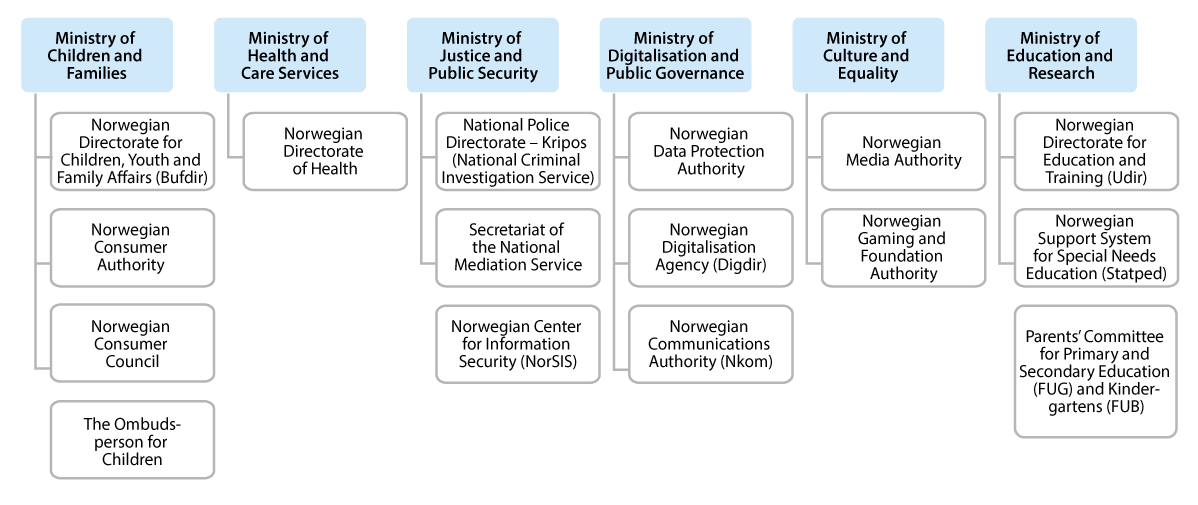
Figure 10.2 Overview of government ministries, subordinate agencies, and associated entities involved in efforts to ensure a safe upbringing in a digital society
The Ministry of Children and Families leads an inter-ministerial working group that coordinates efforts to ensure a safe upbringing in a digital society at the ministerial level. The Ministry of Digitalisation and Public Governance, the Ministry of Health and Care Services, the Ministry of Justice and Public Security, the Ministry of Education and Research, and the Ministry of Culture and Equality participate in the group.
The Norwegian Media Authority coordinates efforts to ensure a safe upbringing in a digital society at the directorate level and has established a group consisting of directorates and supervisory authorities responsible for relevant areas of responsibility. The group’s overall task is to ensure better coordination and more effective and coordinated central government action. The Norwegian Directorate for Children, Youth and Family Affairs, the Norwegian Data Protection Authority, the Norwegian Directorate of Health, the Norwegian Directorate for Education and Training, the Norwegian National Police Directorate, and the Norwegian Consumer Authority are taking part. The group has developed an action plan for a safe digital upbringing to follow up on the goals set out in the national strategy for a safe digital upbringing. In the action plan, the directorate group notes the need for more systematic knowledge sharing among agencies working in this area.50 The Government will continue the cooperation at the directorate level on digital safety in children’s upbringing.
The Norwegian Media Authority receives funding from the European Commission to serve as the Norwegian Safer Internet Centre (NCIS). Such centres have been set up across Europe with EU funding. The centres provide information, advice and assistance to children, parents, teachers and caregivers on digital upbringing and combating online child sexual abuse. The Norwegian Media Authority and the helpline Kors på halsen (Cross my heart), run by the Norwegian Red Cross, are national coordinators for promoting a safer digital everyday life for children and young people. Safer Internet Day is celebrated every year in February throughout Europe, including Norway. The main goal is to raise awareness and improve media literacy among children, parents, teachers, and other professionals who work with children on online issues and risks. In Norway, the Norwegian Media Authority organises Safer Internet Day.
Several supervisory authorities and directorates collaborate on enforcement, guidance and exchange of experience. For example, the Norwegian Consumer Authority leads a supervisory forum to strengthen supervision in the digital domain. The Norwegian Data Protection Authority and the Norwegian Competition Authority are permanent members of this forum. The Norwegian Consumer Authority will contribute to further coordination and cooperation on effective enforcement of consumer protection for children across sectors. Furthermore, the Norwegian Communications Authority (Nkom) has been designated as Norway’s Digital Services Coordinator (DSC) under the Digital Services Act (DSA). The coordinator is responsible for coordinating all national-level regulatory activities and shall ensure a good flow of information and the harmonised application of the regulations.
Cooperation with the voluntary sector
Organisations and the voluntary sector do important work to improve the digital upbringing of children and young people. Organisations, services and other actors interact with children, young people, and parents in their local communities, through school, leisure activities, and voluntary work. They are also important partners for central and local government services. For example, a children’s network has been established to address digital issues, consisting of the Norwegian Consumer Council, the Ombudsperson for Children, the Equality and Anti-Discrimination Ombud, Amnesty International Norway, Press – Save the Children Norway Youth, UNICEF Norway, Save the Children Norway, the Norwegian Cancer Society, and the National Association for Public Health. Furthermore, the voluntary sector can help to strengthen children’s digital competence, prevent risks such as online bullying and digital exclusion, and help to ensure that children have opportunities to participate safely and actively when they are online, contributing to both prevention and support. The Government will strengthen cooperation between public authorities and the voluntary sector on children’s digital upbringing.
10.3 International cooperation
There is considerable international interest in developing effective policies on digital safety during children’s upbringing. Several international organisations have taken the initiative to develop regulations, guidelines, and guidance to assist national authorities in their work to ensure children’s safe digital upbringing. The Government will work to establish Nordic cooperation on children’s digital upbringing.
The European Union (EU)
The EU plays an important role in regulating platform companies and digital services. See the discussion of the EU’s Digital Services Act (DSA) in section 9.2 and the discussion of the European Commission’s proposal for rules to prevent and combat child sexual abuse online in section 9.4. The EU is also working to make the internet safer for children and launched the European strategy for a better Internet for kids (BIK+) in 2022.51 The strategy focuses on three main points: better protection for children, better skills to make sensible choices online, and respect for children’s views in the digital environment. Norway has participated in the EU Internet Forum, which promotes dialogue between Member States and internet companies on combating such abuse.
The United Nations (UN)
The UN and several UN agencies have initiatives to protect children online. In 2021, the UN Committee on the Rights of the Child issued its General comment No. 25 on children’s rights in relation to the digital environment (see section 1.3.1). In 2022, the UN Economic and Social Council (ECOSOC) adopted a resolution strengthening national and international efforts, including those of the private sector, to protect children from sexual exploitation and abuse on the internet. The International Telecommunication Union (ITU) has developed a comprehensive set of recommendations for all relevant partners on how to contribute to the development of a safe digital environment for children and young people. The ITU has also established the Child Online Protection Initiative network to promote awareness of child safety in the digital environment and to develop practical tools for use by authorities, businesses and teachers.
Furthermore, the United Nations Children’s Fund (UNICEF) supports work to prevent the sexual abuse of children on the internet in over 20 countries. In 2022, the World Health Organisation (WHO) published a report on the prevention of online violence against children. The report emphasises the importance of implementing educational programmes for children and parents. The United Nations Educational, Scientific and Cultural Organisation (UNESCO) developed Guidelines for the Governance of Digital Platforms in 2023.52 The guidelines set out responsibilities and obligations for states, digital platforms, civil society, the media, academia, and the technology industry, as well as other actors in the field, to contribute to freedom of expression and access to information. Consideration for children and young people is part of the guidelines.
Council of Europe
The Council of Europe’s Guidelines to respect, protect and fulfil the rights of the child in the digital environment were published in 2018. The guidelines are intended to help authorities and others protect children and promote their participation in the digital environment. Furthermore, the Council of Europe has presented the Council of Europe Strategy for the Rights of the Child (2022–2027). One of the goals of the strategy is to provide access to and safe use of technology. The Council of Europe emphasises children’s right to participate in and protection of their rights in the digital environment. The Council of Europe also points out that it is important for parents and adults who work with children to have knowledge about how to keep children safe online.
Nordic Council of Ministers
Children and young people’s rights are an area in which the Nordic countries work comprehensively and cross-sectorally through cooperation within the Nordic Council of Ministers. One of the Nordic Council of Ministers’ focus areas is the living conditions of children and young people in the Nordic region. The Nordic countries have several councils and recommendations regarding how children spend their time, including screen time, in the realm of public health. Under the Nordic Committee for Senior Officials for Health and Social Affairs (EK-S), Norway will take the initiative to share Nordic knowledge and experience, as well as to coordinate recommendations and regulations related to how children and young people spend their time.
Another of the Nordic Council of Ministers’ overall policy priorities towards 2030 is for the Nordic region to strike a responsible and ethical balance in the development of the digital society. A safe digital upbringing is therefore a topic that is particularly relevant for the activities of the Nordic Council of Ministers in the coming years.
The Nordic Council of Ministers’ cooperation programmes, together with its policy priorities, guide its initiatives and activities. Among other things, the Nordic Council of Ministers has decided that education shall contribute to strengthening digital competence and the ability to navigate a new media and information reality. Furthermore, the Nordic Council of Ministers promotes the need for both frameworks and responsible use of technology in education.53
The Nordic Council of Ministers has also adopted a goal of strengthening Nordic cooperation on cultural and media policy challenges arising from new technology, artificial intelligence (AI), and the influence of big tech on democratic discourse, including their impact on the welfare and well-being of children and young people.54
The Nordic Council of Ministers has decided that the recommendation for a safe and democratic internet for children and young people should be followed up in the period 2024–2026. The recommendations are presented in a report from the Nordic Think Tank for Tech and Democracy on how to safeguard democratic debate in the Nordic region in an age dominated by platform companies. A Nordic analysis of research and knowledge on the impact of social media on the well-being of children and young people will be prepared, along with recommendations for joint Nordic initiatives. At the same time, a civil society report will be produced in which children and young people themselves will have their say.55
Organisation for Economic Co-operation and Development (OECD)
In May 2021, the OECD adopted a recommendation on children in the digital environment.56 The recommendation outlines principles for ensuring a safe and beneficial digital environment for children.
10.4 Knowledge development
In General comment No. 25, the UN Committee on the Rights of the Child recommends ensuring that data is collected for research on the digital environment, its impact on children’s lives and rights, and the effects of government measures. In recent years, a number of studies have concluded that there is a need for a better evidence base on children’s digital upbringing.
10.4.1 Research needs
A key part of the Social Media Harms Committee’s remit was to map and compile knowledge about the harmful effects of different types of media content and to assess the need for further studies or research in this area. The Committee concluded that there is little research on the harmful effects of media on Norwegian or Nordic children. They also highlighted the need for methodological innovation among researchers in order to find better and more precise ways of investigating the effects. The Screen Use Committee points out that studies are needed to shed light on and demonstrate causal links between screen use and various outcomes such as health, learning, and quality of life. Furthermore, there is a need for research on interventions that can help children and young people use screens in a healthy and balanced way. They also believe that it is important to include children’s own experiences and views in the research in order to gain a more nuanced understanding of how they experience and use technology. In addition, they believe that research is needed on how different activities and technologies can support children’s development and needs, including how technology can be used positively in learning and leisure.
10.4.2 Strengthened research efforts
The Government has strengthened research efforts in several areas relevant to children’s digital upbringing, and research has been initiated under the auspices of several government ministries and directorates. The Government will strengthen the coordination of the ministries’ research efforts on children’s digital upbringing.
National focus on artificial intelligence
The Government has decided to increase research efforts on artificial intelligence (AI) and digital technologies by at least NOK 1 billion over the next five years. The initiative has three main tracks:
-
research on the consequences of AI and other digital technologies for society;
-
digital technologies as a standalone research area; and
-
research on how digital technologies can be used for innovation in business and the public sector;
Key themes in main track 1 are democracy, trust, ethics, economics, legal protection, legal regulations, privacy, teaching and learning, art, and culture. These are topics that are relevant to children and young people growing up in a digital society.
In 2024, the Research Council of Norway announced funding to establish four to six research centres on artificial intelligence (AI centres). The centres will conduct high-quality AI research on issues where interdisciplinary research and collaboration across sectors and institutions are necessary to respond to the challenges facing society. Each AI centre will have a budget of NOK 75–200 million and a five-year duration, starting in 2025. Each AI centre is expected to cover at least two of the initiative’s main tracks, and together the centres will cover all three.
Prevalence study on vulnerability and concerns about crime
The Ministry of Justice and Public Security has commissioned the Norwegian Centre for Violence and Traumatic Stress Studies (NKVTS) to conduct a survey on vulnerability to and concerns about crime, including health consequences for young people. The study will include young people aged 12–16 from around 80 upper secondary schools. The background for the study is that international research shows that children and young people are far more vulnerable to crime than adults, especially violent crime. There is a need for knowledge about the situation in Norway, about the connections between vulnerability at home, online, at school, in the local community, and in public spaces, and about the significance of these for the development of health problems. The Government wants to strengthen the evidence base and research on the sexual exploitation of children and young people online.
Research programme for digitalisation and digital competence in kindergartens and schools
The Norwegian Directorate for Education and Training has established a research programme to provide better and more systematic knowledge about digitalisation and digital competence in kindergartens and schools. The research programme will run until 2030, and its overall objective is to develop new knowledge about digitalisation in kindergartens and schools. This includes research on both professional digital competence and the use of digital solutions in teaching and administration. The programme will also contribute to better dissemination of research results to practitioners and decision-makers. Thereby, the Government aims to strengthen research and dissemination of digital practices.
Norway’s participation in EU Kids Online
In 2024 and 2025, the Government has allocated NOK 3.5 million to the University of Oslo for Norway to participate in the EU Kids Online survey on children’s online opportunities, risks, and safety. The aim of the survey is to enhance understanding of children’s and parents’ use of the internet and new online technology. The survey explores the opportunities and risks associated with children and young people’s use of the internet, as well as parents’ knowledge and role. The survey was last conducted in 2018. The survey provides representative and comparable data over time and across European countries.
The social mission of including children and young people
In autumn 2022, the Government presented its plans for a targeted social mission of including children and young people in the white paper the long-term plan for research and higher education 2023–2032 (Meld. St. 5 (2022–2023)). In 2025, the Government will initiate this social mission, which will be a ten-year effort leading up to 2035. A targeted social mission involves mobilising the whole of society, including the public sector, voluntary organisations, and the business sector, to solve a complex social challenge. The vision for the work is ‘No child or young person left behind!’. The overall goal is to significantly reduce exclusion among children and young people by 2035. Research shows that vulnerable children and young people are also at greater risk in the digital environment. The target group is children and young people (aged 0–29) who, for various reasons, are at risk of being marginalised or excluded, or children and young people who are already experiencing exclusion. At the same time, the work is not limited to targeted measures. In terms of measures, broad preventive and universal measures for all children and young people are also relevant.
11 Economic and administrative consequences
The white paper describes how the Government will strengthen and further develop its efforts to ensure that children and young people have a safe, active, and participatory upbringing in a digital society. This is the first white paper on the upbringing of children and young people in a digital society, and it will contribute to a more comprehensive policy in this area. The report provides a broad overview of the characteristics of children and young people’s upbringing today. It proposes educational, legal, and economic measures that, together, could lead to better regulation of digital services and platforms, public services tailored to children’s needs, competent and supportive parents, safe children, better cooperation between different sectors, and a stronger evidence base for policy development. The knowledge base underlying the white paper shows that there are both positive and negative effects of internet and screen use. The Government believes that society currently does not sufficiently protect children.
In general, measures that support children and young people in having a good upbringing can have positive effects for both children and society in the long term. Reducing the negative consequences of internet use can contribute to better mental health, better sleep, and improved learning and concentration in children. This may also lead to better school performance. Furthermore, measures aimed at promoting opportunities for children and young people online, such as measures to improve information and increase competence, could yield benefits in the form of knowledge, inclusion, and increased participation in society. The measures will also provide more opportunities for children and young people to participate and express themselves. The socio-economic effects have not been quantified to a significant degree.
Several of the measures in the white paper are already adopted policies discussed in other documents (see Box 1.2). The measures are covered by the government ministries’ or directorates’ current budgetary frameworks. Funds have been allocated in the 2025 National Budget for measures in this white paper. A total increase of NOK 7 million has been allocated to work on a safe upbringing in a digital society and age limits for social media. This includes NOK 2.5 million from the Ministry of Children and Families’ budget for a study on the setting and enforcement of age limits for social media, as well as knowledge and information about social media. Furthermore, the Norwegian Data Protection Authority has been allocated NOK 1.5 million to strengthen its work on children and age limits, including oversight of the Personal Data Act. The Norwegian Consumer Authority has also been allocated NOK 2.5 million to strengthen its supervision of consumer protection for children in digital media. In addition, the Barnevakten foundation has been allocated NOK 0.5 million to develop and increase the accessibility of information about children and social media to children, parents, and adults who work with children. In terms of research, the Government has allocated NOK 3.5 million to the University of Oslo in 2024 and 2025 to co-finance Norway’s participation in the international survey EU Kids Online. In the Revised National Budget for 2025, the Government has proposed prioritising NOK 2.5 million to strengthen assistance to children and young people who are subjected to the sharing of images and videos online without their consent.
Several of the measures in the white paper concern investigating legislative amendments, including the enactment of age limits. The investigation work itself will not have any financial consequences beyond the administrative costs incurred by the government ministries and directorates involved. The measures recommended as a result of the investigations may have consequences, including for providers of digital services and platforms, in the form of closer supervision, reporting, and new requirements that may affect the operations of the enterprises. The consequences of the measures will be assessed, and the parties concerned will have the opportunity to be heard in the customary manner.
Footnotes
Elvestad et al., 2021.
Norwegian Media Authority, 2023c
Elvestad et al., 2021.
Elvestad et al., 2021.
Elvestad et al., 2021.
Nøra et al., 2022.
Elvestad et al., 2021.
Nøra et al., 2022.
Norwegian Directorate of Health, 2019.
Public Health Agency of Sweden, 2024b.
Norwegian Directorate for Education and Training, 2022.
Norwegian Media Authority, 2023c.
Ministry of Education and Research, 2017a.
Opinion, 2022.
Proba samfunnsanalyse, 2023.
Elvestad et al., 2021.
Gudmundsdottir et al., 2024.
Public Health Agency of Sweden, 2024a.
Reich et al., 2023.
Norwegian Data Protection Authority, 2023.
Staksrud, 2021.
Smahel et al., 2020.
Rohatgi et al., 2024.
Ministry of Education and Research, 2023.
Norwegian Directorate for Education and Training, 2023a.
Sintef, 2019.
Norwegian Directorate for Education and Training, 2023c.
OECD, 2023; Rohatgi et al., 2024.
Kelentrić et al., 2024.
Norwegian Directorate for Education and Training, 2024a.
Ministry of Education and Research, 2023.
UNICEF, 2025.
Norwegian Directorate for Education and Training, 2024a.
KS, 2024.
Norwegian Directorate for Education and Training, 2024d.
Staksrud, 2019.
Norwegian Directorate of Health, 2018.
Minde, 2021.
Save the Children Norway, 2020.
Norwegian Press Complaints Commission, 2023.
European Commission, 2025.
Norwegian Media Authority, 2024b.
Norwegian Directorate for Education and Training, 2021.
Slettemeås et al., 2025.
Steinnes et al., 2020.
European Commission, 2020; European Commission, 2022b.
Rambøll, 2024.
Lindseth Bygdås et al., 2022.
Norwegian Ministry of Children and Families, 2022.
Norwegian Media Authority, 2024h.
European Commission, 2022a.
UNESCO, 2023.
Nordic Council of Ministers, 2024b.
Nordic Council of Ministers, 2024a.
Nordic Welfare Centre, 2024.
OECD, 2021.