3 The influence of corruption on sustainable development, inequality, climate change, democracy and security
Corruption is one of the greatest obstacles to social and economic development. It makes public services less efficient, hampers investment and undermines economic growth. International experience shows that giving priority to anti-corruption measures produces major socioeconomic benefits in the long term.
In the past 20–30 years, the focus on corruption and illicit financial flows has intensified. The Official Norwegian Report Tax Havens and Development, published in 2009, paved the way for heightened Norwegian political engagement on the issue. Leaks, whistleblowing and investigative journalism have resulted in a stream of disclosures documenting the architecture of corruption and illicit financial flows, including the actors involved, conditions that facilitate such behaviour and links to organised crime, tax evasion and money laundering.
Weak governance, a lack of regulatory bodies and political interference in legal systems have allowed illicit capital flows to continue from various countries into jurisdictions characterised by a high degree of financial secrecy.
In many countries the dividing lines between politicians, the public sector and the private sector are unclear, with public sector managers and employees often holding interests in private companies and commercial activities. Corruption in public procurement processes is a major drain on public budgets and resources. Information on who owns companies that receive invitations to tender or are awarded licences and contracts is too often unavailable.
There are often complex links between corruption and a lack of sustainable development, democracy and security. Corruption interferes directly with efforts to achieve the UN Sustainable Development Goals by undermining institutions, exacerbating inequality and hindering access to public services such as healthcare, education and infrastructure. In countries with widespread corruption, trust in democratic institutions is weakened, and this may in turn lead to political instability and conflict. A vicious circle thus emerges, as administrative weakness enables corruption and corruption further weakens administrative capacity.
All countries that receive Norwegian aid face challenges related to weak governance and high levels of corruption. Success in bringing about change requires an accurate assessment of how society is influenced by corruption, which actors are involved, who is involved in anti-corruption efforts and the interplay between politics and the economy.
Corruption and inequality
Systemic corruption increases economic and social inequality by shifting resources from a society’s most vulnerable groups to a small elite. While corrupt elites accumulate wealth and power, the poor lose access to basic services. This exacerbates social and economic disparities and creates institutional distrust. Corruption is also a major problem in the aid sector. When funds intended for poverty reduction and development are diverted through corrupt practices, both aid effectiveness and trust between donor and recipient countries are undermined, and vitally needed funding may fail to materialise. Control mechanisms, transparency and cooperation between all involved parties are necessary. With effective supervisory bodies and strong local administration, disparities are reduced and societies become more inclusive.
Corruption and national resource mobilisation
Corruption undermines national resource mobilisation, and tax collection in particular. When there is corruption in tax systems, the ability of states to finance their own development is compromised. In countries where administrative systems are weak and the risk of corruption is high, the powers that be may, if the necessary control mechanisms do not exist, be able to exploit increased tax revenues to strengthen their own positions rather than promote broad-based development and provide public services. To prevent this from happening, development aid designed to strengthen tax systems and national resource mobilisation must be combined with targeted efforts to boost transparency, accountability and anti-corruption work. Effective anti-corruption efforts can play a crucial role in national resource mobilisation. When anti-corruption measures and the reform of tax administration go hand in hand, this may result in greater trust in the authorities, greater willingness to pay on the part of people and businesses, and more stable state revenues. When public funds are administered transparently and effective control systems are in place, resources are more likely to actually benefit the population. An integrated approach of this kind provides a stronger foundation for sustainable financing of development.
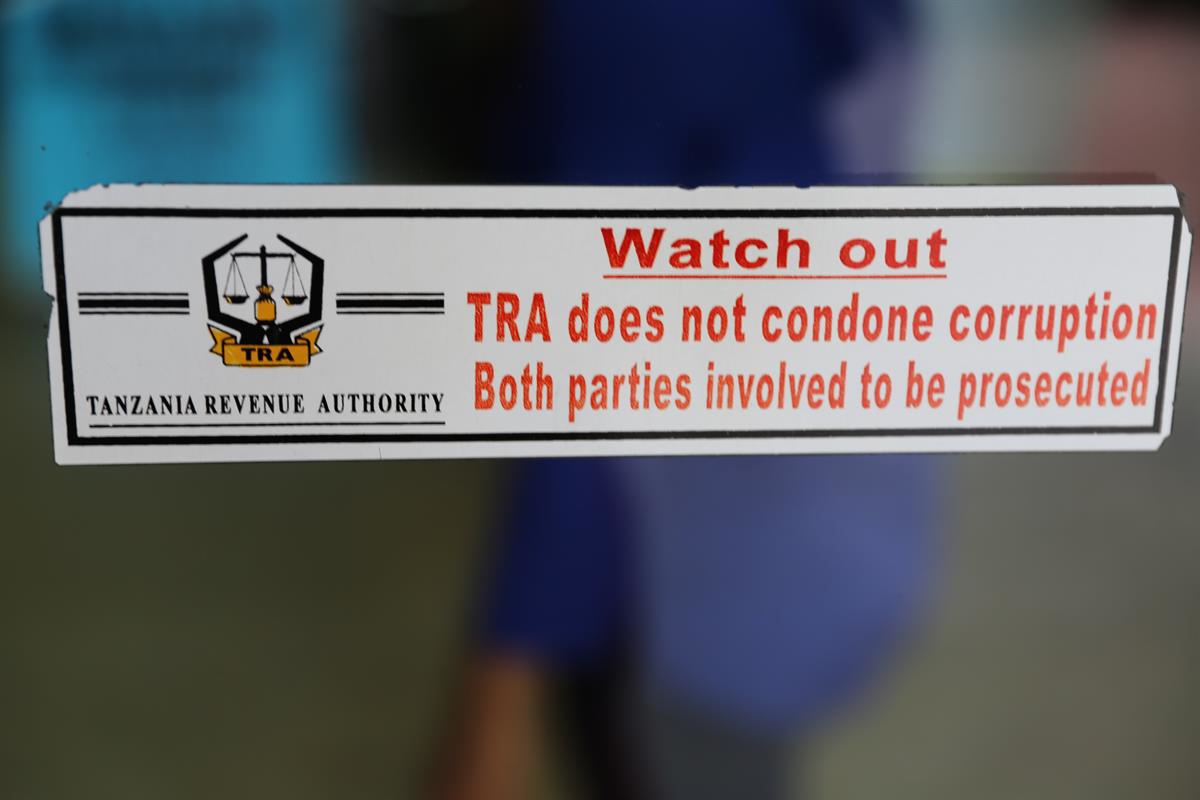
Norway cooperates with Tanzania through the Tax for Development program. This sticker is posted on the doors of the Tanzania Revenue Authority (TRA) and warns that corruption is prohibited.
Photo: Marte Lid/Norad
Corruption disproportionately affects women and people in vulnerable situations
Corruption can obstruct women’s access to public services and limit their participation in public, economic and political life. In some countries, women commonly encounter corruption in the form of demands for bribes when accessing health and education services, including services related to the care of children. Women are particularly vulnerable to ‘sextortion’, a form of corruption in which people in power abuse their position to demand sexual favours in exchange for benefits or rights to which people are entitled. People in vulnerable situations such as people living in poverty, refugees and minorities are also at high risk of being exposed to corruption. They may be deprived of access to services or may have to pay an exorbitant price to obtain them. Corruption therefore creates additional barriers to inclusion and justice.
Corruption and the environment, climate change and climate finance
Corruption can pose a serious threat to the climate and environment by enabling such practices as illegal deforestation, overfishing and illegal mining, which lead to ecosystem degradation and higher greenhouse gas emissions. Grand corruption is often a serious problem in the natural resources sector, and undermines attempts by the authorities to regulate natural resource use.
Climate finance is an important tool for combating climate change, but large finance flows for climate-related measures in countries with weak institutions and limited transparency represent a risk that funding will be diverted by corrupt actors. This may undermine the effectiveness and legitimacy of climate finance. Ensuring transparency and accountability is a way of obtaining the best possible results from climate finance.
National audit institutions: Norwegian support for state-building, economic development and enhanced resource mobilisation often includes support for national audit institutions. These institutions monitor and report on the use of public funds, but also the legality and implementation of programmes administered by the state. The institutions play a part in preventing corruption through these activities and by issuing recommendations for improving integrity systems, including the strengthening of internal controls. National audit institutions are also able also detect corruption during the audits they conduct, including audits of procurement and purchasing. According to the Global Supreme Audit Institution Stocktaking Report 2023, 60 % of national audit institutions also have a mandate to investigate corruption, and some of them can take steps to recover lost or misused funds. In some systems the national audit institution is part of the judicial system and can impose sanctions on public officials for improper administration of funds under their responsibility.
For a number of years the Norwegian Embassy in South Africa has been providing support for the African Organization of Supreme Audit Institutions (AFROSAI) – which represents Africa in the International Organization of Supreme Audit Institutions (INTOSAI) – in capacity-building in national audit institutions in English-speaking African countries.
Corruption undermines democracy, the rule of law and human rights
Corruption is a threat to democracy, the rule of law and human rights. Fair decision-making processes are replaced with processes that enable decisions based on self-interest, abuse of power and economic advantages for the few at society’s expense. This undermines not only trust in the authorities but also fundamental human rights. To protect democracy and human rights, anti-corruption efforts require robust institutions, independent courts, transparency in administrative processes and elections, and effective mechanisms for investigation and holding parties accountable.
Corruption and transnational organised crime
In transnational organised crime, corruption is used as a tool for undermining the capacity of national authorities. Corruption in political and administrative systems reduces public trust, undermines the rule of law and can give criminal actors political influence.
Corruption and organised crime are often tightly intertwined. Corrupt officials can facilitate illegal activities such as trafficking in drugs and people and money laundering. Organised criminal groups exploit weaknesses in legal systems and use corruption to gain impunity and control over resources. This compromises a state’s ability to maintain law and order and results in greater violence and insecurity.