1 Climate – a defining challenge in an unpredictable world
Figur 1.1 Deviation from global average temperature 1880–2020
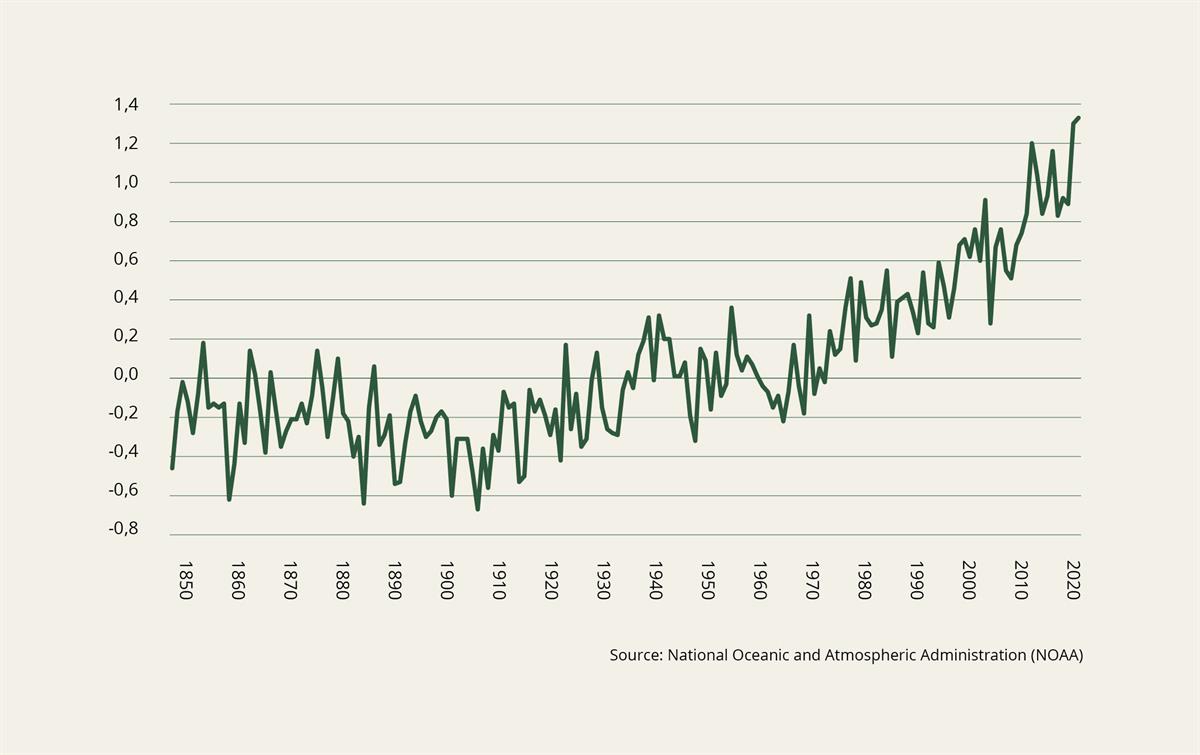
Climate change is the greatest global challenge of our time. Globally, between 3.3 and 3.6 billion people live in areas, or in ways, that make them highly vulnerable to the consequences of a changing climate. Climate change is happening now, and the damaging effects are increasingly noticeable. Droughts, floods, sea level rise and degradation of the marine environment, deforestation, biodiversity loss, high temperatures, extreme weather, and natural disasters are a threat to life, health, property and crops. Global warming contributes to escalating humanitarian crises, drives involuntary migration and displacement, and increases societal instability. Climate change affects conflict patterns, alliances and power relations. The associated costs are substantial.
It concerns our safety and security. The climate challenges can only be solved together. This makes climate change a defining challenge for international co-operation in the 21st century, and thus also for Norwegian foreign and development policy. The 2015 Paris Agreement sets the global framework for countries’ climate action. States Parties agreed to keep the increase in the global average temperature well below 2°C above pre-industrial levels, and to pursue efforts to limit it to 1.5°C. Vulnerabilities vary across countries and populations, with the poorest affected first and most severely. The most critical measure to avert the worst impacts of climate change is rapid and deep global reductions in greenhouse gas emissions. At the same time, it is important to work together on prevention of and adaptation to climate change and the management of loss and damage, especially for those most severely affected.
Several global trends are making international climate co-operation more challenging and are highlighting the links to energy and security. Russia’s full-scale invasion of Ukraine has led to changes in European energy policy. The security and defence policy consequences are such that NATO has identified climate change as a key challenge with implications for the security of its member countries.
The rapid development and major investments we are seeing in renewable energy and cleaner technology are important for achieving the climate targets. At the same time, changes in the international economy and trade policy, international competitive conditions and the geopolitical balance of power affect, and are affected by, the transition. Multilateral forums are crucial for reaching common solutions to climate change. Increasing global polarisation is putting multilateral institutions, such as the UN, under pressure.
Developing countries expect high-income countries to assist them in their contribution to reducing emissions and adapting to climate change. There are also expectations that developing countries, particularly the most vulnerable and exposed, will be supported in their efforts to avert, minimise and address loss and damage resulting from climate change. They also want co-operation and support to ensure that the industrial and technological transition takes place in a manner that safeguards their interests and needs. Among other things, this entails the need to mobilise large capital flows for the climate from public and private sources.
These trends mean that climate, security, energy, industry, competitiveness, trade and the environment must be considered in an even more integrated manner than before. They also imply that development policy will become more closely integrated with broader foreign and security policy.
Geopolitical unrest and changing framework conditions for international co-operation in general will affect international climate co-operation. For example, one of the first actions taken by President Trump when he began his second presidential term was to announce the United States’ withdrawal from the Paris Agreement. These developments may intensify existing disagreements over international climate co-operation in the years ahead. It is important to work to ensure that climate remains a high priority on the international agenda and that systematic efforts are made to both cut emissions and build climate-resilient societies.
Climate action spans virtually all areas in which the Foreign Service operates. This strategy will help to strengthen the Foreign Service’s ability to safeguard and promote Norwegian interests and priorities for climate and green transition in a more polarised and unpredictable world.