1 Introduction
1.1 Foreword by the Chair
2025 was an exceptionally challenging year for the Council on Ethics. Initially, the Government Pension Fund Global’s investments and the Council’s work were drawn into the wide-ranging political and public debate about Norway’s policy on Palestine. Subsequently, the Guidelines for Observation and Exclusion of companies from the GPFG, which define the Council’s mandate, were replaced by interim ethical guidelines.
Under these interim guidelines, the Council shares information on companies with Norges Bank according to the same criteria as before but no longer provides advice on observation or exclusion. Norges Bank assesses how to follow up these cases in its ownership activities based on the information provided by the Council. The interim guidelines will apply until the Norwegian Parliament decides how ethical considerations will be reflected in the management of the Fund.
The Council’s work covers a broad range of business sectors and geographical regions. In 2025, for example, the Council assessed mining companies, energy companies, banks, weapons manufacturers, beverage producers and courier services. A variety of topics was considered, including contribution to war crimes, corruption, money laundering, loss of nature, pollution, as well as violations of labour rights and the rights of Indigenous peoples. The cases extend across all continents.
A common thread running through these cases is the question of whether there is an unacceptable risk that companies in which the GPFG is invested are responsible for or contribute to violations of the norms outlined in the ethical guidelines. The concept of “contribution” is fundamental to understanding the guidelines and was a key topic in the debate about the GPFG’s investments connected to the conflict in Gaza and the West Bank.
The Graver Committee, appointed by the government in 2004 to establish the foundation for the Fund’s ethical guidelines, concluded that an investor can only be considered complicit when an action was reasonably foreseeable and when there is a systematic connection or causal link between a company’s operations and the action in question. At the same time, the Committee found that investments in a company cannot be regarded as a contribution to actions that could not reasonably have been foreseen or known, nor to matters over which the company itself has limited control.
Later on, the Mestad Committee, created in 2020, clarified that the term “contribution” in the ethical guidelines does not refer to criminal complicity but to the ordinary meaning of contributing to something. Reflecting new developments in society, the Committee recommended a slightly broader interpretation of the term “contribution”, encompassing also norm violations occurring in the supply chain of companies.
Together, these two committees, which had their reports ratified by the Norwegian Parliament, provide important guidance on how the term “contribution” in the ethical guidelines should be understood. In public debates about the GPFG’s investments in conflict-affected areas, many of these nuances have been overlooked. I would therefore like to emphasise that the Council’s assessments of individual companies have been based on the wording of the guidelines and the guidance provided by experts and ratified by the Parliament, not on opinions expressed in the public debate.
In 2025, the government appointed a third committee to prepare recommendations for the Parliament’s upcoming revision of the ethical guidelines. The Council agrees that geopolitical developments in recent years justify a new review of the ethical guidelines, as has been done previously. In the committee’s work, questions relating to the concept of “contribution” will again be central: Where does it begin and end, and how should it be implemented? The Council supports this work and will contribute information, professional insight, and practical experience.
In the meantime, the Council continues to work in accordance with the interim ethical guidelines. Although the results of these endeavours will not be published, the Council’s methodology remains the same, based on a robust factual foundation and thorough assessment processes.
Svein Richard Brandtzæg – Chair of the Council on Ethics
1.2 Members of the Council on Ethics
Svein Richard Brandtzæg (Chair)
Brandtzæg has a doctorate in engineering from the Norwegian University of Science and Technology (NTNU) and a diploma in business administration from BI Norwegian Business School. Over the course of 34 years, he occupied a variety of positions at Norsk Hydro ASA, both in Norway and abroad. For 10 years up until 2019, he was the company’s CEO. Brandtzæg has served on the boards of directors of numerous enterprises and industry associations. He is currently chair of Dormakaba AG (Switzerland) and a director of Mondi PLC (UK) and Rotork PLC (UK). Brandtzæg is also CMI mentor at Chair Mentors International.
Siv Helen Rygh Torstensen (Vice Chair)
Rygh Torstensen is a lawyer, who is currently EVP Legal & Compliance at Equinor ASA. She has worked for Equinor in a variety of roles since 1998, mostly in the Legal & Compliance Department. She has previously served as the company’s Chief Compliance Officer. Rygh Torstensen also headed the CEO’s Office for three years until August 2019. Before joining Equinor, she worked as a lawyer with the law firm Cappelen & Krefting DA and in Stavanger City Council’s Legal Services Department.
Vigdis Vandvik
Vandvik has a PhD in plant ecology and is a professor in the Department of Biological Sciences at the University of Bergen, where she also heads the CeSAM Centre for Sustainable Area Management. Since 2017, she has been affiliated with the Bjerknes Centre for Climate Research. Vandvik has extensive experience at the intersection between research, public administration and environmental policy, and has participated in a number of national and international research projects, knowledge processes and committees. She has also participated in various advisory councils and commissions. Vandvik was previously a member of the Norwegian government’s Nature Risk Committee. She is the lead author of several reports published by the Intergovernmental Science-Policy Platform on Biodiversity and Ecosystem Services (IPBES) and the Intergovernmental Panel on Climate Change (IPCC).
Egil Matsen
Matsen holds a PhD in Economics from the Norwegian School of Economics and Business Administration (NHH) and is CEO of Sparebankstiftelsen DNB. He has previously served as Deputy Governor of Norges Bank, with particular responsibility for the Norwegian Government Pension Fund Global (GPFG) and was a member of the Bank’s Executive Board. He has also been employed as CEO of Forte Fondsforvaltning, professor and head of the Department of Economics at the NTNU, and served as a member of KLP’s board of directors.
Cecilie Hellestveit (until 10 November 2025)
Hellestveit is a lawyer, with a doctorate in humanitarian law. She also holds an MPhil in Middle Eastern Studies. Hellestveit has worked at various research institutions, including PRIO, SMR, NUPI, IKOS and ILPI. She has also been affiliated with the Atlantic Council in Washington DC and the Max Planck Institute in Germany. She is currently a researcher at the Norwegian Academy of International Law and is a special advisor at the Norwegian National Human Rights Institution. She is also affiliated with the Norwegian University of Science and Technology (NTNU). Hellestveit works within academia on issues relating to international law and armed conflict. She has authored a textbook on the international law of war as well as several books on contemporary armed conflicts.
Secretariat
The Council on Ethics has a multi-disciplinary secretariat, whose members carry out assessments and prepare matters for the Council’s consideration. At the start of 2025, the secretariat had nine employees and was led by Eli Lund.
1.3 The work of the Council on Ethics
The Council on Ethics’ mandate is decided politically through guidelines determined by the Norwegian Ministry of Finance. On 7 November 2025, those guidelines were materially altered. Until that date, the Council’s task was to assess companies against predetermined criteria and, depending on the outcome, issue recommendations to Norges Bank to exclude them from investment by the GPFG or place them under observation. Under the prevailing, interim guidelines, the Council will share information regarding such companies with the Bank. This information is referred to as risk assessments in the annual report. Both the product-based criteria, covering the production of tobacco, cannabis, coal and certain types of weapons, and the conduct-based criteria, covering financial crime, the sale of weapons to certain states, human rights abuses, environmental damage and greenhouse gas emissions, remain in place. The guidelines are forward-looking and apply to unacceptable conditions that are ongoing or may occur in the future.
Portfolio monitoring and information gathering
The Council continuously monitors whether GPFG-invested companies engage in business activities which fall within the scope of the ethical guidelines. Two portfolio monitoring services pick up on relevant information about, respectively, product-related and conduct-related cases. In addition, the Council monitors a number of databases and websites containing information about, for example, corruption, weapons sales or business activity in areas of conflict. It also receives relevant information from organisations and individuals. This information may be received directly or forwarded from Norges bank.
To identify cases that are not necessarily covered by news monitoring, the Council also conducts specific investigations into areas where the risk of serious norm violations is high. This may, for example, involve the surveying of companies that impact nature conservancy areas.
Furthermore, the Council keeps track of issues that have previously led to companies being excluded and where similar cases may arise. Examples of such issues include shipbreaking in certain countries and the exploitation of natural resources in Western Sahara.
The Council assesses every company that is identified in relation to the product-based criteria. With respect to the conduct-based criteria, where cases are many and highly diverse in nature, the Council investigates those where the risk of the companies causing, or contributing to, serious norm violations is considered to be greatest. In its initial assessment, the Council attaches weight to the seriousness and scale of the norm violation, the company’s association therewith and the likelihood of the norm violation continuing in the future. Particularly serious cases are given priority. These may be cases linked to escalating conflicts or serious individual incidents in which GPFG-invested companies are involved.
If the Council decides to pursue a case, a thorough investigation of the allegation levelled at the company concerned is set in train. The secretariat gathers information, both through conversations with experts and from open sources. In some cases, the Council also makes use of consultants and research institutions, for example, to investigate working conditions or the environmental impact of companies’ activities. The companies being investigated are also important sources of information.
Table 1.1 Overview of the Council’s activities in the period 2023–2025
|
Year |
2023 |
2024 |
2025 |
|---|---|---|---|
|
No. of limited companies in the GPFG at year-end |
8859 |
8659 |
7201 |
|
No. of companies excluded at the recommendation of the Council on Ethics at year-end |
92 |
105 |
115 |
|
No. of companies placed under observation at the recommendation of the Council on Ethics |
12 |
8 |
9 |
|
No. of companies on which the Council on Ethics issued a recommendation during the year |
15 |
21 |
19 |
|
No. of companies excluded during the year at the recommendation of the Council on Ethics |
6 |
14 |
10 |
|
No. of companies placed under observation during the year |
5 |
0 |
2 |
|
No. of observations terminated during the year |
2 |
4 |
1 |
|
No. of exclusions revoked during the year |
2 |
1 |
0 |
|
No. of new cases accepted for assessment during the year |
102 |
163 |
261 |
|
No. of cases concluded during the year |
100 |
143 |
222 |
|
Total no. of companies under assessment during the year |
209 |
268 |
363 |
|
No. of companies the Council has been in contact with |
69 |
76 |
76 |
|
No. of companies the Council has met with |
11 |
22 |
24 |
|
No. of Council meetings |
10 |
10 |
15 |
|
Secretariat (no. of staff) |
9 |
9 |
9 |
|
Budget (NOK million) |
18,1 |
20,3 |
20,3 |
The table above summarises the extent of the Council’s endeavours with respect to companies in 2025, compared with in 2024 and 2023. Companies excluded by Norges Bank under the coal criterion, without the Council’s recommendation, are not included in the table.
Summary of the Council’s activities in 2025
Table 1.1 provides an overview of the Council’s activities in the period 2023–2025. The companies in the GPFG’s portfolio constitute the starting point for the Council’s endeavours. At the close of 2025, the GPFG was invested in around 7,200 limited liability companies, headquartered in around 70 countries. The number of companies in the GPFG’s investment portfolio has been significantly reduced in recent years. However, this has not so far led to fewer cases being picked up on via the portfolio monitoring process.
At the close of the year, 115 companies had been excluded from the GPFG at the recommendation of the Council on Ethics, while nine were under observation. Furthermore, Norges Bank has, at its own initiative, excluded 65 companies under the coal criterion and placed 11 under observation.
In 2025, the Council recommended that 17 companies be excluded, one company’s exclusion should be revoked, while one company should be placed under observation. Norges Bank’s decision and the Council’s recommendation with respect to eight of these companies have been published. Those recommendations on which a decision had not been made prior to 7 November 2025 will be treated as information provided in accordance with the interim ethical guidelines. The Council also issued one risk assessment to Norges Bank under these guidelines in 2025.
The Council has a heavy caseload and will normally have cases relating to the majority of criteria under assessment at any given time. It is not unusual for a single company to be linked to several cases, or for a case to encompass multiple companies. In 2025, the Council worked on 395 cases, involving 363 companies. Of these, 261 were identified during the year, while 64 were identified in 2024. During the same period, the assessment of 247 cases was terminated. This includes companies for which a recommendation was made to Norges Bank, companies where the Council’s investigations found no grounds for either exclusion or observation, and companies in which the GPFG was no longer invested. In 2025, 11 companies under investigation by the Council exited the GPFG before a conclusion had been arrived at.
The majority of cases did not end in a recommendation to exclude or observe the company or companies concerned, but were shelved at an earlier stage in the assessment process. A recommendation to exclude was issued in eight of the new cases initiated in 2025, while a risk assessment was sent to Norges Bank, pursuant to the ethical interim guidelines, in connection with one of the cases. 174 of the year’s new cases were terminated with no recommendation being issued or information shared with Norges Bank.
In 2025, the Council put its portfolio management services out to tender once again. We see that suppliers find it difficult to achieve the same high level of coverage with respect to news monitoring in all regions, especially emerging markets. As can be seen in Figure 1.1, more than 50 per cent of the limited companies in the GFPG’s portfolio are domiciled in Asia, while these account for just 18 per cent of its market value. This means that these investments comprise many small companies with smaller operations than, for example, the companies included in the North American portion of the portfolio, which accounts for 57 per cent of its market value but just 20 per cent of the companies. Since the majority of investors are most interested in larger, Western companies, the majority of those supplying ESG-related news monitoring services place the greatest emphasis on these. It is also easier to keep track of and report on English-language news media, even though artificial intelligence-related developments also offer new opportunities here.
Figure 1.1 Regional breakdown of the GPFG’s 7,201 shareholdings at 31 December 2025
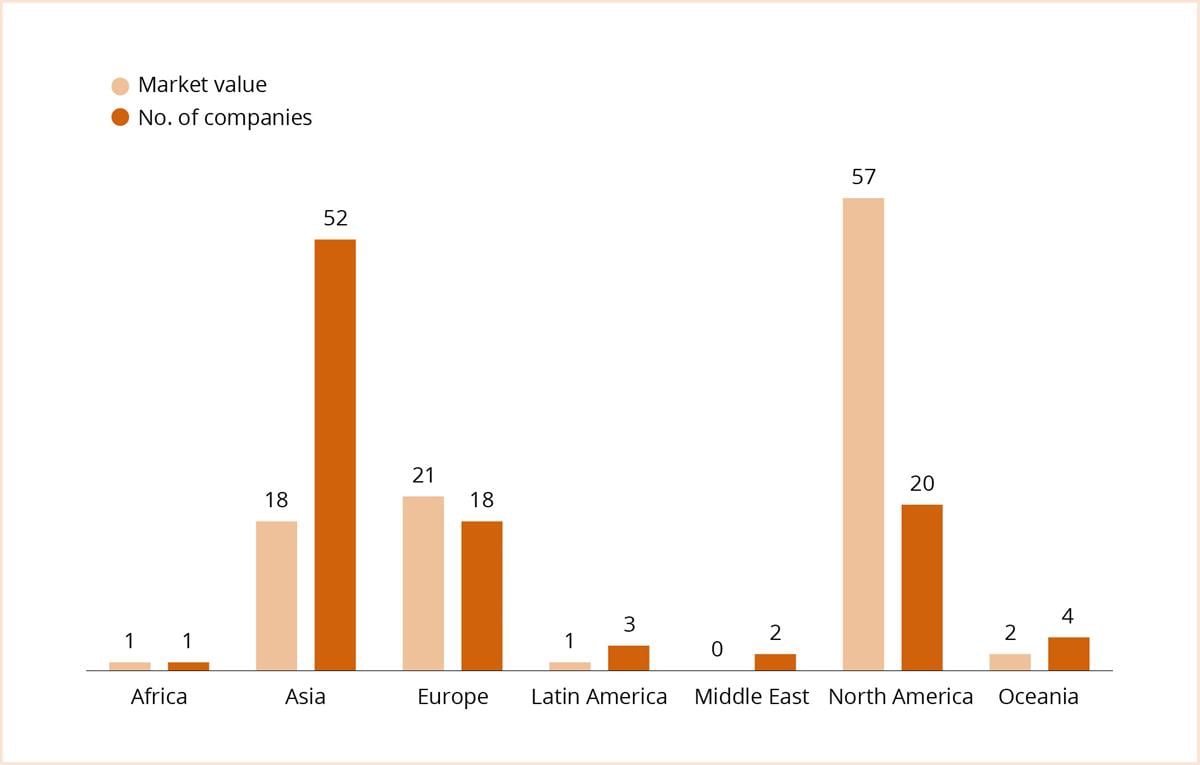
Regional percentage distribution of the GPFG’s shareholdings by market value and no. of companies.
Figure 1.2 Regional breakdown of the companies assessed by the Council in 2025
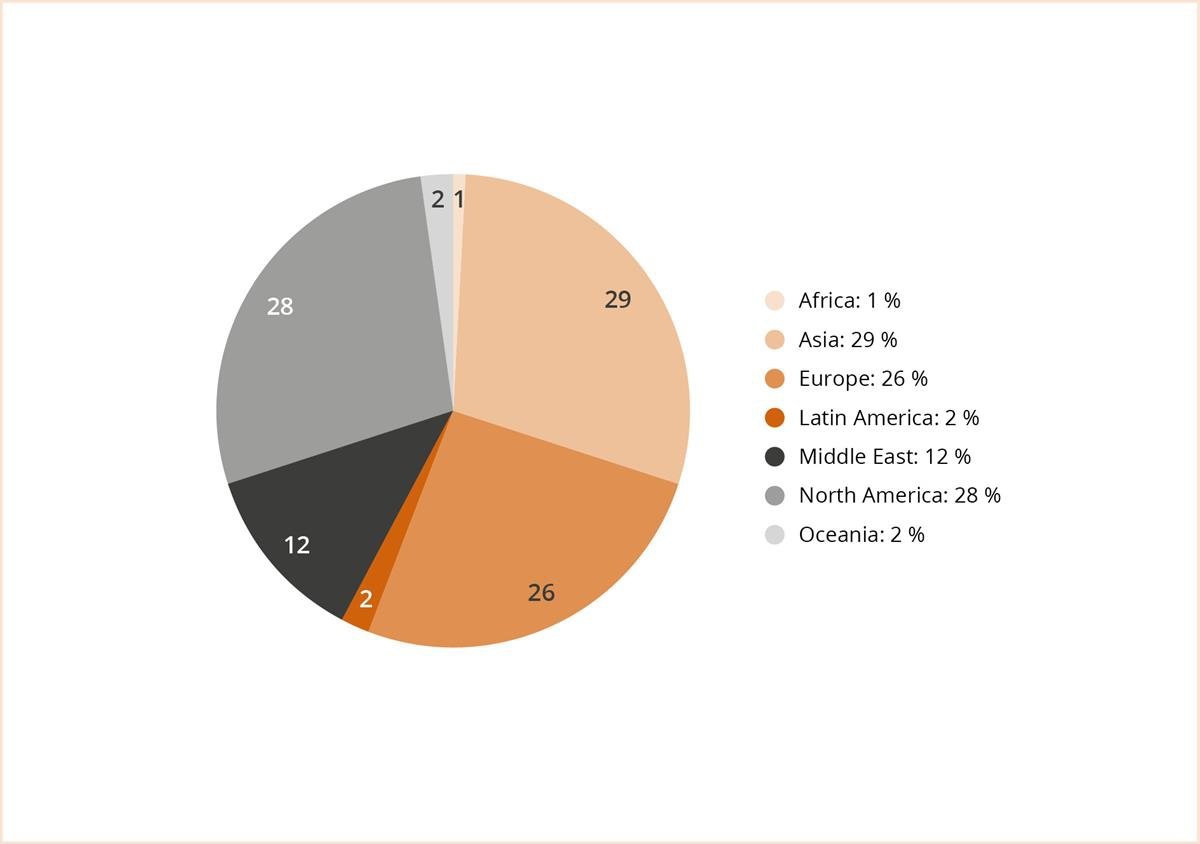
Fig. 1.2 shows a percentage breakdown of companies from different regions that the Council has assessed in 2025. The geographic breakdown varies considerably from year to year and reflects both topical issues and those issues on which the Council has decided to focus at any given time. In 2025, the conflict in the West Bank and the war in Gaza continued to significantly impact the number of companies assessed. A preponderance of the companies with links to the conflict are domiciled in Europe and North America, in addition to Israel.
Of the just over 100 Asian companies that the Council assessed in 2025, one-third were linked to human rights cases, while one third were linked to financial crime cases. Most of the human rights cases related to working conditions, with many of the companies being selected for further investigation because they operate in a sector and a country where the risk of labour rights violations is high. On the financial crime side, a review of money laundering risk relating to casino operations included many Asian companies. Three of the companies on which the Council issued recommendations in 2025 were Asian.
The Council worked on around 100 companies from 15 European countries in 2025. Just under half of the cases are based on a review of lists of companies which, in various ways, are linked to the violation of international law in the West Bank and Gaza. Thirty of the cases related to the risk of financial crime. One of the companies on which the Council issued a recommendation in 2025 was European.
The dominant topic for the approximately 120 companies domiciled in the American continent concerns their potential contribution to the violation of the rights of individuals in situations of war and conflict through business operations linked to the West Bank and Gaza. The Council has also assessed a number of US companies under the financial crime criterion, following reviews of companies in, respectively, the health and casino/gambling sectors. Seven of the companies on which the Council issued recommendations in 2025 were from North America, while three were from Latin America.
Approximately 45 companies domiciled in the Middle East were assessed in 2025. Almost all of these were Israeli companies, which were assessed in relation to the risk that they, through their business operations in the West Bank and Gaza, may be contributing to the violation of the rights of individuals in situations of war and conflict. Five of the companies on which the Council issued recommendations in 2025 were domiciled in the Middle East.
Figure 1.3 Breakdown of the Council’s activities in the period 2023–2025 by criterion
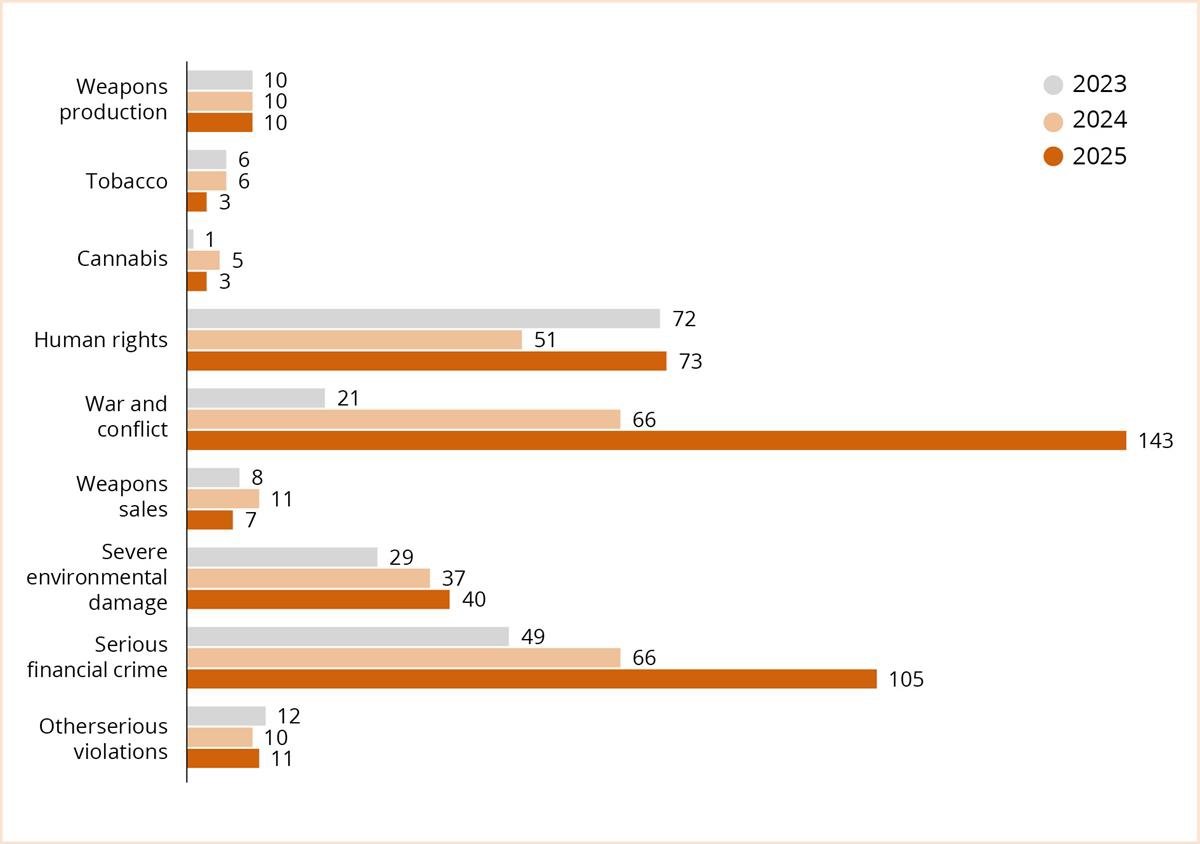
Fig. 1.3 shows a breakdown of the cases on which the Council has worked, distributed by criterion, in the period 2023–2025.
During the period, there has been a manyfold increase in the number of cases assessed under the war and conflict criterion. This increase is ascribable primarily to the war in Gaza and the escalating violations of international law in the West Bank, with which a number of GPFG-invested companies have links. In 2025, the Council recommended that six companies be excluded from investment by the GPFG under this criterion, due to their business links to the West Bank.
The number of companies assessed in relation to financial crime has also risen sharply during the period. Much of this increase may be attributed to the fact that the criterion was extended in 2021 to cover all financial crime and not, as previously, merely corruption. The large number of companies assessed each year in relation to this criterion is due to the fact that the Council often carries out sector based reviews to identify those companies which warrant further investigation. In 2025, in addition to corruption, for example in the health sector, the Council has reviewed companies in the casino and gambling industry, which is a sector with a heightened risk of money laundering. The Council issued recommendations on two companies pursuant to this criterion in 2025, one recommendation related to money laundering and the other to gross corruption.
Human rights cases still account for a significant proportion of the Council’s work. Labour rights violations, including the risk of forced labour, constitute the dominant topic. However, all of the three recommendations issued in 2025 under the human rights criterion concern violation of the rights of Indigenous peoples. In two of these recommendations, there was also an independent justification under the environmental criterion related to the loss of biodiversity.
Apart from biodiversity loss, serious industrial and mining-related pollution has been the most important assessment topic pursuant to the environmental criterion in 2025. The other recommendations concern three companies in the same business group whose exclusion was recommended on the grounds of their failure to clean up pollution caused by mining operations.
Under the criterion addressing other particularly serious violations of fundamental ethical norms, the Council has worked in part on cases relating to the risk of serious animal welfare violations.
Under the product-based criteria, the Council has assessed several companies that produce, respectively, nuclear weapons and cannabis. The Council has issued recommendations to Norges Bank concerning five companies in this area.
Contact with companies
Before the Council comes to a conclusion, it is normally in contact with the companies concerned several times. Early in the assessment process, the Council sends a letter containing questions regarding the issue at hand. Companies that have been assessed pursuant to the conduct-based criteria have also been invited to comment on a draft version of the Council’s recommendation to exclude it or place it under observation.
In 2025, the Council was in contact with 76 companies and met with 24 of these. When the Council meets with companies, it is often late in the assessment process, often on the basis of a draft recommendation to exclude or observe. Fig. 1.4 provides a breakdown of the companies with which the Council has been in contact in 2025, distributed by criterion.
Figure 1.4 Breakdown of contact with companies by criterion
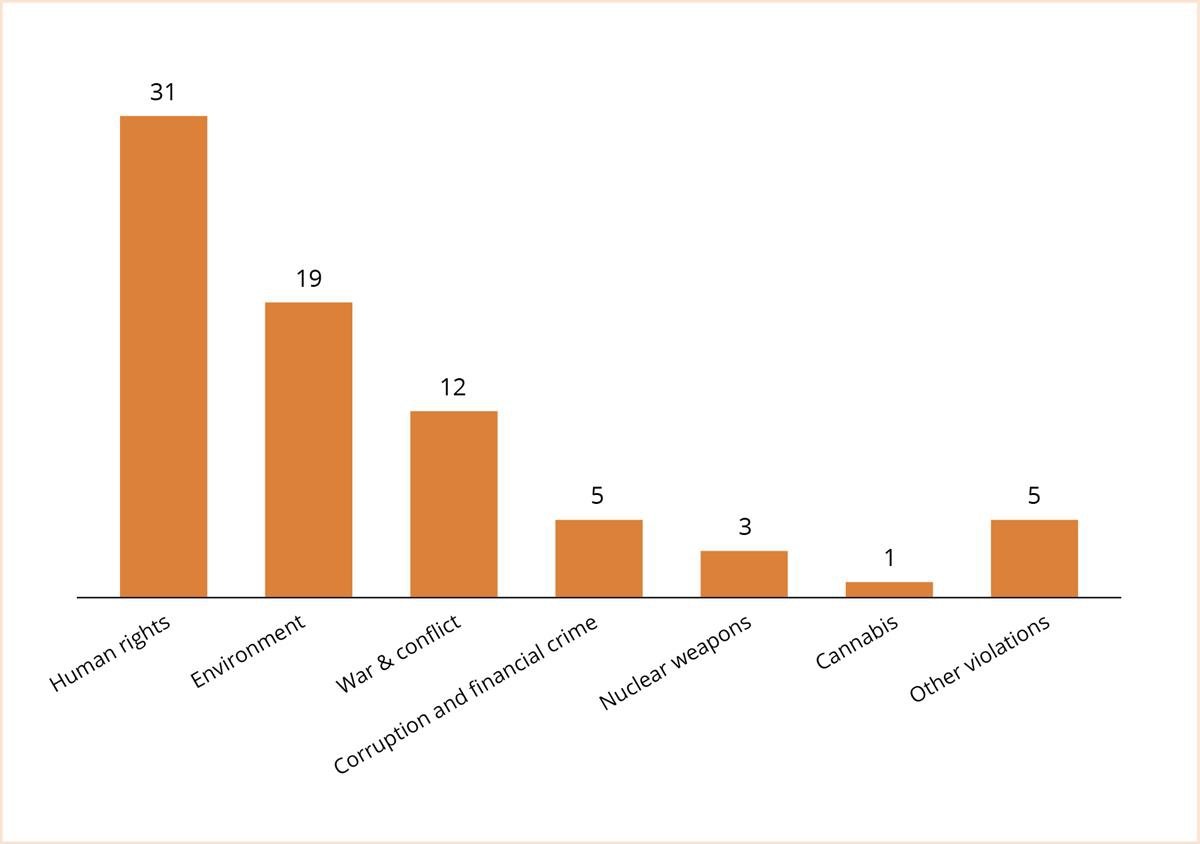
The Council attaches great importance to information provided by the companies themselves and takes the view that any failure to respond on the part of companies may help to heighten the ethical risk.
Assessment of companies that have been excluded or placed under observation
A company is not excluded for a specific period of time, and its exclusion may be revoked if the grounds therefore cease to exist. Norges Bank makes a formal decision to revoke a company’s exclusion at the recommendation of the Council. In 2025, the Council was in contact with six excluded companies that sought to have the grounds for their exclusion reassessed.
Companies that have been placed under observation are monitored continuously by the Council, which often submits one or more observation reports per company to Norges Bank during the observation period. An observation report is a status report in which the Council describes important development trends. Observation reports on two companies were issued in 2025. When the specified observation period has come to an end, the Council will issue a recommendation to terminate observation if there are no grounds for continued scrutiny. In 2025, the observation of one company was discontinued.