2 Introduction
These are the overriding objectives set by the Government for its data centre policy:
- Norway shall be an attractive location to data centre establishments that contribute to overall value creation, increased security and the safeguarding of Norwegian interests.
- Data centre establishments shall strengthen local communities and contribute to value creation at the local and national levels.
- The data centre industry shall have predictable and appropriate framework conditions. The framework conditions for the industry shall balance and safeguard both national security interests and crime prevention interests, and the desired establishment and development of data centres in Norway.
- Data centres shall have adequate security in times of peace, crisis and war. Norway has robust data centres that ensure both national and regional autonomy of data centre services. The most critical digital services shall be delivered from data centres in Norway or from data centres located with allies.
- The data centre industry in Norway shall be sustainable and have a low climate and environmental footprint.
- The development of the data centre industry shall be guided by the following principles:
- The development and operation of data centres must take into account how they affect the climate, the environment, nature and society as a whole. Critical digital infrastructure as a prioritised development purpose shall be developed within a framework of sound decisions for nature, considering differentiated land-use management.
- Data centre developments shall be land-efficient and, as far as possible, shall not be planned in areas with climate and environmental values that are of national or significant regional interest.
- Data storage and processing shall be based on renewable energy. Data centres in Norway shall be energy efficient.
- Data centres in Norway must capitalise on the real opportunities for energy recovery and reuse of excess heat from their operations.
- All hardware in data centres shall be reused or recycled to the extent possible.
One of the goals of the National Digitalisation Strategy 2024–2030: The Digital Norway of the Future is for Norway to become the most digitalised country in the world. As a follow-up to the National Digitalisation Strategy, the Government is now presenting a new Data Centre Strategy.
Data centres located in Norway, combined with a sound and robust national digital infrastructure in general, enable critical digital services to be produced domestically rather than abroad. This will enhance national control and secure opportunities for national autonomy. At the same time, it may be appropriate to adopt a flexible approach. This means, for example, that some services are produced on international cloud service platforms, but that provisions are made for data storage and service production to be seamlessly transferred to Norwegian data centres in the event of a crisis or emergency situation. Conversely, in certain critical situations, we may need to move parts of our data storage and service production out of Norwegian data centres to allied countries.
The most critical digital services shall be delivered from data centres in Norway or from data centres located with our allies. We also aim to ensure that data centres and data centre services have adequate security in times of peace, crisis and war. The Government has enhanced the national control of data centres. Data centres are now regulated by the new Act relating to electronic communications (Electronic Communications Act). Among other things, the Electronic Communications Act introduces a registration obligation for data centre operators and requirements for adequate security in data centres. Norwegian data centres are subject to supervision. The ability to maintain data storage and processing capacity in Norway has been identified as a fundamental national function under the Security Act. The Government has initiated work on making the Act applicable to data centres that are of significant importance to fundamental national functions or national security interests.
Interest in establishing data centres in Norway has grown in recent years and is currently high. The Norwegian data centre industry can be broadly divided into the ‘ordinary’ data centre industry, with data centres that support the use of digital services and technologies in a number of critical areas (traditional data centre operations, high performance computing (HPC)), and the ‘cryptocurrency industry’, with data centres engaged in data centre activities specifically related to cryptocurrency mining. These are among the most energy-intensive data centres. The Government wants to facilitate the establishment of data centres that foster innovation and value creation which contribute to modern industry and business development. It is undesirable for a large proportion of power resources used by data centres to be allocated to cryptocurrency mining, and the Government is therefore working to prevent cryptocurrency mining in Norway.
For the Norwegian welfare society and a sustainable economy, it is crucial that we succeed in the digital and green transition. Data centres and artificial intelligence can, in isolation, support emission reductions across all sectors through digital solutions, such as more climate-friendly and efficient production processes in industry and trade. At the same time, data centres are highly energy-intensive and require considerable space. These considerations must be balanced when establishing new data centres.
Electrical power is the main input factor for data centres. In its report on the state of the power system from 2025, the Norwegian Water Resources and Energy Directorate (NVE) writes that it expects an increase in power consumption of around 10 terawatt hours (TWh) by 2029. The Directorate estimates that the power surplus in 2029 will be 11 TWh. The reduction in the power surplus is lesser than previously projected. The speed and extent of the increase in consumption remain uncertain. If power becomes a scarce resource in the future, it could affect our ability to meet our climate, industry, and energy policy targets. To boost national value creation and the industry’s international competitiveness, the Government will adopt a strategic and comprehensive approach to increasing net sustainability from Norwegian data centres. This will require cross-sectoral co-operation.
2.1 What is a data centre?
A data centre is a facility, part of a facility or group of facilities used to place, connect and operate IT and network equipment for data storage, data processing or data transmission, and related activities, cf. Section 1-5(36) of the Electronic Communications Act. A data centre service is a service that facilitates the placement, connection and operation of IT and network equipment for data storage, data processing and data transmission. The service also includes physical security, power and cooling, and may include other related services, cf. Section 1-5(37) of the Electronic Communications Act.
Data centres vary in nature and size. They range from basic server rooms to hyperscale data centre installations that consume several hundred megawatts of power. A data centre can be part of a business’ internal infrastructure, or it can serve as a core activity by providing data centre services to external clients. All businesses send and receive data, and a data centre is therefore a critical component in the operations of many businesses. Data centre services are offered through different business models and with varying scope.
Data centres can be roughly divided into three categories: Hyperscale, Colocation and Edge.
- Hyperscale (large, dedicated data centres): Such data centres are typically owned and operated by major international companies, including Meta, Microsoft, Apple, Amazon, and Google, which enables them to provide their own services, such as infrastructure (storage and data processing), platform services, or software-as-a-service offerings. These services are utilised by a diverse group of users, and depending on the type of service, they are marketed to both businesses and consumers.
- Colocation (colocation data centre): Such data centres are owned and operated by a data centre operator, such as Stack, Bulk, or Green Mountain in Norway, or companies like Equinix, NTT, and CenturyLink internationally. The operator either sells space, cooling, network connections, or power to various customers who run their own IT, or IT operations are sold as a service. For example, Microsoft operates some of its cloud services aimed at Norwegian customers from such colocation data centres in Norway.
- Edge (often smaller installations – typically container-sized): Edge centres are often located close to where the data is generated. Such centres are typically owned and operated by telecommunications firms or large IT operators that offer data processing as a service.
2.2 The framework for this Data Centre Strategy
Data centres have become a vital part of the digital infrastructure, and the data centre industry in Norway is now an established industry that has experienced substantial growth in recent years.
This strategy addresses the physical aspects of the data centre, that is to say the data centre facility, but does not cover the logical part of service delivery (logical infrastructure, platforms, and application services). At the same time, the fact is all digitalisation, innovation and value creation based on digital solutions rely on the logical service layer provided by the data centre facility.
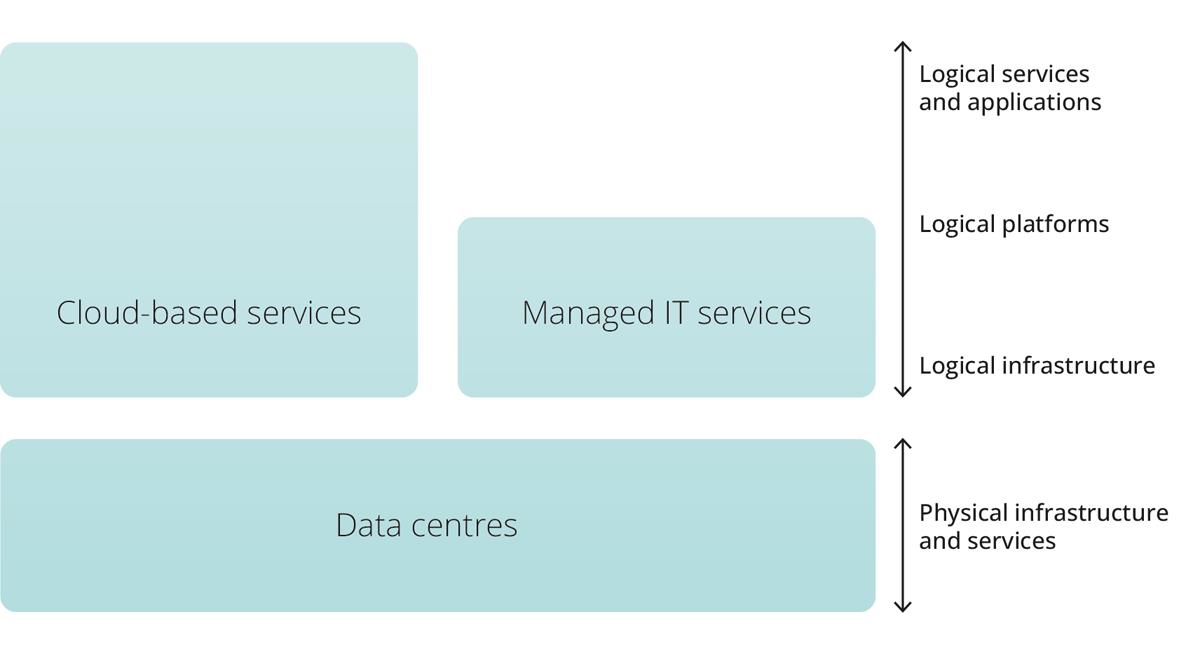
Source: A nskaffelse av datasentertjenester [Procurement of data centre services. Available in Norwegian only] (The Norwegian National Security Authority (NSM)/Norwegian Communications Authority (Nkom), 2024)
The Government wants Norway to remain an attractive country for investment in data centres that contribute to value creation, increased security and the safeguarding of Norwegian interests. With this strategy, the Government aims to further promote measures that can support ongoing growth in the data centre industry, while ensuring that development occurs sustainably and aligns with security needs and considerations.
Box 2.1 The Electronic Communications Act
The Norwegian Parliament (the Storting) has enacted a new Act relating to electronic communications (the Electronic Communications Act). This is the first time legislation has been introduced to regulate the data centre industry in Norway. New Regulations relating to data centres entered into force on 1 January 2025, at the same time as the new Electronic Communications Act. The new regulations require data centre operators to register with the Norwegian Communications Authority. Data centre operators are required to register their name, address, the physical location of the data centre, and details regarding the data centre operator’s legal status or organisation number. Additionally, they are required to describe the services provided in the data centre and register information about certain public or municipal authorities and businesses that are their clients. They are also required to estimate the amount of power used for cryptocurrency mining and the size of the subscribed electrical capacity. The regulations also require operators to appoint a representative who can physically attend the data centre with the authority and knowledge to follow up on inquiries from the authorities. The registration duty requires data centre operators to register prior to commencing operations. For data centre operators already in operation, a transitional arrangement has been established that will gradually phase in the registration duty until 1 July 2025.