5 A data centre industry for a greener future
The Government has high ambitions for the climate impact of data centres in Norway and for the industry’s contribution to meeting climate targets. The Government has set the following goal:
The data centre industry in Norway shall be sustainable and have a low climate and environmental footprint.
5.1 The need for electrical power and efficient energy use in data centres
Status
The fact that Norway has good access to renewable electrical power makes us well-suited for data centre establishments. Our cold climate also provides us with a good starting point for energy efficiency in data centres. For example, less energy is required for cooling here than in other parts of the world.
Data centres require a significant amount of electrical power. In the Norwegian Water Resources and Energy Directorate (NVE) report on the state of the power system in Norway from 2025, the main conclusion is that Norway will continue to have a positive power balance in a normal year until 2030. NVE expects power consumption to continue rising over the next five years, but has revised its projected increase downward from previous forecasts, partly because several plans for battery factories and hydrogen production have recently been postponed, scaled back, or cancelled.
Power consumption, grid connection, energy efficiency and excess heat are key aspects of the relationship between the data centre industry and the power system. The members of the Norwegian Data Centre Industry (NDI) have signed the Climate Neutral Pact , a self-imposed commitment to be climate neutral by 2030, and several of them have already entered into local partnerships to utilise excess heat from their data centres. According to NDI’s annual report, 9 of the 18 largest data centres have heat recovery, mainly in the form of local systems.
The total electricity consumption for digital infrastructure in Norway in 2024 is estimated at 3.7 TWh in Nkom’s sustainability analysis (see section 5.2), which represents 2.6 per cent of Norway’s total electricity consumption of 140 TWh. 6 The figure below illustrates the distribution of total electricity consumption across various parts of Norway’s digital infrastructure. As the figure shows, data centres accounted for around 41 per cent of this consumption.
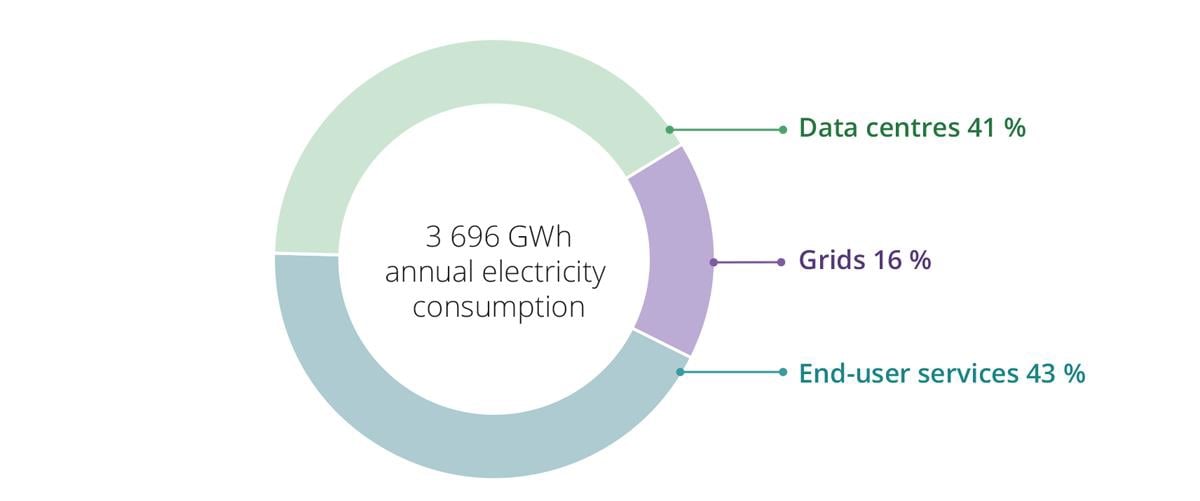
Source: The Norwegian Communications Authority (2025) Fotavtrykket fra norsk digital infrastruktur 2024 [The footprint of Norwegian digital infrastructure 2024. Available in Norwegian only]
Data centre services is one of the areas that are expanding, as a result of the rising use of big data and artificial intelligence. NVE expects power consumption in the data centre industry to increase from 2.5 TWh in 2024 to 6.0 TWh in 2030. In its long-term power market analysis from 2023, NVE assumes that electricity use in data centres could increase to 8 TWh by 2040. NVE emphasises that there is considerable uncertainty surrounding the development of power consumption in the coming years.
The grid has limited available capacity for connecting new major consumers. Statnett, the system operator of Norway’s power system, states that 2,691 megawatts (MW) are presently reserved for new data centres. In addition, projects requiring 4,390 MW are currently awaiting connection in the capacity queue. 7
The widespread emergence of AI technology will be a significant driver of how much data is stored and processed, and thus of power consumption in data centres. The table below shows the typical share of energy consumption for different types of AI activity. 8 As the table shows, model training is an activity that does not depend on proximity to the end user and can, in principle, be carried out anywhere in the world, thus representing a market opportunity for Norwegian data centres.
|
Type of activity |
Share of energy consumption |
Description |
|---|---|---|
|
Model development |
10% |
Models are developed and fine-tuned prior to training. |
|
Model training |
30% |
Algorithms learn by processing a comprehensive data set to make predictions or decisions without exact input-response relationships being programmed in advance. This demands substantial computational effort and consumes a lot of energy over extended periods. This activity does not require a rapid response and can, in principle, be undertaken anywhere in the world. |
|
Use |
60% |
The activity involves the implementation and application of developed AI models in real-world scenarios. This requires computational resources to interpret new data and generate results or predictions based on pre-trained models. This activity often requires a rapid response and to a greater extent must be carried out in proximity to the user. |
Under the Energy Act, anyone who wishes to do so has the right to be connected to the power grid. A large number of actors have applied to connect to the grid in recent years to establish new commercial and industrial activities or phase out fossil fuels through electrification. The grid companies report that there is little spare capacity in the grid that has not been reserved or utilised. Therefore, many of the actors seeking grid connection are now queued. It is therefore imperative for the Government to facilitate faster establishment of grid facilities in the future and to ensure that the grid is used as efficiently as possible. This work is well underway.
Where it is not possible to connect a customer to the existing grid, agreements on connection with conditions for disconnection or limitation of the customer’s consumption may be an alternative to investing in grid facilities. Conditional connection means that the customer accepts that the power supply may be reduced or entirely disconnected if required to ensure the stable operation of the power system. The actual conditions must be determined according to the grid situation at the location where the customer will be connected. In principle, data centres are well-suited for connection on certain conditions. Ordinary data centres have high requirements for security of supply and often have their own backup power solutions, such as battery capacity and diesel generators. Since they are largely able to sustain themselves during power outages, they can additionally contribute flexibility to the power market.
There must always be a balance between consumption and production in the power system, and Statnett among other things uses various reserve products to balance the system. Ordinary data centres are well-suited to participating in reserve markets. In addition to being an essential driver of digital innovation and business development, and providing more efficient and climate-friendly solutions and services, data centres therefore can also contribute to the power market. Statnett and the grid companies are working with the data centre industry to promote participation in the power markets.
The data centre industry can take measures to limit the need for electricity and facilitate the use of excess heat for various purposes. Data centres generate large amounts of excess heat that can be reused for other purposes, where this is beneficial for society. NVE points out that there is considerable potential for increased reuse of excess heat from data centres, but that there are several barriers to utilising excess heat. 9 The most significant barriers are a lack of infrastructure for transporting and storing heat. However, there are also organisational barriers, for example, related to the parties having to agree on the price and ownership of infrastructure (pipes, heat pumps, etc.), who will bear the investment costs and have operational responsibility, and assessing the risk of one of the parties withdrawing from the collaboration. Excess heat from data centres also has a relatively low temperature. This often necessitates measures to increase the temperature in order to utilise the excess heat.
Nevertheless, several examples exist of excess heat from data centres in Norway being utilised today. Many smaller data centres are situated in central locations where district heating infrastructure is also available, partly because they offer services that need to be close to the market. The largest data centres are often established in locations that are favourable due to the electricity grid and affordable land prices. In such large data centres, which require several terawatt hours of power, there will also be several terawatt hours of excess heat. This will require the extensive development of compatible businesses with high heat demand if a significant share of the excess heat from large data centres is to be utilised.
Box 5.1 Collaborating to ensure efficient energy recovery and help reduce the climate footprint
Skygard, a data centre operator owned by Telenor, Hafslund and HitecVision, is currently building a data centre facility in Hovinbyen that will be used in Hafslund Celsio’s district heating network. This will ensure efficient energy recovery and help reduce the climate footprint of the data centre facility’s operations. The energy from the data centre facility in Hovinbyen will be used to heat both commercial buildings and residential homes in the area, and the excess heat will be able to heat up to 12,000 flats in Oslo. The collaboration with Skygard will enable Hafslund Celsio to supply more district heating to Oslo, produced from local surplus energy. The collaboration also contributes to supporting the goals of emission reductions and sustainable energy use for both Oslo and the whole country.
Hafslund Celsio is also collaborating with Stack Infrastructures on the reuse of excess heat from Stack’s data centre facility at Ulven, which is used for district heating for 5,000 homes in Oslo.
Box 5.2 More sustainable operation with solar panels on the roof
Orange Business’s data centre in Lørenskog is the first in Norway to have solar panels on its roof. The 10,000 square metre data centre facility is expected to produce around 450 megawatt hours annually, equivalent to approximately 3.5 per cent of the data centre facility’s annual energy consumption.
Orange Business has a goal of reducing the company’s global carbon footprint by 30 per cent by 2025, and the solar cell facility is one of many measures that will help them achieve this goal. The company also plans to install similar solar power systems at its data centre facility in Grorud outside Oslo.
The way forward
5.1.1 Energy efficiency
Norway has a national goal of improving the energy intensity of the mainland economy by 30 per cent from 2015 to 2030, cf. the white paper on Norwegian energy policy towards 2030 (Meld. St. 25 (2015–2016)). Energy intensity indicates the amount of energy used relative to value creation, calculated by dividing energy consumption by gross domestic product. Energy efficiency is a measure of how effectively energy is utilised, for example, in the production of a product or service.
The Government believes that increased energy efficiency in data centres is vital for a green and sustainable data centre industry. There is much to be gained from colocating the data storage and processing needs of multiple businesses, so that these needs can be met through a single, more energy-efficient facility. To achieve an energy-efficient data centre industry, the companies must also prioritise reducing their power consumption.
The Government has introduced new energy assessment requirements for companies with an average annual consumption exceeding 2.5 GWh. The requirements entail preparing an implementation plan for beneficial energy measures to be presented to company management. Findings from the assessments and the implementation of measures shall be reported in the annual report or published in another way. The first energy assessment shall be implemented before 1 October 2026. Energy assessments will help to make data centre operators in Norway more aware of energy consumption and energy efficiency.
It may also be appropriate to develop an energy labelling scheme for the data centre industry. Nkom has therefore initiated preliminary discussions with the Norwegian Data Centre Industry about such a scheme.
5.1.2 Excess heat
The reuse of excess heat in the data centre industry must increase. If we use energy more efficiently, we will not need to expand power production and the grid as much as we would otherwise have to. Operators planning data centres have a responsibility to help ensure that excess heat from data centres can be utilised.
The Government has therefore introduced a regulation requiring a cost-benefit analysis of the possibilities for utilising excess heat from data centres above 2 MW. The regulation entered into force on 1 April 2025 and applies to the planning of new data centre facilities. NVE must approve the analysis before construction or upgrades can commence, and NVE has prepared a guide to accompany the regulations. In line with the 2023 action plan for energy efficiency, the Government is working on expanding and tightening the requirements for conducting cost-benefit analyses. In this context, the Government is looking at possible changes to ensure that the regulations cover more facilities and impose stricter requirements for the implementation of beneficial measures.
In addition, the Government has introduced requirements in the Regulations relating to pollution control stipulating that those who operate or control the operation of the facility must, to the greatest extent possible, ensure that surplus energy from existing and new facilities is utilised internally.
In the early planning phase, municipalities also have a responsibility to facilitate the utilisation of excess heat, cf. section 3.2. The new national planning guidelines for climate and energy stipulate that municipalities shall have an up-to-date overview of the possibilities for supplying heating and cooling based on local energy sources, and facilitate the utilisation of local heating and cooling sources, including excess heat. In addition, public support schemes can contribute to promoting the reuse of waste heat.
The Government
- wants the energy authorities to closely monitor how energy use in the data centre industry is developing and report regularly on this development
- will follow up on energy assessments among data centre operators by way of supervision
- will submit a legislative proposal for public consultation that requires more facilities to carry out cost-benefit analyses of excess heat utilisation, as well as requirements to implement beneficial measures, including data centres
- will follow up and evaluate the effects of newly established measures to increase the reuse of excess heat
- wants the data centre industry to utilise the opportunities offered by existing support schemes for the use of excess heat
- will continue to implement the measures announced in the Government’s action plan to accelerate grid development and improve grid utilisation
5.2 Climate challenges and environmental impact
Status
To ensure sustainability and welfare for the future, it is crucial that Norway succeeds in the digital and green transition. As centres for the storage and processing of data and digital services, data centres are the very heart of the digital infrastructure and an essential prerequisite for innovation and development in both the public and private sectors. As such, data centres play an essential role in the transition to a sustainable society. There is currently considerable international interest in establishing data centres in Norway, and the Norwegian data centre industry has grown rapidly over the last decade. The increased interest in Norway as a data centre location stems from Norway’s favourable climate conditions, with naturally low outdoor temperatures, access to suitable land areas, clean and renewable energy, and lower electricity prices compared to many other parts of the world. The figures below show that Norway is in a class of its own compared to other countries in Europe when it comes to access to emission-free and renewable power and low average temperatures.

Source: The role of power in unlocking the European AI revolution, McKinsey 2024.
With naturally low outdoor temperatures, less energy is needed to run cooling systems in data centres. However, because data centres consume large amounts of power and require large areas of land, the data centre industry also has a climate and environmental footprint. The expected growth in the development and use of AI could affect the footprint of the data centre industry, as demand for data centre capacity is likely to increase.
The EU is a driver in the efforts for a sustainable data centre industry. The European Commission will introduce new mechanisms for measuring the energy efficiency of data centres and electronic communications networks used by European companies in the EU’s Digital Economy and Society Index (DESI). At the same time, within the framework of the 2023 Energy Efficiency Directive, the EU has adopted a first common assessment scheme requiring the reporting of specific information and key figures annually to a European database, including total energy consumption, energy consumption for IT equipment, water supply and reuse of excess heat, using a common measurement and calculation method and defined sustainability indicators for data centres. The requirements apply to all data centre operators managing data centres with an installed power consumption of at least 500 kW. Directive 2012/27/EU of the European Parliament and of the Council on energy efficiency, as amended by Directive 2018/2002 of the European Parliament and of the Council, is expected to be incorporated into the EEA Agreement, and we refer to the discussion of this in Prop. 136 S (2024–2025). Directive 2023/1791 of the European Parliament and of the Council repeals the directives from 2021 and 2018, effective 12 October 2025. No decision has yet been made on whether the 2023 Directive will be incorporated into the EEA Agreement and transposed into Norwegian law. The EU has also developed common criteria for green public procurement for data centres, server rooms and cloud services, and will work to establish a European Code of Conduct for the sustainability of electronic communications networks by 2025. The EU also has several other measures that affect data centres, including the EU’s Action Plan for the Digitalisation of the Energy System, the revision of the Ecodesign Directive, and the new Taxonomy Regulation. The EU initiatives in this area that are legal acts may be EEA-relevant and could have an impact on Norwegian law.
Box 5.3 The Norwegian Communications Authority is leading the way with an analysis of the climate and environmental impact of Norwegian digital infrastructure from a consumer perspective10
Currently, there is no knowledge-based and cost-effective framework for documenting the sustainability potential and actual environmental impact of digitalisation at the national level. However, the Norwegian Communications Authority (Nkom) has conducted an analysis of the climate and environmental impact of digital infrastructure in operation on Norwegian soil. The analysis, which is one of the first of its kind in the world, is divided into two parts and addresses the situation in 2024 and the expected development towards 2030 and 2050. It shows that the adverse impact will increase in the future; however, to determine the net sustainability of digital infrastructure, both positive and negative effects must be considered. The analysis only considers first-order, or direct, effects related to the life cycle of digital infrastructure in Norway. This means that the positive spillover effects of having a digital infrastructure are not considered. Based on the analysis, Nkom is also in the process of developing a beta version of an index that assesses digital sustainability nationally in Norway.
The total climate footprint of digital infrastructure in Norway in 2024 is estimated at 1.1 million tonnes of CO 2 emissions, based on a location-based 11 electricity mix (the electricity physically used in Norway). By comparison, direct emissions from the aviation sector were 1.2 million tonnes of CO 2 equivalents in 2023. The table below shows the climate footprint of Norwegian digital infrastructure, per technical segment and life cycle phase, based on a location-based electricity mix. The footprint is expressed in thousands of tonnes (kt) of CO 2 equivalents. It is worth noting that end-user devices, which include various types of devices used for digital communication, account for as much as 76 per cent of the total climate footprint. It is particularly the production of end-user devices that accounts for a significant share of the climate footprint. The actual production does not take place in Norway, but the equipment is used here.
|
Life cycle phase |
End-user devices |
Grids |
Data centres |
Total |
|---|---|---|---|---|
|
Production |
694 kt |
98 kt |
37 kt |
830 kt |
|
Distribution |
53 kt |
14 kt |
2 kt |
69 kt |
|
Packaging |
19 kt |
- |
- |
19 kt |
|
Use |
93 kt |
40 kt |
67 kt |
200 kt |
|
Disposal |
10 kt |
12 kt |
0,2 kt |
22 kt |
|
Total |
868 kt |
165 kt |
106 kt |
1140 kt |
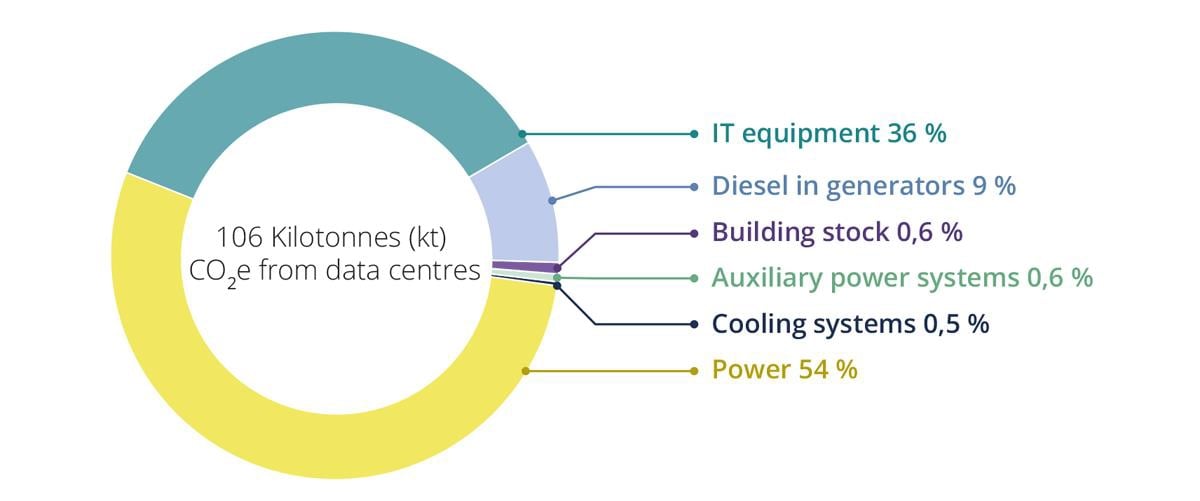
Data centres accounted for 9 per cent of the total climate footprint, with 106 kilotonnes of CO 2 emissions in 2024, and are expected to increase the most towards 2050. As shown in the figure below, energy consumption in the form of electricity (reuse of excess heat is not taken into account) and IT equipment (servers, storage capacity and network equipment) accounted for most of the emissions from data centres, at 54 and 36 per cent, respectively.
The way forward
The Climate Change Act stipulates that the target is to achieve reductions in greenhouse gas emissions of the order of 90-95 per cent from the level in the reference year of 1990, in order to become a low-emission society by 2050. This means that Norway must transform and reduce emissions across all sectors of society, including the public and business sectors. The report by the 2050 Climate Committee, Norwegian Official Report (NOU) 2023: 25 The transition to low emissions: Climate policy choices towards 2050 , highlights technology as one of the paths to a low-emission society.
The green and digital transitions are both complex and necessary, and have great potential for increased sustainability, competitiveness, and value creation. The data centre industry can support emissions reductions across all sectors through digitalisation, and is essential for the realisation of the white paper The Norwegian industry – competitiveness for a new time (Meld. St. 16 (2024–2025)) by acting as a driving force for new digital solutions and data-based innovation in industry. At the same time, the data centre industry also has a climate and environmental footprint in that it consumes large amounts of power and requires large areas of land.
The favourable conditions in Norway, including low outdoor temperatures, access to suitable land, clean and renewable energy, and lower electricity prices compared to other countries, are critical competitive advantages not only for the data centre industry but also for many other industries and for Norwegian society as a whole. It is crucial that we manage and utilise these advantages in a sustainable manner, creating good synergies and ensuring their retention in the future. Sustainability also enhances competitiveness, and sustainability in Norwegian data centres helps to preserve and strengthen the competitiveness of Norwegian business and society.
In the Norwegian action plan for biodiversity (Meld. St. 35 (2023–2024)), critical digital infrastructure is mentioned as a prioritised development purpose. Among other things, the report states: “In land-use management, socially beneficial purposes such as renewable power production, power lines, critical digital infrastructure, and defence shall be given particular weight in the event of conflicts between development purposes.” This is further followed up in the Royal Decree of 20 December 2024, where the central government planning guidelines for land use and mobility state as follows in section 7.7: “Municipalities, county authorities and central government authorities should co-operate to facilitate sufficient land for renewable energy production, power lines, defence purposes and critical digital infrastructure. In land-use management, socioeconomic beneficial purposes such as those mentioned above shall be given particular weight in the event of conflicts between development purposes.” At the same time, the white paper promotes a goal of reducing the development of particularly important natural areas. New data centres must also be established in a way that contributes to achieving this goal.
The type of equipment used for processing and storing data also affects the climate footprint of data centres. Technological equipment is advancing rapidly, and new, more efficient solutions are constantly entering the market. Therefore, recycling electronic waste from data centres in Norway is vital.
The public sector can play a crucial role by ensuring that greater emphasis is placed on energy and resource efficiency in the data centre industry in Norway. The public sector is a major purchaser and therefore has considerable purchasing power. Targeted use of public procurement is important. For example, public authorities and bodies can, to a greater extent, require the use of more energy-efficient IT equipment in contracts for the provision of data centre services. Public procurement of data centre services can also be designed to encourage the reuse of excess heat from the data centre in question.
Public-Private Partnerships (PPPs) at the industry level can also make it easier to jointly identify, prioritise and initiate activities and measures for value-creating and digital sustainability. It is also essential to establish a framework that can contribute to more regular documentation of the sustainability potential and the actual environmental impact of digitalisation at the national level. Such a framework will enable better management and facilitation of a value-creating data centre industry and desirable digitalisation.
In the long term, it may be of interest to quantify changes in biodiversity on Norwegian soil as a result of data centres and digital infrastructure. The Norwegian Environment Agency is working with Statistics Norway (SSB) to develop natural resource accounts for Norway. The natural resource accounts will provide a better overview of the distribution of nature, its condition and associated ecosystem services, and how these develop over time. This will provide better knowledge of how the degradation and use of nature impacts biodiversity. Part of the work also involves improving mapping data on nature. With improved maps and knowledge, it could become possible to link activities within Norway’s borders more effectively to potential changes in biodiversity.
5.2.1 Energy-intensive mining of cryptocurrencies
The Government has a clear intention to limit cryptocurrency mining to the greatest extent possible. Cryptocurrency mining is resource-intensive in terms of power consumption and generates minimal benefits for the local community in terms of job opportunities and income. There is little public information available about cryptocurrency mining in Norway. The registration obligation in the new Regulations relating to data centres ( Forskrift om datasenter ) will eventually make it easier to obtain an overview, monitor developments and supervise data centres, including those that mine cryptocurrency.
Norway is an attractive country for cryptocurrency mining due to its combination of low electricity prices, renewable energy, a stable power system and a cool climate, which result in lower cooling costs. Electricity is the primary input factor for mining cryptocurrency. Proof of Work (PoW) technology is the most energy-intensive method for validating cryptocurrencies. It is also the method used by Bitcoin, which is by far the most mined cryptocurrency in Norway. Measures targeting PoW will therefore affect both the majority of mining and the majority of power consumption for cryptocurrency mining in Norway.
The Government has assessed its scope to regulate cryptocurrency mining. We must ensure that any measures taken are effective and target cryptocurrency mining. The Government has decided to investigate a central government planning provision with a temporary and limited prohibition on the establishment of data centres that mainly engage in energy-intensive cryptocurrency mining. A central government planning provision may be limited to a geographical area or apply to the entire country. It can be introduced to safeguard national or regional interests, such as high power consumption in areas with limited grid capacity, jobs, environmental impact or other societal considerations. Central government planning provisions are legally binding rules and are adopted by Royal Decree. The introduction of a central government planning provision will not, by itself, bring new responsibilities for the municipal sector.
The measure aims to free up power, grid capacity and land for other purposes. At the same time, the measure must not affect data centres that are necessary for the desired digitalisation of society. Data centres are a vital part of the digital infrastructure and a critical prerequisite for all digitalisation. It will be important to distinguish between useful applications of blockchain technology and AI so as not to impede innovation and development in areas that are beneficial to society. EEA legal assessments must be carried out. The Government will closely monitor what the European Commission writes in its forthcoming report on crypto-technology, climate and environmental impacts and remedies.
The Government
- will establish a public-private partnership between the electronic communication authorities and industry actors within digital infrastructure and services to set common goals and formulate common visions related to increased and lasting sustainability, for example, a possible energy labelling scheme for data centres in Norway, the promotion of circular solutions for ICT equipment, and waste management in the data centre industry
- wants the new sustainability analysis commissioned by Nkom to serve as the basis for measurements and projections of the national status regarding digital sustainability
- will promote climate-friendly solutions in relevant international forums to inspire other countries
- will take the initiative for Nordic co-operation to be at the forefront of innovation and sustainable solutions
- will investigate a central government planning provision with a temporary and limited prohibition on the establishment of data centres that mainly engage in energy-intensive cryptocurrency mining