4 Individual responsibility and self-help
The assistance provided by Norwegian authorities to Norwegians abroad is based on the principles of individual responsibility and self-help. The most important thing people can do to help themselves is to ensure that they have adequate travel insurance. This was one of the key points made in the previous white paper on consular assistance (Meld. St. 12 (2010–2011)) and it is still valid today. These principles apply both in cases involving assistance to individuals and in cases involving crisis management.
4.1 Travel insurance
Norwegians are not required to have travel insurance, but it is strongly recommended that anyone who travels abroad purchases it. According to figures from the insurance industry, far too many people, especially young adults, travel without travel insurance.
Individuals who choose to travel without adequate travel insurance are exposing themselves to significant financial risk, particularly if they experience health problems. If they fall ill, are injured or have an accident while abroad, the cost of the necessary medical treatment may quickly become very high, and they or their next of kin may have to cover these costs themselves. Those who choose to travel without travel insurance should have sufficient funds to cover unforeseen costs such as for a hospital stay or medical transport back to Norway. The experience of the Foreign Service is that the death of an uninsured person abroad puts the next of kin in a very difficult position, requiring them for example to decide whether to engage a local funeral director and pay to have the deceased transported to Norway for burial.1
As a general rule, Norwegian citizens are not automatically entitled to medical treatment when abroad. This applies to all countries apart from the other Nordic countries, the EU/EEA countries and Switzerland. In these countries, medical expenses incurred during a temporary stay will be covered on an equal footing with the nationals of the country concerned, provided that the individual involved can present a European Health Insurance Card.2 It is important to be aware that the card does not necessarily cover all types of expenses, such as expenses for transport back to Norway. Transport on an air ambulance from a European country back to Norway may cost upwards of NOK 300 000. It is therefore important to have valid travel insurance in addition to the European Health Insurance Card, and to bear in mind that different rules may apply for those who have chosen to take up residence in another country.
For travellers in countries outside the Nordic countries and the EU/EEA, it is generally the case that neither the Norwegian authorities nor the local authorities will cover expenses in connection with medical treatment. In some countries, critical life-saving treatment may be provided free of charge, but not any other forms of medical treatment. Travel in these countries without valid travel insurance thus poses an even greater risk. A hospital stay in the US, for example, can cost up to NOK 100 000 per day, while the price of an air ambulance from Thailand to Norway can exceed NOK 1 million.
It is particularly important for Norwegian citizens who are staying for an extended period in, or have emigrated to, other countries to find out about the implications this has for their health insurance. Most travel insurance policies require permanent residence and membership of the Norwegian National Insurance Scheme. Compulsory membership of the Norwegian National Insurance Scheme confers certain health care-related and pension rights, and stays abroad can affect the individual’s membership. It is up to the individual to find out about the impacts that a planned stay abroad (or in progress) may have on their rights under the Norwegian National Insurance Scheme, and determine whether to apply for voluntary membership of the scheme when this is desirable and provided that they meet the requirements.3 Students studying abroad must have their own travel insurance, and there are a number of companies that offer student policies.
Most Norwegian insurance companies link their policy terms and conditions to any advice against travel to a particular country that has been issued by the Ministry of Foreign Affairs. This is a business decision taken by the industry itself. In cases where the Ministry of Foreign Affairs has advised against travel to the final destination, the travel insurance may be deemed invalid for the entire journey.
4.2 Costs and reimbursement of expenses
In accordance with current practice, expenses incurred by the Foreign Service in connection with consular assistance are covered under the Foreign Ministry’s operating budget, whereas the individuals concerned will be required to cover their own expenses. This means the embassy does not charge for its time or travel costs, but the individual involved must pay for such things as doctor’s consultations, legal assistance or airline tickets home. In exceptional cases, where life and health are at stake, certain unforeseen expenses in connection with assistance to Norwegians abroad may be covered. See chapter 5.7 for more information. In other special circumstances, where the recipient of consular assistance has shown gross negligence, the Norwegian authorities may demand reimbursement of their expenses. The potential to demand reimbursement is important, as it may have a preventive effect.
As a rule, Norwegians who receive assistance in connection with major crises have also been required to cover their own expenses. For example, individuals have been required to pay a specified amount when they use transport services made available by the Norwegian authorities. In practice, this means that individuals must either document that they have adequate travel insurance coverage or apply for an emergency loan. The Foreign Service can then have its expenses refunded at a later time.
In cases involving assisted departure, the Foreign Service has generally not received full reimbursement for the expenses that relate directly to the individual involved. This is partly because it is difficult to calculate costs during an ongoing crisis. In the Government’s view, consideration should be given to establishing a framework where the state would cover a somewhat larger portion of the costs associated with unexpected crises, such as natural disasters, while individuals who take too great a personal risk by travelling to or staying in areas the Norwegian authorities have advised against, would be required to cover more of the costs themselves. This could also have a preventive effect.
4.3 Preventive consular assistance
Providing advice and guidance to Norwegians abroad is a core component of consular work. The purpose is to equip individuals with the information they need to make sound, informed choices about foreign travel. These information activities are an important means of helping people to help themselves. The aim is to reduce to a minimum the number of people who end up in a situation where they need consular assistance abroad.
The Ministry issues two types of general consular guidance. These are now referred to as travel information and travel warnings, and they are intended to prevent problems from arising. Both are published on regjeringen.no and are among the most read content there. Travel information and travel warnings are also available on the Foreign Ministry’s travel app Reiseklar, which is also used to send notifications of incidents in relevant countries. In addition, the app provides easy access to the travel registration portal reiseregistrering.no, where Norwegians travelling or planning to travel abroad can register their trips and receive timely information by email or text message from the Foreign Service if a significant incident occurs in the country they are travelling to. The app was launched in 2021 and has been downloaded to some 400 000 phones. It is used by more than 20 000 people every month.

Figure 4.1 The Foreign Ministry’s travel app Reiseklar (‘Travel-ready’)
The information in the Reiseklar app is in Norwegian only.
Illustration: Ministry of Foreign Affairs
In addition to the information available on regjeringen.no, the missions also provide some general consular guidance on their websites (norway.no). This includes practical and administrative advice, as well as answers to frequently asked questions. Norwegians living permanently in other countries are a key target group for this information.
4.3.1 Travel information
Travel information issued by the Ministry of Foreign Affairs provides Norwegians with advice and guidance about risks it may be useful to be aware of and consider before deciding to travel to a country. It is the task of the mission that is in, or has responsibility for, the country concerned to make the assessments and update the information as necessary. The Ministry’s travel information is not a substitute for material that is publicly available on the internet or in commercial travel guides, or for information that other authorities are better suited to provide.
Travel information for each country is divided into fixed categories. General information is provided on the security situation, healthcare, crime and the risk of natural disaster in the country concerned. The travel information includes a brief overview of key local laws and customs that differ from those in Norway, as well as essential contact information, such as emergency numbers for the police and health services. General information about national entry and exit rules is also provided. Experience shows that publishing correct, up-to-date information reduces the number of enquiries the missions and the Ministry receive from members of the public.
Individuals can use the Ministry’s travel information to assess for themselves the risks of travelling to another country. In addition to the general risks faced by anyone who travels to or stays in a particular country or area, it is unfortunately the case that certain people or groups may encounter varying degrees of scepticism, discrimination, harassment or even criminal sanction. When assessing the risks involved, it is therefore essential that individuals give consideration to risks specifically associated with who they are or what they plan to do abroad. The Foreign Ministry’s travel information for many countries includes a brief description, for example, of risks specifically faced by LGBT+ people. A number of other groups may also be subject to greater risk when travelling abroad. As with sexual orientation and gender expression, factors such as gender, ethnicity and religion may increase the level of risk. The same applies to disabilities, chronic diseases and mental disorders. An individual’s area of work may be another risk factor, and dual citizenship can make some people more vulnerable. This is especially the case for those engaged in political or social activism in their country of origin.
Advice for vulnerable groups on the risks of travelling abroad should primarily be provided by actors with specialised knowledge, who can give better, more specific guidance than the missions about the risks involved.
4.3.2 Travel warnings
The Norwegian authorities can never guarantee that journeys or stays abroad will be safe. In cases where the Ministry of Foreign Affairs considers that the situation in a country or area is such that Norwegians should avoid travelling there, an official travel warning is issued. This was previously referred to in Norwegian as reiseråd (travel advice). However, in connection with the presentation of this white paper, the term has now been changed to reiseadvarsel (travel warning) to help Norwegians to better distinguish between specific travel warnings and general travel information. Although the term has been changed, the purpose and structure of this information remain unchanged and are described below.
A travel warning is issued in cases where there is reason to advise Norwegians to leave or avoid travelling to a specific country, area or region. This is generally because of war, war-like situations or other forms of unrest that, on the basis of an overall assessment, indicate that Norwegian citizens should not travel to the place in question or stay there.
Textbox 4.1 The Foreign Ministry operates with three levels of travel warnings
-
Advice against non-essential travel to a country or area.
-
Advice against all travel to a country or area.
-
Advice against all travel to or stays in a country or area, including urging Norwegians to leave the area.
The Foreign Ministry’s travel warnings clearly advise against travelling or staying in a country or area, but they do not constitute travel bans or travel restrictions preventing individuals from travelling where they wish. It will always be up to individuals to assess how much risk they are willing to accept.
In countries or areas for which travel warnings have been issued, it will be difficult and sometimes impossible for the Foreign Service to provide consular assistance. Moreover, it is common practice in the insurance industry to deem travel insurance invalid for trips to countries where a travel warning is in effect, as mentioned in chapter 4.1. The Ministry of Foreign Affairs has published information clarifying the level of consular assistance the public can expect to receive in connection with trips to countries and areas for which a travel warning has been issued. This information has been translated into English, French, Arabic, Urdu, Tigrinya, Polish and Somali in order to make it accessible to dual citizens and transnational families in particular.
Official travel warnings are issued, revised or withdrawn following an overall assessment of the situation in question. Decisions to issue travel warnings are not politically motivated, and their sole purpose is to enhance the safety and well-being of the Norwegian public. However, it is clear that travel warnings issued by Norway can prompt reactions, and there have been cases where the Norwegian authorities have reacted to advice issued by the foreign services of other countries regarding specific risks associated with travelling to Norway. The Ministry is therefore considering the need to provide more information about the key factors included in the assessments that are carried out when official travel warnings are issued.
4.3.3 Travel registration
In 2024, Norwegians registered a total of 114 684 trips or stays abroad in the Foreign Ministry’s travel registration portal (reiseregistrering.no) or via the Reiseklar app. The trips were to 230 different countries and territories. About a third of all registered trips were to Spain, Greece, Türkiye, Thailand, Italy or France.
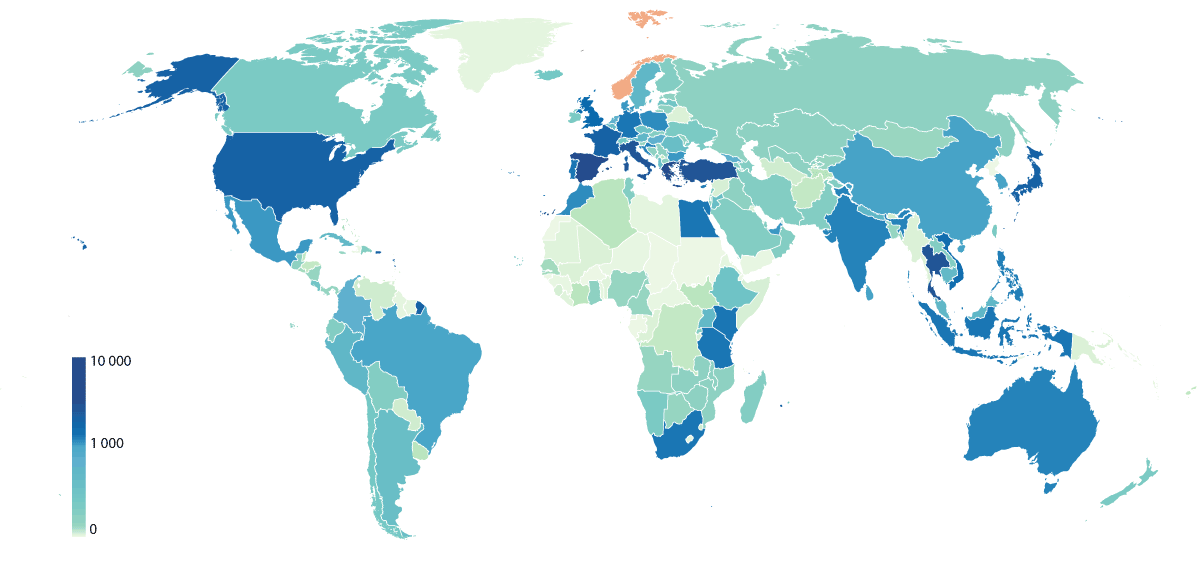
Figure 4.2 Trips registered in the travel registration portal reiseregistrering.no in 2024
Source: Ministry of Foreign Affairs
Registering a trip in the portal is voluntary, and does not give the Foreign Service information about where someone actually is. The Foreign Service does not, for example, have access to location data in the Reiseklar app.
When a serious incident or crisis occurs, the Ministry of Foreign Affairs can rapidly disseminate useful, practical information to those who have registered that they are in a country. The threshold for sending out information to registered users will vary. In countries with good warning systems and countries where most Norwegians can be expected to be able to follow local media on their own, there may be less reason for the Ministry to send out messages.
Most messages are sent out in connection with an ongoing crisis management operation. Experience shows that the number of Norwegians present in a country is generally far higher than the number of people registered. As a result, registrations often rise sharply in the first few days of a crisis. In a crisis situation it is crucial that the Foreign Service can target its efforts towards the people who are actually affected. Norwegians who are in the area but are not affected are therefore urged to make this known, including to family members or friends in Norway.
It is important to modernise and upgrade technical tools that can facilitate communication with the public in crisis situations. A number of commercial solutions are already available that enable people to communicate that they are safe and do not need assistance. In the longer term, consideration will be given to the possibility of developing solutions for two-way communication with members of the public using a suitable digital interface. In the future, if an assisted departure operation is to be carried out or some other need for consular assistance arises it should, for example, be possible for members of the public to confirm their identity or apply for an emergency loan digitally. Manual solutions must remain available, but relying on them as standard practice, as is the case today, is not cost-effective and is not always feasible.
Textbox 4.2 Travel warnings
Norwegian citizens may have difficulty travelling out of a country while a major crisis is ongoing. Airports may be closed at short notice and the authorities may impose a state of emergency or curfew. In severe crises, the Ministry of Foreign Affairs urges Norwegian citizens in affected areas to leave before it is too late. Individuals registered in the travel registration portal reiseregistrering.no or using the Reiseklar app will receive messages with advice about possible departure options. When the Ministry of Foreign Affairs issues the highest level of travel warning, this is also an indication that it may be difficult or impossible for the Foreign Service to help people who remain in the area.

Figure 4.3 Communication with the public
Recording an information video urging more Norwegians to use the Foreign Ministry’s travel app Reiseklar.
Photo: Ministry of Foreign Affairs