2 Paradigm Shift in Aviation
The aviation sector is undergoing a fundamental transformation. While conventional aviation continues to rely on airport-centric infrastructure and fossil-based propulsion, a new wave of technologies – most notably drones and AAM – is emerging, driven by automation, electrification, and digital innovation. This shift marks a move toward more flexible, decentralized, and sustainable aviation systems.
In Norway, these developments hold particular promise due to the country’s dispersed population, mountainous geography, and challenging climatic conditions. Drones and AAM offer new possibilities for delivering critical services, improving logistics, and enhancing connectivity in remote regions. The Norwegian government actively supports the safe and sustainable integration of these technologies in line with national transport and climate policies.
Recognizing the strategic significance of these developments, the Norwegian government has adopted a proactive and coordinated policy approach. Within the frameworks of the National Transport Plan 2025–2036 and the National Aviation Strategy, drones and AAM are identified as transformative tools for achieving national goals related to accessibility, climate mitigation, technological innovation, and public sector efficiency. These strategies envision a transport system that is not only safe and efficient, but also aligned with the broader transition to a low-emission society by 2050.
The integration of drones and AAM into the national transport system is being approached holistically. In the near term, drones are already delivering clear benefits across several sectors. In infrastructure and civil engineering, drones are used for bridge inspections, construction monitoring, and geodata collection. In the energy sector, they contribute to the safe and cost-effective inspection of power lines and wind turbines. Health and emergency services have begun operations or trials using drones to transport medical samples, deliver emergency equipment such as defibrillators, and support search-and-rescue operations. These applications not only increase operational efficiency but also reduce environmental footprints and human risk.
Looking ahead, Norway is preparing for the gradual introduction of larger, often piloted, electric aircraft capable of transporting people and heavier cargo. These aircraft vary widely in size and configuration, from vertical take-off and landing (VTOL) models suitable for intra-city travel, to short take-off and landing (STOL) vehicles optimized for regional connections. Many of these models combine the lift characteristics of helicopters with the energy efficiency of fixed-wing aircraft.
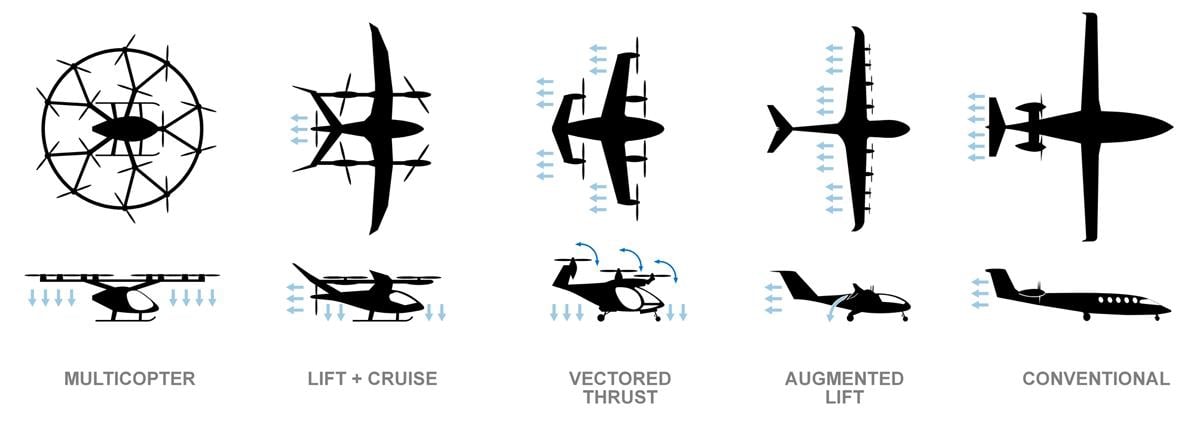
Figure 2.1 Categories of AAM aircraft
Source: SMG Consulting
Norway anticipates that the initial adoption of these technologies will take place in the freight sector. Cargo operations – especially those serving offshore installations, medical logistics, and remote regions – offer ideal test cases due to their recurring routes and lower complexity compared to passenger services. As the technology matures and regulatory frameworks evolve, passenger transport is expected to follow. This transition is likely to begin with short-range, on-demand services connecting industrial parks, regional hubs, and eventually smaller urban centers.
To support this evolution, a comprehensive ecosystem must be developed. Norway is working to ensure that the physical and digital infrastructure is in place to accommodate new aircraft types and flight patterns. This includes not only the adaptation of existing airports, particularly within the country’s well-developed regional airport network, but also the construction of new landing facilities – known as vertiports – near population centers and logistics hubs. Equally important is the establishment of advanced airspace management systems capable of safely integrating manned and unmanned aircraft. These systems must be supported by appropriate legislation, certification processes, training programs, and maintenance operations, all of which are being addressed through cross-sectoral collaboration.
One of the most important initiatives to accelerate this development is the establishment of Norway as an international test arena for zero- and low-emission aviation. With state funding and a national mandate, this initiative provides a platform for the demonstration and regulatory evaluation of emerging technologies under real-world conditions. The test arena brings together regulators, developers, industry stakeholders, and researchers to build shared knowledge, reduce uncertainties, and identify barriers to adoption. It also enables iterative learning across operational, regulatory, and societal dimensions, helping to ensure that new aviation solutions are not only technically feasible but also scalable, safe, and publicly acceptable.
Norway’s leadership in electrification across other transport sectors – including its early adoption of electric vehicles and ferries – provides a strong foundation for this work. Furthermore, the government’s targeted use of public funding, policy incentives, and interministerial coordination strengthens the institutional capacity to guide this transition. The test arena is expected to yield significant insights into the regulatory adaptations required, while also attracting domestic and international investment in clean aviation technologies.
Nevertheless, the introduction of drones and AAM is not without challenges. Issues such as airspace integration, safety in mixed manned and unmanned traffic environments, noise pollution, public trust in automation, and data privacy are all critical considerations. Norway’s approach emphasizes transparency, incremental implementation, and active public engagement. Studies have shown that while public attitudes towards AAM are generally positive, there remains a strong emphasis on safety, reliability, and community benefit. These factors will continue to shape both policy development and technology design.
Importantly, drones and AAM are not intended to replace existing transport modes, but rather to complement them. In sparsely populated areas, they may offer viable alternatives where road or rail connections are limited. In urban contexts, they can enhance emergency response capabilities or offer niche transport services where time is critical. Their contribution to the broader goals of climate mitigation and social inclusion makes them a valuable addition to Norway’s long-term approach to sustainable mobility.
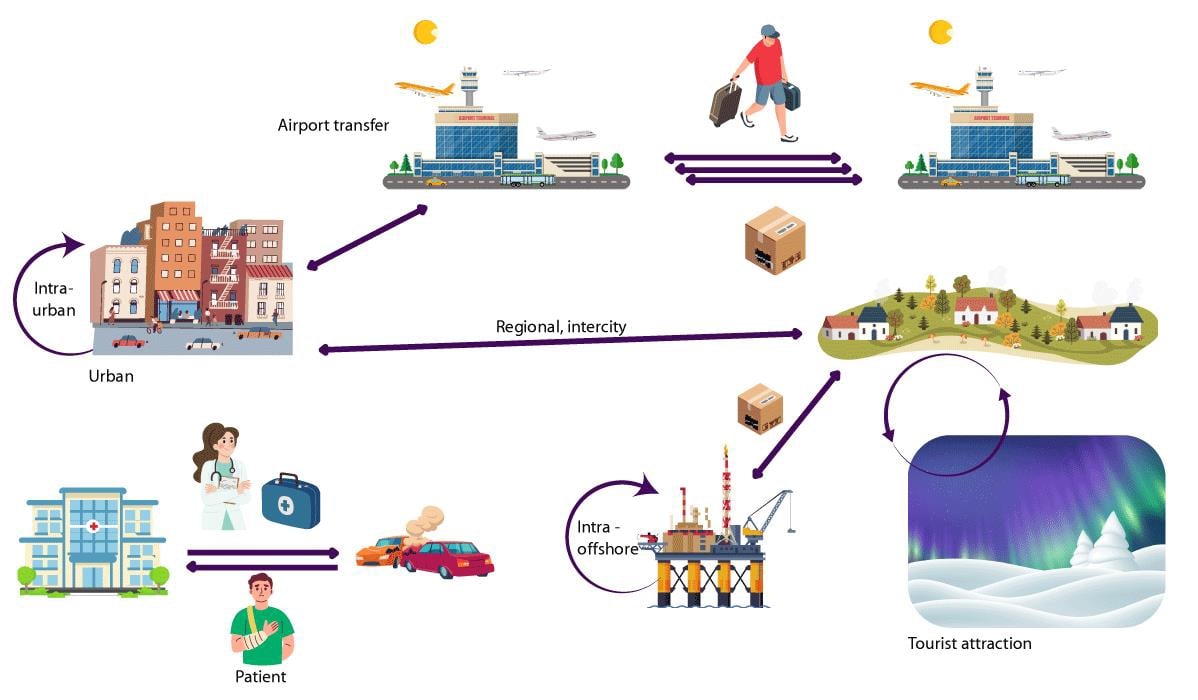
Figure 2.2 Use cases of drones and AAM
Source: Avinor AS
As part of its future-oriented vision, the Norwegian government has reaffirmed its commitment to ensuring that the benefits of these technologies reach all parts of the country. Efforts are being made to involve municipalities, regional authorities, and private actors in planning and implementation. The government is also continuing its work through a dedicated interministerial drone and AAM coordination group, ensuring that national security, environmental protection, and societal welfare remain central to policy formulation.
In summary, Norway is positioning itself at the forefront of the global shift toward sustainable and intelligent aviation. By aligning regulatory innovation with societal needs and technological progress, and by embedding new aerial systems within a coordinated national transport framework, Norway aims to realize the full potential of drones and AAM – not just as tools for innovation, but as instruments of public value.
To ensure that drones and AAM technologies contribute meaningfully to national development and innovation, the Norwegian government commits to:
- Promoting the use of drones and AAM in ways that benefit society and support equitable development across the entire country
- Assessing how drones and AAM can complement and enhance the mobility provided by conventional aviation as part of long-term transport sector planning
- Leveraging Norway’s role as an international test arena for zero- and low-emission aviation to support the safe and targeted introduction of new aviation technologies
- Continuing and strengthening the interministerial working group tasked with addressing strategic challenges related to drones and AAM