7 Climate, Environment and Agriculture
The government recognizes the growing potential of drones and AAM in contributing to national and international climate and environmental goals. Provided that the new aircraft types are emission-free and replace means of transport and equipment powered by fossil energy sources, there is potential to reduce greenhouse gas emissions. Furthermore, drones and AAM can help to reduce both land use and the burden of physical movement with other vehicles on the ground in vulnerable areas.
At the same time, the increasing presence of aircrafts in low-altitude airspace introduces new environmental and regulatory challenges. The government is working to balance the benefits of drones and AAM against risks such as noise, wildlife disturbance and overuse in vulnerable areas.
In the agricultural sector, drones are already being used to improve productivity while reducing environmental impacts. Through high-resolution imaging and AI-driven analytics, drones can monitor soil moisture, plant health, and biomass throughout the growing season. These data are used to optimize irrigation, fertilization, and pesticide application – key elements of precision agriculture.
Drones can also assist in detecting wildlife, such as fawns hidden in tall grass, before harvesting begins, helping to avoid unnecessary harm. Furthermore, drone-based seeding and fertilizer spreading can reduce soil compaction compared to traditional tractors, especially in soft or hilly terrain.
In livestock management, drones integrated with GPS tracking and AI algorithms are used to monitor grazing herds, particularly sheep, cattle and semi-domesticated reindeer. Drones support real-time tracking of animals, identification of distressed or immobile individuals, and efficient documentation of grazing boundaries and losses. These capabilities are especially useful in rugged terrain and during search-and-rescue operations for animals lost in remote areas.
Reindeer herders are increasingly using drones for daily oversight, herding, and mapping tasks. Lightweight and portable drones reduce the need for motorized vehicles such as snowmobiles and helicopters, helping to cut costs, emissions and noise. Drones equipped with thermal cameras allow for population surveys and monitoring of calving rates without disturbing vulnerable animals. AI-assisted tools are under development to automatically count herds and distinguish species using infrared and visual signatures.
These technological advances can assist not only individual herders but also public authorities managing reindeer husbandry policies and compensation systems.
The forestry sector in Norway is an early adopter of drone technologies. Drones are used extensively for forest inventory, post-harvest assessments, and planning of timber operations. Prior to salvage logging after natural disturbances – such as storms, fires, or pest outbreaks – drones can quickly provide high-resolution data to support damage assessments and emergency response.
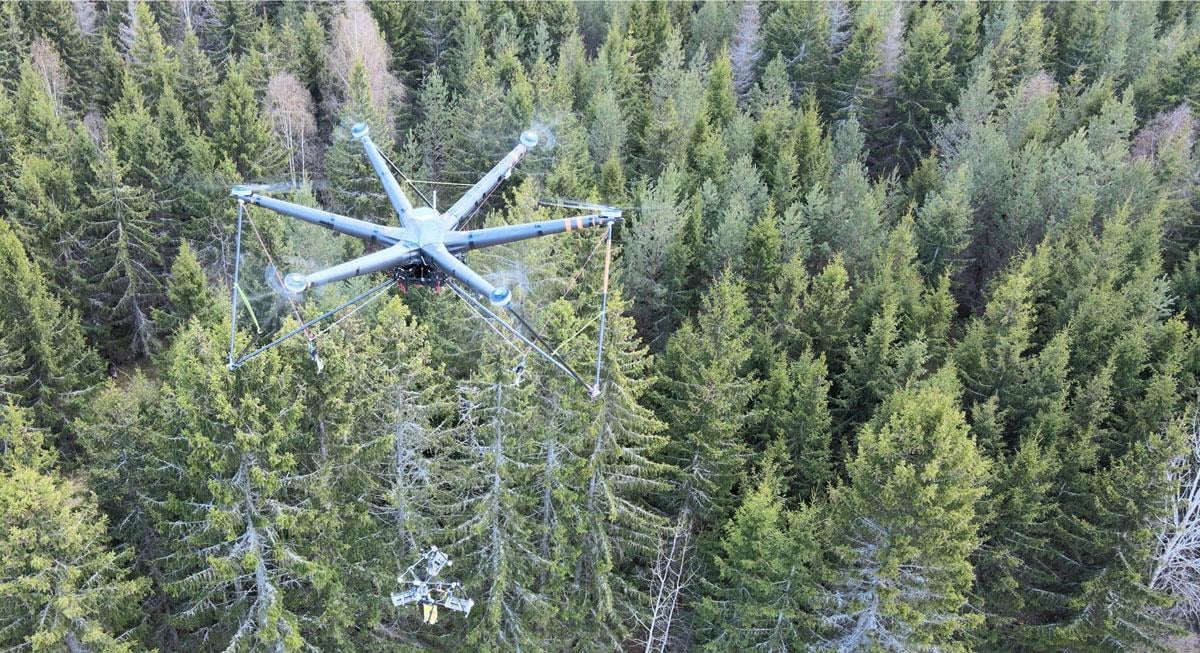
Figure 7.1 Forest thinning operation using a drone with attached cutting device
Photo: AirForestry AB
Drones equipped with LiDAR (Light Detection and Ranging) sensors are particularly valuable for producing detailed 3D maps of forest structure, tree height and density, which support sustainable forest management. As drone capacity, range, and lift capabilities improve, their use in large-scale forest operations is expanding. Experimental projects in Sweden are also testing heavy-lift drones for selective thinning and timber extraction. In Norway, Statskog SF is evaluating this concept and aims to start test thinning using drones in 2027.
Drones are proving effective in a variety of environmental protection and enforcement roles. These include monitoring illegal activity (e.g., poaching, unauthorized vehicle access), tracking ecosystem changes, identifying marine and land-based litter, and inspecting protected areas. Public authorities use drones for both real-time operations and long-term observation of sensitive areas.
While the use of drones for active hunting is prohibited under Norwegian law, they may be used under strict conditions by wildlife management authorities for animal search operations or sanctioned lethal wildlife control. Remote operations enable rapid deployment in cases involving injured or diseased animals, reducing suffering and improving response coordination. Thermal imaging and live video feeds can aid wildlife officers in tracking, identification, and planning safe interventions.
Though quieter than helicopters and all-terrain vehicles, drones are not entirely silent. Wildlife – including birds and mammals – can be sensitive to low-frequency noise, movement, and visual disturbances. In certain habitats, such as seabird nesting cliffs, even small drones flown too close can disrupt breeding behavior or provoke stress responses. Ongoing research is exploring how different species respond to drone presence, and the government is considering whether additional guidelines are needed for drone use near sensitive wildlife.
To reduce unintended harm, operators are encouraged to fly at safe distances, avoid nesting seasons, and observe best practices for environmentally responsible drone operations.
A range of regulations affect drone use in environmental and agricultural contexts. For example, the Nature Diversity Act and the Act relating to Motor Traffic on Uncultivated Land and in Watercourses impose duties of care on drone operators to avoid environmental harm. Separate provisions apply to protected areas, where local regulations may restrict or prohibit drone use entirely, including takeoff, landing or flight through specific zones.
Drone spraying of pesticides is currently prohibited in Norway, except under special exemptions for research or emergencies. The government is monitoring EU developments in this area and evaluating the need for harmonized standards, environmental risk assessments and safe application methods.
The government sees drones and AAM as part of the effort to decarbonize the transport sector. These aircraft can help reduce physical ground traffic and infrastructure footprints in sensitive or inaccessible areas, which can further support nature preservation and reduced land use. Tasks traditionally carried out by helicopters – such as powerline inspections, environmental monitoring, or remote logistics – can increasingly be handled by low or zero-emission aircraft, with significantly lower carbon footprints.
Wider adoption of drones and AAM with zero and low emission propulsion systems will contribute to the increased power demand across the transport sector. While their energy needs are modest compared to larger transport modes, their cumulative impact – especially in rural or off-grid areas – will require planning for adequate power infrastructure and charging capacity. The government is therefore coordinating energy demand forecasts with transport planning.
Furthermore, drones are subject to electronic waste regulations, as they contain materials such as lithium and rare earth elements. According to Norwegian law, drone manufacturers may be required to assess supply chain risks and increase recycling of strategic components (these requirements correspond with similar regulations in the EU Critical Raw Materials Act). This ensures proper handling of critical raw materials and reduces environmental risks associated with improper disposal.
To ensure that the growing use of drones and AAM supports environmental, agricultural, and climate goals, the government commits to:
- Facilitating the adoption of drones and AAM in ways that reduce greenhouse gas emissions and lessen the impact on nature
- Encouraging the use of drones for mapping, monitoring, and inspection activities in agricultural and environmental management
- Evaluating the need for guidelines to prevent harm or disturbance to nature, wildlife and birds
- Providing information about drone use restrictions in protected areas, during hunting, and more broadly, about the potential impacts of drones on ecosystems
- Assessing whether drone technology can improve the effectiveness of sanctioned lethal wildlife control efforts related to large carnivores
- Further investigating the noise and other disturbances drones may cause to nature and wildlife, and evaluating whether current regulations adequately protect these interests
- Monitoring developments in the use of drones for plant protection products application, including discussions in relevant EU forums