4 Creating Ownership of the SDGs
4.1 Whole-of-Government Approach
4.1.1 Governmental Implementation and Coordination
Responsibility for the implementation and achievement of the Sustainable Development Goals rests with national governments. Each country is required to adapt the Goals to its national context by identifying country-specific challenges, setting national targets, and integrating the SDGs into national policies, plans, and strategies.
Since the adoption of the 2030 Agenda in 2015, the Government’s approach has been to mainstream the SDGs into ordinary policy development rather than treating them as a separate policy domain. This strengthens ownership, enhances awareness of our shared challenges, and supports a more coherent and effective implementation.
The Ministry of Digitalisation and Public Governance is responsible for the national coordination on the SDGs, while the Ministry of Foreign Affairs has the overall responsibility for Norway’s international engagement related to the Goals. Responsibility for the 17 SDGs is shared among 12 ministries, each tasked with coordinating and following up on one or more goals within their area of responsibility. To support effective coordination, an interministerial administrative network on the SDGs has been established. All ministries participate in this network, which serves as a platform for information sharing and cooperation. Key matters related to national SDG implementation are discussed in the network before being submitted to a government conference. The network is chaired by the Ministry of Digitalisation and Public Governance.
Government conferences in Norway are normally held on a weekly basis. All important matters are discussed in a government conference before a formal decision is made, either by the Council of State or in the ministry concerned. This process helps ensure that decisions are anchored across the entire Government. Thus, the government conference is the Government’s most important mechanism for discussion and coordination. While the conclusions reached at government conferences or during the preparation of matters for the Council of State have no formal legal status, they are politically binding for the members of government.
4.1.2 Localising the SDGs in Norwegian Municipalities
Local and regional authorities constitute an integrated component of Norway’s multi-level system of governance. Within this model, the primary responsibility for delivering welfare services to citizens rests with local and regional authorities. The scope and quality of these services are defined through legislation and public budgets adopted by parliament. Consultation and dialogue between different levels of government are central to policy development and legislative processes. For the past two decades, the Government has systematically consulted local and regional authorities through their representative association.
Local and regional authorities play a particularly important role in implementing the SDGs. As the level of government closest to citizens, the private sector and civil society they are well positioned to translate global goals into concrete local action. Localising the SDGs is therefore an important strategy for the Government and ensuring that local and regional authorities have the necessary tools, competencies and resources to implement the SDGs.
In May 2025, the government appointed a commission tasked with proposing changes to the state’s governance of the municipal sector. The objective is to facilitate sound use of resources, more flexible deployment of personnel, and more efficient execution of municipal responsibilities.
The Planning and Building Act is one of the most important governance tools for local and regional authorities. Planning is intended to ensure transparency, predictability and public participation for all affected stakeholders and authorities. Emphasis is placed on long-term solutions, and all decisions on societal and spatial planning must include assessments of environmental and social impacts. The Government has revised the Central Government Planning Guidelines for climate and energy as well as for land use and mobility. The guidelines are designed to support municipalities and county authorities in working systematically with climate challenges and sustainable land use, and to provide clearer directions for planning under the Planning and Building Act. They are also intended to contribute to Norway’s targets. Biodiversity and the circular economy are highlighted among the new and important themes in climate-related planning efforts.
The Norwegian Association of Local and Regional Authorities (KS) play an active role in national dialogue on sustainable development. KS participates in the Norwegian delegation to the High-Level Political Forum and works to strengthen local and regional authorities’ role in the follow-up of the 2030 agenda. They work to take the global SDGs set by the United Nations, and to adapt them to local contexts like cites, regions and communities, e.g. localising the SDGs. KS is also a permanent member of the Higher Executive Forum for the SDGs. The Ministry of Digitalisation and Public Government and the Norwegian Association of Local and Regional Authorities have a formal cooperation agreement covering innovation and sustainable development. Inter-regional cooperation also takes place at the Nordic level, and in 2024 a Nordic Voluntary Subnational review was presented.
The National Sustainability Network
KS coordinates a network consisting of municipalities and regional governments which are frontrunners in working with the SDGs. The network aims to enhance competencies and capabilities, develop methods for analysing and evaluating local and regional SDG efforts, facilitate local and regional SDG data utilisation in governance mechanisms, bolster citizen involvement, and promote sustainable public procurement. Together with KS they produce monthly webinar series called “Sustainability Fridays“ since 2020. The webinars cover a broad range of sustainability topics and offer opportunities for peer learning, exchanging experiences and discussion of sustainability challenges. The webinar series attracts a broad audience from government, municipalities, academia and other sectors.
Source: KS, Sustainability Network
Nordic Voluntary Subnational Review
“The Nordic View on Sustainability – Learnings from the Local Level” a Nordic Voluntary Subnational Review (VSR) is the first cross-national report of its kind in the world, published in 2024 and presented at HLPF. It was developed as a joint venture by the Nordic Associations of Local and Regional Governments (the LRGAs) and Nordregio, and with funding from the Nordic Council of Ministers. The aim of the report was to highlight how the Nordic municipalities and regional authorities have localised the SDGs – progress made, as well as obstacles they have met in their work.
Source: Nordregio, The Nordic View on Sustainability – Learnings from the Local Level, 2024
4.1.3 The Norwegian Parliament’s Role in the Implementation of the 2030 Agenda
The Norwegian Parliament, the Storting, represents the people and exercises legislative authority. It adopts legislation, authorise public expenditure, levies taxes, and supervises and holds the Government and public administration to account.
Parliamentary committees address matters related to the 2030 Agenda through their ordinary committee work. The Storting has 12 standing committees, each responsible for specific policy areas. The Standing Committee on Scrutiny and Constitutional Affairs reviews and submits recommendations on matters concerning supervision of the Government. Members of the Storting may also seek additional information through questions and interpellations to the Government.
The Office of the Auditor General is the most important supervisory body. It audits the activities of the national administration to ensure that the State assets are managed according to sound financial principles and in line with the decisions and intentions of the Storting.
4.1.4 Consultation with the Sami Parliament
The Sámediggi, the Sami Parliament, is consulted on matters that may directly affect Sami interest, also when measures to achieve the SDGs are developed.
Formal rules for consultations have been in place by agreement since 2005 and were codified in the Sami Act in 2021. The provisions in the law track closely with the requirements in ILO Convention No. 169, and the UN Declaration on Indigenous Peoples’ Rights. The relevant articles state an obligation, on the state, to good-faith consultations (and cooperation), carried out with a real and substantive effort to reach agreement or consent.
The duty to consult applies to the Government and its ministries, as well as directorates and other subordinate state agencies or activities. The obligation also applies to the municipalities and county municipalities.
4.2 Whole-of-Society Approach
4.2.1 Inclusive Governance and Stakeholder Engagement
The public sector cannot achieve the Sustainable Development Goals on its own. A key factor in the implementation of the 2030 Agenda is the active involvement and mobilisation of all actors, including citizens, towards a shared effort.
To support coherent and cross sectoral implementation of the 2030 Agenda, the Government established The Higher Executive Forum for the SDGs in 2022. The Forum serves as a high-level platform for dialogue and collaboration between government, the private sector, civil society, the labour market parties, farmers union, academia and the municipal sector. Its purpose is to develop a shared knowledge base and a common understanding of interlinkages, trade-offs and synergies across the SDGs.
During the initial preparation of Norway’s most recent White Paper on the Sustainable Development Goals (Meld. St. 35 (2024–2025)), the Forum provided input and commented on a draft of the White Paper, supporting early-stage dialogue, policy coherence and inclusive stakeholder engagement.
In 2025, the Forum was evaluated with a view to strengthening its effectiveness and contribution to intensified SDG implementation towards 2030. Further work to refine and strengthen the Forum is ongoing and is expected to be concluded in 2026. As part of the preparation of this VNR, the Forum has shared their perspectives on progress and challenges through a joint Message to the Government, which is included in chapter 7.
Public consultation is an established and integral part of policy development in Norway, ensuring that stakeholders and citizens can provide input on proposed policies prior to adoption. To further strengthen public participation in sustainability policymaking, Norway established its first National Citizens’ Panel in 2024. The panel addressed persistently high levels of material consumption, identified as a key challenge to achieving the SDGs, particularly Goal 12 on responsible consumption and production.
The panel was established to strengthen inclusive public participation in sustainability policymaking and to integrate citizens’ perspectives into the development of fair, effective and socially legitimate measures to reduce overconsumption while maintaining a high quality of life. In the context of complex sustainability transitions, the initiative also sought to sustain and reinforce public trust through transparency, informed public debate and dialoguebased participation between citizens and public authorities, thereby strengthening democratic resilience.
In February 2025, the panel submitted its recommendations to the Government. The Government committed to a formal review and response to the recommendations, which were subsequently incorporated into Norway’s White Paper on the national follow-up of the SDGs, adopted by Parliament in March 2026.
Tripartite Cooperation
The following is an unedited text written by the Norwegian Confederation of Trade Unions (LO) and the Confederation of Norwegian Enterprise (NHO).
In Norway, tripartite cooperation has a long history. Our system of wage formation with centralised collective bargaining between a few strong organisations on the workers’ and employers’ side is an important part of the model. A key feature of the model is what often is referred to as the ‘frontrunner model’ or the ‘pace setting model’ (‘frontfagsmodellen’). According to this model, the sectors most exposed to foreign competition are the first to negotiate. The pay increase that the parties agree on for these sectors sets the norm for the other sectors, which subsequently start their bargaining.
The organisations can consider the impact that wage increases have on the level of unemployment, given their size and representativity. The centralised aspect of the negotiations also facilitates a relatively equal distribution of income. Combined with our welfare state, a well-functioning insurance system for the unemployed and strong institutions, the Norwegian model has contributed to a flexible labour market.
Of great importance is also the model’s system for avoiding conflicts and conflict-solving measures when a conflict has arisen. The parties make hard efforts to reach compromises and agreements. The National Mediator and the Labour Court are both additional vitally important institutions that both parties trust. As long as a collective agreement is in force, no industrial action (strike or lockout) can take place. This secures predictability and industrial peace for long periods, and makes the system work well. Social dialogue, in particular collective bargaining, has secured influence for the social partners, and it plays an important role in securing decent work for the whole workforce. The Norwegian model has proven its strength in challenging times when the economy has been under pressure. The model has also paved the way for reforms in the welfare system such as the pension system.
4.2.2 Civil Society’s Commitment
Civil society plays a vital role in advancing the SDGs both through its own initiatives and by shaping political priorities and decision making. Civil society actors contribute significantly to the planning, implementation and review of the SDGs at both national and global levels. In addition to established mechanisms for consultation and cooperation with civil society actors, the Government seeks to create enabling conditions that allow civil society stakeholders to fully utilise their engagement, expertise and innovative capacity. Non-Government Organisations (NGOs), trade unions and business organisations continue to demonstrate strong commitment. At the same time, new actors such as social entrepreneurs, start-ups, clusters and networks are emerging as increasingly prominent contributors to sustainable development.
Internationally, civil society space is under increasing pressure, with a majority of people living in contexts where it is restricted or closed. Civil society organisations report that their work has become more difficult and dangerous, forcing some organisations to adapt their support or withdraw. New laws and tighter regulations have limited freedom of expression and assembly, increased surveillance and reporting requirements, and made it harder for local civil society to operate and access funding.
The Norwegian development agency (Norad) funds several civil society organisations, both as implementing partners, and as watchdogs monitoring Norway’s follow-up of the SDG agenda. The Ministry of Foreign Affairs supports the UN Association of Norway, which carries out public information on the SDGs. From 2024, responsibility for this support was transferred to Norad.
In the following several messages from national stakeholders are included to illustrate how a whole-of-society approach contribute to sustainable development in Norway.
Inclusion of Youth in Norwegian Political Processes
The following is an unedited message from The Norwegian Children and Youth Council (LNU).
Ensuring meaningful youth inclusion in political processes is essential for a democratic and forwardlooking Norway. Young people make up a significant part of society, yet many political structures still aren’t built to address our experiences, priorities, or concerns. Although Norway has strong democratic traditions, youth involvement remains inconsistent and often dependent on individual politicians or temporary initiatives. For political decisions to be legitimate and futureproof, youth participation must be strengthened, formalised, and recognised as a necessity, not an optional addon.
Across the country we are already contributing to social change. Democratic youth organisations and national youth structures help connect these efforts, but our influence still varies. Meaningful youth participation requires that young people are included in defining the problems, shaping the processes, and influencing the solutions. It means that methods, timelines, and arenas must be adapted to the realities of young people, not the other way around. Too often, we are invited into processes only after key decisions have been made, or our perspectives are reduced to symbolic feedback. Real youth inclusion requires more than consultation, it requires genuine powersharing.
Institutionalised mechanisms are essential to ensure that progress is longterm, not temporary. The UN Youth Delegates and other formal representation systems must be protected, expanded, and adequately funded. Another promising development is the growing recognition of youth as partners across sectors, including LNU’s involvement in the Government’s Higher Executive Forum for the SDGs. This is a clear sign that the Government acknowledges that achieving the SDGs requires young people at the table. Complex societal challenges can only be solved through collaboration across generations and sectors; when youth are included alongside leaders from civil society, business, academia, and public administration. It also demonstrates that youth perspectives are relevant not only in “youth policy,” but in the full spectrum of national priorities.
At the same time, youth inclusion must be equitable. Barriers tied to geography, income, disability, or cultural background still prevent many from participating. If Norway is serious about reducing inequality and strengthening democracy, then all young people must be able to contribute, not just those who already know how the system works.
Youth are ready to contribute, and we expect political processes that include us not to be optional or temporary. If Norway intends to meet the ambitions of the 2030 Agenda, youth participation must be more systematic, youthdriven, and embedded across every level of decisionmaking.
Message to the Government from Organised Labour
The following is an unedited message from the Norwegian Confederation of Trade Unions (LO).
Norway has strong traditions of cooperation between the authorities and the social partners. LO wishes to emphasise that this organised cooperation is crucial for high employment, low inequality, and a high level of trust. At the same time, Norway is facing increasing inequality, a shortage of skilled workers, social exclusion, and the need for a just climate transition.
To meet climate and energy needs, LO together with NHO took the initiative for the Energy Boost (“Kraftløftet”) in 2023. This cooperation aims to ensure increased power production, faster grid expansion, and a foundation for new green industry.
LO contributes through concrete cooperation schemes. The joint initiatives between LO and Confederation of Norwegian Enterprise (NHO), and between LO and The Federation of Norwegian Enterprise (Virke), are bipartite funding schemes through which enterprises can apply for support for development projects. The funds are used to strengthen cooperation between management and employees, improve the working environment, reduce sick leave, and manage restructuring processes. This makes social dialogue operational at workplace level.
The IA Agreement (Inclusive Working Life Agreement) is another key instrument. LO, employers, and the authorities cooperate through this agreement to reduce sickness absence and prevent people from dropping out of working life through systematic follow-up in the workplaces.
The shortage of skilled workers is a major challenge. LO has therefore prioritised vocational education and training through more apprenticeships, a strengthened apprenticeship scheme, and closer cooperation between schools and working life. The right to continuing and further education is important to ensure that workers can adapt in line with technological developments and new requirements.
Growing economic inequality is another challenge. LO works for collective wage bargaining with low-pay supplements and high collective agreement coverage, combined with strong universal welfare. This helps to keep inequalities down and ensures broad participation.
Gender equality and inclusion remain challenges. Many women work involuntary part-time, therefore LO works for full-time and permanent positions and equal pay. At the same time, more women must enter industry and the energy sectors to ensure that the green transition does not exacerbate gender inequalities. Minority women face particular barriers, and LO advocate for the need for targeted skills development, Norwegian language training, and better access to employment.
Unlawful and unfair practices in working life are a persistent challenge. Measures supported by LO include mandatory Health Safety and Environment cards on construction sites, joint labour crime centres where several agencies cooperate, and stricter regulation of temporary agency work. Public procurement increasingly includes requirements for wages and working conditions in line with collective agreements.
LO believes that responsible supply chains are crucial. Companies and public contracting authorities must carry out due diligence assessments in line with the OECD Guidelines and the UN Guiding Principles on Business and Human Rights.
LO’s experience is that institutions and cooperation deliver concrete results.
Message to the Government from the Norwegian Farmers’ Union
The following is an unedited message from the Norwegian Farmers’ Union.
Sustainable Food Production
Sustainability is a key concept in Norwegian agriculture. All three dimensions – economic, social, and environmental sustainability – must be emphasised when designing a sustainable food system. The Norwegian Farmers’ Union believes that food must be produced in a way that does not degrade natural resources, safeguards the viability of ecosystems and biodiversity, and contributes to reducing global warming. At the same time, production must be economically sustainable at the farm level and provide a basis for farmers and employees throughout the value chain to earn incomes on par with other groups in society.
The global population is expected to reach 9.8 billion by 2050. At the same time, climate change is expected to reduce food production in several regions of the world. Norway is among the countries with the lowest level of food self-sufficiency. Making optimal use of Norway’s agricultural resources to produce sustainable food is therefore an important contribution to global food security. A healthy and sustainable diet should be based on foods that can be produced locally, while also aligning with sound nutritional advice.
Norway’s natural conditions, including abundant rainfall, provide good opportunities for livestock production. About two-thirds of agricultural land is suitable primarily for growing grass. In addition, 45 percent of the total land area consists of high-quality pastures. Only ruminants – such as goats, sheep, and cattle – are able to convert grass into nutrient-rich food for humans. Grain is grown on almost one-third of agricultural land, but due to climatic limitations, only a small portion reaches food-grade quality. The proportion varies from year to year but averages 15 percent. The remaining 85 percent is used as concentrate feed for pigs, chickens, laying hens, and other livestock.
Vegetables, fruit, berries, and potatoes are grown in the most climatically favourable areas and account for 2.3 percent of agricultural land. There is significant potential to increase production of fruit and vegetables in Norway. Achieving this requires, among other things, strengthened import protection, improved storage quality, and varietal development that meets consumer preferences. Agriculture aims to reduce greenhouse gas emissions and increase carbon sequestration in soil by a total of 5 million tonnes of CO2 equivalents by 2030. This will be achieved through improved feeding practices, better animal health, breeding, fossil-free machinery and heating, more efficient fertiliser use, sound agronomy, biogas production, improved soil management, and carbon-smart practices.
Norwegian farmers are at the forefront of adopting new technologies that make food production more efficient and environmentally friendly. Nearly 90 percent of new barns are equipped with milking robots, and about half of all milk is now produced in such barns. Electronic monitoring of livestock on outfield pastures is becoming common, and many farmers use precision technology such as GPS-guided tractors and sensor-based fertilisation and pesticide applications.
Agriculture is crucial for employment and value creation across the country. Today, three major grocery chains control almost the entire Norwegian grocery market, resulting in limited competition in several parts of the value chain. Strengthening the position of farmers and improving competition is therefore essential. Sustainable Development Goal 17 highlights the need for cooperation between authorities, businesses, and civil society. The Norwegian agricultural model is characterised by close collaboration both within the industry and between the sector and public authorities.
Norwegian agriculture operates under high standards for animal welfare and environmental management and has the potential – with governmental support – to become a world leader in sustainability. Norway benefits from high animal welfare, low greenhouse gas emissions per unit of production, low use of antibiotics and pesticides, abundant access to clean water, and good working conditions across the food value chain. By using local resources to produce food, we can reduce pressure on the global food system and strengthen national preparedness. At the same time, it is essential that agriculture continuously improves its production methods to ensure even more sustainable food production in the future.
Message to the Government from Local and Regional Authorities
The following is an unedited message from The Norwegian Association of Local and Regional Authorities (KS).
Key Messages to the Government
- The 2030 Agenda delivers real value when embedded in local and regional governance. Norwegian local and regional authorities are working actively to implement, measure and deliver on the SDGs, and are a pivotal part of the Norwegian SDG achievement.
- The 2030 Agenda remains relevant for local and regional authorities. No matter what new challenges emerge, economic uncertainty, shifting demographics and technological paradigms, or the accelerating impacts of climate change, the framework continues to offer a relevant framework for the transformation needed for achieving sustainable development
- The national government must support local level action by recognising the pivotal role played by municipalities and regions in driving the sustainability transition. Provide them with the mandate and resources needed to act effectively, while taking into consideration different geographies and socio-economic conditions.
- Maintain a holistic approach to sustainability by addressing the social, economic and environmental aspects of all policy proposals. Ensure policy coherence, synergies, and reduce any negative spill-over effects that arise across sectors. Break down silos and contribute to secure the inter-connection between innovation, digitalisation and sustainable development.
- Continue funding national initiatives to support local SDG implementation, social innovation, and climate action through a multi-stakeholder approach. Support the development of local- and regional-level indicators and reliable data collection that can help local and regional authorities measure progress towards SDG achievement.
The 2030 Agenda delivers real value when embedded in local and regional governance. With at least 65 per cent of SDG targets linked to the work and mandates of local and regional authorities, local action is a precondition for achieving the 2030 Agenda for Sustainable Development. Local and regional authorities actively contribute to the SDGs by integrating them in key strategies and budgeting, and by taking part in coordination mechanisms and collaborations to facilitate their delivery. Given that municipal and regional responsibilities closely align with the SDGs, the 2030 Agenda is an effective tool for local and regional development and improving quality of life. A vast majority of local and regional authorities in Norway are working actively to implement, measure and deliver on the SDGs, as documented in the Nordic Subnational Review in 2024.
Norway’s decentralised governance model facilitates the localisation of the SDGs and empowers municipalities and regions to engage in sustainability work. Key factors to localising the 2030 Agenda include capacity and competence work, political prioritisation, and the incorporation of the 2030 Agenda into the administrative management of the local and regional authority. High levels of trust and cooperation between local, regional and national authorities are important success factors, as well as a collaborative governance culture that facilitates the involvement of diverse stakeholder groups. This is particularly beneficial for the local and regional work with the 2030 Agenda, since achieving the SDGs requires a whole-of-society approach.
Despite these efforts, there are still significant obstacles to overcome in implementing the SDGs and reaching the global ambitions of the 2030 Agenda. Political leadership determines success or stagnation, and stable political support across all governance levels is essential for accelerating implementation and ensuring that the 2030 Agenda translates into real and lasting impact.
4.3 Leaving No One Behind (LNOB)
4.3.1 Upholding the LNOB Principle
Efforts targeting those furthest behind in achieving the Sustainable Development Goals continue to be a priority, both nationally and internationally. Reaching these groups is essential to achieving progress across all goals and to ensuring that development is inclusive and equitable.
In the national context, the Norwegian welfare model remains the backbone of the LNOB approach. Strong institutions, high levels of trust and universal access to public services are critical to preventing exclusion and mitigating social risks.
Ensuring inclusive access to decent work remains a key challenge. Structural changes in the labour market, driven by skills mismatches, demographic ageing, digitalisation and the green transition, affect opportunities for participation and increase the risk of exclusion for some groups.
Insufficient education and skills, labour market exclusion, discrimination and cumulative vulnerabilities remain among the most significant factors contributing to people being left behind.
The implementation of minority rights has improved across several areas. Nonetheless, challenges persist in relation to effective participation, service delivery and local implementation, underlining the need for continued dialogue and targeted measures.
4.3.2 Promotion of the LNOB Principle in Foreign and Development Policy
Leaving No One Behind remains a core principle of Norway’s foreign and development policy. Human rights, gender equality, anti-corruption, and climate and environmental sustainability are cross-cutting priorities that guide all aspects of Norway’s engagement.
Through the Action Plan for Women’s Rights and Gender Equality (2023–2030) and the Action Plan on Gender and Sexual Diversity (2023–2026), Norway will promote equality, challenge discriminatory laws and norms, and advance the rights and inclusion of marginalised groups, including LGBTI persons, persons with disabilities, Indigenous Peoples and minorities. Intersectional perspectives will systematically inform policies and programmes.
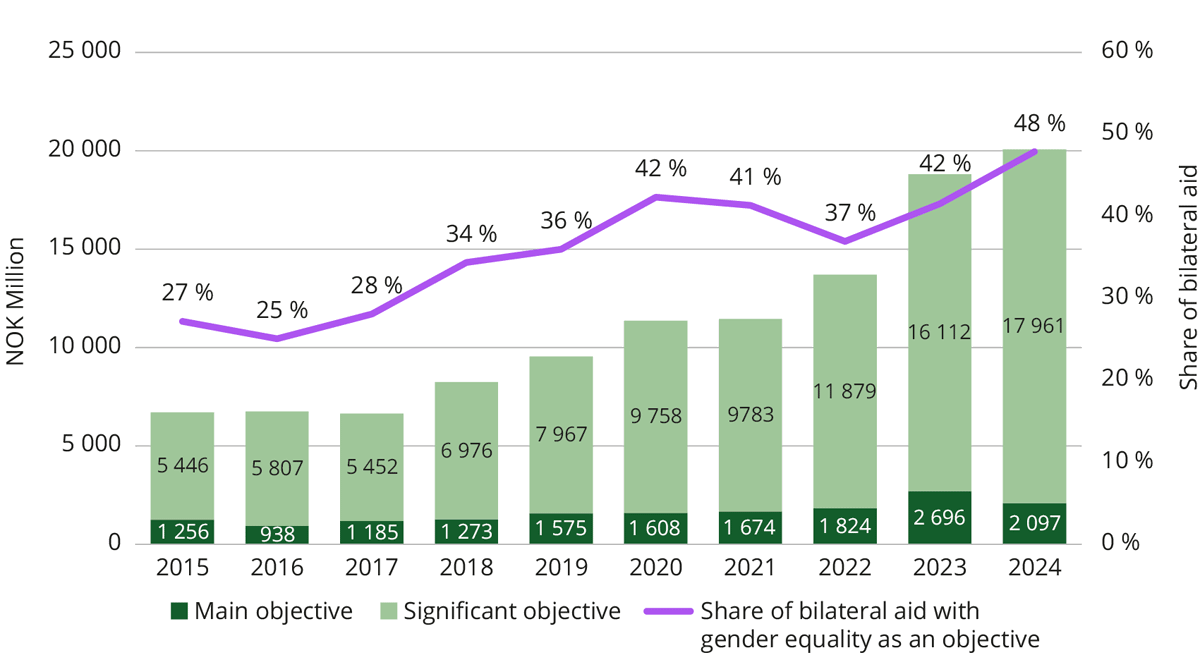
Norway will continue to take a leading role in promoting and protecting women’s rights and gender equality through its development cooperation, with a particular focus on sexual and reproductive health and rights. This includes sustained political dialogue and financial support in multilateral fora as well as at the country level. Women’s political and economic participation, access to contraceptives, safe abortions, and comprehensive sexuality education will remain key priorities. The figure below illustrates trends in the integration of gender equality in Norway’s bilateral assistance.
Figure 4.1 Gender Equality in Norway’s Bilateral Development Cooperation
Source: Norad, 2026
Government policy is based on the principles of human rights, equal treatment, non-discrimination, with particular emphasis on the protection and promotion of minority culture, language and identity.
4.3.3 Five National Minorities
The Government works to ensure that national minorities are able to develop their languages, cultures and social life, are included in decision-making processes, and enjoy equal treatment both in law and in practice. Their participation in sustainable societal development is supported through targeted grants to minority organisations and structured dialogue between these organisations and public authorities. The five national minorities in Norway are Kven/Norwegian Finns, Forest Finns, Roma, Romani people/Tater and Jews.
Norway ratified the Framework Convention for the Protection of National Minorities in 1999. A core principle of the Convention is the effective participation of minorities in matters affecting them, in line with SDG target 16.7 on inclusive and participatory decision-making.
To support the participation of the national minorities in implementing the Framework Convention, a dedicated grant scheme for national minorities was established in 1999. The grant scheme has been strengthened in recent years.
The Norwegian Government aims to develop a comprehensive and coherent policy in dialogue with the national minority organisations. The Ministry of Local Government and Regional Development organises an annual contact forum that serves a key platform for dialogue between the national minority organisations and central government authorities. In addition, the Ministry holds annual meetings with individual organisations, as well as meetings on specific issues when required. Annual meetings with young representatives from national minorities were introduced from 2023. Minorities may also submit input to public hearings on an equal footing with other stakeholders.
Another important element in the Government’s policy towards national minorities is ensuring equal access to education, both at primary and secondary level, leading to relevant and beneficial learning outcomes and support full participation in society.
An active and comprehensive policy to combat racism, anti-Semitism and discrimination is essential. In November 2024, the Government presented a new action plan against antisemitism for the period 2025 to 2030 – the third plan since 2015. The action plan forms part of the Government’s broader efforts to strengthen and renew the fight against racism and discrimination based on ethnicity and religion.
The Norwegian Parliament appointed a Truth and Reconciliation Commission to examine the Norwegianisation policy and injustices towards Sami, Kven/Norwegian Finns and Forest Finns. The commission submitted its report to the Parliament in 2023, documenting the impact and consequences of the Norwegianisation policy across a range of sectors.
The Parliament concluded its consideration of the report in 2024 and adopted 17 resolutions. The first resolution concerns the Parliament’s formal apology to the groups, while the remaining 16 resolutions were forwarded to the Government for follow-up. The Government is actively following up on the Commission’s recommendations in dialogue with the Sami Parliament and representatives of national minorities’ organisations – and in consultation with the Sami Parliament where required.
Message to the Government from the Sami Parliament
The following is an unedited message from the Sámediggi , the Sami Parliament.
The Sámi Parliament considered the matter Climate Change in Sápmi in 2023 (Case 023/23). It established that climate change is affecting Sámi communities in ways that challenge the natural resource base, livelihoods and cultural sustainability in Sápmi. The decision makes clear that climate change must be understood in conjunction with biodiversity loss, land encroachments and increasing pressure on Sámi areas. It states that responses must be grounded in Sámi values and knowledge systems. This provides the basis for the Sámi Parliament’s work on the Sustainable Development Goals.
In this context, the Sámi Parliament refers to the report from 2023 “Climate Change in Sápmi – an overview and a Path Forward”, prepared in cooperation with the Saami Council. The report documents how changes in snow and ice conditions, sea temperatures, ecosystems, and seasonal rhythms affect reindeer husbandry, fishing, hunting, gathering, traditional Sámi handicraft products (duodji), health, and community life. It emphasises Indigenous knowledge as a part of climate adaptation and environmental governance and shows that Sámi use of nature represents sustainable practices that should guide work. It also recommends strengthening Sámi institutions and knowledge environments and establishing a Sámi Climate Council and an Arctic climate platform.
Against this background, the Sámi Parliament stresses that the Sustainable Development Goals must be understood and implemented in ways that reflect Sámi realities. Climate change and biodiversity loss affect Sámi communities early and severely, while the cumulative effects of climate change and land encroachments reduce ecological resilience and the adaptive capacity of Sámi livelihoods. Intact ecosystems are essential for climate adaptation, food security, and the exercise of Sámi culture. The Sámi Parliament expects the principle of free, prior and informed consent (FPIC) to be applied before interventions in Sámi areas.
Sámi values such as community, responsibility, moderation, and respect for nature must guide implementation of the Sustainable Development Goals. Sámi languages, culture, livelihoods, and traditional knowledge must have a natural place in strategy development. Sámi food systems, harvesting practices, and customs represent sustainable approaches that should be recognised as part of the response to climate and biodiversity crises.
Businesses and industries establishing themselves in Sápmi must undertake thorough due diligence assessments of the consequences for Sámi culture and the natural resource base and adhere to standards and ethical guidelines that safeguard Indigenous rights. The Sámi Parliament maintains that the Sustainable Development Goals cannot be achieved unless Sámi communities are genuine partners in decision-making and Sámi knowledge systems and institutions are strengthened as part of this work.