5 Norway’s Implementation of the SDGs

5.1 Sustainable Development in the Norwegian State Budget
The Ministry of Digitalisation and Public Governance coordinate the Government’s annual report to Parliament on progress towards the SDGs. Additionally, each Ministry reports on the SDGs within its area of responsibility through its annual budget proposition to Parliament. This ensures that progress on each SDG is assessed and reported annually through a well-established political process, providing Parliament with a solid basis for evaluating development in Norway’s sustainability efforts.
Norway has also taken steps to complement traditional economic indicators such as GDP as measures of the country’s development. Recent initiatives include the Climate Status and Plan (published annually since 2022), which tracks progress toward climate commitments and serves as the Government’s reporting under the Climate Act. This report is presented to Parliament alongside the Ministry of Climate and Environment’s budget proposal. In addition, Norway has adopted a National Quality of Life Strategy, introducing more holistic measures of development, that reflect what matters most for people’s well-being.
5.2 The 2030 Agenda in Innovation and Industry Policy
Norway has several tools to help reduce emissions: pricing of emissions, requirements and regulations, and various forms of support for transition. Some types of support, such as research and technology development, are important for bringing forward new solutions for emission reductions that benefit society as a whole.
The business-oriented policy instruments are intended to promote value creation, innovation, and sustainable development in the business sector in cases where the market alone is unable to ensure the desired socioeconomically efficient allocation of resources. This may be due to asymmetric information, the need for public goods, or externalities, where economic actors do not consider the consequences of their activities for others. This can lead to the business sector underinvesting in research and development compared with what is socioeconomically optimal, because the private profitability for individual firms is lower than the value of the research to society.
Research, development, and innovation are crucial for Norwegian companies to remain competitive internationally over time and for achieving the ambitious climate targets we have set. New solutions and technologies developed in the private sector also contribute to innovation in the public sector. The business-oriented policy instruments cover the entire value chain, from research to commercialisation and growth. Through these instruments, businesses can gain access to financing, innovation and business development infrastructure, expertise, networks, and advisory and profiling services. Environmental considerations are given significant weight when prioritising projects supported through the policy instrument agencies. In addition, businesses can make use of the Skattefunn tax deduction scheme, intended to promote R&D investments in the business sector.
Industry in Norway accounts for around 25 percent of the country’s total emissions, a significant share of which comes from point-source emissions. To achieve the climate targets, industry must continue to reduce greenhouse gas emissions. Participation in the EU Emissions Trading System (ETS) is the most important policy instrument for achieving this.
The Government has presented Report to the Storting No. 16 (2024–2025) Industry – Competitiveness for a New Era, which provides an updated overview of the overall challenges and opportunities facing the industrial sector. The report includes measures related to framework conditions that are of broad significance for industry. The Government aims to contribute to increased value creation, facilitate profitable private investments, and promote a more adaptable and resilient business sector.
Message to the Government from Industry
The following is an unedited message from UN Global Compact Norway.
From Ambition to Implementation: Enabling Conditions for Business Contribution to the SDGs
Norway has demonstrated strong commitment to sustainable development and benefits from high levels of institutional trust, rule of law and social stability. These are significant assets in advancing the 2030 Agenda.
As we move closer to 2030, the central challenge is no longer ambition alone, but implementation at scale. Delivering on the Sustainable Development Goals requires long-term investment, structural change and sustained collaboration between public authorities and business. From a business perspective, three enabling conditions are particularly important to ensure progress across the full SDG agenda – environmental, social and economic.
First: Long-term Predictability
Transforming business models in line with the SDGs – whether related to climate, biodiversity, decent work, human rights, circularity or responsible value chains – requires significant capital investments, innovation and competence-building. These decisions require stable planning horizons and confidence that the rules of the game will not shift mid-course.
Stable and consistent framework conditions are therefore essential. Clear direction over time reduces uncertainty and enables companies to manage risk, mobilise capital and accelerate transformation. In contrast, frequent changes in priorities or conflicting signals may delay investment decisions and slow implementation.
Second: Policy Coherence and Coordination
The SDGs are inherently interconnected. Climate policy, industrial policy, financial regulation, labour market policy and social inclusion efforts all shape the environment in which businesses operate.
Effective implementation requires that objectives and instruments across policy areas reinforce rather than contradict each other. Fragmented governance increases complexity and transaction costs for companies and can weaken the overall pace of progress. A coordinated and whole-of-government approach strengthens both impact and legitimacy.
Third: Stability of Core Principles
The Ten Principles of the UN Global Compact – covering human rights, labour standards, environment and anti-corruption – reflect widely shared expectations for responsible business conduct and provide a common normative foundation for markets.
In contexts where sustainability becomes subject to political polarisation rather than treated as shared standards for responsible conduct, the normative foundation that responsible business depends on comes under pressure.
Maintaining clarity and consistency in public expectations related to responsible business conduct is therefore not only a matter of values, but of market function. Clear and stable expectations contribute to a level playing field, reduce reputational and regulatory uncertainty, and support companies that seek to integrate sustainability into core strategy rather than treating it as a peripheral activity.
Implementation under Uncertainty
The decisions businesses make – or defer – in the coming years will determine whether Norway’s sustainability ambitions translate into structural change or remain commitments on paper. Delayed investment carries real costs: for Norway’s competitiveness, for SDG progress, and for the credibility of the responsible business model.
Increased global uncertainty – including geopolitical instability, economic pressure and the risk of normative drift – may accelerate this dynamic.
This is not primarily a question of individual policy instruments, but of direction, consistency and institutional quality – and ultimately, of measurable results in Norway’s work with the 2030 Agenda.
5.3 The 2030 Agenda in Education System and Research Policy
The Education 2030 agenda was adopted in 2015 to ensure inclusive and equitable education and promote lifelong learning opportunities for all by 2030, through a set of defined targets under the SDG 4.
In Norway, the principles of sustainable development are integrated into the educational system through national curricula for primary and secondary education. Sustainable development is an interdisciplinary topic in the curricula, comprising challenges related to the environment, climate, poverty and resource distribution, as well as issues related to health, demography, education, equality and conflict. The Government expects pupils to develop the knowledge and competence needed to understand sustainability challenges and to make informed and responsible choices.
Norway’s long-term policy frameworks for research and higher education embeds the objectives of the 2030 Agenda. Sustainability considerations shape strategic priorities across education, research and innovation policy. The Norwegian Government prioritises tuition-free, high-quality higher education that is accessible to all, including through decentralised provision and flexible modes of study. A key objective is to widen participation by recruiting students from a broader range of social and socio-economic backgrounds. In 2027, the Government will present a strategy to strengthen recruitment in mathematical, technical and science-based fields (STEM), as well as measures to improve gender balance in these fields.
Within nationally defined frameworks and strategic policy documents, universities and university colleges are responsible for the content of study programmes. Sustainability perspectives are increasingly integrated into higher education curricula, through interdisciplinary approaches, research-based education and programme development aligned with Norwegian societal and labour market needs.
Research and innovation policy is an important component of Norway’s implementation of the 2030 Agenda. Norwegian research and innovation actors contribute to coordinated research efforts, knowledge development and innovation aligned with shared objectives related to green transition and sustainability, both on the national and the international level. This includes cooperation on research and policy development, as well as collaboration to promote mobility, recognition of qualifications and capacity-building in higher education.
Through these combined national and international efforts, Norway contributes to the achievement of SDG 4 and related goals under the 2030 Agenda.
Message to the Government from Academia
The following is an unedited message from the Sustainability Committee for Higher Education.
As a highly educated society with strong institutions and resources, Norway is well positioned to advance sustainable development. At the same time, climate change, biodiversity loss, and social inequalities highlight the need for substantial changes. This makes it increasingly important to define and strengthen the role of higher education institutions in advancing societal transformation.
Universities as Drivers of Societal Transformation Toward Sustainability
As stated in the Norwegian University and University College Act (§ 1-1), higher education institutions are mandated to “contribute to an environmentally, socially and economically sustainable development.” This creates a clear expectation that the university sector has a major responsibility to help ensure that society achieves the transformation that the 2030 Agenda requires.
While Norwegian higher education institutions have made progress integrating sustainability over the recent years, research shows that incremental changes are insufficient. To act as systemic drivers of change, universities must strengthen their role within the broader societal system, align internal structures with societal needs, and operate within supportive national frameworks and societal partnerships.
Integrating Sustainability Across Functions
Evidence from whole institution approaches and sustainability transitions indicates that impact is greatest when sustainability is embedded across governance, leadership, research, education, operations, and partnerships. Societal impact can also be strengthened when universities move beyond discipline-bound, publication-focused models toward mission-oriented, societally embedded knowledge production.
Aligning strategies, incentives, and evaluation systems with sustainability objectives, strengthening interdisciplinary and transdisciplinary research, and recognising societal relevance alongside academic excellence are essential steps. Such integration enables universities to connect knowledge generation directly to real-world challenges and contribute meaningfully to sustainable societal transformation.
Educating for Sustainable Futures
Research on sustainability competencies and transformative learning highlights that higher education requires a paradigm shift. UNESCO emphasises that sustainable development depends on key cross-cutting competencies that enable learners to engage responsibly with complex challenges.
Higher education must therefore integrate sustainability learning outcomes across all programs, fostering interdisciplinary, challenge-based, and experiential learning that prepares students to match their problem-solving approaches to the complexity of real-world issues. While well-defined problems may be addressed within disciplines, sustainable solutions require broader systems thinking and, for more complex challenges, transdisciplinary collaboration. Equipping all graduates with these competencies is essential for enabling sustainable societal transitions. Although many institutions have begun this shift, further systemic integration is needed to ensure sustainability competence becomes universal rather than optional.
Shared Responsibility and Enabling Frameworks
Research highlights that transformative change requires enabling conditions beyond individual institutions. Stable funding, evaluation systems that reward societal engagement, and strong protection of academic freedom are essential. Transformation is a shared responsibility among universities, government, funding agencies, and civil society.
The Way Forward
The National Sustainability Committee for Higher Education recommends that Norwegian universities:
- Move beyond incremental changes toward paradigm shift and institutional transformation.
- Prioritise interdisciplinary and transdisciplinary research and education on societal challenges, where living labs represent one promising approach for integrating collaboration, experimentation, and real-world learning.
- Systematically embed transformative learning and sustainability competence for all graduates.
- Integrate sustainability across all university operations to serve as living examples and build societal trust.
- Ensure that national frameworks and funding systems enable systemic sustainability transformation while protecting academic freedom.
Together, these directions illustrate how universities can strengthen their societal role as drivers of sustainable transformation, building on progress achieved while recognising the systemic work still ahead.
The Sustainability Committee for Higher Education was established in 2018 and now consists of members from six major Norwegian universities, as well as a representative from Universities Norway (UHR) and from the National Union of Students in Norway (NSO). The Ministry of Foreign Affairs, The Ministry of Education and Research, The Ministry of Digitalisation and Public Governance, and the Norwegian Agency for Development Cooperation (Norad) act as observers in the committee.
5.4 Norway’s Official Development Assistance
Norway has for several years provided around 1 percent of GNI in official development assistance (ODA), see figure below. In 2025, when the overall level of development aid fell with more than 23 percent, Norway was one of only four member countries of the Development Assistance Committee (DAC) which met or exceeded the United Nations’ target of 0.7 per cent of GNI going to ODA.
Figure 5.1 Official Development Assistance as share of GNI
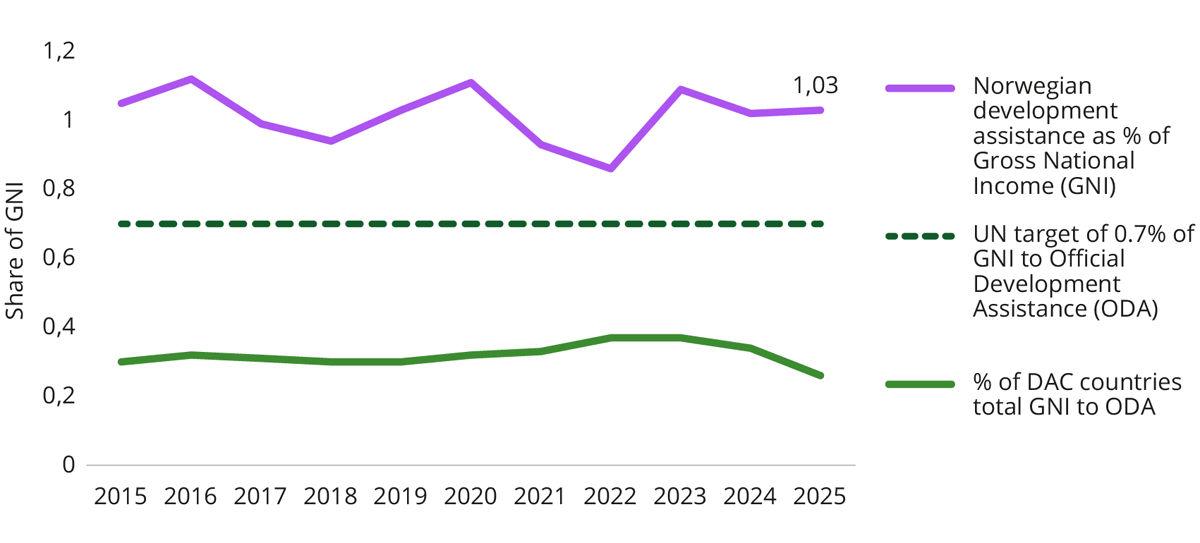
Source: OECD, 2025
Norway has also consistently reached the UN target to give between 0.15 and 0.20 per cent of GNI to LDCs. Norwegian development assistance has grown substantially over the last decade and totalled NOK 58.9 billion in 2025.
The main goal of the Norwegian development policy is to combat poverty and promote economic growth and welfare in developing countries, within the framework of human rights, the SDGs and the Paris Agreement.
Since 2021, the two main new features are support to Ukraine, which has become the largest recipient of Norwegian aid, and ambitious climate financing and climate adaption goals. In 2025, the civilian support to Ukraine amounted to NOK 12.5 billion, just above 20 percent of total Norwegian development aid budget. The aim is for Ukraine to be able to determine its own future.
Norway recognises climate change as a multiplier of conflict, poverty, and humanitarian need. Norwegian climate support in the reporting period covers inter alia climate adaptation and mitigation, renewable energy, food security, and sustainable ocean management.
Norway continues to prioritise gender equality and the advancement of women’s sexual and reproductive health and rights. Another priority is to combat inequality by addressing structural drivers such as corruption, illicit financial flows, and weak tax systems.
Norway channels a large share of Norwegian aid through the UN system, the World Bank and regional development banks to ensure effectiveness, coordination and global reach. Core support for multilateral organisations is a Norwegian priority and accounts for a significant proportion of total Norwegian development aid. Civil society organisations also manage a substantial part of Norwegian development aid. They are important partners for promoting democracy, human rights and locally led development. The Norwegian Investment Fund for developing countries, Norfund, is a central vehicle for mobilising funding from the private sector for joint investments and job creation in developing countries.
Norway also places emphasis on global health preparedness and on ensuring access to quality education, particularly in crisis affected areas. Alignment with national strategies for poverty eradication and sustainable development remains central to Norway’s development policy.
Increasing emphasis is placed on documented results, learning, and evaluation, including through independent assessments and international joint initiatives such as MOPAN. In addition, the evaluation department hosted by Norec has a key role in in securing good and independent evaluations.
5.5 The 2030 Agenda in Development, Foreign and Security and Trade policy
Norway’s development policy is anchored in the Sustainable Development Goals, climate targets and international human rights. The main objective is to combat poverty and inequality and promote economic development and welfare in low-income countries.
A well-functioning and inclusive multilateral system and an international order based on international law are core interests for Norway. In pursuit of this, Norway plays an active role in advancing reforms of the United Nations, the World Trade Organization and the multilateral development banks.
The Sevilla Commitment, from the Fourth International Conference on Financing for Development, is our common global framework for accelerating implementation of the SDGs.
The Government has initiated a comprehensive and inclusive process to develop a new Norwegian development policy in response to major geopolitical and financial shifts affecting global development aid. The process will culminate in a White Paper to be presented to Parliament in the spring session of 2027.
Norway’s new national security strategy underlines that international law and binding international cooperation form the foundation for peace and international security and remain our first line of defence.
Norway has worked actively to ensure that NATO places greater emphasis on climate issues. NATO’s Strategic Concept from 2022 describes climate change as a defining challenge of our time and as a crisis and threat multiplier that exacerbates underlying conflicts and geopolitical competition. The Norwegian defence sector has developed a strategic paper on climate and environment and subsequently prepared an action plan to implement the strategy. Norway shares information and experiences with NATO and other allies to support collective efforts on this. Norway has also been a driving force in strengthening NATO’s work on integrity-building and anti-corruption in the defence and security sector.
Norway’s action plan for women, peace and security (2023) demonstrates the ministries’ joint efforts to fulfil the ambitions of UN Security Council Resolution 1325 on women, peace and security. This is operationalised and implemented through the Armed Forces’ action plan Gender in Military Operations (2024).
As for Norwegian trade policy, integration into the global economy has proved to be a prerequisite for sustainable economic growth over the past decades. Our belief is that participation in the rules-based multilateral trading system, including implementation of World Trade Organisation (WTO) rights and obligations, enhances foreign investment, business development and competitiveness. Norway’s top trade policy priority is preserving and strengthening the WTO. Development must be at the heart of WTO and the ongoing reform discussions.
The EEA Agreement is Norway’s most important trade agreement. A harmonised regulatory framework in the EU’s internal market reduces the challenges Norwegian companies face due to differing requirements across markets. Through the EEA Agreement, Norway participates in the EU’s efforts to promote a more circular economy.
In bilateral trade agreements, Norway seeks to include comprehensive chapters on trade and sustainable development with commitments related to the environment, climate, workers’ rights, and gender equality.
5.6 Linkages to the EEA and Nordic Council of Ministers
Norway’s ability to achieve the Sustainable Development Goals is particularly influenced by developments in the Nordic region and the rest of Europe. Shared challenges related to areas such as climate, biodiversity, consumption, and health do not stop at national borders and affect the entire region. Norway’s efforts are therefore closely linked to the overall efforts of the Nordic countries and the EU to deliver on the 2030 Agenda.
The Nordic countries cooperate closely in the follow-up of the Sustainable Development Goals. In 2019, the Nordic prime ministers adopted Vision 2030, aiming for the Nordic region to become the world’s most sustainable and integrated region. The vision guides all activities of the Nordic Council of Ministers. It is followed up through 14 sectoral policy programmes for the period 2025–2030. One of these programmes concerns sustainable resource management, with a shared focus, clear priorities, and targeted efforts for Nordic cooperation. Sustainable development is a cross-cutting and integrated perspective in all work carried out by the Nordic Council of Ministers.
Nordic Policy Brief
“Stepping up or Stepping back? – Nordic Local and Regional Views on the 2030 Agenda and Beyond”, a joint Nordic Policy Brief presents perspectives from Nordic local and regional sustainability experts and youth representatives on the implementation of the 2030 Agenda, examining what is working, where gaps remain and actions needed to accelerate progress. It also outlines their priorities and expectations for the global sustainability framework beyond 2030. The aim is to ensure that their knowledge and experiences are reflected in future global development work, enabling more effective support for those driving sustainability on the ground. Conducted as part of the “Sustainable Nordic Municipalities and Regions” project, implemented by Nordregio in collaboration with the Nordic local and regional government associations (the LRGAs).
Source: Nordregio, Stepping up or Stepping back? – Nordic Local and Regional Views on the 2030 Agenda and Beyond, 2026
Cooperation with the rest of Europe, both the EU and other European countries, is a cornerstone of our foreign policy. Norway is an integrated part of the EUs Single Market through the EEA Agreement and has over 100 bilateral agreements with the EU. In addition, Norway is a member of the Schengen Area. The EEA Agreement guarantees equal rights and obligations within the Single Market for citizens and economic operators in EU/EEA Member States. Norway’s climate and environment policy is closely intertwined with the EU through the EEA Agreement, the agreement on cooperation with the EU to fulfil the 2030 climate target (including participation in the EU Emissions Trading System), and because the EU is Norway’s most important trade partner.
The EU’s green growth strategy, the European Green Deal, which in recent years has charted the course toward achieving the EU’s goal of climate neutrality by 2050 and reducing net greenhouse gas emissions by at least 55 percent by 2030, is also important for Norway’s green transition. In the spring of 2023, Norway and the EU entered into a Green Alliance. The agreement has provided the Government with a political framework for further developing cooperation with the EU in the areas of climate, environment, energy, industry, and the green transition.
The EEA Grants are the voluntary contributions from Norway, Iceland, and Liechtenstein toward economic and social cohesion in 15 EU member states. EEA Grants are an important instrument for contributing to the achievement of the Sustainable Development Goals in Europe, and 12 of the Goals have been explicitly supported through the EEA Grants.
5.7 Drivers and Barriers for Implementation
The need for sustainable development has never been greater. At the same time, the world is increasingly characterised by heightened geopolitical tensions, economic uncertainty, accelerating climate change and growing social inequalities. Today, Norway, like the rest of the world, faces significant challenges that will influence how public authorities prioritise and allocate resources. This chapter outlines some of the key driving forces and trends that influence Norway’s capacity to achieve the Goals.
Changing Security Conditions
Democracy is under growing pressure globally, with the number of liberal democracies declining over the past 10–15 years. Changes in the security policy environment affect Norway’s economic security and its ability to engage in global cooperation on sustainable development.
Conflicts and uncertainty threaten Norway’s security interests and core societal values, necessitating increased investment in defence, security and preparedness. Heightened geopolitical tensions undermine the conditions for effective international cooperation on climate action. At the same time, climate change is increasingly recognised as a significant risk factor for conflict and instability.
Norwegian welfare and value creation are closely linked to international trade and economic cooperation. After decades of globalisation, trade is becoming more constrained and regulated. Cooperation with the EU through the EEA Agreement remains crucial, providing access to Norway’s most important market. Going forward, it will be essential to balance national security, an open and competitive economy and the transition to a lowemission society.
Climate Change and Loss of Biodiversity
Greenhouse gas emissions and extensive landuse change are driving climate change and biodiversity loss. If current trends are not reversed, the consequences will be severe and, in many cases, irreversible. Addressing these challenges requires rapid emission reductions, strengthened conservation efforts, sustainable use and restoration of ecosystems, and effective climate adaptation.
In Norway, landuse change is the single largest pressure on nature, alongside climate change, pollution, invasive species and overharvesting. Marine ecosystems are increasingly affected by rising temperatures, ocean acidification and pollution, with significant implications for food security, oceanbased industries and coastal communities. Nature also plays a vital role in recreation, public health, quality of life and cultural identity.
Norway aims to become a lowemission society by 2050 and is committed to reducing pollution and conserving biodiversity, while preparing society and ecosystems for the impacts of climate change. International agreements provide an important framework for action, and global progress in emission reductions and technology development will strongly influence Norway’s transition.
Technological Development and Digitalisation
Rapid technological development presents both opportunities and challenges for sustainable development. Digitalisation enables more efficient resource management, improved public services and innovative solutions for the green transition. The development of innovative technology will be crucial in achieving a future low-emission society. For example, increased international investment in solar power, wind energy and battery solutions has made several low-emission technologies competitive with fossil-based energy sources. Artificial intelligence (AI) is expected to play an increasingly important role in societal development, contributing to welfare and value creation, while supporting the green transition.
At the same time, the growing use of digital technology and services, combined with rapid turnover of equipment, is driving higher demand for energy and raw materials, including critical and rare minerals. To ensure sustainable technological development, efforts must be made towards energy-efficient solutions, responsible extraction of raw materials, and improved management of electronic waste. A balanced approach to digitalisation will help ensure that technological development supports the SDGs without exacerbating existing environmental challenges. Furthermore, we need to make sure that no one is excluded from an increasingly digitalised society, while safeguarding privacy, promoting ethical and safe use of AI, and upholding national digital security and preparedness.
Changes in Consumption Patterns
Population growth and consumption are major drivers of global environmental pressures. An estimated 60–80 per cent of total environmental impact is associated with the production of goods. Norway has among the highest levels of material consumption per capita in the world. The growth of ecommerce and fast fashion, particularly platforms offering lowcost, shortlived products, reinforces unsustainable consumption patterns.
High levels of consumption leads to extensive resource use, waste and pollution, much of which occurs outside Norway, often in developing countries. This poses a significant challenge for Norway in achieving the SDGs. A transition to circular economy, involving changes in both production and consumption, is therefore essential.
Demographic Changes and the Need for Labour
Despite high employment, Norway is facing growing labour and skills shortages. An ageing population and a declining share of people of working age challenge the long-term sustainability of the welfare system and increase pressure on health and care services. Statistics Norway estimates a shortage of nearly 70,000 health care workers by 2040.
Technological change and digitalisation are also driving rising demand for ICT skills, with substantial shortages expected before 2030. Government assessments highlight education in technology, health and ICT as critical to meeting future labourmarket needs and supporting the green transition. Ensuring an inclusive labour market and increasing participation among those currently outside employment will be essential to sustaining the welfare state.
Differences in Living Conditions and Health
Strong public services, low levels of inequality and high trust in institutions have made Norway one of the best countries to live in. Nevertheless, disparities between population groups are increasing. Persistent low income is often linked to weaker labourmarket attachment. To address this Norway has implemented a range of inclusive employment policies, comprehensive welfare schemes and a fair, redistributive tax system.
At the same time health inequalities linked to socioeconomic factors are widening. These disparities are closely associated with broader living conditions, including material circumstances, psychosocial stress and lifestyle factors. Preventing noncommunicable diseases and promoting both physical and mental health are central to reducing inequalities and alleviating pressure on health services.
There is also a clear link between challenging livingconditions and exposure to violence. Good childhood conditions, along with access to education, employment, housing, health services, culture and leisure activities play a key role in reducing inequality and preventing violence and crime.
Increased Need for Financing
The 2030 Agenda requires substantial investment at both national and global levels. Norway is facing rising costs driven by geopolitical tensions, climate and nature-related risks, demographic change and the transition to a lowemission society. Achieving green and inclusive growth will require accelerated investment in technology, innovation and sustainable business models.
At the same time, demographic trends challenge the longterm sustainability of the welfare state. This underscores the need for a forwardlooking and adaptable public administration that can mobilise all parts of society to develop and implement sustainable solutions.